
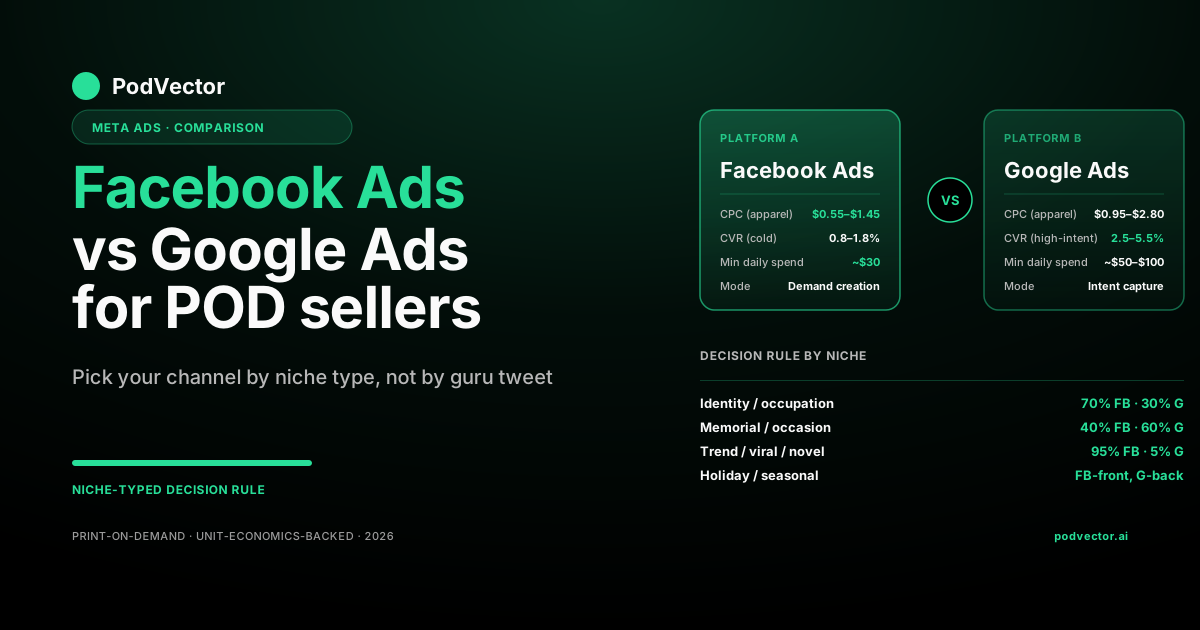
Quick Answer: If you're a print-on-demand seller searching "Facebook Ads vs Google Ads," you're probably already leaning Facebook — and for most POD niches in 2026 that lean is correct. Facebook still has the lower minimum efficient daily spend (about $30/day per ad set vs Google Shopping's $50–$100/day floor), the cheaper average CPC ($1.07 vs $2.69 across e-commerce), and the interest-and-lookalike targeting that finds buyers who weren't searching for your design.
Google Ads wins decisively in three POD scenarios: niches with real branded or long-tail search volume, products people actively shop for (memorial gifts, profession-specific apparel, holiday-occasion items), and accounts that already have 30 days of clean conversion data flowing into a Performance Max feed. The "best" platform isn't a universal answer — it's a function of three POD-specific variables: the search-volume shape of your niche, the contribution margin left after Printify or Printful supplier costs, and whether your design pipeline can sustain Facebook's creative-volume treadmill. This guide names which niches each platform wins, the unit-economics math behind why, and gives you a niche-typed decision rule you can apply tonight.
Why this question matters more for POD than DTC
Almost every Facebook-vs-Google comparison published this year — including thoughtful breakdowns from WordStream, Databox, and AgencyAnalytics — is written for a brand with stable cost-of-goods, healthy 60–80% gross margins, and a curated SKU lineup of maybe twenty products. Print on demand is the structural opposite.
Your supplier base cost moves with garment, color, size, and ship-to country. Your contribution margin after the Printify or Printful base, shipping, payment processing, and platform fees usually lands between 20% and 35%. Your SKU count is in the hundreds, and you launch new designs faster than any single platform's algorithm can fully learn them.
That structural mismatch matters because it changes the arithmetic of the comparison. A direct-to-consumer brand selling a $30 candle with $8 cost can absorb a $2.69 Google CPC at a 1.5% conversion rate and still come out ahead.
A POD seller selling a $26 hoodie with $14 supplier base, $5.50 shipping, and a $1.20 platform fee has roughly $5.30 of contribution before any ad cost. The same $2.69 CPC at the same 1.5% conversion rate burns about $179 of ad spend to generate $5.30 of contribution per sale. The comparison stops being "which platform has cheaper clicks" and becomes "which platform's economics survive a 20–35% margin wrapper."
The second thing POD changes is what each platform's strongest signal is actually worth. Google's superpower is intent capture: somebody typed "german shepherd dad t-shirt" into the search bar, which means click-through-to-conversion in high-intent POD niches frequently runs 2.5% to 5.5%.
Facebook's superpower is demand generation against interest and lookalike audiences — which is exactly what you need when your niche-design appeal is broad and visually interrupting but nobody is searching for it yet. The "better" platform isn't the one with cheaper CPCs in the abstract — it's the one whose structural strength matches the demand shape of your specific designs.
The third thing POD changes is the cost of the wrong bet. A DTC brand burning $5,000 on a channel that doesn't work has spent test budget against healthy margins.
A POD seller burning the same $5,000 on the wrong platform without a clean baseline of true contribution margin can end the month with negative contribution and no way to know whether the channel is structurally wrong, just under-optimized, or slowly improving. That's why this comparison has to lead with niche shape and unit economics, not platform feature lists.
What is Facebook Ads — through a POD lens
Facebook Ads is Meta's paid-distribution platform across Facebook, Instagram, Messenger, and the Audience Network. For POD sellers it's effectively the default channel, for three reasons that have nothing to do with Meta itself.
First, your ideal customer is somebody who didn't know they wanted your design until they saw it — which is exactly the job demand-generation platforms exist to do. Second, the visual canvas (a single image or short video) is precisely the format your designs already exist in; you don't need to create new content infrastructure to advertise. Third, the lower minimum efficient daily spend means a POD seller doing $3,000 MRR can run two or three meaningful tests a month, where Google's $50–$100/day Shopping floor would consume the same budget on a single test.
The platform's targeting logic is interest-based, lookalike-based, and increasingly broad-prospecting with creative as the steering wheel. In 2026, Advantage+ Shopping Campaigns (ASC) and broad Sales-objective campaigns dominate POD playbooks because they let Meta's AI find buyers across detailed-targeting audiences your team would never have manually chosen. The trade-off is that you have to feed the algorithm enough varied creative to keep it learning — typically 8 to 15 net-new creatives per week at scale, far more than Google requires.
For a deeper structural view of how POD operators actually run Meta in 2026 — including campaign structure, naming conventions, and budget pacing — the complete Meta Ads playbook for print-on-demand sellers covers the playbook that sits behind the comparison this article is making.
What is Google Ads — through a POD lens
Google Ads is the umbrella for paid placements across Google Search, Google Shopping, YouTube, the Display Network, Discover, and Performance Max — the AI-driven format that pools inventory across all of those into a single campaign. For POD sellers, Google's relevance is concentrated in Shopping and Performance Max, with Search Ads playing a supporting role for branded queries and high-intent design niches. Display and YouTube are usually wrong-shape for the average POD account: too much creative work for too little incremental return at sub-$50K-per-month spend.
Google's logic is the inverse of Facebook's. Demand already exists; Google captures it at the moment of intent.
The CTR and conversion-rate math reflects that. Apparel-and-accessories advertisers see Google Shopping CPCs of $0.95–$2.80 with conversion rates between 2.5% and 5.5% on well-matched queries. Facebook's prospecting CPCs are roughly half that, but conversion rates are typically 0.8% to 1.8% — meaning the cost-per-acquisition equation often favors Google when somebody is actively shopping for your specific niche, and favors Facebook when they aren't.
The hard part for POD on Google isn't the cost — it's the feed. Google Shopping needs a structured product feed with clean titles, descriptions, GTINs (or proper "GTIN does not apply" handling), inventory states, image quality, and policy compliance.
POD shops with hundreds of SKUs across dozens of designs frequently fail Merchant Center policy checks (most often around image quality, "promotional overlay" violations on the design itself, or restricted product categories). The feed work is the price of admission. Once it's clean, the platform can be very efficient — but the setup cost is non-trivial in a way Facebook's "upload one image and write three lines" workflow isn't.
Facebook Ads: pros and cons for POD sellers
Pros
- Lower minimum efficient spend. A single ad set can run on $30/day and still produce statistically usable signal. That matters when you're under $5K MRR and can't afford $50/day per Shopping campaign just to keep Google's algorithm alive.
- Demand creation, not just capture. POD designs frequently target buyers who weren't searching for them. Facebook's interest-targeting and lookalike-from-purchaser audiences put the design in front of people who would buy if they saw it — which is exactly the job your business needs done.
- Visual format matches your existing assets. A single design mockup is a complete Facebook ad. No new creative infrastructure required to start.
- Granular interest and behavior targeting. "German shepherd owners + dog moms + dog-rescue volunteers + female + 35–55 + US" is a real targeting stack you can build in five minutes. Google offers nothing equivalent for high-niche POD designs.
- Lookalikes from your customer list. Once you have 200+ purchases, lookalike audiences frequently outperform any cold audience you could build manually. POD businesses with even modest customer lists punch above their weight here.
Cons
- Creative-volume treadmill. At scale, Meta's algorithm fatigues creative quickly. POD operators running $5K+/day report needing 8–15 net-new creatives weekly to keep CPMs stable. Your design team becomes your bottleneck before your media buyer does.
- Attribution opacity post-iOS 14. Facebook's reported ROAS is consistently 20–40% higher than what hits your Shopify or warehouse numbers. You can't trust the platform's number — you have to triangulate against true business contribution. The complete guide to Meta Ads ROAS and attribution for POD is the deep version of this issue.
- Learning-phase volatility. Each new ad set takes 7–14 days to exit Meta's learning phase, then another 1–2 weeks to produce a meaningful ROAS signal. You can't pivot in 48 hours.
- Lower conversion rate per click. Cold prospecting on Facebook converts at 0.8–1.8%. You're paying for clicks from people who are interrupted, not searching — which means you need cheaper clicks to make the math work.
- Account-disable risk for POD specifically. Trademark complaints, copyright trolls, and aggressive enforcement around "personal attributes" targeting (which sneaks into a lot of niche apparel) hit POD accounts disproportionately.
Google Ads: pros and cons for POD sellers
Pros
- Intent capture. Somebody typed "memorial picture frame for grandma" into Google. They are not browsing — they are shopping. Conversion rates of 2.5–5.5% reflect that.
- Feed-as-creative. Once your Shopping feed is clean, you don't need to produce new creatives weekly. Google Shopping pulls product images and titles directly from your feed, which is a massive operational win for high-SKU POD shops.
- Better attribution honesty. Google Ads reported numbers usually align within 10–15% of true contribution, vs Meta's 20–40% gap. Easier to trust the platform's own optimization signal.
- Performance Max scales. A well-fed PMax campaign can absorb significant budget without the manual restructuring Meta requires. POD shops over $30K MRR find PMax much less labor-intensive than scaled Meta.
- Branded search defense. When your designs go viral on TikTok or Pinterest, Google captures the branded-search demand that follows. Without a Google Ads presence, third-party listicles and competitors run those queries to you.
Cons
- Higher minimum efficient spend. A Shopping campaign or PMax asset group below $50/day frequently doesn't get enough impressions to learn, especially in mid-volume niches.
- Feed approval friction. Merchant Center routinely flags POD products for image quality, promotional overlays on the design, copyright complaints, or category restrictions. Time spent on feed compliance is real and recurring.
- Demand-shape dependency. If your niche has fewer than ~500 monthly searches across all variants, Google has nothing to capture. A "german shepherd K-9 unit retired veteran shirt" might convert at 8% on Google — but it might also see five impressions a month.
- Performance Max is a black box. You don't see which placements (Shopping, Display, YouTube, Discover) are converting. Optimization is upstream feed-quality, audience signals, and creative variety — not bidding tweaks.
- Less effective for "didn't-know-I-wanted-it" designs. Trend-driven, meme-driven, or aesthetically-novel designs without established search demand have nowhere to capture on Google.
Side-by-side: the POD comparison table
Numbers below are 2026 ranges from public benchmark data and our own POD-client cohort. The verdict column is the POD-specific call.
| Factor | Facebook Ads | Google Ads | POD verdict |
|---|---|---|---|
| Avg CPC (apparel) | $0.55–$1.45 | $0.95–$2.80 | FB cheaper, but Google converts harder per click |
| Avg CPM | $11–$26 | $3–$9 (Display) / $30–$60 (Search) | Apples-to-oranges; use cost-per-acquisition |
| Conversion rate (cold) | 0.8–1.8% | 2.5–5.5% (high-intent search) | Google wins where search demand exists |
| Minimum efficient daily spend | ~$30 per ad set | ~$50–$100 per Shopping campaign | FB lower floor — better under $5K MRR |
| Creative volume burden | High (8–15/week at scale) | Low (feed = creative) | Google easier for high-SKU POD |
| Best for novel designs | Excellent — interest + lookalike | Poor — no search demand to capture | FB wins decisively |
| Best for shopper-intent niches | Decent | Excellent | Google wins on memorial / occasion / profession |
| Attribution honesty vs true revenue | Reports 20–40% high | Reports 10–15% high | Google more trustworthy in-platform |
| Time to first usable signal | 10–28 days | 1–3 days (Search) / 7–14 days (PMax) | Google faster diagnostic |
| Account-disable risk for POD | Elevated (trademark, targeting) | Moderate (feed policy) | Plan a backup ad account on FB |
Five real differences for a POD operator
1. Cost: CPC, CPM, and what they mean at 25% margin
Facebook's cheaper clicks ($1.07 average across e-commerce vs Google's $2.69) sound like a clear win until you do the conversion-rate math. At a Facebook conversion rate of 1.4% on cold traffic, you need ~71 clicks to get one sale — which costs ~$76 in clicks.
At a Google Shopping conversion rate of 4.4% on a high-intent niche query, you need ~23 clicks — which costs ~$62. Same sale, less cost, on Google. The CPC headline lies; CPA is the only number that pays bills.
What flips the math back toward Facebook is when there is no high-intent Google query for your design — which is the default situation for trend-driven and aesthetically-novel POD niches. If "watercolor cat with tiny mushroom hat" has fifty monthly searches across all variants, Google's 4.4% conversion rate on fifty impressions is two sales a month.
You can't run a business on that. Facebook's broader interest-targeting on "cat moms + cottagecore + watercolor art" generates the impressions — at a worse conversion rate, but on enough volume to matter.
2. Buyer intent vs interest interruption
This is the heart of the comparison. Google captures demand that already exists.
Facebook creates demand against people whose state of mind is "I'm scrolling, not shopping." For POD specifically, the question is whether your design has demand that exists yet. Memorial gifts, professional-occupation apparel ("I'm a registered nurse and I — "), niche-hobby-identity tees, holiday-occasion items — these all have search demand. Trend-driven designs, aesthetic novelty, viral-meme references, and most apparel art that's "interesting because you didn't expect it" don't.
If you can't tell which kind of design you're selling, run a Google Keyword Planner check on three or four phrasings of the design's core concept. If you see fewer than 200 combined monthly searches across reasonable variants, treat the design as demand-creation, not demand-capture. Facebook is your channel.
3. Targeting: keywords vs interests, lookalikes, and creators
Google's targeting is keyword-and-feed-mediated. You can't tell Google "show this hoodie to female fire-department spouses ages 40–60 in the Midwest." You can tell it "show my product feed against the query 'firefighter wife shirt'" — and that's a categorically different mechanism. Facebook can layer interests (firefighter, fire-department spouse) with demographics with lookalike audiences with retargeting in a single ad set, then let the algorithm figure out which combination converts best.
For POD, this matters because most niches are identity-based and demographic, not keyword-based. The buyer is "a 52-year-old woman whose husband retired from the FDNY" — not somebody who typed "firefighter wife shirt" into a search bar. Facebook's targeting model fits that buyer; Google's doesn't.
4. Creative: the volume treadmill nobody warns POD sellers about
Meta's algorithm in 2026 fatigues creative aggressively. At $1K/day spend, you need 3–5 net-new creatives weekly.
At $5K/day, that becomes 8–15. At $20K/day, you're looking at a full-time creative pipeline. POD shops without an in-house designer or paid creative pipeline can't sustain that and watch CPMs balloon as creatives wear out.
Google Shopping and Performance Max effectively use your product feed as creative. You're not making new ads weekly — you're making sure your feed is clean, your titles are keyword-rich, and your images are high-quality.
The creative cost is a one-time setup, not a weekly tax. For POD shops with hundreds of SKUs and limited creative bandwidth, this is Google's most underrated structural advantage.
5. Attribution: which platform lies less to a POD seller
Both platforms over-report. Facebook's reported ROAS is consistently 20–40% higher than what reconciles against your Shopify orders, Stripe payouts, and itemized Printify or Printful supplier costs.
Google's gap is smaller — typically 10–15%. Neither is the truth. The truth lives in your warehouse, where ad spend gets paired with actual product cost, actual shipping, actual payment-processing fees, and actual refunds.
This is exactly the gap PodVector AI's Victor agent fills for POD operators: it pulls every Shopify order, Printify or Printful supplier line item, and ad-platform spend record into a single live data layer, then answers questions like "what was true contribution ROAS on the Meta Trump-Vance retargeting campaign last week, after supplier costs?" with a number that survives the platform's self-reporting bias. You can ask the same question against Google Ads, Meta Ads, or both — and the answer comes from your real ledger, not the platform's optimistic dashboard. Try Victor free if you want a live answer instead of two platforms each claiming credit for the same sale.
The decision rule by niche type
The fastest way to pick is to type your niche. Most POD designs fall into one of these four categories.
Type A: Identity-and-occupation niches (nurse, teacher, firefighter, veteran, dog-breed-specific)
Lead channel: Facebook. Search demand exists but is concentrated on a few obvious phrasings, while Facebook's identity-targeting (job-title interests, lookalikes from past identity-niche purchasers) reaches the long tail of the audience who would buy but aren't searching. Add Google later for branded-search defense and to capture the high-intent "[occupation] [item] gift" queries. Budget split at scale: 70% Facebook, 30% Google.
Type B: Memorial, occasion, and gift niches (memorial frames, "first Christmas as a — " items, anniversary-specific apparel)
Lead channel: Google. These are shopper-intent searches with predictable phrasings ("memorial picture frame for dad," "first Christmas as a married couple ornament"). Conversion rates run 4–8% on tightly-matched queries. Facebook works as a secondary channel for retargeting and lookalike-from-purchaser audiences. Budget split at scale: 60% Google, 40% Facebook.
Type C: Trend-driven, viral-reference, or aesthetically-novel designs
Lead channel: Facebook. No search demand exists for the design yet — Google has nothing to capture. Meta's interest-and-lookalike model is the only real demand-generation engine that fits. Skip Google entirely until the design produces enough branded-search demand to justify defensive Search Ads. Budget split: 95% Facebook, 5% Google (branded only).
Type D: Holiday-occasion designs (Halloween, Mother's Day, Valentine's Day, graduation)
Run both, weighted by season. Six weeks before the holiday, lead with Facebook to seed demand and build retargeting pools. Three weeks before, shift weight toward Google as branded and category search volume spikes.
The week of the holiday, keep both running but monitor Google's CPCs — they spike sharply and can stop being efficient even on high-intent queries. Budget shape: a Facebook-heavy front, a Google-heavy back, both off within 48 hours of the holiday.
Running both: the integrated POD playbook
The strongest POD ad accounts at $50K+ MRR run both, and they run them in coordinated roles — not as parallel competing channels.
- Facebook is the demand-generation engine. Top-of-funnel prospecting, interest and lookalike audiences, broad ASC/Sales-objective campaigns. The job is putting designs in front of people who didn't know they wanted them.
- Google captures the demand Facebook generates. Branded Search Ads catch the "[your-store-name] [product]" queries from people who saw the Facebook ad and went to Google to research. Performance Max captures category-level search demand against your product feed.
- Retargeting splits across both. Facebook retargets video-viewers and ad-engagers; Google retargets site-visitors and abandoned-cart users via Shopping and Display.
- Measurement consolidates outside both platforms. Don't try to reconcile Meta's reported ROAS with Google's reported ROAS — they overlap and double-count. Pull all spend and revenue into one source of truth — your own ledger, not either platform's dashboard — and measure true contribution per platform after supplier and shipping costs. This is the only honest read on which channel is incremental.
For the deeper how-to on this two-platform pattern at the cluster level — including the full alternative-channel comparison (TikTok, Pinterest, Google) and budget allocation logic — see Meta Ads vs alternatives: the complete comparison for POD.
Five mistakes POD sellers make in this comparison
- Comparing CPC instead of CPA. Facebook's $1.07 CPC is meaningless without conversion-rate context. A $2.69 Google CPC at 4.4% conversion is cheaper per sale than a $1.07 Facebook CPC at 1.4% conversion in many high-intent niches. Do the CPA math before declaring a winner.
- Running Google Shopping with a dirty feed. Most POD shops bleed budget on Google because of feed problems — broken titles, missing GTINs, image-quality flags, promotional-overlay rejections — not because Google is wrong-shape for their niche. Fix the feed before declaring the channel doesn't work.
- Trying to scale Meta without a creative pipeline. Meta at $5K+/day is a creative-volume problem, not a media-buying problem. POD shops without ongoing design output stall here every time, then blame the algorithm.
- Trusting platform-reported ROAS as the deciding number. Both platforms over-report. The platform with the prettier dashboard isn't the better channel — it's just the better marketing department. Reconcile against true contribution after supplier costs.
- Picking one channel because of a guru tweet. "Google is dead for POD" and "Facebook is dead for POD" are both wrong. Both are wrong for some designs and right for others. The decision rule is niche-typed (above), not platform-loyal.
FAQs
Is Facebook Ads cheaper than Google Ads for POD sellers?
Cheaper per click, yes — Facebook's average CPC of about $1.07 is roughly 60% lower than Google's $2.69. Cheaper per sale, often no.
Google's higher conversion rates on high-intent queries (2.5–5.5%) frequently produce a lower cost-per-acquisition than Facebook's cheaper clicks at 0.8–1.8% conversion. Compare CPA, not CPC.
Which platform is better for new POD stores under $5K MRR?
Facebook, almost always. The lower minimum efficient daily spend ($30 per ad set vs Google's $50–$100 per Shopping campaign) means a small budget actually generates usable signal. Add Google once you've crossed roughly $10K MRR or once a specific niche shows clear branded-search demand worth defending.
Can I run Google Ads without a clean product feed?
You can run Search Ads against keywords without a feed, but those campaigns are low-volume and rarely work for general POD listings. Google Shopping and Performance Max — which are where the volume lives — both require a Merchant Center feed. If your store can't produce a clean feed, Google effectively isn't available to you yet.
How long until I know if Facebook Ads is working for my POD store?
Plan on 21–28 days minimum. Each new ad set takes 7–14 days to exit Meta's learning phase, then another 7–14 days to produce enough conversion data to evaluate ROAS. Killing a campaign at day 7 because results look bad is the most common avoidable mistake new POD advertisers make.
Should I trust the ROAS Facebook and Google report in their dashboards?
No, not as the primary number. Facebook over-reports by 20–40% vs reconciled true revenue; Google over-reports by 10–15%. Use the platform numbers for in-platform optimization, but make business decisions on a single warehouse view that pairs ad spend against actual orders, supplier costs, and refunds.
What's the budget split if I'm running both?
Depends on niche type. Identity-and-occupation: 70% Facebook, 30% Google. Memorial-and-occasion: 60% Google, 40% Facebook. Trend-and-viral designs: 95% Facebook, 5% Google for branded defense. Holiday-seasonal: front-loaded Facebook, back-loaded Google. Run the splits for 30 days before re-weighting.
Which platform has more risk of disabling a POD ad account?
Facebook, by a noticeable margin. Trademark complaints, copyright trolls, and aggressive enforcement around "personal attribute" targeting (which sneaks into a lot of niche-identity apparel) hit POD accounts disproportionately. Always have a backup ad account ready and your Business Manager structure clean before scaling Meta.
Is Google Performance Max worth it for POD?
Yes, once your Merchant Center feed is clean and you have at least 30 days of conversion data flowing through proper conversion tracking. PMax struggles to learn without that signal. POD shops above ~$30K MRR with clean tracking find PMax much less labor-intensive than scaled Meta — but the prerequisites are real.
How does a POD seller actually compare true ROAS across both platforms?
Pull spend and revenue from both platforms into the same warehouse, pair every order with its actual Printify or Printful supplier cost line items, subtract shipping, payment processing, and platform fees, then compute contribution-margin ROAS per platform. PodVector AI's Victor agent does this live against your data warehouse — ask it "what was my true contribution ROAS by ad platform last week?" and you'll get a number that survives both platforms' self-reporting bias.
Stop trusting two ad dashboards that disagree.
Facebook says one ROAS. Google says another. Your Shopify number says a third. Victor pulls every Shopify order, every Printify or Printful supplier line item, and every Meta and Google spend record into a single live data layer — then answers "which channel is actually profitable this week, after supplier costs?" with a number that survives both platforms' optimism.
Try Victor free