
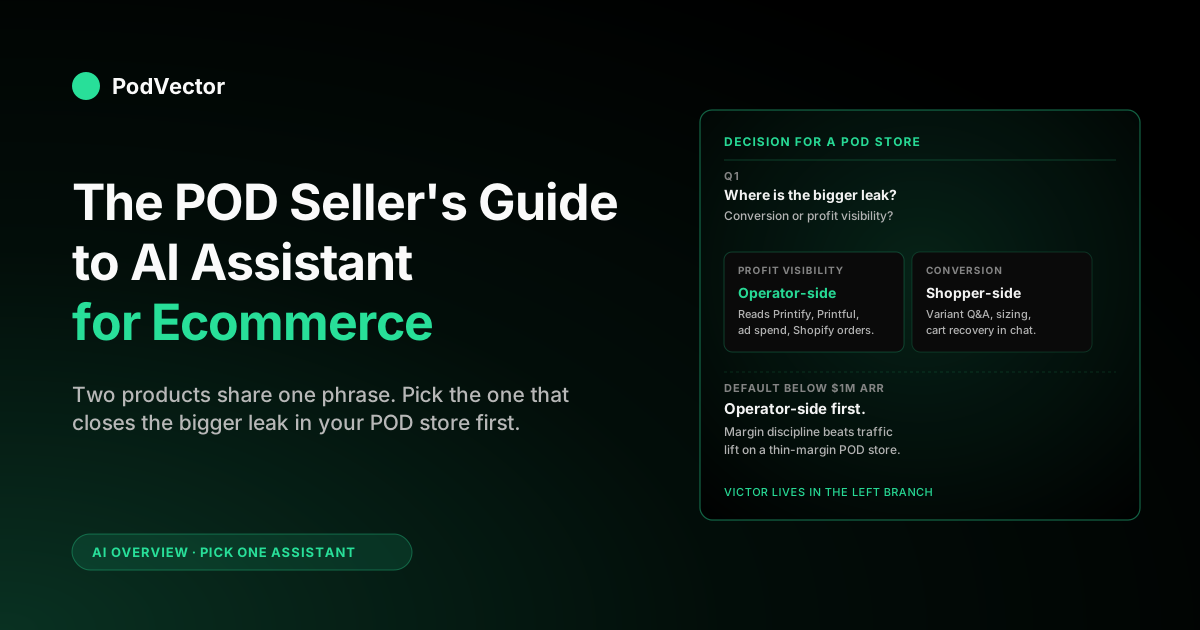
Quick Answer: "AI assistant for ecommerce" is two products under one phrase. The one most guides describe is the shopper-side assistant — a chat layer on your storefront that helps buyers pick products and check shipping.
The one most print-on-demand operators actually need first is the operator-side assistant — an AI employee that reads live Shopify, Printify or Printful, and ad-platform data, tells you which designs are profitable, which suppliers to keep, and where margin is leaking. This guide covers both, ranks the assistants worth evaluating for a POD store, and explains why the order in which you adopt them matters more than which one you pick.
What an AI assistant for ecommerce really is in 2026
An AI assistant for ecommerce, in 2026, is any LLM-driven interface that helps a person make a decision or take an action inside an ecommerce workflow. That person is sometimes a shopper choosing a product, sometimes an employee deciding what to restock, promote, or pause. The phrase covers both even though most articles only describe one.
If you skim the top guides — Algolia's practical guide for ecommerce brands, BigCommerce's overview, the various roundups — you'll see they almost all default to the shopper-side definition. That's not wrong, it's just incomplete.
The shopper assistant is the loudest segment of the market because it's the easier product to demo and the one that ecommerce platforms have integrated into their core funnel. The operator-side assistant is newer, less visible in roundups, and for a POD seller running on margins under 30%, often the more important purchase.
The category is also no longer confined to your own storefront. By mid-2026 the loudest growth is in third-party shopping agents — ChatGPT's shopping surface, Google Gemini, and Amazon Rufus — that shoppers now use to research and, increasingly, check out without ever landing on your product page. Analysts peg the AI shopping-assistant market on a path toward roughly $85B by the mid-2030s, and a meaningful share of retailers are already piloting autonomous agents. For a POD seller, that adds a third surface to the two below: the assistant a shopper brings with them, which you don't control but can be found by. We cover that one at the end.
This guide covers the singular case — picking one AI assistant to actually deploy on a print-on-demand store — rather than the broader category split. For the side-by-side category comparison and a longer treatment of the two-product framing, see The POD Seller's Guide to AI Assistants for Ecommerce. Here we focus on the practical question of which assistant goes in first.
Why the singular framing changes the answer
If you're evaluating "AI assistants" as a category, you compare features and prices. If you're picking the AI assistant for your store — singular, one slot, one budget — you have to make a different decision: which problem hurts most right now?
For a POD operator with steady traffic but unclear profit, that problem is operator-side. For a POD operator with traffic that doesn't convert, it's shopper-side.
The guides that don't distinguish push everyone toward the shopper bot because it's the obvious answer. The right answer depends on which side of the funnel is leaking.
"The" AI assistant doesn't exist — there are two
The single most useful frame for picking an AI assistant in 2026 is to recognize that the phrase covers two distinct products with different buyers, different surfaces, and different success metrics. Holding both categories in mind before you decide is what separates operators who pick well from operators who buy three tools and use one.
The two products at a glance
- Shopper-side assistant. Lives on the storefront. Buyer talks to it. Goal: convert sessions and deflect support tickets. Examples: Tidio Lyro, Octane AI, Gorgias AI, Shopify's own chat surfaces, Amazon Rufus on the marketplace side.
- Operator-side assistant. Lives behind the storefront, in your admin workflow. You talk to it. Goal: read live business data and answer profitability, attribution, and operations questions. Examples: Victor (PodVector AI), generic LLMs wired to your warehouse via MCP, Shopify Sidekick on the admin side.
The shopper-side market is mature and crowded. The operator-side market is younger, less commoditized, and — for POD specifically — under-served by generic ecommerce vendors because POD's economics don't fit their default reports. The POD Seller's Guide to Shopify AI Assistant covers the operator side from Shopify's own angle.
Why the two get conflated
Three reasons. First, the same underlying tech (LLMs + retrieval + tool use) powers both, so vendors describe themselves with overlapping language.
Second, the major commerce platforms (Shopify, BigCommerce, Salesforce) ship a single "AI assistant" surface that tries to cover both, blurring the line. Third, the SEO winners on the keyword "AI assistant for ecommerce" are mostly shopper-side vendors writing roundups, so the search results bias toward that definition. None of this is malicious — it just means the operator's job is to insist on the distinction before they spend.
Shopper-side AI assistant: the storefront chat layer
The shopper-side assistant is what most people picture when they hear "AI assistant for ecommerce." It's a chat widget — sometimes a search bar, sometimes a voice surface — that converses with a buyer and helps them complete a purchase. In 2026, the leading versions are LLM-grounded, retrieval-augmented over your catalog, and capable of taking simple actions (apply a discount code, look up an order, open a return ticket) without a human in the loop.
What it does well for an ecommerce store
- Pre-purchase Q&A. "Does this hoodie run small?" "Will it ship before Christmas?" These are the questions that kill conversion when nobody answers; a shopper-side assistant catches them and converts the session.
- Recommendations. Either reactive ("show me the same design on a tee") or proactive ("you'll probably also like this matching beanie"). Lift on AOV typically lands in the 5–15% range when wired in well.
- Cart recovery. The assistant detects abandonment, opens a conversation, addresses the friction. Reported recovery rates run 5–10% of recoverable carts depending on the store and the offer.
- Support ticket deflection. Order status, returns, sizing — the bot handles 60–80% of common tickets, the rest escalate cleanly. Vendor case studies report 45% support cost reduction at the high end.
Where the POD use case bends the playbook
POD breaks four assumptions that generic shopper-side assistants make: you don't hold inventory (so "in stock" is a function of the supplier, not a binary), shipping windows vary per order and per supplier, print quality is a real concern shoppers ask about, and your size charts change with each new POD base you add. Generic assistants quote a single shipping window for the whole catalog and confidently misinform the customer half the time. The good ones — or the ones you tune — pull live data per SKU. AI Chatbot for Ecommerce: What It Looks Like for POD Sellers walks through the seven specific use cases that move POD revenue once the assistant is wired correctly.
The shopper-side assistants worth evaluating
The mature shopper-side platforms a POD seller should look at: Tidio (Lyro), Octane AI, Gorgias AI, Rep AI, Shopify's native chat. Each varies in how cleanly it grounds answers in your live Printify or Printful data; that's the question to ask on every demo.
The roundups will tell you about features. They will not tell you which one knows the difference between a Bella+Canvas tee and a Gildan tee.
Operator-side AI employee: reads your data and acts on the answers
The operator-side assistant is the quieter category and the one POD operators most often need first. Unlike a shopper bot it doesn't sit on your storefront. It sits in your admin workflow — Slack, a dashboard, an admin chat surface — and answers the questions you'd otherwise hire an analyst for.
The questions an employee-side assistant answers
- "What's my actual margin on the trending design last week, after Printify cost, ad spend, and Shopify fees?"
- "Which products lost money in the last 30 days when I include attributed ad spend?"
- "My ROAS on Meta dropped this morning. What changed — the campaign, the audience, or the underlying creative?"
- "Should I switch this SKU from Printify to Printful given current per-unit cost and shipping reliability?"
- "Which 10 designs in my catalog are eating margin from the rest of the store and should be paused?"
None of these are answerable by a shopper-side assistant. None are well-served by Shopify's native reports either, because Shopify doesn't see Printify costs as itemized line items, doesn't reconcile ad attribution back to product, and doesn't know which of two suppliers carries which SKU. The Complete Guide to AI Analytics for Print-on-Demand covers the data-architecture side; this section is about the assistant interface that sits on top.
What the operator-side assistant is plugged into
- Shopify Admin API — orders, products, customers, fulfillment status.
- Printify or Printful API — production cost per variant, shipping cost per zone, fulfillment time, supplier ID.
- Ad platforms — Meta, Google, TikTok spend at the ad set or campaign level, joined back to orders.
- Email and SMS platforms — Klaviyo, Postscript, attributed revenue per flow or campaign.
- One place where everything comes together — so Victor can look at your orders, ads and costs side by side and give you a straight answer.
Victor — the AI employee PodVector AI ships — runs against a live data feed of all of the above, which is why it can answer profitability questions in seconds rather than days. Most POD operators don't have a warehouse at all; the assistant they pick has to either bring its own or give up answering the questions that depend on cross-source joins. The POD Seller's Guide to AI for Ecommerce Business goes deeper on what the operator workflow looks like end to end.
Why operator-side is harder to demo than shopper-side
A shopper assistant looks impressive in a 90-second demo: ask it a question, get an answer, watch the chat bubble pop. An operator assistant only looks impressive when it's wired to your real data — and wiring takes a day to a week.
Vendors selling shopper assistants therefore convert in demos at a much higher rate, which is part of why the shopper-side category is more visible. None of that means it's the right one to buy first.
Which one a POD seller should adopt first
The honest decision rule: pick the assistant that addresses the bigger leak. For most POD stores below $1M ARR, that's the operator-side one. The reasoning:
- POD margins are thin. A 25% gross margin on a $25 tee is $6.25. If a shopper-side assistant lifts conversion 5%, that's $0.31 incremental gross profit per session. If an operator-side assistant flags one losing campaign worth $500 in monthly waste, that pays for itself for a year.
- POD operators are usually solo. The bottleneck isn't traffic-to-revenue conversion; it's operator hours spent figuring out what's working. An assistant that compresses six hours of weekly analysis into ten minutes returns those hours to creating new designs or testing new ads.
- Shopper-side ROI requires good catalog data. A shopper-side assistant grounded in messy Shopify data will hallucinate confidently. The operator-side one has to clean up that data anyway, which is a prerequisite for the shopper-side assistant working well.
Above $1M ARR, traffic volume usually justifies adding a shopper-side assistant on top — the absolute lift in dollars starts to matter. Below that line, operator-first is almost always the better order. The POD Seller's Guide to AI Solutions for Ecommerce has the broader sequencing argument.
The AI assistants on the table for a POD store
A short, opinionated list of what to actually evaluate, ordered by how well each fits a print-on-demand workflow rather than by SERP position.
Operator-side
- Victor (PodVector AI). Built specifically for POD operators on Shopify. Reads live Printify, Printful, Shopify, and ad platform data via your warehouse. Answers margin, attribution, and supplier-comparison questions in chat. Today's product is read-only; the employee capability that takes actions (pause campaigns, switch suppliers) is on the public roadmap.
- Shopify Sidekick. Native, free with Shopify. Strong at Shopify-native questions (sales, traffic, products). Weak at anything that requires joining outside data — ad spend, Printify costs, supplier reliability. Useful but partial. The POD Seller's Guide to Shopify Sidekick AI covers the limits.
- A general AI chatbot connected to your own store data. Tools like ChatGPT or Claude can be hooked up to your store's data if you build the connections yourself. This can work, but you have to build and keep up the plumbing that makes it accurate. That's fine if you already have your data organized and someone technical to run it. Otherwise it gets expensive fast.
Shopper-side
- Tidio (Lyro). Strong on intent recognition and Shopify integration. Good first option for a POD store starting on shopper-side. Pricing scales with conversation volume.
- Gorgias AI. Best when support tickets are the primary leak. Less optimized for pre-purchase conversion than Tidio.
- Octane AI. Strong on quizzes and personalized funnels — useful if you have catalog breadth (multiple POD bases × design library) where guided discovery converts.
- Rep AI. Marketed as a sales agent rather than a chatbot. Strong on conversion lift in case studies; less mature on support deflection.
- Shopify's native chat surfaces. Free, basic, improving. Reasonable to start here while you build the catalog data the better assistants will need anyway.
A POD-specific evaluation checklist
Whichever side you're picking from, the evaluation questions that matter for POD aren't the ones on most vendor comparison sheets.
For shopper-side assistants
- Does it pull live production-time data from Printify or Printful, or does it quote a flat shipping window?
- Can it answer per-variant questions (color, size, fabric) using your actual variant data, or does it default to generic answers?
- Does it know your size chart per POD base — Bella+Canvas vs Gildan vs AS Colour — or just "the size chart"?
- Does it handle the misprint-replacement workflow with the supplier API, or hand it off to a human ticket?
- What's the cost model — per conversation, per resolution, per month? POD margins don't support unlimited overage.
For operator-side assistants
- Does it itemize Printify or Printful cost per variant, or treat them as a single line in COGS?
- Does it reconcile ad spend back to specific products — not just campaigns or ad sets — and net it from gross sales?
- Can it compare suppliers head-to-head for the same product (cost, reliability, ship time)?
- Does it answer in real time against live data, or is it batch-refreshed once a day?
- Does it have an employee capability — pausing campaigns, switching suppliers — or is it permanently read-only?
Common to both
- How long does setup actually take (not the marketing claim, the real number)?
- What happens when the model is unsure — does it hallucinate or refuse cleanly?
- What's the data retention and privacy posture? POD shoppers' data is yours, and the assistant vendor shouldn't train on it without consent.
- How does pricing scale as the store grows? Per-conversation pricing on a shopper bot can become punishing once a viral product hits.
For a deeper checklist on the agent dimension specifically, AI Agents for Ecommerce: What It Looks Like for POD Sellers goes into what "agentic" means in practice for POD.
Implementing without bleeding margin
POD margins make implementation discipline matter more than for higher-margin stores. A few practical rules.
Start with the data, not the assistant
Whichever assistant you pick, it's only as good as the data you can hand it. Before signing a vendor, get your Shopify, Printify or Printful, and ad platform data into one place — even a Google Sheet refreshed weekly is better than nothing. The vendors that say "we'll handle the data" usually mean "we'll handle Shopify and ignore everything else." For POD, ignoring everything else means ignoring half the P&L.
Tune one assistant before adding another
The instinct is to bolt on a chatbot, then a sidekick, then an analyst. The result is three half-tuned assistants that disagree with each other.
Pick one, run it for 60–90 days, measure the leak it was supposed to fix, then add the next. Stacking assistants without measuring is how POD operators end up paying for tools they don't open.
Watch the per-conversation pricing on shopper-side
Most shopper-side assistants price per conversation or per resolution. A viral TikTok can quintuple your conversation count overnight, and the bill arrives a month later. Either pick a flat-fee plan, set hard usage caps, or budget aggressively for the upside scenarios. The POD Seller's Guide to AI for Ecommerce has the full cost-model framing.
Don't over-train on early outputs
The first month of an AI assistant that works inside your store will produce some surprising claims about your business. Some are real insights; some come from bad data getting mixed together. Keep a "verify before acting" rule for anything that would meaningfully change the business — a paused campaign, a discontinued product — until you trust what it's telling you.
From assistant to agent: the next 18 months
Today's assistants — both shopper- and operator-side — answer questions. The next generation takes actions.
On the shopper side that means assistants that don't just describe a refund policy but issue the refund and ship the replacement. On the operator side it means assistants that don't just flag a losing ad set but pause it, draft a replacement, and report what they did.
The agentic shift is the most consequential change to the assistant category since LLMs themselves. Agentic AI for Ecommerce: What It Looks Like for POD Sellers is the deepest treatment of what this looks like for POD specifically, including the trust and authorization patterns that make it safe to delegate work. Victor is explicitly agentic — he answers your questions and takes the actions you'd otherwise take yourself, with your approval.
The practical implication for picking an assistant in 2026: bias toward vendors with a credible employee roadmap rather than ones doubling down on chat-only features. The chat interface is settled tech; the agent layer is where the next 5x of value lives.
The third surface: the shopping agent your customer already brought
The newest wrinkle isn't an assistant you install — it's the one the shopper arrives with. ChatGPT's shopping surface, Google Gemini, and Amazon Rufus increasingly handle the research-and-recommend step that used to happen on your storefront, and some now carry the buyer all the way to checkout. You don't deploy these and you can't tune them, but they decide whether your product gets surfaced when a shopper asks an agent "find me a funny cat-dad t-shirt under $25."
For a POD seller the practical takeaway is that product discoverability is shifting from search-engine SEO toward answer-engine optimization: clean, structured product data, accurate variant and shipping info, and reviews an agent can parse are what get you cited inside someone else's assistant. The work of keeping your catalog and data clean — the same work that makes Victor and any storefront bot accurate — is also what makes you legible to the external agents. It's one more reason that clean, accurate data, not just a chat widget, is the real investment. Agentic AI for Ecommerce: What It Looks Like for POD Sellers covers how to prepare for agent-mediated shopping.
Mistakes POD sellers make with AI assistants
1. Buying both before tuning either
Stacking a shopper-side and operator-side assistant in the same month, without proving either against a measurable leak, is the most common pattern. You end up paying for both and trusting neither.
2. Treating Shopify Sidekick as the operator-side answer
Sidekick is useful, free, and partial. It can't see your Printify costs or your ad spend. Treating it as the full operator-side assistant means you're answering profit questions with revenue data — and POD's whole problem is that revenue and profit don't track each other.
3. Picking on demo, not on data
Shopper-side assistants demo well. The right test is "give it my real catalog and watch it answer per-variant questions" — not "watch it answer a generic question in a sales call." If a vendor won't load your data into a sandbox, that's the answer to your question.
4. Ignoring the cost model
Per-conversation, per-resolution, per-message-volume pricing all interact differently with POD's spike-driven traffic. A flat-fee operator assistant is usually predictable; a per-conversation shopper assistant can become the second-largest line item in your P&L overnight.
5. Not measuring the leak
If you can't say what specifically you bought the assistant to fix — recovered carts, deflected tickets, hours of analysis saved, losing campaigns flagged — you can't tell whether it's earning its keep. Measure the leak before you sign, not after.
FAQs
What's the difference between an AI assistant and an AI chatbot for ecommerce?
In 2026 the line is mostly marketing. Vendors who want to sound modern call themselves "assistants"; vendors who don't, call themselves "chatbots." The technical distinction that does matter is whether the surface only answers (assistant or chatbot) or also takes actions (agent). For practical purposes, anything LLM-grounded with retrieval over your store data is an "AI assistant." AI Chatbot for Ecommerce: What It Looks Like for POD Sellers covers the chatbot framing in depth.
Can I use ChatGPT or Claude as my ecommerce AI assistant?
You can, but you have to do the wiring yourself. A general-purpose LLM doesn't know your store.
You'd connect it to Shopify, Printify or Printful, and ad platform APIs (typically via MCP or function calling) and make sure it has retrieval over your live data. For a technically capable operator that's a real option; for everyone else a purpose-built assistant pays back the time difference quickly. The POD Seller's Guide to ChatGPT for Shopify has the buy-vs-build trade-off.
Will Shopify Magic or Sidekick replace third-party AI assistants?
For Shopify-native questions, partly. For anything that crosses Shopify boundaries — Printify or Printful cost data, ad attribution, supplier comparison — no, because Sidekick is bounded by what Shopify itself sees. POD operators will keep needing third-party assistants for the questions that span data sources. The POD Seller's Guide to Shopify Magic AI goes through what's in scope.
How much does an AI assistant for a POD store actually cost?
Shopper-side: $30–$500/month depending on conversation volume, with surge risk on viral days. Operator-side: $50–$300/month for a purpose-built tool, or warehouse + LLM tokens for a DIY setup, which is usually higher all-in once you cost the operator hours. Free tiers exist on both sides but typically cap features that POD specifically needs (per-variant grounding, supplier API access).
Should I deploy a shopper-side AI assistant before I have product-market fit?
No. A shopper-side assistant amplifies whatever your storefront is doing — if conversion is low because the catalog or pricing is off, the assistant just makes the failure faster. Get to repeatable conversion first, then layer the assistant in to lift the rate.
Is a free AI assistant good enough for a small POD store?
For a brand-new store with under 100 monthly visitors, free Shopify-native chat is fine — the volume doesn't justify the spend. Once you're past 1,000 visitors or $5k MRR, the leaks the free version doesn't catch (per-variant accuracy, attribution) start mattering more than the savings. The POD Seller's Guide to AI for Ecommerce News tracks how the free-tier landscape is shifting.
How long does setup take?
Shopper-side: 1–7 days for a Shopify-native install with reasonable catalog hygiene; 2–4 weeks if you also need to clean variant data and rewrite size charts. Operator-side: 1 day if your data already connects cleanly; 1–4 weeks if the vendor has to get everything set up and cleaned first. Anything quoted as "instant" is usually skipping the step where your data gets cleaned up and connected, which is what actually makes the assistant useful.
The operator-side AI assistant for POD sellers
Victor is the AI employee built specifically for print-on-demand sellers on Shopify. It reads live Printify, Printful, Shopify, and ad-platform data and answers the margin, attribution, and supplier questions a generic AI assistant can't. Today's Victor answers; tomorrow's takes the actions.
Try Victor free