
Quick Answer: An AI chatbot for ecommerce is an LLM-powered conversational agent on your storefront — or in WhatsApp, Instagram, and Messenger — that answers shopper questions, recommends products, recovers carts, and resolves support tickets in real time. By 2026 roughly 80–85% of online retailers run one or plan to. For print-on-demand sellers, the generic playbook breaks in a few specific places: shoppers ask about variants, print quality, and shipping windows that change order by order — questions a generic LLM can't answer without a live feed of your Printify or Printful data. The chatbots that actually move POD revenue are the ones wired to your fulfillment supplier's per-SKU production and shipping data, not the ones trained on generic FAQs.
What is an AI chatbot for ecommerce?
An AI chatbot for ecommerce is a conversational interface — typically a chat widget on your storefront, sometimes inside Messenger, Instagram, or WhatsApp — that uses a large language model to answer shopper questions, recommend products, recover abandoned carts, and resolve support tickets. The good ones close the loop with your store's data: they know your inventory, your shipping rules, your return policy, and the customer's order history before they reply.
Two things separate a 2026-grade AI chatbot from the rule-based bots of five years ago. First, it understands intent rather than matching keywords — a shopper can type "where's my hoodie" and the bot pulls the order without a scripted decision tree. Second, it can hand off cleanly to a human when needed, with full context, instead of dumping the customer back at the start. BigCommerce's overview of ecommerce chatbots covers the broader category if you need a primer; this guide focuses on what changes when the store is print-on-demand.
The three layers of an AI chatbot
- The model layer. Usually GPT-4o, Claude, or Gemini under the hood. This is what understands the question and writes the reply.
- Your store’s real information. This includes your product catalog, order history, customer details, shipping rules, and policies. The chatbot uses this real information to give true answers, not made-up ones.
- The orchestration layer. The logic that decides when to escalate to a human, when to trigger a discount, when to fire a back-in-stock email, when to silently log a feature request.
If any of these three parts is weak, the chatbot fails in easy-to-predict ways. If it doesn't know your real business information, it makes up shipping dates. If it doesn't know when to hand off to a person, it frustrates the customer. If its writing is weak, it sounds robotic. Print-on-demand makes the business information harder to get right — and that's where most generic ecommerce chatbots fall short.
How AI has changed ecommerce chatbots
The shift from scripted bots to LLM-powered agents happened in the last 24 months. Three things changed at once: models got cheap enough to run at the scale of a busy storefront, retrieval-augmented generation (RAG) became standard so bots could ground answers in your data, and tool-use protocols (Anthropic's MCP, OpenAI's function calling) made it trivial to let the bot read inventory, create draft orders, or trigger workflows in your stack.
The practical effect for ecommerce: chatbots stopped being deflection tools and started being conversion infrastructure. The leading platforms now report 15–35% conversion lift, 45% fewer support tickets, and 12–20% higher average order value when product recommendations are personalized in-chat. Those numbers come from Tidio, Octane AI, and similar players' published case studies — not vendor-neutral, but directionally consistent across the category.
The next wave is agentic. Today's chatbot answers questions; tomorrow's takes actions. The Complete Guide to AI Agents for Ecommerce Analytics covers the operator-side version of this shift. For customer-facing chat, the equivalent is bots that don't just describe a refund policy but actually issue the refund, draft the replacement order with the right variant, and send the shipping label — without a human in the loop.
Why the POD use case is different
Generic ecommerce chatbots assume a few things that don't hold for print-on-demand:
- You don't hold inventory. A generic bot trained on "in stock / out of stock" logic doesn't know what to say when the answer is "always available, but the production time depends on the supplier and the variant." For POD, "in stock" isn't a binary — it's a function of supplier capacity, variant, and ship-to country.
- Shipping windows change per order. Printify and Printful both quote production time separately from shipping time, and both vary by base provider, region, and product. A bot that quotes a single shipping window will be wrong for half the catalog.
- Print quality is a real customer concern. Shoppers ask "will this look like the mockup?" more than they ask about anything else. Generic bots don't have a great answer; POD-aware bots can explain the printing process for that specific product (DTG vs DTF vs sublimation) and link to real customer photos.
- Sizing is non-standard. Different POD bases — Bella+Canvas, Gildan, AS Colour — have different size charts. A bot that links to "the size chart" loses the customer; a bot that pulls the right chart for the product they're looking at converts.
- Returns aren't really returns. Most POD orders aren't restockable, so the policy is usually "no returns on personalized items, replacements for misprints." The bot needs to understand the difference between a print defect (replace) and buyer's remorse (refund or store credit) and route accordingly.
Miss any of these and your chatbot will look helpful right up until a real customer asks a real POD question. For a deeper view of the cost side that the bot also needs to be aware of, see Printify costs and fees and Printful costs and fees.
7 use cases that move POD revenue
These are the chatbot use cases POD operators report the highest revenue impact from. Order roughly reflects ROI for a typical Shopify POD store doing $10k–$500k/month.
1. Pre-purchase variant assistance
The single highest-converting use case for POD. A shopper looks at a t-shirt, can't decide between three colors, and asks "which color is closest to navy?" A POD-aware chatbot pulls the actual hex codes from your product variants, references real product photos, and answers in three seconds.
Without the bot the shopper bounces; with it they buy. Conversion lift on hesitating sessions is typically 5–15%, depending on how cleanly the variant data is wired in.
2. Sizing recommendations
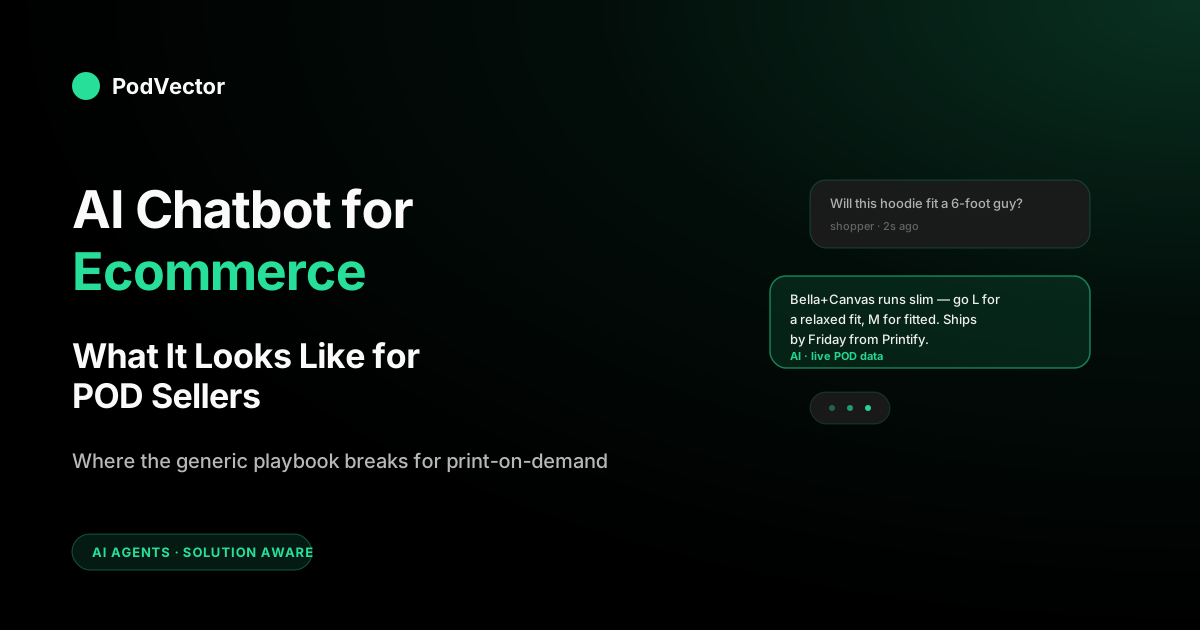
Apparel POD brands lose 8–15% of carts to sizing uncertainty. A chatbot that takes "I'm 5'10" and 175lb, what size in this hoodie?" and replies with "Bella+Canvas runs slightly slim — go with L for a relaxed fit, M for fitted" recovers the bulk of those carts.
The bot needs the brand's size chart per SKU plus a basic body-measurement → recommendation rule. The math is easy; what's hard is keeping the size charts current as you add new POD bases.
3. Shipping ETA on demand
"When will it arrive if I order today?" is a top-three pre-purchase question for POD. The naive answer ("3–7 business days") is almost always wrong because production time varies by supplier and base provider. A bot that can read the live Printify or Printful production estimate for the specific variant being viewed, add the relevant shipping zone, and quote a real range — "production takes 2–4 days, then ships USPS, you'll have it by next Friday" — converts hesitating buyers at a rate dashboards underestimate.
4. Order status and tracking
The lowest-glamour use case but the highest support-ticket-deflector. "Where's my order?" is the single most common ticket in any DTC store, and POD's longer fulfillment windows mean POD stores get even more of them. A chatbot wired to your Shopify orders and your Printify/Printful tracking can resolve 90% of these without a human, freeing whoever's running support to handle the genuinely tricky cases.
5. Misprint and replacement workflow
POD-specific. When a customer sends a photo of a misprinted shirt, a good bot can recognize this is a quality issue, ask for the order number and a photo, file the replacement claim with Printify or Printful, and send a confirmation — all without a human reviewing it.
The unhappy-customer-to-resolution time drops from days to minutes, and the customer often returns. Few generic ecommerce chatbots are wired for this; the bot has to understand your POD supplier's claims API.
6. Cart recovery with personalized incentives
Standard ecommerce play. The chatbot detects an abandoning cart, opens a conversation, asks if there's a question stopping the purchase, and (if needed) offers a discount the merchant has pre-authorized.
POD twist: the discount can't blow your already-thin margin, so the bot needs to know your per-SKU profit and only discount where there's room. Done well, this is 5–10% of recovered revenue you weren't getting before.
7. Upsell to higher-margin SKUs
The shopper picks a $22 cotton tee. Your hoodie has a much higher absolute margin.
A bot that understands which products in your catalog have the best margin can suggest "if you like this design, the same artwork is on a hoodie that's been our bestseller this month" — without the merchant having to write the upsell rule for every product. Margin-aware recommendations require the bot to know your COGS per SKU, which is exactly the data POD merchants struggle to keep current. Tools like profit tracking for Shopify POD are upstream of this.
Omnichannel and multilingual: where POD shoppers actually are
The top-ranking ecommerce-chatbot guides all converged on the same two points in 2026, and both matter more for POD than for warehoused retail: the bot has to live wherever the shopper already is, and it has to speak their language.
Omnichannel: the chat widget isn't the whole job
A lot of POD traffic now starts in social DMs — an Instagram comment on a viral design, a WhatsApp message after a TikTok, a Messenger reply to a retargeting ad. A storefront-only chatbot misses all of it. The bots that win are wired to answer the same way across the widget, WhatsApp, Instagram, and Messenger, with one shared memory so a shopper who asked about sizing in a DM doesn't have to repeat themselves on the product page. For POD specifically, that matters because the social channel is often where the design went viral in the first place — the conversation is already happening there, with or without you.
Multilingual: POD ships globally by default
Print-on-demand has no warehouse, so selling into Europe, Latin America, or Asia is just a fulfillment-region toggle — which means your shoppers arrive in a dozen languages whether you planned for it or not. Modern LLM chatbots handle this natively: the same bot answers a sizing question in German, a shipping-ETA question in Spanish, and a misprint claim in Portuguese without you staffing for any of it. Roughly 77% of consumers say they'll pay more for, recommend, or choose a brand that personalizes — and answering in the shopper's own language about the exact variant they're viewing is about as personal as it gets. The catch is the same as everywhere else in POD: the translation is only useful if the underlying answer is grounded in your live Printify/Printful data, not a generic "ships in 5–7 days."
Customer chatbot vs AI employee: don't confuse them
Two AI tools sit on top of a POD business and they get conflated. They're not the same thing.
A customer chatbot talks to your shoppers. It lives on the storefront. Its job is to convert browsers into buyers and resolve tickets. The platforms in this space — Tidio, Gorgias AI Agent, Intercom Fin, Octane AI — are built for conversational customer-facing UX.
An AI employee talks to the merchant. It lives in your back office.
Its job is to answer business questions like "which campaigns lost money last week" or "which SKUs are eating my margin." Different platforms entirely: Victor, Triple Whale Moby, Polar sit in this category. PodVector AI's Victor is purpose-built for POD sellers — he sees your itemized Printify and Printful costs together with your ad spend, so he can answer your questions in plain English.
You probably want both. They're not substitutes. Confusing them — buying a customer chatbot and expecting it to answer your business questions, or buying an AI employee and expecting it to talk to shoppers — is the most common mistake POD operators make on this purchase.
What a good POD chatbot looks like in practice
A worked example. A shopper lands on your store from a Meta ad, picks a t-shirt design, and pauses on the product page.
- Trigger. The chatbot opens after 30 seconds of inactivity on the product page with a contextual prompt: "Hey — questions about sizing or shipping on this design?"
- Conversation. Shopper asks "will this fit a 6-month-old?" The bot understands the size chart, asks for the baby's weight, recommends a size, and links to one-tap "add to cart" with that size pre-selected.
- Closing. Shopper asks "and when will it arrive?" Bot pulls production time for that exact variant from Printify, adds the shipping zone for the IP-detected country, and quotes a date range. Not a generic "5–7 days" — a real date.
- Recovery. Shopper still hesitates. Bot offers a 10% discount it knows is within margin tolerance for that SKU. Cart converts.
- Post-purchase. Two days later the bot proactively messages: "Your shirt is in production. Tracking will arrive by end of week."
That entire flow is what generic chatbots try to do but can't, because they don't have live access to your Printify and Printful costs for each product. Pulling in that real information — the cost per product, the production time per variant — is where most of the real work goes. The chat window itself is the easy part.
The architecture under the hood
Most modern POD chatbots run roughly this stack:
- Frontend: Shopify app or embedded widget
- Model: GPT-4o, Claude 4, or Gemini 2 (vendor-dependent)
- Retrieval: RAG over product catalog, policy docs, FAQ, order data
- Connections needed: Shopify, Printify/Printful, Klaviyo, and your fulfillment claims system
- Memory: Customer profile and conversation history per session
- Escalation: Handoff to human via Gorgias, Front, or Help Scout when the bot's confidence drops
The underlying technology isn't special anymore — what matters is whether the hard work of connecting your suppliers is already done. The chatbots that win for POD sellers are the ones whose vendor has already done that connection work for you.
How to measure if it's working
The metrics that matter for a POD chatbot, in priority order:
- Conversion lift on engaged sessions. Sessions that talked to the bot vs sessions that didn't, holding traffic source constant. Aim for 10%+ within 60 days.
- Ticket deflection rate. Percent of conversations resolved without human escalation. Top performers hit 70–85%; below 50% means it doesn't know enough about your real business to answer well.
- Average order value lift. Sessions with chatbot interaction vs without. Personalized in-chat recommendations should drive AOV up 8–15%.
- Resolution time. Median seconds to resolve. Bots should be sub-30s for routine questions; humans take minutes. The gap is the operating leverage.
- CSAT post-conversation. The single one-tap rating after the conversation closes. Below 4.0/5.0 means the bot is frustrating people, regardless of what the deflection rate says.
What not to optimize for: total conversation count. A chatbot can drive that number up by being chatty and not actually resolving anything. Resolution rate × CSAT is the real signal.
Common mistakes POD sellers make
- Buying the chatbot before fixing the data. The bot will be only as good as the data it can access. If your product catalog doesn't have accurate variant-level descriptions, accurate size charts, and current Printify/Printful integration, no chatbot will save you.
- Not pre-authorizing discounts. Cart-recovery flows need a discount to fall back on, but if the bot has no upper bound it'll eat your margin. Set a per-SKU discount ceiling tied to your margin floor.
- Treating the bot as a deflection tool. Bots that exist purely to keep customers away from humans drive CSAT into the floor. The bot's job is to resolve, not to gate.
- Forgetting the escalation path. When the bot fails, the handoff to a human should carry the full conversation context. Bots that dump the customer back at "how can I help you?" make the experience worse than no bot at all.
- Conflating chatbot ROI with AI employee ROI. Discussed above — they're different tools, different buyers, different ROI math. Track them separately.
FAQs
Do AI chatbots actually drive sales for POD stores?
Yes, but the ROI shape is different from generic DTC. POD chatbots win mostly through pre-purchase assistance (variant + sizing + shipping ETA) rather than post-purchase support. Expect a 10–25% conversion lift on engaged sessions if the bot has live access to your Printify/Printful data; closer to 0–5% if it's just a generic LLM with no integration.
What's the difference between an AI chatbot and an AI agent?
A chatbot has a conversational UI and is built primarily for back-and-forth dialog. An AI agent has tools and goals — it can take actions on your behalf (issue refunds, place orders, run analyses).
Modern AI chatbots are increasingly agentic; the line is blurring. For POD specifically, the customer-facing chatbot and the AI employee are still distinct categories.
Can I use ChatGPT or Claude directly as my ecommerce chatbot?
Not really. The model is the easy part — the hard part is the data integration, the orchestration logic, and the production hosting.
You can connect ChatGPT to a Shopify app, but you'll still need to build the system that pulls in your real business data, connects to Printify and Printful, recovers abandoned carts, and knows when to hand off to a real person. Most POD merchants buy a vendor (Tidio, Gorgias, Octane AI) rather than build it themselves.
How long does it take to deploy an AI chatbot for a POD store?
For a turnkey vendor (Tidio, Octane AI, Gorgias AI Agent): 1–2 weeks to launch with default flows, 4–6 weeks to tune for your catalog. For a custom build: 8–16 weeks at minimum. The data work — keeping size charts current, mapping Printify/Printful production times, defining the discount ceilings — never really ends.
What does an AI chatbot for ecommerce cost?
Entry-level: $30–$100/month for basic vendors with limited AI features. Mid-market: $200–$1,000/month for a full AI chatbot with deep Shopify integration. Enterprise: $2,000+/month with custom integrations, dedicated CSM, and SLA. For most POD stores in the $10k–$500k MRR band, the $200–$1,000 mid-market tier is the sweet spot.
Will the chatbot replace my customer-support team?
No. It will deflect 60–80% of routine tickets — order status, sizing, shipping ETA, simple returns — and free your team to focus on the 20–40% that need human judgment. The teams that try to fully replace humans usually end up with worse CSAT and a customer-trust problem within 90 days.
Does an AI chatbot replace the need for an AI employee agent like Victor?
No. They solve different problems. A chatbot talks to your customers; an AI employee answers your business questions. You probably want both. Victor is built for the operator side — POD-specific profit and attribution against live Printify/Printful + Shopify + Meta/Google Ads data. The chatbot doesn't know which campaigns are profitable; Victor does.
You picked the customer chatbot. Now answer the merchant's questions too.
A great AI chatbot handles your shoppers. Victor handles the questions you ask about your business — "which SKUs lost money last week after fulfillment and ad costs?" — and answers using your real, up-to-date numbers. Built for POD sellers running Shopify + Printify/Printful + Meta/Google Ads.
Try Victor free