
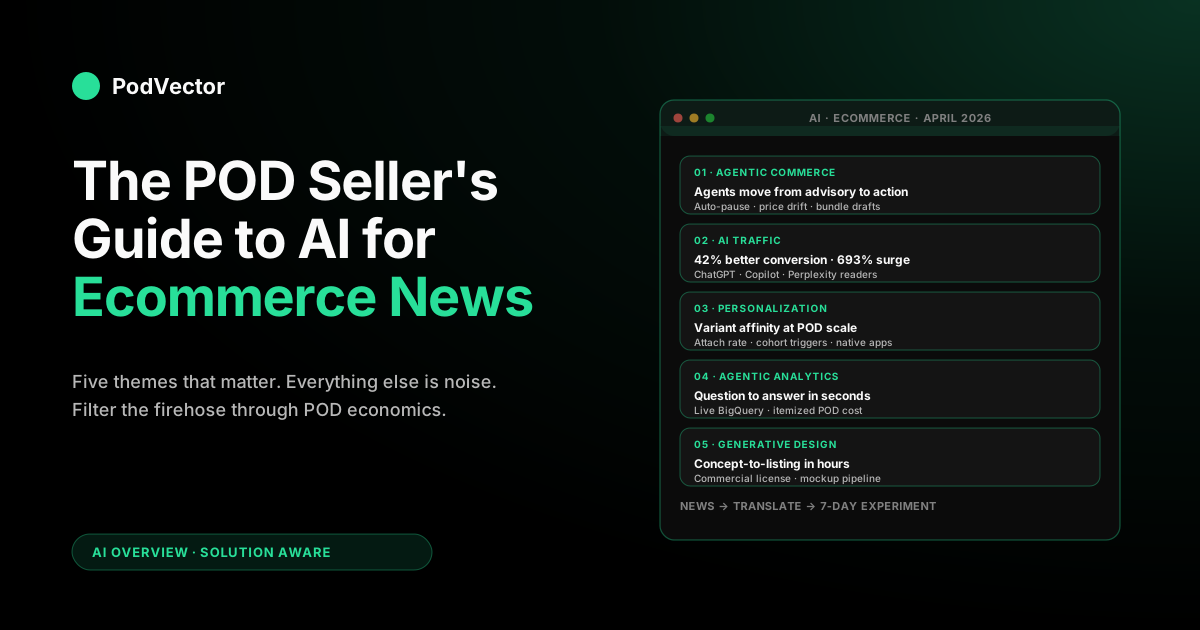
Quick Answer: "AI for ecommerce news" in mid-2026 is a firehose — agentic commerce forecasts, ChatGPT and Perplexity checkout integrations, personalization benchmarks, vendor consolidations, model drops — and most of it does not change how a print-on-demand store runs on Monday morning. The headline story right now is Bain's December 2025 forecast that agentic AI could drive $300–500 billion in U.S. ecommerce (15–25% of online retail) by 2030, with checkout moving inside the AI interface itself. The news that actually matters for a POD operator falls into five themes: agents moving from advisory to action, AI-driven shopping traffic now converting 42% better than non-AI traffic, variant-level personalization becoming cheap enough to deploy at POD scale, AI analytics collapsing the question-to-answer loop from hours to seconds, and generative design tools compressing the creative cycle. This guide filters the news through the POD operator lens — what's signal, what's noise, what to do Monday morning — and points at the tooling that turns headlines into operating moves.
What "AI for ecommerce news" actually covers in 2026
Search "AI for ecommerce news" in April 2026 and you'll get three distinct article shapes stacked on the first page. The first is the trend piece — agentic commerce, predictive personalization, conversational search — usually framed as "seven ways AI is reshaping ecommerce." The second is the statistics roundup: fifty-plus data points on adoption, conversion lift, and investment flows, pulled from Adobe, Gartner, McKinsey, and vendor research. The third is the executive report — long-form analyses from Stord, Shopify, BigCommerce, or a logistics incumbent mapping how AI fits across the ecommerce stack.
All three shapes answer the same underlying question: what is AI doing to ecommerce right now, and what's coming next. None of them are written for print-on-demand operators specifically.
That's the gap worth closing. A POD store has different economics than a stocked-inventory DTC brand — variant-level fulfillment cost from Printify or Printful, design catalogs that turn over in weeks, near-zero inventory risk but thin margins — and the AI news that matters for a generic DTC operator is often irrelevant or actively misleading for POD.
The scope of "AI for ecommerce news" in 2026 covers eight categories worth distinguishing: agentic commerce (agents that take actions, not just suggest), AI-driven traffic from ChatGPT and Copilot, personalization and recommendation engines, generative creative tools (images, video, copy), conversational search and product discovery, AI analytics and forecasting, fraud and trust layers, and warehouse and fulfillment automation. Of those eight, five matter for POD today.
Two are tangential. One will matter in eighteen months but isn't ready yet. Sorting them out is the work of this guide.
For the broader landscape view — what AI in ecommerce actually is and how the category is structured — the POD seller's guide to AI for ecommerce lays out the full map. This piece is narrower: what's happening this year, what's news versus marketing, and what a POD operator should actually do about it.
The five AI-ecommerce news themes that matter for POD
Filtering the AI ecommerce news cycle through POD economics yields a short list. Each theme below has live news coverage, documented market movement, and a specific operator-level implication. The rest is either premature, irrelevant to POD scale, or a restatement of things that were already true.
1. Agentic commerce: agents move from advisory to action — and toward checkout
The headline trend of 2026 is that AI agents have stopped being chat interfaces and started being action layers. Bain's December 2025 analysis put a number on the trajectory: agentic AI could account for $300–500 billion in U.S. ecommerce — 15% to 25% of total online retail — by 2030, and 30–45% of U.S. consumers already use generative AI to research products or compare options before they buy. Salesforce data showed AI and autonomous agents influenced roughly $3 billion in U.S. Black Friday sales in late 2025. The shift that matters most: 52% of AI shoppers now say they'd rather complete the purchase inside the AI interface than be sent to a merchant site. The tooling news under this theme includes Shopify Sidekick adding action primitives, Microsoft Copilot Agents entering retail workflows, and a growing tier of vertical AI agents specializing in ecommerce operations.
For POD, the "advisory to action" shift matters in three places specifically. First, ad spend reallocation — an agent that can pause a losing Meta campaign without a human in the loop saves hours per week and catches unprofitable campaigns before they drain budget overnight.
Second, price updates in response to supplier cost drift — Printify and Printful adjust base garment costs continuously, and an agent that can detect the drift and draft a price update for Shopify closes a margin leak most POD stores don't even measure. Third, inventory decisions on the edge cases that don't look like inventory decisions — retiring designs whose sell-through slips below a threshold, promoting variants whose attach rate with a top-seller looks high enough to bundle.
There's a second, quieter implication in the agentic-checkout news that POD operators should track: if 15–25% of online retail flows through AI interfaces by 2030, the agent — not your Shopify storefront — becomes the surface where the buyer decides. A POD store whose product data isn't clean, structured, and machine-readable risks being skipped by the agent doing the comparison, and a store that depends on storefront upsells and post-purchase flows loses that real estate when checkout happens inside ChatGPT or Perplexity. The defensive move is the same as the offensive one: expose specs as text, keep your feed clean, and treat AI surfaces as a channel you optimize for, not one that happens to you.
The honest read on agentic commerce news is that "fully agentic" claims are premature. The actions that ship today are narrow and advisory-approved.
The actions that ship in eighteen months will be standing-authority within explicit guardrails. For a deeper operator-level view on how to evaluate agentic claims, the agentic AI for ecommerce guide covers the governance and rollback patterns that separate real agents from dressed-up chatbots.
2. AI-driven shopping traffic is converting 42% better — and it's not evenly distributed
Adobe reported in March 2026 that AI-driven traffic converted 42% better than non-AI traffic — a full reversal from a year earlier, when AI traffic converted at roughly half the rate of traditional traffic. The growth curve is maturing rather than exploding: AI-referred traffic to U.S. retail sites grew 673% year-over-year in December 2025 but slowed to 393% in Q1 2026, which means the channel is moving from novelty to baseline. The quality signal is what's striking. AI-referred visitors bounce 12% less, spend 48% more time on site, view 13% more pages per session, and generate 37% higher revenue per visit than non-AI visitors. Adobe's survey work adds that 79% of consumers using AI to shop feel more confident in the purchase and 69% report fewer returns. The mechanism is that shoppers arriving via ChatGPT, Perplexity, Gemini, and Copilot-assisted searches arrive with more defined intent than organic or paid traffic — they've already had the "should I buy X or Y" conversation with an AI before the click-through.
For POD, this news has two practical implications. First, it matters whether your store is machine-readable for AI agents doing product research.
Adobe's follow-up research flagged that retail sites lag in AI search visibility — product pages that don't expose clean structured data, clear specifications, and direct product answers get skipped by agents in favor of sites that do. POD stores are unusually vulnerable here because generic Shopify themes often bury variant details (material, fit, print method) inside tabs or rely on images to communicate them. An agent reading your page wants text.
Second, the content that captures AI-assisted traffic is different from the content that captures organic or paid. AI agents pull from pages that answer specific questions directly — "is this shirt pre-shrunk," "how does the fit run," "what's the print durability after fifty washes." POD sellers who write product descriptions around brand voice instead of operator-relevant specs are leaving AI-assisted traffic on the table. The POD seller's guide to AI search for ecommerce covers the structural changes that matter for discovery in this environment.
3. Personalization economics finally work at POD scale
Most of the personalization news through 2024 was written for enterprise retailers with thousand-variant catalogs and six-figure martech budgets. The 2026 news is that the same personalization capabilities — dynamic product recommendations, customer-specific pricing offers, cohort-triggered email flows — are now accessible at Shopify-plan prices through AI-native apps. The shift is that the modeling layer moved from custom builds to commodity infrastructure, and the delivery layer moved from custom frontends to native Shopify theme extensions.
For POD, this matters because variant-level personalization is where POD stores were previously locked out. A stocked-inventory brand with thirty SKUs can hand-tune recommendation rules.
A POD store with two hundred SKUs cycling through a hundred designs a quarter can't. AI-powered recommendation systems that learn variant affinity automatically — which colorway pairs with which design, which size runs together in cart additions — are the version of personalization that POD stores can actually deploy without a data team.
The news to watch under this theme is attach-rate lift and repeat-purchase lift on specifically POD-type catalogs, not on stocked-inventory incumbents. Generic case studies showing a 12% AOV lift on a single-SKU skincare brand don't translate to a POD store with a hundred apparel designs. Ask vendors for case studies that look like your catalog shape, not for generic ecommerce benchmarks.
4. AI analytics collapses the question-to-answer loop
Through 2025, ecommerce analytics news was about better dashboards — Triple Whale, Polar Analytics, and Glew racing to ship better chart catalogs. The 2026 news is different: new analytics tools let you type a plain English question and get a real answer back in seconds. The meaningful shift is that the loop between "I have a question" and "I have an answer" collapsed from a Sunday-evening spreadsheet session to under a minute.
For a POD store, this is the single highest-leverage category in the AI ecommerce news cycle. The reason is that POD economics are variant-level and supplier-cost-sensitive, and generic dashboards model them wrong.
A campaign's break-even ROAS shifts as the variant mix it sells matures. A supplier price change on a Gildan 5000 moves the margin on twenty-three SKUs overnight.
A refund has different cost implications depending on whether Printify started fulfillment before the cancellation. None of these questions have pre-built dashboards in generic tools. All of them have clean answers in an agentic analytics layer that reads your live warehouse.
The vendor landscape here is fragmenting fast. Shopify Sidekick covers Shopify-native data only; Triple Whale's Moby covers cross-channel marketing with a chat interface; a small number of agentic-analytics tools including Victor cover the POD-specific stack with itemized Printify and Printful cost at the line-item level.
For the category-level breakdown of what's available and which tool fits which shape of POD store, the best AI agents for ecommerce 2026 comparison runs the tools side by side. For the deeper architectural view on why POD needs its own data spine, the complete guide to AI analytics for print-on-demand covers the integration patterns that keep generic tools from working.
5. Generative design and creative compression
The creative side of AI for ecommerce news covers text-to-image design tools, AI-generated ad creative, automated product mockups, and video generation. The news through 2026 has been Midjourney and Ideogram gaining commercial licenses, Runway and Sora shipping product-grade video, and native-Shopify tools embedding image editing into the product upload flow.
For POD specifically, generative design compresses the concept-to-listing cycle from days to hours. A seller who used to commission a designer for each collection can iterate twenty concepts in an afternoon, mock them up on garment templates, test them on cold audiences, and promote the winners. The commercial license question is settled for the main tools — paid tiers of Midjourney, Ideogram, and Adobe Firefly grant full commercial rights — which was the blocker that kept most POD sellers out of generative design through 2024.
The news worth watching under this theme is not the next image model drop but the integrations — which upload flows, product catalog tools, and mockup generators natively take AI-generated files without friction. That's where the operator-time savings compound.
A five-second improvement in the upload flow across two hundred listings is an afternoon back. For the tooling map, the complete guide to AI tools for POD sellers covers the creative-side stack.
The news that's noise for POD (and why)
Not every AI ecommerce news story warrants operator attention. A few categories consume a disproportionate share of the news cycle and deliver very little to a POD store. Recognizing these patterns saves hours of reading per month.
Enterprise retail consolidation news. When Microsoft announces retail-specific Copilot capabilities, or when Salesforce Commerce Cloud adds an AI layer, or when a Fortune 500 retailer stands up an agents function, the news is real — but the tooling is priced for enterprise and wired for stocked-inventory, multi-warehouse, multi-brand operations. A POD store's Printify-and-Shopify stack won't touch this tooling for two years, minimum. Skim the headlines for category direction; skip the product details.
Warehouse and fulfillment automation. Autonomous picking robots, micro-fulfillment center announcements, and last-mile drone news is fascinating and almost entirely irrelevant for POD. POD sellers don't own warehouses.
The supplier (Printify, Printful, Gooten, SPOD) handles fulfillment, and the AI layer that matters there is the supplier's problem. Unless you're evaluating switching suppliers, this category is noise for POD operators.
Generic "AI will transform commerce" think pieces. Any article that talks about AI in ecommerce without naming specific tools, specific case study numbers, or specific implementation costs is opinion, not news. The signal-to-noise ratio on these pieces is near zero. If an article can be summarized as "AI is important and will continue to be important," skip it.
LLM capability announcements divorced from ecommerce use cases. Every time OpenAI, Anthropic, or Google ships a new model, the ecommerce news cycle lights up with speculation about applications. The real impact lags by six to twelve months, shows up inside tools the operator already uses, and doesn't require the operator to pay attention to the underlying model. Use the tool when the tool adds the capability; skip the model-launch cycle unless you're building your own AI product.
Web3 or crypto-adjacent AI commerce stories. Tokenized loyalty, NFT receipts, and decentralized commerce protocols recur in the news cycle and continue to have near-zero adoption in POD. Skip until adoption data says otherwise.
How to translate AI ecommerce news into POD operator moves
Reading AI ecommerce news without a translation habit turns into inspiration without action. The operators who actually get value from the news cycle have a repeatable translation process. The pattern below is five questions to ask about any AI ecommerce story before deciding whether it changes anything on Monday morning.
Question 1: Does this touch a decision I already make weekly? If the news is about a capability that applies to a decision you don't currently make (say, international shipping route optimization for a domestic-only POD store), it's not actionable for you yet. If it touches a weekly decision — campaign budget, price updates, new design launches, refund handling — keep reading.
Question 2: Does the case study look like my catalog shape? A 30% AOV lift on a single-SKU skincare brand does not generalize to a POD apparel catalog. Look for case studies with SKU counts, variant counts, and catalog turnover that resemble your operation. If the vendor can't produce one, that's a signal the tool isn't tuned for your shape.
Question 3: Does the tool integrate with Printify, Printful, or both? The itemized fulfillment cost feed is the difference between real margin analytics and blended guesses. A tool that doesn't pull from Printify or Printful natively is probably not ready for POD operations regardless of what the news piece says.
Question 4: What's the implementation cost, in operator-hours? The news story usually skips the setup tax. Realistic setup for POD-worthy tools is two to four weeks including a reconciliation gate where you verify the AI layer's numbers match a known-good spreadsheet close. Tools promising 48-hour implementations are skipping reconciliation, and the numbers will be quietly wrong downstream.
Question 5: What's the smallest concrete experiment I could run in the next seven days? This is the translation question. If you can't name a seven-day experiment, the news is inspiration, not an employee move.
A good experiment has a measurable outcome, a clear revert path, and a decision deadline. Example: "connect X to Y, run for five business days, compare to last week's numbers, decide continue or kill on Friday."
Operators who build this translation habit consume less news and extract more from it. The habit applies to every category above and collapses the news cycle from a distraction into a quarterly input on strategy.
The operator's AI news diet: sources, cadence, filter
The AI ecommerce news firehose is large enough to occupy a full-time job. Since no POD operator has a full-time news reader, the diet has to be intentional. The pattern below is what works for POD operators running one- to ten-person teams with real revenue to manage.
Weekly read: two sources, twenty minutes. Pick one industry publication and one operator-focused newsletter. Good weekly picks include Digital Commerce 360 for industry coverage, Retail Dive for category movement, and one operator newsletter like 2PM, Not Boring, or an AI-ecommerce-specific substack. Read Monday morning; skim for headlines, read two articles in full, mark one for the translation process above.
Monthly read: one deep source, one hour. Pick the monthly or quarterly report cycle — Adobe's Digital Economy Index, Shopify's merchant data releases, or a State-of-AI-in-Commerce report from Stord or a similar incumbent. These are long, data-dense, and worth reading in full because they give you the statistical backbone to evaluate weekly news claims against. A weekly piece claiming "AI traffic is growing rapidly" lands differently when you've already read the Adobe report showing the 673% December 2025 surge cooling to 393% in Q1 2026 — growth that's normalizing, not accelerating.
Quarterly read: one book-length analysis, half a day. Once a quarter, block three hours for a long-form report or book-length industry analysis. The goal is to update your mental model of where the category is going, not to extract operator moves. This is the read that catches you the news the weekly diet missed — category shifts that take months to show up in the weekly cycle.
On-demand: vendor announcements from tools you already use. When Shopify, Printify, Printful, Meta, Klaviyo, or the AI-analytics tool you use ships a feature, read the announcement. These are the news items with the highest signal-to-noise ratio for your specific operation because they're immediately available to you. Most of them will be irrelevant; the ten percent that aren't will be the ten percent with the highest leverage.
What to skip: the Twitter/X AI commentary cycle. The hot-take economy around AI in 2026 is high-volume and low-signal. There are exceptions — a handful of practitioners post substantive threads — but the dominant genre is speculation framed as insight. Skipping this cycle entirely frees five to ten hours per week with minimal knowledge loss.
The cumulative time cost of a working news diet for AI ecommerce is about ninety minutes a week plus a monthly deep-read plus a quarterly long-read. That's sustainable. It's also enough to stay ahead of most competitors, because most POD operators either over-consume (six hours per week, diminishing returns) or under-consume (zero minutes, miss the category shifts).
Where POD will diverge from the rest of ecommerce
The AI ecommerce news cycle treats the category as monolithic. It isn't. Several trends in the news will play out differently for POD than for the rest of ecommerce, and the divergence is worth naming explicitly so you can read the news with the right lens.
Inventory AI doesn't matter for POD. A huge fraction of AI ecommerce news covers inventory forecasting, stockout prevention, and demand prediction. POD has no inventory.
The underlying question ("will I run out of this item") doesn't exist. The news in this category is almost entirely irrelevant. The exception is fulfillment-time forecasting (when will Printify ship this order), which matters for customer experience but isn't usually framed as "inventory AI."
Generative design will reshape POD faster than DTC. A stocked-inventory brand's design cycle is constrained by manufacturing lead times. A POD store's design cycle is constrained by how fast you can generate, test, and list.
AI generative design collapses the production step to near-zero, and POD is the first category where this compounds into a real competitive advantage. The operator who learns to run twenty design experiments a week will pull away from the operator running two. Expect the category gap to widen through 2026.
Agentic ad buying hits POD earlier than enterprise DTC. POD stores are well-suited to agentic ad spend management because the decision cadence is fast and the downside of a wrong call is bounded. Enterprise DTC has more complex attribution models and more stakeholders, which slows adoption. For POD, an agent that auto-pauses losing campaigns against a variant-weighted break-even ROAS is a straightforward win that ships this year.
AI customer service will cover more of the POD support surface. Generic ecommerce customer service has a long tail of questions that AI handles poorly. POD customer service has a narrower question set — fit questions, print durability, shipping status from Printify or Printful, refund processing — that maps well onto AI chatbot capabilities. Expect POD stores to automate 70%+ of tier-one support through 2026, faster than the broader ecommerce average.
Pricing AI diverges because POD costs move continuously. Most AI pricing tools assume stable cost tables. POD supplier costs move every week or two.
An AI pricing tool that works for POD has to pull in Printify and Printful cost changes and update prices when your margin drops too low. This is a specific requirement, not a generic capability, and the news under "AI dynamic pricing" rarely addresses it. Filter the pricing category through this lens.
The stack that actually puts the news to work
Reading AI ecommerce news without a stack to act on it is inspiration without execution. The POD operators who convert news into operator moves have a small, consistent stack that turns a new capability into a live experiment in days, not months. The components below are the minimum viable configuration.
A Shopify-native baseline. Shopify is the anchor. Every AI ecommerce capability that matters ships a Shopify integration first, and running on Shopify Plus or Advanced cuts the implementation tax by weeks on most tools. The POD seller's guide to Shopify AI covers the Shopify-native side of the stack in detail.
A clear picture of your itemized POD cost. Without the margin truth, every other AI decision is made on blended assumptions. Knowing the exact Printify and Printful cost for every product variant, always kept current, is the foundation. The AI for ecommerce analytics guide covers how this fits.
A generative creative workflow. One paid image tool, one mockup generator, one version-control habit. Twenty concepts a week is the target; most stores ship two to five a week by default. The gap is almost entirely operational, not creative.
A conversational AI support layer. Tier-one customer service is AI-handleable for 70%+ of POD questions. The tool choice matters less than the escalation rules. The AI chatbot for ecommerce guide covers the selection logic.
A news-to-experiment system. The habit from the translate section above, captured in a lightweight tool — Notion page, Linear project, a single channel in Slack. One input (AI ecommerce news), one filter (the five translation questions), one output (seven-day experiments with decision deadlines). The operators who build this system compound their AI-ecommerce knowledge faster than operators who treat news as reading.
For the broader architectural view on how the pieces connect, the complete guide to AI agents for ecommerce analytics covers the cross-category integration patterns.
FAQs
What does "AI for ecommerce news" even mean as a search term?
Most people searching this phrase want a snapshot of what AI is doing to ecommerce right now — trends, tools, adoption numbers, what matters and what doesn't. A smaller group is looking for an AI-powered way to monitor ecommerce news. This guide covers both interpretations for POD specifically: the current state of AI in ecommerce through a POD lens, and how to build a news-consumption habit that an AI employee ritual actually values.
How often should a POD operator check AI ecommerce news?
Weekly is the right cadence for headlines and operator-focused newsletters — about twenty minutes on Monday morning. Monthly for a deep-dive industry report. Quarterly for a long-form analysis. Daily news reading is a trap for POD operators: the signal-to-noise ratio is too low and the time cost compounds.
What's the biggest AI ecommerce news story of 2026 so far?
The agentic-commerce shift — agents moving from advisory to action, and now toward checkout — is the category-defining trend. The most-cited specific is Bain's December 2025 forecast that agentic AI could drive $300–500 billion in U.S. ecommerce (15–25% of online retail) by 2030, with 52% of AI shoppers preferring to complete the purchase inside the AI interface. Underneath it sit Adobe's March 2026 data showing AI traffic converting 42% better than non-AI traffic, the Microsoft and Salesforce enterprise agentic rollouts, and the Shopify Sidekick action-layer expansion. For POD operators, the highest-impact specific is the agentic-analytics category maturing enough to actually answer margin questions correctly.
Which AI ecommerce news sources are worth paying for?
Free tier sources cover most of the category — Digital Commerce 360, Retail Dive, industry newsletters. Worth paying for: one operator-focused premium newsletter in your specific niche (POD, DTC, or ecommerce ops), and one research report subscription if you're making six-figure tool decisions. The Adobe Digital Economy Index and the Stord State of AI in E-Commerce report are free and worth reading whenever they release.
How much of AI ecommerce news is vendor marketing dressed up as journalism?
A substantial share. The heuristic: if the piece names specific tools, gives specific case study numbers, and addresses limitations or failure modes, it's closer to journalism.
If it reads as uniformly positive, avoids mentioning competitors, and ends with a call to action, it's marketing. Both have value, but knowing which you're reading prevents over-weighting the marketing.
Can AI tools help me actually read AI ecommerce news faster?
Yes, and this is a legitimate productivity move. A daily news scraper feeding into an AI summary tool (ChatGPT, Claude, or Perplexity) can compress twenty headlines into a five-minute summary.
The limit is that summaries miss nuance — the operator still has to read the two or three most relevant pieces in full. Useful as a filter, not a replacement.
Should POD sellers be investing in AI infrastructure or AI features?
Features, not infrastructure, for the next eighteen months. The infrastructure — vector databases, model fine-tuning, custom RAG systems — is overkill for a POD store and under-delivers relative to off-the-shelf agentic tools. The operator move is to subscribe to tools that already have the infrastructure built and spend operator time on experiments, not engineering.
What's the single most under-covered AI ecommerce news story for POD?
Supplier cost drift automation. Printify and Printful move base garment prices continuously, and almost no AI ecommerce news covers the category of tools that watch this drift and auto-draft price updates.
It's a narrow, POD-specific problem with real margin implications — and it's where most POD stores lose 3–5 percentage points of margin quarterly without noticing. Watch this category through 2026; it's earlier than the news cycle suggests.
How do I know if an AI ecommerce news claim applies to my store?
Apply the five translation questions: does it touch a weekly decision you already make, does the case study look like your catalog shape, does the tool integrate with Printify or Printful, what's the operator-hour cost, and what's the smallest seven-day experiment you could run. If you can't answer all five with a clean yes, the claim doesn't translate to your store yet. That's fine — most news doesn't translate to any given store on any given week.
Where does this guide sit relative to other PodVector AI content?
This is a Solution Aware piece in the AI Overview cluster — it assumes the reader knows AI matters for ecommerce and wants the POD-specific read on current news. For the category map, see the AI Overview cluster hub.
For the full topic spread on AI analytics, see the AI Analytics topic hub. For the head-to-head tool comparison, see the best AI for ecommerce comparison. For the external industry view, Insider One's seven ways AI is reshaping ecommerce in 2026 covers the general-purpose DTC perspective.
Victor turns AI ecommerce news into POD operator moves
Victor is the AI employee for POD stores. He pulls in your itemized Printify and Printful costs before you even make a sale, tracks your ad spend across channels, follows Klaviyo revenue, and answers margin and campaign questions in seconds. When the news cycle says "AI analytics is collapsing the question-to-answer loop," Victor is what that actually looks like for a POD operation. — no CSV uploads, no daily batch, no dashboards to interpret.
Try Victor free