
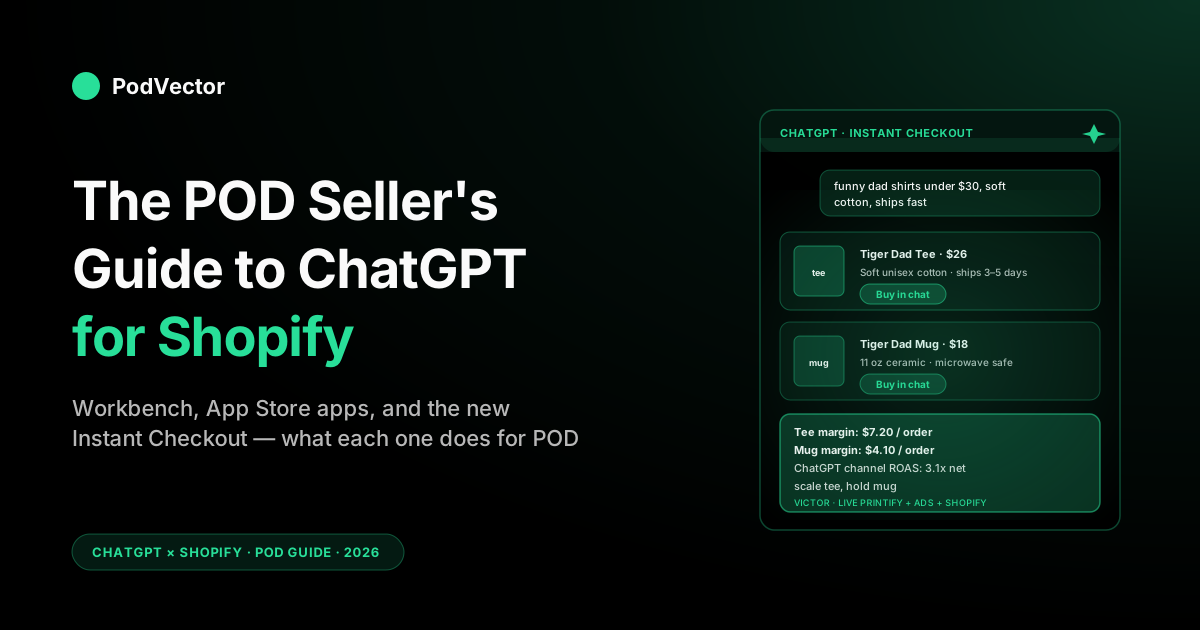
Quick Answer: "ChatGPT for Shopify" in 2026 means three different things: ChatGPT the writing tool you copy-paste into the admin, ChatGPT-powered apps in the Shopify App Store, and the new ChatGPT Instant Checkout that lets shoppers buy your products without leaving the chat. For a print-on-demand store, the first two save real time on descriptions, emails, and support replies; the third is a discovery channel you should opt into the moment your store qualifies. None of these tools can see your Printify costs or Meta ad spend, which is the gap a POD-aware analytics layer fills.
What "ChatGPT for Shopify" actually means in 2026
The phrase has drifted a long way from where it started. In 2023 it meant "I paste a product into ChatGPT and get a description back." In 2026 it covers three distinct surfaces, and most POD sellers conflate them.
The first is ChatGPT as a workbench — the chat.openai.com interface (or the desktop app) used as a writing, research, and prompting tool that lives outside Shopify. You generate something there, you paste it into the admin. Free tier covers basics; Plus and Pro tiers unlock GPT-5, longer context, image generation, and the agentic browse-and-act mode.
The second is ChatGPT-powered apps in the Shopify App Store — third-party apps that wrap the OpenAI API and present a Shopify-native UI for a specific job. Bulk product description generation (Yodel), customer service chat (HeiChat, Rep AI), email and SEO copy. These are the "ChatGPT integrated with my store" experience most sellers are looking for.
The third — and the most important shift in 2026 — is the official Shopify × OpenAI integration built around the Agentic Commerce Protocol. ChatGPT Instant Checkout lets shoppers buy your products inside the chat window itself, with Shopify handling fulfillment on the back end. This isn't an app you install and it isn't a writing tool; it's a new sales channel where ChatGPT is the storefront and your Shopify catalog is the inventory.
For a print-on-demand store, all three matter, but they earn their keep at different stages. Surfaces one and two help you ship more product faster. Surface three is where you decide whether ChatGPT becomes a top-five referrer to your store over the next 18 months.
ChatGPT Instant Checkout and the agentic storefront
This is the headline feature and the one that will reshape POD discovery if it scales the way OpenAI and Shopify believe it will. The mechanics are worth understanding before the use cases.
When a U.S. ChatGPT user asks a buying-intent question — "best funny dad shirts under $30," "personalized mugs for a coffee snob," "matching family Christmas tees with cats" — ChatGPT can now surface live product listings from participating Shopify merchants and offer a one-tap checkout inside the chat. The shopper enters payment and shipping once, ChatGPT confirms the order, and the merchant fulfills exactly the way they always have.
Orders, payments, and tax all route through the merchant's existing systems. Product results are organic and unsponsored; ranking is based on relevance to the user's query.
For a POD seller, three things follow from how this works.
It rewards specificity. ChatGPT's ranking treats product titles, descriptions, tags, and metafields as the input signal. The store that wrote "Tiger Dad Funny Father's Day Tee, Soft Unisex Cotton, Black" with a description that names the wearer ("for the dad who's calmly competitive") will outrank a store with "Black Tee #4587." The long-tail SEO discipline POD sellers built for Google search transfers cleanly here. If you've been lazy with descriptions because you assumed nobody read them, that's now a discoverability bug.
The Shopify documentation on ChatGPT agentic storefronts spells out the eligibility criteria, but the practical gate is: U.S.-based merchant, USD pricing, accurate inventory, clear product taxonomy, and policies (returns, shipping) configured. Onboarding rolled to over a million merchants in waves through 2025 and 2026.
If your store qualifies, opt in. There is no downside to letting another channel surface your products organically.
It rewards inventory width. ChatGPT's product surfaces respond well to "I want X with Y twist" queries. POD's natural strength — same artwork on tee, hoodie, mug, tote, sticker, poster — gives you more eligible answers per design. A store with one shirt design and one variant has one shot to appear; a store with the same design across eight product types has eight shots.
It rewards reviews and trust signals. ChatGPT pulls in product reviews, return policies, and shipping turnaround as part of how it presents results to the shopper. POD's default weakness — production lead times that read worse than Amazon Prime — gets less penalized when expectations are set in the listing copy itself. Be explicit. "Ships in 3–5 business days, made-to-order in the USA" is better than burying lead times in a return policy footer.
The four jobs ChatGPT does well for a POD store
Set the agentic storefront aside for a moment. For day-to-day work in the Shopify admin, ChatGPT — the chat.openai.com tool you tab over to — earns its monthly subscription on four jobs.
Product description generation at catalog scale
POD catalogs are wide and shallow. Two hundred SKUs across a single design family is not unusual. Writing a unique description for each by hand is uneconomical; leaving them blank is a search-visibility tax.
ChatGPT closes the gap. Paste in your design concept, target audience, two or three brand-voice samples, and a list of variants, and you get back distinct descriptions per variant in one pass. The quality is meaningfully better than a templated approach because GPT-5 will actually adjust the copy for the product type — a coffee mug description that mentions handle grip and microwave safety reads differently from a tee description that mentions cotton weight and unisex fit, even when the underlying design is identical.
Where this tips from useful to essential: brand voice. Pre-load the conversation with five or six descriptions you've written yourself, and ChatGPT will mimic your sentence rhythm and word choice on subsequent generations. The 2024-vintage AI-content tell ("everything sounds like the same beige LLM") gets meaningfully quieter when you do this.
Customer service drafting and macros
POD support volume clusters around three questions: where is my order, does this fit, can I get the design on a different product. ChatGPT can draft empathetic, on-brand responses to all three faster than you can type them.
The pattern most sellers settle on isn't real-time chatbot — it's draft-and-edit. You paste the customer message into ChatGPT with one line of context ("this is a Printify order delayed at production"), get a draft reply in your store's voice, edit for accuracy, send. Cuts response time per ticket roughly in half once you have two or three reusable system prompts saved.
For sellers who want chat actually inside the storefront, the better path is one of the ChatGPT-powered Shopify apps below — they handle the integration plumbing so you don't have to. A full breakdown of the chatbot landscape lives in our walkthrough of AI chatbots for Shopify and what they look like for POD sellers.
Marketing copy: emails, ads, and social
ChatGPT draws cleanly here. New design drops, holiday campaigns, abandoned cart sequences, Instagram captions, Meta ad headlines and primary text.
The honest framing: ChatGPT writes a perfectly serviceable first draft fast, then you edit. The edit is where the brand-specific voice and the actual offer details get sharp. Expect to spend five minutes editing what would have taken thirty to write.
For POD specifically, the leverage compounds because design drops are continuous. A store shipping a new artwork every week ships fifty-two campaigns a year. Cutting each campaign's copywriting time from an hour to fifteen minutes is forty hours back over the year — a full work week, recovered.
Research, analysis prompts, and operations brainstorming
The least-discussed but highest-leverage use. POD sellers face a steady stream of research questions that don't have a clean Shopify report: "what are the trending niches in dad-tee designs right now," "what's a fair production cost for a unisex hoodie with all-over print," "what's the typical return rate for personalized mugs," "what should my profit margin floor be on Printify Premium." ChatGPT won't always be right, but it pattern-matches across its training and gives you a starting frame much faster than a Google search would.
The catch — and this is the catch for every external AI tool — is that ChatGPT can't see your store's actual numbers. Asked "what's my profit margin on hoodies," it'll explain how to calculate one.
It can't answer the question for your store. That gap is structural, not a model limitation, and it's the boundary of what ChatGPT-as-workbench does for you.
Prompts that earn their keep on a POD catalog
Three prompts that move the needle once you save them as templates.
The brand-voice description prompt. Prime ChatGPT once with five descriptions you wrote yourself and the product attributes (title, type, colors, sizes, design concept, target buyer). Ask for descriptions in the same voice for ten new SKUs in one pass, with a 50–80 word range and a one-line meta description.
The output is paste-ready. Save the prompt with placeholders.
The drop-launch email prompt. Give it the design name, design story (one sentence), the product types it ships on, the offer (price, discount, deadline), and three of your past launch emails for voice. Ask for a subject line set (six options ranked by likely open rate), preheader, and body with a clear single CTA. You'll have five subject lines you actually like and a body that's 90% there.
The customer reply prompt. Provide your store's tone in two lines, the customer's message verbatim, and a one-line context note ("Printify order, delayed at production, ETA pushed back 3 days"). Ask for a reply that acknowledges the issue, sets a realistic new expectation, and offers a small concession if appropriate. The drafts are usually one sentence away from sendable.
The compounding pattern across all three: pre-load voice samples, supply context as bullet points, ask for a specific output shape. Generic prompts produce generic copy. Specific prompts with your voice baked in produce copy that's faster to edit than to write.
ChatGPT-powered Shopify apps worth knowing
If you don't want to live in the chat.openai.com tab, the Shopify App Store has wrapped ChatGPT into native admin experiences for the most common jobs. The trade-off is the standard one: less flexibility, more convenience.
Yodel — bulk product description generation. Generates descriptions, social posts, and SEO copy across thousands of products in one operation. The right pick for a one-time catalog buildout where you need to fill 500+ empty description fields fast. Quality is acceptable; brand-voice fidelity is lower than the manual pre-load workflow above.
HeiChat — AI sales chatbot. Handles customer inquiries, order tracking, and store policy questions 24/7. Trained on your store's product catalog and policy pages. The right pick when support volume is high enough that draft-and-send through chat.openai.com isn't sustainable.
Rep AI / ChatGPT Plus for Customer Care. Customer-care-focused chat that also captures contact information from anonymous browsers. The right pick if list growth from on-site engagement is a priority.
SEO and metadata apps. Several apps generate meta titles, descriptions, alt text, and schema markup using ChatGPT under the hood. For a POD store running a real SEO motion, these compress hours of manual metadata into minutes per product.
None of these apps are exclusive to ChatGPT — most also offer Claude or other providers as a fallback model — but ChatGPT is the default in the App Store ecosystem and the model with the most Shopify-specific tuning. We've stack-ranked the broader landscape in our comparison of the best AI chatbots for Shopify.
ChatGPT vs. Shopify Magic for catalog work
The natural comparison is to Shopify Magic — the generative AI baked directly into the Shopify admin. The trade-off is real and worth understanding before you pick.
Shopify Magic wins on integration depth. It lives inside the product editor, the email composer, the blog editor. One click, content appears in the right field. Reads your existing product attributes automatically. Free on every plan. Brand voice cloning trains on your past content with no copy-paste setup.
ChatGPT wins on quality ceiling and flexibility. GPT-5 is a more capable model than the one currently powering Magic. It handles longer prompts, multi-product comparisons, off-platform research, image generation for design ideation, and arbitrary creative tasks Magic can't. If you're paying for ChatGPT Plus or Pro for non-Shopify work anyway, the marginal cost of using it for store work is zero.
The pragmatic answer for most POD stores: use both. Magic for the high-frequency, in-the-flow tasks (one-off descriptions, email subject lines from inside the email composer, image background removal).
ChatGPT for the higher-stakes, off-platform tasks (catalog-wide rewrites with a unified voice, ad copy variants, customer support drafts that require external context, market research). The full Magic feature breakdown is in our POD seller's guide to Shopify Magic AI features; for the conversational side of Shopify's native AI, see the POD seller's guide to Shopify Sidekick.
Where ChatGPT falls short for POD economics
Everything ChatGPT does well for a POD store sits on one side of a hard line. On the other side is the question that matters most: which of my products and ad campaigns are actually making money?
POD profit lives in a five-system mess. Shopify has order revenue.
Printify or Printful has per-order production cost (varies by product, plan tier, and shipping zone). Meta and Google Ads have spend by campaign, ad set, and creative.
The connection between an ad click and an order — the attribution layer — usually lives in a tracking pixel of varying reliability. And monthly fixed costs (apps, Printify Premium, design tools) sit in a spreadsheet nobody opens.
ChatGPT can't see any of this. It can write a description for a tee, but it can't tell you the tee's contribution margin.
It can draft a Meta ad, but it can't tell you the ad's ROAS net of production cost. It can summarize a CSV you upload, but the moment your dataset changes — every order, every refund, every ad spend tick — the summary is stale. The agentic browse-and-act mode in ChatGPT Plus narrows the gap a little (it can navigate Shopify reports), but it still can't join across Shopify, Printify, and ad platforms in a single answer because the data lives in five different walled gardens.
This is the gap a POD-aware analytics layer fills. Victor reads Printify and Printful invoices live, joins them to your Shopify orders, layers in Meta and Google ad spend, and answers profit questions in plain English against the reconciled dataset.
Asked "which Printify variants are losing money on the Premium tier this month," ChatGPT explains how you'd figure that out. Victor returns the variants.
The boundary is data access, not model intelligence — which is why pairing the two works: ChatGPT for the content layer, a live-data agent for the profit decisions. The full breakdown of what that looks like for POD sellers is in the complete guide to AI analytics for print-on-demand.
Getting started in under 30 minutes
A workable starting setup, in order:
- Sign up for ChatGPT Plus or Pro ($20–$200/mo). The free tier is fine for trying it out; for daily store work the rate limits and model access on Plus pay back in week one.
- Build three reusable prompts — one for descriptions, one for emails, one for customer replies — each pre-loaded with five samples of your existing voice. Save them as Custom GPTs or in a notes app you can paste from quickly.
- Audit your product catalog for empty or templated descriptions. Generate replacements in batches of 20–50 with the description prompt. This alone moves the SEO floor on a long-tail catalog.
- Check ChatGPT Instant Checkout eligibility. If you're a U.S. merchant on Shopify and your store has accurate inventory and policies configured, opt in via the Shopify admin. There's no downside.
- Set up one ChatGPT-powered app for the volume problem you face most. If you're drowning in support tickets, install HeiChat or Rep AI. If you have hundreds of empty descriptions, install Yodel for the bulk pass.
- Connect a profit layer for the analysis ChatGPT can't do. Pair the content tooling above with a tool that actually reads your Printify and ad spend data, so the "is this making money" question has a real answer.
Mistakes POD sellers make with ChatGPT
Treating ChatGPT output as finished work. The drafts are 80% there; the last 20% is the brand-specific edit. Skipping the edit produces the same beige content every other AI-using seller is shipping. The edit is where the differentiation lives.
Asking ChatGPT for store-specific numbers. It cannot see your store. Every answer it gives about your data is a hallucination. Use it for the work that doesn't depend on your live numbers; use a connected analytics tool for the work that does.
Ignoring ChatGPT Instant Checkout because "my customers don't shop in chatbots." Today, mostly true. Eighteen months from today, less true. Discovery channels reward early opt-in; the cost of being listed is near zero, and the cost of waiting is being late to a channel competitors have been ranking in for a year.
Stacking five ChatGPT-powered apps when one would do. Each app is a separate subscription, a separate UI, and a separate point of failure. Pick the app that addresses your single biggest volume problem; do the rest in the chat.openai.com tab.
Skipping the brand-voice setup. The single highest-leverage move for catalog-scale content quality. Twenty minutes of pre-loading voice samples saves hours of editing across hundreds of generations.
FAQs
Is there an official ChatGPT app for Shopify?
Not an "install ChatGPT" app in the traditional sense. The official integration in 2026 is the ChatGPT Instant Checkout / agentic storefront — a sales channel where shoppers buy your products inside ChatGPT itself.
There are also third-party apps in the Shopify App Store that wrap the OpenAI API for specific jobs (descriptions, customer chat, SEO). For broader writing, research, and prompting work, most sellers use chat.openai.com directly and copy-paste into the admin.
How much does ChatGPT cost for Shopify use?
The free tier is enough for occasional use. ChatGPT Plus is $20/mo and unlocks GPT-5, longer context windows, image generation, and meaningfully higher rate limits — the right tier for a POD seller doing daily store work.
ChatGPT Pro at $200/mo adds advanced features that most single-store POD sellers won't need. The third-party Shopify apps that use ChatGPT under the hood charge their own monthly fees on top, ranging from free starter tiers to $50–$150/mo depending on volume.
Can ChatGPT write product descriptions in my brand voice?
Yes, with setup. Out of the box, ChatGPT writes in a generic helpful tone.
Pre-load five or six descriptions you've written yourself at the start of a session (or in a saved Custom GPT) and subsequent generations adopt your sentence rhythm, word choice, and structural habits. The fidelity scales with the quality of the samples — pick your best descriptions, not your most recent.
Will ChatGPT see my Printify or Printful production costs?
No. ChatGPT has no native connection to Printify, Printful, or your Shopify admin data. You can paste data in manually for one-off analysis, but the moment a new order or refund comes in, that pasted data is stale.
For continuous, live access to production cost joined to Shopify orders and ad spend, you need a tool that connects to the supplier APIs directly. Victor reads Printify and Printful invoices live and joins them to your full ecommerce stack, which is what makes profit-by-variant questions answerable in plain English.
How does ChatGPT compare to Shopify Magic for catalog work?
Magic wins on integration depth — it's free, lives inside the Shopify admin, and outputs to the right field automatically. ChatGPT wins on quality ceiling and flexibility — GPT-5 handles harder prompts, longer context, and off-platform tasks Magic can't.
The pragmatic answer is to use both: Magic for in-the-flow tasks where convenience matters, ChatGPT for higher-stakes content where quality matters. Full Magic breakdown in our POD seller's guide to Shopify Magic.
What is the ChatGPT Shopify Instant Checkout?
It's a new sales channel that lets U.S. ChatGPT users buy from participating Shopify merchants without leaving the chat. The shopper sees product results in the chat thread, taps to buy, enters payment and shipping once, and ChatGPT confirms the order.
The merchant fulfills exactly the way they always have — orders, payments, tax, and shipping all route through Shopify. Product results are organic and unsponsored; ranking is based on relevance to the user's query, which means description quality and product taxonomy directly affect visibility.
Will using ChatGPT to generate content hurt my SEO?
No, not in 2026. Google has clarified that AI-generated content is acceptable when it's helpful, accurate, and meets the same quality bar as human content.
The risk isn't AI generation per se; it's publishing low-effort, generic AI content at scale without the brand-specific edit. POD product descriptions written by ChatGPT and lightly edited for accuracy and brand voice rank fine. Bulk-published filler with no editing is what gets penalized — same rule that's always applied to human content.
Can ChatGPT handle customer service for my Shopify store?
Two ways. As a draft tool, ChatGPT writes excellent first-pass replies that you edit and send — the right model when ticket volume is moderate and brand-voice consistency matters.
As a live chatbot via apps like HeiChat or Rep AI, ChatGPT-powered support works well for the high-volume FAQ tier (where's my order, return policy, sizing) but still benefits from human handoff on edge cases. Most POD stores end up with a hybrid: bot for tier-one questions, human for anything that involves a refund, replacement, or a custom design request.
Should I opt into ChatGPT Instant Checkout if my store qualifies?
Yes, almost always. The downside is near zero — your orders flow through Shopify the same way they always have, your fulfillment doesn't change, and you can opt out anytime.
The upside is a new discovery channel that, even at small early-2026 volumes, surfaces your products to shoppers who would never have found you through Google. Discovery channels reward early opt-in; the merchants who treat this as a 2027 problem will be entering a channel where competitors already have ranking history.
Where does ChatGPT stop being useful for a POD store?
The line is data access. ChatGPT does the content and writing layer well across the full surface of a POD store — descriptions, emails, ads, support, research.
It cannot do anything that depends on live, joined data from Shopify, Printify, Printful, Meta Ads, and Google Ads. Profit by variant, ROAS by campaign net of production cost, monthly P&L, "what should I scale and what should I cut" — these questions need a tool that reads your actual systems, not a chat interface that depends on what you paste in. The full picture of where AI fits across a POD operation is in our AI overview hub, and the analytics-specific layer in our AI analytics topic page.
ChatGPT writes the content. Victor answers the profit questions.
ChatGPT is the right tool for the content layer of a Shopify POD store — descriptions at scale, drop emails, support drafts, ad copy, brand voice cloning. It can't see your Printify production costs, your Printful shipping tiers, or your Meta and Google ad spend, which is where POD profit actually lives. Victor reads those systems live, joins them to your Shopify orders, and answers profit questions in plain English against the reconciled dataset. Pair ChatGPT for the writing, Victor for the decisions.
Try Victor free