
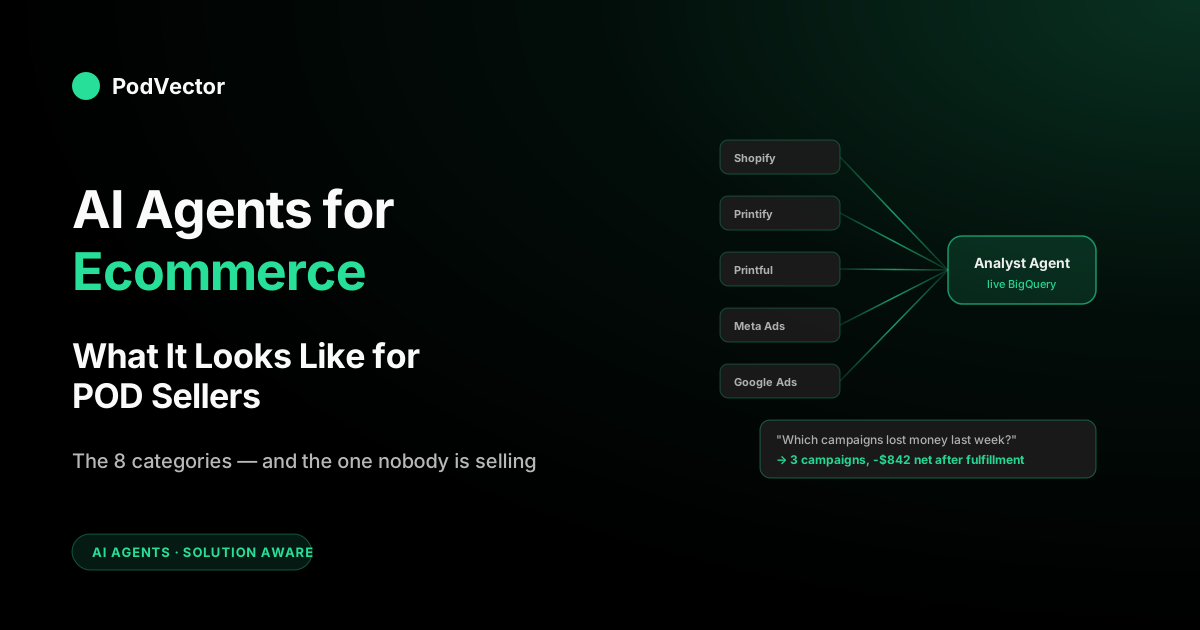
Quick Answer: An AI agent for ecommerce is autonomous software that takes a goal, reads your live store and supplier data, and either answers the question or acts on it end-to-end without a human stepping through the workflow — the line that separates an agent from a chatbot. The generic 2026 playbook covers customer support, inventory forecasting, dynamic pricing, fraud, and marketing, and a fast-rising sixth front: agentic commerce, where the shopper's own AI does the buying.
Print-on-demand sellers need one more category nobody else talks about: a POD-aware AI employee that reconciles itemized Printify and Printful costs against ad spend in real time and acts on what it finds. Without that, every other agent in your stack is making decisions on incomplete margin data.
What is an AI agent for ecommerce?
An AI agent for ecommerce is software that combines a large language model with tools and a goal. Give it a question or a job — "find every SKU losing money this week," "respond to this support ticket," "reorder anything below threshold" — and it reads the data it needs, decides what to do, and either reports back or executes. The defining trait is autonomy: an agent runs a multi-step workflow without a human walking it through each step.
Three things had to mature for ecommerce agents to work. Models got good enough at instruction-following to handle long workflows without falling off the rails.
Tool-use protocols (Anthropic's MCP, OpenAI's function calling) made it trivial to plug a model into your Shopify Admin API, your Printify API, your ad platforms. And RAG made it cheap to ground answers in your actual store data instead of model training data. The combination turned 2025 into the year ecommerce stopped buying chatbots and started buying agents.
The numbers back the shift: Deloitte's 2026 Retail Outlook found 68% of retailers plan to adopt agentic AI within the next 12–14 months, and AI-driven traffic to US retail sites jumped roughly 693% year over year over the 2025 holiday season. Gartner still projects 33% of enterprise software will include agentic AI by 2028. For independent DTC and POD merchants the adoption curve is steeper — the upside per dollar spent is larger when the operator is also the analyst, the buyer, and the support lead. BigCommerce's overview of ecommerce AI agents covers the broader category if you need a vendor-neutral primer; this guide focuses on what changes when the store is print-on-demand.
AI agent vs chatbot vs automation
These three words get used interchangeably and they shouldn't. The differences map to what you can expect the tool to do for you.
- Automation follows a fixed rule. "When a customer abandons cart, send email after 1 hour." No language model, no judgment. Klaviyo flows are automation.
- A chatbot uses a model to handle conversation. It can answer in natural language and pull data via RAG, but its job is dialog. An AI chatbot for ecommerce is built around a chat UI; the agent layer underneath is usually shallow.
- An agent uses a model to take actions toward a goal. It plans, calls tools, evaluates results, and re-plans. The interface might be chat, might be a dashboard, might be a Slack message — but the surface is incidental. The capability is decisions and actions.
The agentic line is "can it do something without me telling it the next step." A chatbot that answers "where's my order" is conversational; an agent that detects a delayed shipment, drafts the apology email, applies a 15% discount, and updates the customer record is agentic. Most of the platforms marketed as "AI agents" in 2026 are still chatbots with a thin agent layer; the genuinely agentic ones are easy to spot because they advertise the actions they take, not the questions they answer.
Agentic commerce: when the shopper's AI does the buying
The fastest-moving story on the 2026 SERP isn't merchant-side agents — it's the consumer side. "Agentic commerce" is the shift where the buyer delegates shopping to an AI agent: ChatGPT, Gemini, or a Perplexity-style assistant that searches, compares, and increasingly checks out on the shopper's behalf. AI-driven traffic to US retail sites jumped roughly 693% year over year over the 2025 holiday season, and platforms like Salesforce and BigCommerce now frame this as the next structural change in how people buy.
What it means for a POD store: your product gets evaluated by a machine before a human ever sees it. The shopping agent reads your structured data — title, description, variant attributes, price, shipping estimate, reviews — and decides whether to surface you at all. Thin product feeds, missing variant detail, and vague shipping windows that a human shopper would forgive get you filtered out by an agent comparing twenty options in a second.
The defensive moves are unglamorous and concrete: clean structured product data, accurate per-variant shipping estimates (the same non-deterministic production-time problem that trips up support agents), and enough review volume to clear an agent's trust threshold. None of this is POD-exclusive, but the thin-margin, variable-shipping reality of print-on-demand makes the data-quality bar harder to clear than it is for a warehoused DTC brand. The merchant-side agents below are how you stay profitable while it happens.
The 8 agent categories ecommerce sellers actually buy
Across the 2026 SERP these are the categories that show up in every "best AI agents for ecommerce" roundup. We've ordered them by how relevant they are to a typical $10k–$500k MRR POD store on Shopify.
1. Customer service agents
The largest category by spend. Tools like Fin, Gorgias AI Agent, and Intercom Fin handle WISMO ("where is my order"), returns, sizing questions, and tier-1 product questions.
Top performers report 60–80% deflection rates and sub-30-second median resolution. For POD specifically, the agent has to understand that "in stock" isn't a binary, that production time and shipping time are separate, and that misprints aren't returns — they're replacements. Generic ecommerce support agents miss those nuances and frustrate customers.
2. Cart recovery and checkout agents
An agent that detects abandonment, decides whether to message, picks the right channel (chat, email, SMS), and pre-authorizes a discount within margin tolerance. POD-aware versions know your per-SKU profit and only offer discounts on SKUs that can absorb them. The naive version blows your margin on a $4-profit shirt by handing out 20% off.
3. Product recommendation and personalization agents
Real-time browsing-behavior to suggested-products. The good ones blend collaborative filtering with margin awareness — they prefer to recommend high-margin SKUs you actually want to sell, not just the most-viewed ones. Klaviyo's AI features, Octane AI, and Rebuy fit here for POD stores.
4. Inventory forecasting agents
For traditional ecommerce this is huge. For POD, it's narrower: you're not holding inventory, so the question is "which designs to push more ad spend behind based on conversion velocity" rather than "how many units to order." The agent layer is the same — predictive demand modeling — but the action it takes is bidding more on Meta, not reordering from a supplier.
5. Dynamic pricing agents
Agents that adjust prices in response to competitor moves, time-of-day demand, or stock pressure. For POD, dynamic pricing has a hidden constraint: your floor is your supplier cost plus shipping plus an attribution buffer.
An agent that drops price without modeling that floor will quietly turn a profitable hour into a loss-making one. Most POD sellers don't run dynamic pricing for exactly this reason.
6. Marketing and ad-creative agents
Agents that draft ad copy, generate variants, manage bids, and rotate creatives. Meta's Advantage+ suite is the most-used; Pencil, AdCreative.ai, and Smartly sit on top of it. For POD, ad agents need to know your real per-SKU profit to optimize against true ROAS rather than vanity ROAS — which loops back to the analytics agent problem (see below).
7. Fraud detection agents
Signifyd, NoFraud, and Shopify's built-in fraud analysis. Less pressing for POD because chargebacks usually trace back to a misprint complaint rather than an actual fraud event, but worth having on if your ASP is above $50 and you ship internationally.
8. Analytics and profit agents
The category most under-served in the 2026 roundups, and the one that matters most for POD. Agents that take a question — "which campaigns lost money last week after fulfillment costs," "what's my actual margin on this design across both Printify and Printful" — and answer from live store + supplier + ad-platform data. PodVector AI's Victor is the POD-specific AI employee here — it acts on the answer, not just a dashboard you read. The Complete Guide to AI Agents for Ecommerce Analytics goes deep on this category, including Triple Whale Moby and Polar AI for non-POD stores.
Why POD breaks the generic agent playbook
Almost every "AI agents for ecommerce" guide online assumes a few things that are false for print-on-demand. If you adopt the playbook unmodified, you'll waste budget on agents tuned for the wrong constraints.
Cost data lives outside Shopify
For traditional ecommerce, COGS sits in the platform. You bought 500 units at $4.20 each, the cost-per-unit is on the product.
For POD, COGS is a function of which supplier produced this order, which base provider, and which color/size variant. None of that data is in Shopify by default. Tracking COGS for Shopify POD covers the wiring problem; the upshot is that any agent that doesn't know per-order supplier cost is making decisions on phantom margin.
Margins are thin and variable
A typical POD net margin runs 5–15% after ad spend. That's small enough that an agent making one wrong autonomous discount decision can erase a day's profit.
Compare to a $50-cost-of-goods, $200-retail product — agents have room to be wrong. POD agents have to be precise, especially the ones that take actions on margin (cart recovery, dynamic pricing, marketing optimization).
Shipping windows are non-deterministic
Production time at Printify or Printful varies by base provider, by region, by day of the week. A customer-service agent that quotes "5–7 business days" is wrong half the time. The agents that work for POD have an integration layer that pulls the live production estimate per variant, then adds the shipping zone for the customer's address.
The fulfillment supplier is a separate system
Printify and Printful are not Shopify. Their information — order status, production stage, shipping carrier, claims — lives on their own sites, not yours. A helper that only looks inside Shopify is missing half the picture. Victor also checks Printify and Printful directly, then brings both sides together so your answer is actually complete.
Returns are mostly replacements
Generic ecommerce return-handling agents start by validating the item and generating a return label. POD agents start by asking "is this a quality issue or buyer's remorse" — because the first triggers a free replacement (no return shipped), the second triggers a refund or store credit. Wiring the agent to the supplier's claims API matters more than wiring it to a 3PL return system you don't have.
The missing category: the AI employee for POD agent
The 2026 roundups all cover support, inventory, pricing, fraud, and marketing agents. None of them cover the AI employee — the one that sits in your back office and answers business questions on demand. For POD, this is the highest-leverage agent you can deploy, because the questions are the ones you'd otherwise spend hours answering manually in spreadsheets.
What it looks like in practice. You ask, in plain English: "Which Meta campaigns lost money last week after Printify costs and shipping?" Victor looks at your Shopify orders, your Printify product costs, and your Meta ad spend together, and gives you a clear answer: which campaigns lost money, how much, and why.
No clicking through a dashboard. No typing code. No waiting for Monday's report.
That workflow is what Victor — PodVector AI's AI employee — is built for. The differentiator versus a generic AI dashboard is that Victor pulls itemized fulfillment costs from Printify and Printful per line item (not just an estimated COGS), then reconciles them against attributed ad spend in real time. The result is a profit number you can actually act on, broken down per campaign, per SKU, per design, per supplier.
The reason this is its own category and not a feature of an existing platform: every general "AI for ecommerce" tool treats your product cost as one fixed number. That doesn't work for print-on-demand, where supplier costs can change. Victor is built to know your real Printify, Printful and Gelato costs from the start, not guess at them.
What a working POD agent stack looks like
A realistic 2026 agent stack for a $20k–$200k/month Shopify POD store, listed in priority order:
- Customer-facing chatbot/agent — Tidio, Gorgias AI Agent, or Octane AI. Handles WISMO, sizing, variant questions, post-purchase support. Target: 60–80% ticket deflection.
- AI employee agent — Victor (POD-specific) or a stitched-together combination of Triple Whale + a custom dashboard. Answers profit and attribution questions. Target: replaces the weekly spreadsheet work.
- Cart-recovery agent — built into the chatbot platform usually, sometimes a separate Klaviyo flow with AI personalization. Target: 5–10% recovered cart revenue.
- Recommendation agent — Rebuy, Klaviyo AI, or your chatbot's recommendation engine. Target: 8–15% AOV lift on engaged sessions.
- Ad-creative agent — Meta Advantage+ at minimum, AdCreative.ai or Pencil if you're scaling creative volume. Target: faster creative iteration, not lower CAC.
- (Optional) Fraud agent — Signifyd or Shopify's built-in if your ASP is above $50.
What's not on this list and probably shouldn't be: dynamic pricing agents (margin-too-thin problem), inventory forecasting agents (POD doesn't hold inventory), and most of the "all-in-one" agentic suites that promise to do everything — they're shallow on the POD-specific bits that matter.
The employee roadmap — answers your questions and acts on them with approval
The interesting question in 2026 isn't "which agent should I buy" — it's "where's the agent autonomy line going to move next." Today's AI employee for POD agent answers questions. Tomorrow's takes actions on what it finds.
The roadmap, generically, looks like this:
- Today. Agent reads data, answers questions, surfaces problems. Operator decides what to do.
- Next. Agent recommends specific actions ("pause this campaign — it lost $340 last week after fulfillment cost"). Operator approves or denies.
- Next-next. Agent takes actions in pre-authorized lanes ("automatically pause any Meta campaign with sustained negative net-margin ROAS for 3+ days"). Operator reviews after the fact.
- Eventually. Agent runs the full ad-buying loop autonomously within margin and budget constraints, escalating only edge cases.
That's the trajectory Victor and the rest of the AI-employee category are moving along. The pace is gated by trust, not capability — operators want a few months of "agent answered correctly" before they hand it the keys to the ad account. The platforms that win here will be the ones that build the trust layer (auditable decisions, clear undo, conservative defaults) as carefully as the action layer.
How to choose an AI agent for a POD store
Six questions to ask any AI agent vendor before signing a contract. They cut through the marketing copy fast.
- Does it integrate directly with Printify and Printful? Not "you can build it yourself with our API." Direct, supported, maintained integrations. If the answer is "no" or "via Zapier" the agent is going to be wrong on POD-specific data.
- Does it model per-order supplier cost or just a static product COGS? Per-order is right. Static COGS is wrong for POD because the cost varies by base provider.
- What actions can it take versus just answer questions? Get a specific list. "It's agentic" means nothing. "It can pause an underperforming Meta campaign" means something.
- How does it handle ambiguity or low confidence? Good agents flag uncertainty and escalate. Bad agents confidently hallucinate.
- What's the audit trail look like? Every action the agent takes should be logged with the data it acted on and the reasoning. If the vendor can't show you the audit log, the agent is a black box you can't trust with autonomous decisions.
- What's the off-ramp? If you cancel, do you keep your historical data, your custom workflows, your integrations? If the answer is "everything resets," factor in the lock-in cost.
One more, specifically for POD: ask whether the agent treats Printify and Printful as first-class data sources or as generic third-party APIs. The difference shows up in how granular the cost reporting is and whether the agent understands fulfillment-specific concepts like base provider, production region, and claims workflows. Printify costs and fees and Printful costs and fees cover the cost structures the agent needs to model.
Common mistakes POD sellers make
- Buying horizontal agents and assuming they'll handle POD. Most "AI agent for ecommerce" tools are built for traditional inventoried DTC. The POD edge cases are the ones that determine whether the agent is helpful or harmful.
- Skipping the AI employee because it's not in the roundup articles. Customer-facing agents get all the coverage; AI employees are where the operating leverage actually is for a 1–3 person POD team.
- Letting agents act autonomously before they've earned trust. Run any new agent in "recommend, don't act" mode for 30+ days. The cost of an agent making a wrong decision in your ad account is much larger than the cost of you clicking "approve" on its recommendations.
- Not tracking agent ROI separately. Each agent in your stack has a separate cost and a separate impact. Lump them together and you can't tell which one to renew. Track each one's contribution against a baseline.
- Confusing chatbot ROI with AI employee ROI. Chatbots win on deflection and conversion lift. AI employees win on operator hours saved and decisions improved. Don't grade the AI employee on chat metrics or vice versa.
FAQs
What's the difference between an AI agent and an AI chatbot?
A chatbot has a conversational UI and primarily handles dialog. An agent has tools and a goal — it can take actions, run multi-step workflows, and operate without a human in the loop. Modern chatbots are increasingly agentic, but in 2026 the distinction still matters for POD: the customer-facing chatbot and the AI employee are different categories with different vendors. More on the chatbot side here.
Do AI agents actually work for small POD stores?
Yes, with caveats. Customer-service agents pay back at any volume above ~50 tickets/month.
AI employees pay back the moment they replace a recurring spreadsheet workflow — typically as soon as you're spending more than 2 hours/week on profit reporting. Cart-recovery and recommendation agents need more traffic to show signal — usually $20k+ MRR before the lift is measurable.
Can ChatGPT or Claude be my ecommerce agent directly?
Not really. The model is the cheap part.
The hard parts are the integrations to Shopify, Printify, Printful, your ad platforms, and your support stack — plus the orchestration logic that ties them together, the auth, the rate-limit handling, and the audit logging. You can prototype an agent in a weekend with the OpenAI or Anthropic API. Operating one in production for a real POD business is months of work or a vendor purchase.
How much does an AI agent for POD cost?
Customer-service agents: $30–$1,000/month depending on conversation volume. AI employees: $50–$500/month for the POD-specialized ones (Victor sits in this band), $1,000+/month for horizontal platforms like Triple Whale.
Cart-recovery and recommendation agents are usually included in your chatbot or email tool. Ad-creative agents: $50–$300/month for self-serve, much more if you're using an agency-attached tool. Stack a sensible 4-agent setup and budget $200–$1,500/month total for a typical mid-market POD store.
Will AI agents replace my customer-support team?
Not if you're serious about CSAT. They'll deflect 60–80% of routine questions and free your team for the 20–40% that need judgment — sizing edge cases, complaint escalations, B2B inquiries. The teams that fully replace humans usually crater their CSAT inside 90 days and have to rebuild trust the hard way.
What's the right order to add agents to a POD stack?
If you're starting from zero: customer-service agent first (highest immediate ROI from ticket deflection), then the AI employee (highest ROI from operator hours saved), then cart-recovery and recommendation agents (require traffic to be useful). Add ad-creative and fraud last. Skip dynamic pricing and inventory forecasting — they don't fit the POD constraint set.
Are AI agents safe to give access to my Shopify and ad accounts?
Most reputable vendors use scoped OAuth permissions and read-only access by default, with action permissions opt-in per workflow. The risk model is the same as any SaaS integration. The agentic risk that's new is autonomous decisions — make sure the vendor has an audit log, an undo mechanism, and conservative defaults before you turn on any "act on my behalf" feature.
Does Victor work with Printify and Printful both?
Yes. Victor pulls itemized line-item costs from both Printify and Printful, plus your Shopify orders and Meta/Google Ads spend, into a single live view. The use case it nails is "show me my real net margin per SKU, per campaign, per design, with both fulfillment suppliers reconciled." That's the question every horizontal ecommerce agent gets wrong because they treat COGS as a static product attribute.
The customer chatbot answers your shoppers. Victor answers you.
You probably already have a customer-facing AI agent — or you're shopping for one. Victor is the other side: the AI employee that answers your business questions about what's profitable, what's losing money, and what to change next. He looks at your Shopify orders, your Printify and Printful costs, and your ad spend together, so you never have to open a spreadsheet.
Try Victor free