
Quick Answer: For a print-on-demand store, "AI for ecommerce business" comes down to three questions: which AI categories actually shift your P&L, how AI changes the unit economics of running the store, and what an AI-native POD operation looks like now that both shopper-side and merchant-side agents exist.
Generic guides treat AI as a marketing layer because they're written for wholesale brands. For POD, the real leverage is margin visibility and operational ceiling — not conversion-rate widgets.
The defining 2026 shift is agentic: tools moved from answering questions to taking bounded actions on your store, with your approval. This guide takes the business view — where AI changes what your store earns, what it costs to run, and how big you can grow before adding another person.
What 'AI for ecommerce business' actually means in 2026
Search "AI for ecommerce business" and you'll find a wall of feature lists: chatbots, recommendation engines, dynamic pricing, content generators, fraud detection. That framing treats AI as a stack of plugins.
It's the wrong framing for an operator trying to decide where to spend attention and money. The real question for someone running an ecommerce business is narrower: which AI capabilities change the shape of my P&L, my operating model, and my growth ceiling — and which are just noise sold at $99/month?
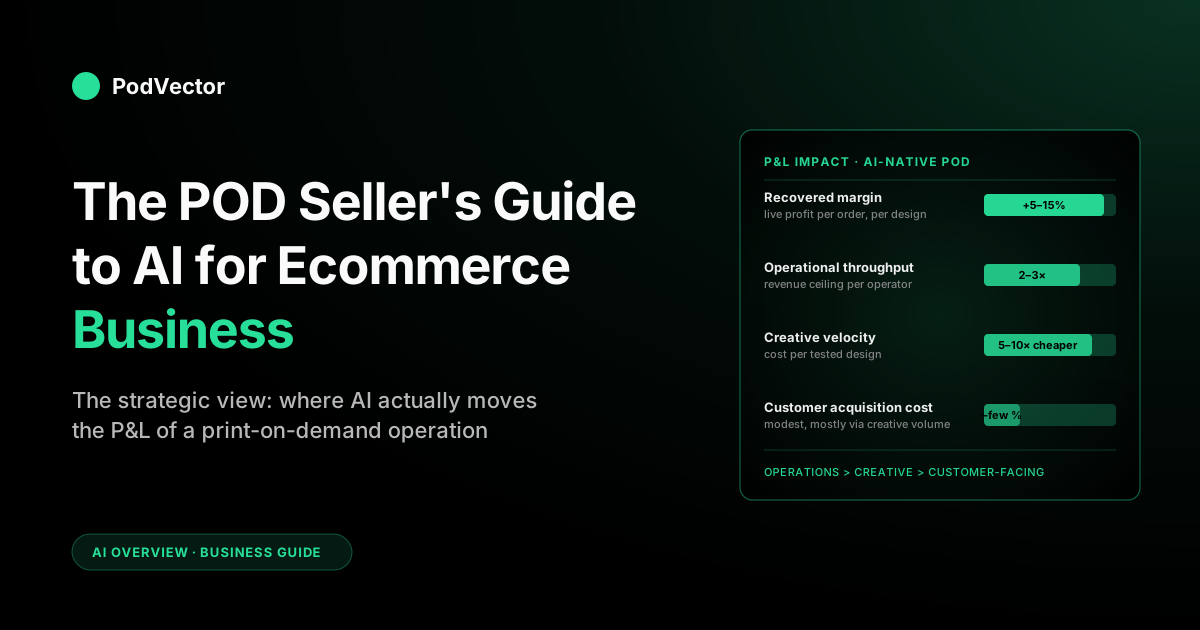
For a print-on-demand store, that question has clear answers. AI moves three numbers that matter: margin visibility (you finally know what each design and order actually earns), operational throughput (one operator runs more catalog, more campaigns, more SKUs), and creative velocity (designs, ads, and copy ship in hours instead of weeks).
AI does not, for most POD operators, move conversion rate dramatically — that's traffic-quality and creative-quality work, and AI helps the second more than the first. Knowing that distinction up front saves thousands of dollars in misdirected SaaS spend.
The rest of this guide treats AI for ecommerce as a business decision rather than a feature inventory. It's organized around the four questions a POD operator should be asking: what shifts in my unit economics, what shifts in how I work day-to-day, what shifts in how big I can get with one or two people, and what shifts in the next 12–24 months as agents replace dashboards.
How AI for ecommerce business changed between 2023 and 2026
Three shifts matter to POD operators specifically:
- The agentic shift. AI moved from "answer questions about your store" to "take bounded actions on your store" — pause underperforming campaigns, flag margin anomalies, draft customer responses, route orders between suppliers. The vendors building toward that future are the ones worth subscribing to. The vendors still pitching better dashboards in 2026 are aiming at where the puck was.
- The numbers behind the scenes got better. AI tools used to give bad advice because they were looking at bad numbers — costs typed in by hand, missing shipping charges, sales linked to the wrong ad. The newest tools fix the numbers first, then let AI use them. That's the difference between "AI advice you don't trust" and "AI advice you act on."
- Discovery shifted toward LLM-mediated search. A growing share of product research happens through ChatGPT, Gemini, Perplexity, and shopping agents instead of Google. Your product titles, descriptions, and structured data are now being read by language models, not just human shoppers. Optimizing for that audience (sometimes called GEO — generative engine optimization) is becoming a real line item.
The first shift changes what you buy. The second changes how you set it up. The third changes what your content needs to look like. All three have business consequences for a POD operation, not just feature consequences.
Why the generic AI-for-ecommerce framing breaks for POD
Walk through any of the major guides — Shopify's AI in ecommerce overview, BigCommerce's transformation guide, the major SaaS roundups — and you'll notice the use cases assume a wholesale-style business model. They talk about inventory forecasting (you hold inventory), warehouse optimization (you have a warehouse), demand planning across SKU counts in the dozens (you have dozens of SKUs). POD breaks every one of those assumptions.
You don't hold inventory, so 'inventory AI' is mostly irrelevant
The biggest section of any generic ecommerce-AI guide is inventory and demand forecasting. For POD that section is mostly noise — you don't have inventory to forecast. What you have is design demand, supplier capacity, and shipping lanes. AI tools that map onto those concepts are useful; tools that ask you for "current stock levels" don't translate.
Your COGS is per-order, not per-SKU
Generic AI ecommerce tools assume you set a unit cost when you onboard. POD doesn't work that way: a Printify hoodie shipped from the Midwest to Oregon costs different from the same hoodie shipped to New Jersey, and the supplier invoice is the only source of truth.
AI analytics that read those itemized line items via API give you real margin numbers. AI analytics that ask you to type in a COGS estimate give you a guess dressed up as data. The difference compounds over a year of decisions.
Design is the SKU
A wholesale brand has 50 SKUs. A working POD store has hundreds or thousands of designs, each applied across product types and colors.
That combinatorial volume is where AI's leverage actually lives for POD: a profit question like "which 12 designs are losing money after fulfillment and ad spend" is unanswerable in a spreadsheet but trivial for an AI analytics agent reading live data. For the operations layer in detail, see the complete guide to AI analytics for print-on-demand.
You usually run two suppliers, not one
Most POD operators run both Printify and Printful, or they're considering the tradeoff. Routing products between the two by geography, product type, or margin target is a real lever. Generic ecommerce AI doesn't model multiple fulfillment networks. POD-aware AI does. (Background: Printify alternatives compared and the complete Printful review.)
Margins are tighter, so attribution math has to be tighter
A 4x ROAS that's profitable for a wholesale brand can be a loser for a POD seller after supplier costs, Shopify fees, and payment processing. Generic AI tools report ROAS as revenue ÷ spend.
POD-appropriate AI reports contribution margin: revenue minus all four cost layers. That's not a feature difference — it's a category difference. Tools that don't reconcile all four are reporting vanity numbers.
How AI changes the unit economics of a POD business
The interesting question for any operator isn't "do AI tools work" — it's "where do they show up in the financial statements." For POD specifically, AI moves four lines:
1. Recovered margin (the biggest line)
The single largest impact of AI on a POD P&L is margin you didn't know you were leaking. Designs that look profitable in Shopify's dashboard but are net-negative once Printify fulfillment, shipping, ads, and fees are factored in.
Campaigns running at "great ROAS" that are quietly underwater on contribution margin. Routing decisions that send a product to the more expensive supplier when the cheaper one would have produced an identical end result.
AI analytics that read all four cost layers surface these in days. Operators commonly recover 5–15% of revenue as margin in the first 90 days after switching from manual or generic dashboards to POD-aware AI analytics. For a deeper look, the complete Meta Ads ROAS and attribution guide for POD walks through the math.
2. Reduced operational time per dollar of revenue
The second-largest effect is on the implicit hourly cost of running the store. A POD operator without AI spends meaningful time on dashboard maintenance, weekly P&L reconstruction, campaign monitoring, and ad-hoc spreadsheet analysis.
An operator with AI analytics spends that time on creative, audience research, and supplier negotiation — the levers that grow the business. The shift isn't measured in dollars saved; it's measured in revenue ceiling raised. A solo operator who can run more SKUs and more campaigns can profitably reach a higher revenue floor before having to hire.
3. Creative cost per design
Generative design (Midjourney, DALL-E, Firefly) and AI copywriting tools have collapsed the cost of producing a polished design from "a freelancer day" to "an afternoon of prompting." For POD specifically, that's a unit-economics shift: each design is the SKU, and cheaper SKUs let you test more themes and find more winners. The cost-per-tested-design fell roughly 5–10x between 2023 and 2026, and operators who haven't restructured their creative process to take advantage are competing against ones who have.
4. Customer acquisition cost (modest effect)
The smallest effect, despite getting the most marketing attention, is on conversion rate from AI storefront features. Personalized recommendations, AI search, and on-site chat help — but a well-designed POD storefront's conversion rate is usually capped by traffic quality, not by recommendation engines.
Storefront AI is worth setting up; expect a few percentage points of lift, not a transformation. Where AI does meaningfully change CAC is upstream, in ad creative volume — more variants, faster, means more learning per ad-spend dollar.
Three categories of AI, three different P&L effects
Every "AI for ecommerce business" feature falls into one of three buckets. Each has a different ROI curve for POD.
Operations AI (highest ROI for POD)
Profit intelligence, anomaly detection, supplier-cost reconciliation, attribution, fraud screening. The value lever is margin — finding money that would otherwise leak.
POD's per-order variable costs and design-level catalog complexity make this the highest-leverage category. If you're picking one to invest in first, pick operations. The category overview lives in the complete guide to AI agents for ecommerce analytics; comparison shopping in best AI agents for ecommerce 2026 compared.
Creative AI (high ROI, productivity multiplier)
Design generators, ad creative tools, copywriting assistants, video tools. The value lever is speed — more SKUs and ad variants tested per unit of time and money.
POD is uniquely well-positioned to benefit because the product is the creative. Most operators who have been at it more than a year find creative AI is the second category to expand into, after operations.
Customer-facing AI (lower ROI for most POD stores)
On-site chat agents, AI search, personalized recommendations, conversational shopping. The value lever is conversion rate. Useful, table-stakes on Shopify, but rarely transformational for POD specifically. Worth the basic Shopify-native setup; usually not worth specialized add-ons until traffic volume crosses a threshold. For the chatbot category specifically, see best AI chatbot for ecommerce compared.
Generic ecommerce content emphasizes category three because that's what storefront brands ask for help with. POD operators reading this should weight categories one and two much higher.
What an AI-native POD operating model looks like
The shift from "POD store with some AI tools bolted on" to "AI-native POD business" is mostly about operating habits. Three changes:
Decisions get made against live data, not weekly dashboards
The traditional POD operating cadence is weekly: pull a sales export, reconcile against a supplier invoice, check ROAS in the ad platform, eyeball Shopify's dashboard, decide what to scale. The AI-native version compresses that loop to "ask a question about live data, get an answer, decide." Shipping decisions in hours instead of in batches at the end of a reporting week makes a tangible difference in what gets paused, scaled, or relaunched. For the conversational query layer, the POD seller's guide to ChatGPT for Shopify covers the conversational query-and-act pattern.
Creative production runs as a pipeline, not a project
A traditional POD designer batches: spend a week generating designs, a week mocking them up, a week testing in ads. The AI-native pattern runs creative as a continuous pipeline: prompts produce designs daily, AI mockup tools render them onto products, ad-creative tools spin variants, all feeding into the testing budget on a rolling basis. The bottleneck moves from "production capacity" to "judgment about what to test next."
Operational rules graduate to bounded autonomous actions
The most advanced operating shift, and the one most operators haven't made yet: rules that you used to enforce manually ("pause this campaign if true ROAS drops below 2.0 for 3 days") become bounded actions that an agent runs on your behalf, with a notification trail you can audit. This is where the agentic shift shows up in your day-to-day. It's discussed in detail in agentic AI for ecommerce: what it looks like for POD sellers.
The agentic shift — and what it means for your business
The defining trend in AI for ecommerce business in 2026 isn't smarter chatbots. It's agents — AI systems that take bounded actions on your behalf rather than just answering questions. Two sides matter for POD.
Shopper-side agents change how products get discovered
Shoppers are starting to delegate purchase research to AI agents. "Find me a custom t-shirt for someone who runs trail marathons, under $30, delivered by Friday." The agent searches, evaluates, and either presents options or completes checkout directly. The shift is real, even if it's still early: your product titles, descriptions, structured data, and reviews are now being read by language models, not just human shoppers.
This is what the major platforms now call agentic commerce, and the forecasts are not small. Industry estimates put agent-driven retail in the hundreds of billions by 2030, and Gartner expects traditional search traffic to fall meaningfully by 2028 as buyers ask assistants instead. Agentic checkout — where the agent completes the purchase, not just the research — is the part that reaches your store directly.
For a POD seller this changes the SEO and content layer. Generic product descriptions that sound machine-generated get filtered out by both human shoppers and AI agents.
Specific, niche-relevant copy that explains who the design is for, what the fit is like, and what materials it's printed on wins on both sides. This is where creative AI and content AI converge with discovery strategy.
Merchant-side agents change how the store is operated
On the merchant side, agents are starting to take operational actions on your store: pausing a Meta campaign that's underwater on true ROAS, flagging a supplier cost spike on a specific routing lane, drafting and sending the weekly P&L summary, responding to routine customer service tickets, suggesting (or executing) supplier-routing changes. The pattern is "read live data, reason about it, take a bounded action, report back." This is what Victor is built for: he answers profit questions in natural language against live data and takes bounded actions like pausing ad sets and re-routing fulfillment — all on the same architecture, with your approval.
Why this matters for the business question
If you're choosing AI tools as a business decision in 2026, the question to ask every vendor isn't "what does it do today" — it's "what is it on track to do autonomously, and how does the architecture enforce that the agent acts within bounds you set." Vendors with a credible answer are building the next generation of operating system for ecommerce. Vendors without one are selling features that will be commodity within 18 months. The strategic move is to align with vendors building toward agency, not vendors selling dashboards.
ROI: when AI for ecommerce pays back, when it doesn't
AI for ecommerce business pays back when three conditions are met:
1. Your data is clean enough for AI to read
The single most common reason AI tools "don't work" for print-on-demand sellers is that the numbers they're using are wrong. Costs typed in by hand, missing supplier costs, sales linked to the wrong ad, no direct connection to Printify or Printful. The AI is fine. The numbers are the problem. Fix the numbers first; the payoff from AI follows on its own.
2. The category matches your bottleneck
If your bottleneck is creative production, customer-facing AI won't help. If your bottleneck is margin visibility, creative AI won't help.
Match the category to the bottleneck. Most POD operators under $500K/year have a bottleneck on either operations (don't know real margin) or creative (can't test fast enough). Buying tools outside those two categories first is misallocated.
3. You commit to running the new operating loop
AI tools deliver ROI when the operator changes how they work to use them. An AI analytics tool sitting in a tab you forget to open is the same as no tool.
Operators who structure their week around "ask the agent first, then act" capture the value. Operators who layer the tool on top of the old workflow capture less.
When all three conditions are met, ROI for operations AI is typically realized within 30–60 days (margin recovered exceeds subscription multiple times over). Creative AI ROI shows up faster — usually within the first design batch. Customer-facing AI ROI is the slowest and smallest of the three.
A 90-day plan to make your POD store AI-native
The pattern that works, ordered by sequence and dependency:
Days 1–14: Establish a real profit baseline
Before any AI tool can help, you need to know what your margin actually is — not Shopify's number, not a manual COGS estimate, but the real per-order, per-design contribution margin after supplier cost, ad spend, Shopify fees, and payment processing. Connect Shopify orders, Printify and Printful API for itemized fulfillment costs, and ad-platform spend.
The guide to AI analytics for POD walks through the setup. This step is non-negotiable; without it, every "AI insight" downstream is calibrated against a wrong starting number.
Days 15–30: Layer in operations AI
Pick a POD-aware AI analytics tool that reads your live data and answers profit questions in plain language. Test it against three questions you already know the answer to (sanity check), then start using it for the questions you didn't have answers to. Look for: design-level profitability, campaign-level true ROAS, supplier-routing comparison, anomaly detection on margin and ROAS.
Days 31–60: Restructure creative as a pipeline
Move creative production from project-based to pipeline-based. Set up a generative design workflow (Midjourney or equivalent), an AI copy workflow for product descriptions and ad copy, and an AI ad-creative tool if you run Meta or TikTok at scale. Aim to ship 3x the design tests you ran in your last batch period.
Days 61–90: Add bounded automations and one agentic action
Once data and creative are humming, layer in automations that require approval (pause-campaign rules, design-level ROAS alerts, supplier-routing suggestions). Pick one bounded action — usually "pause campaigns that hit a specific true-ROAS floor" — and let an agent run it autonomously with a notification trail.
Expand from there one action at a time. Don't auto-approve anything in the first 60 days.
Mistakes POD operators make adopting AI as a business strategy
Treating AI as a feature menu, not an operating-model shift
Subscribing to six AI tools without changing how you work is the most common failure mode. The tools sit in tabs you don't open. The way to capture value is to redesign the weekly operating cadence around AI-mediated questions and actions, not to bolt features onto the old cadence.
Buying customer-facing AI before operations AI
The marketing for AI ecommerce features pushes customer-facing tools (chat, recommendations) hardest because that's where storefront brands want help. POD operators who follow the marketing end up with the lowest-ROI category as their first investment. Operations AI is the higher-leverage starting point for almost every POD store.
Picking generic ecommerce AI for a POD operation
If a tool's onboarding asks for a manual COGS field, doesn't pull from Printify or Printful APIs, and doesn't model multi-supplier routing, it's a wholesale tool you're using by analogy. The numbers it shows you will be wrong in ways that compound. Verify POD specificity directly with the vendor or pick a purpose-built option.
Skipping the agentic question
In 2026, every AI vendor pitch should be evaluated on what it's on roadmap to do autonomously, not just what it answers today. Tools without an agent roadmap are pitching the 2024 product at 2026 prices. The strategic move is to align with the vendors building toward bounded autonomous action.
Underinvesting in creative volume after switching to AI
A common pattern: operator switches to generative design tools, ships exactly the same number of designs per month as before, and concludes "AI didn't help." The capacity went up. If the test budget didn't, the lift didn't materialize. Expand creative testing in proportion to the new production capacity.
Trusting AI outputs without an audit loop
AI models can get things wrong. A tool that turns your question into a search of your store's numbers can search for the wrong thing.
A design generator can produce something that violates a license. Build sample audits into your weekly cadence: spot-check the AI's answer against source data, flag discrepancies, escalate. Rigorous vendors handle this at the platform level (parameter-bound queries, tenant-isolated execution); light-touch vendors leave it to you.
FAQs
What does 'AI for ecommerce business' mean for a POD seller specifically?
It means three things, ranked by impact: AI that gives you real margin visibility on every order, design, and campaign (operations AI); AI that compresses how long it takes to design, mock up, and test new product ideas (creative AI); and AI that helps shoppers find and evaluate your products (customer-facing AI). For a POD operation, the first two move the P&L significantly. The third is helpful but rarely transformational.
Is AI worth it for a POD store doing under $10K/month?
Yes, in the operations and creative categories. Margin visibility at small scale changes what designs you scale, which compounds over the next year.
Creative AI shrinks the cost of testing new design themes, which is the single biggest growth lever for stores at that revenue level. Skip customer-facing AI until traffic volume crosses a threshold where the conversion-rate math justifies the setup.
How is AI for ecommerce business different from AI marketing tools?
AI marketing tools focus on top-of-funnel and storefront work: ad creative, copy, on-site chat, recommendations. AI for ecommerce business is broader — it includes operations, attribution, supplier cost analysis, fraud, and inventory (where applicable). Marketing AI is a subset; the business framing covers the full P&L.
Will AI replace POD sellers?
Not anytime soon. AI is excellent at pattern recognition, data reconciliation, and execution within bounded rules.
It's weak at taste, niche instinct, design direction, and audience-building — the things that determine which POD niches actually win. What AI does is reduce the operational overhead of running a POD store, which means one operator can profitably run more store. The leverage expands; the operator stays.
What's the minimum viable AI stack for a POD business in 2026?
Three components: a POD-aware AI analytics tool that reads itemized supplier costs (operations layer), a generative design tool plus an LLM for copy (creative layer), and Shopify's built-in AI features for storefront basics. Total subscription cost typically lands under $200/month for stores doing under $500K/year. Expanding beyond that should follow specific bottlenecks, not category completeness.
How do I know if an AI tool actually understands my POD business?
Ask it one question during the demo: does it pull in the real cost of each order from Printify and Printful automatically, or does it ask you to type in a cost number yourself? If it's the second one, it's a generic ecommerce tool you're stretching to fit print-on-demand.
The answer to that one question filters the category fast. The same logic applies to other POD-specific signals: does it model two suppliers, does it reconcile Shopify fees and payment processing into contribution margin, does it understand design-level (not store-level) profitability.
Where is AI for ecommerce business heading in the next 24 months?
Toward agents. The category trajectory is from "AI that answers your questions" (the 2024 generation) to "AI that takes bounded actions on your behalf" (the 2026–2028 generation).
Shopper-side, agents will increasingly research and complete purchases on behalf of customers — meaning your product content needs to be readable by language models, not just humans. Merchant-side, agents will absorb operational overhead like campaign monitoring, supplier routing, and customer service.
Vendors without a credible agent roadmap will be commoditized. The strategic move is to align with vendors building toward agency.
Do I need technical skills to run an AI-native POD business?
No. The useful tools for POD operators are built for operators, not engineers. You connect your Shopify, Printify or Printful, and ad platform accounts; you ask questions in plain English; you read the answers.
The only time you'd need technical skill is if you decide to build your own custom system to track everything, which most print-on-demand stores under $2M a year don't need. Start with tools built for this job; only consider building your own if you outgrow what they can do.
What's the single highest-leverage AI investment for a POD business?
Victor pulls in your real Printify and Printful costs and matches them up with your Shopify orders and ad spend, so you always know your true profit — then, with your approval, he can act on it. That's what unlocks the decisions that compound: which designs to scale, which to kill, which campaigns to fund and which to pause. All of them depend on accurate profit numbers that generic tools don't give you, so without this, every other AI tool is working off the wrong numbers.
Hand off your POD ops to an AI employee
Victor runs your Meta and Google ads, updates your Shopify catalog, and routes Printify and Printful fulfillment — asking for your approval before each material action.
He works off your live data: itemized supplier costs reconciled against orders, ad spend, and fees, so the contribution-margin math is right before he acts. Built for POD operators specifically — no manual COGS, no DTC-tool-by-analogy.
Try Victor free