
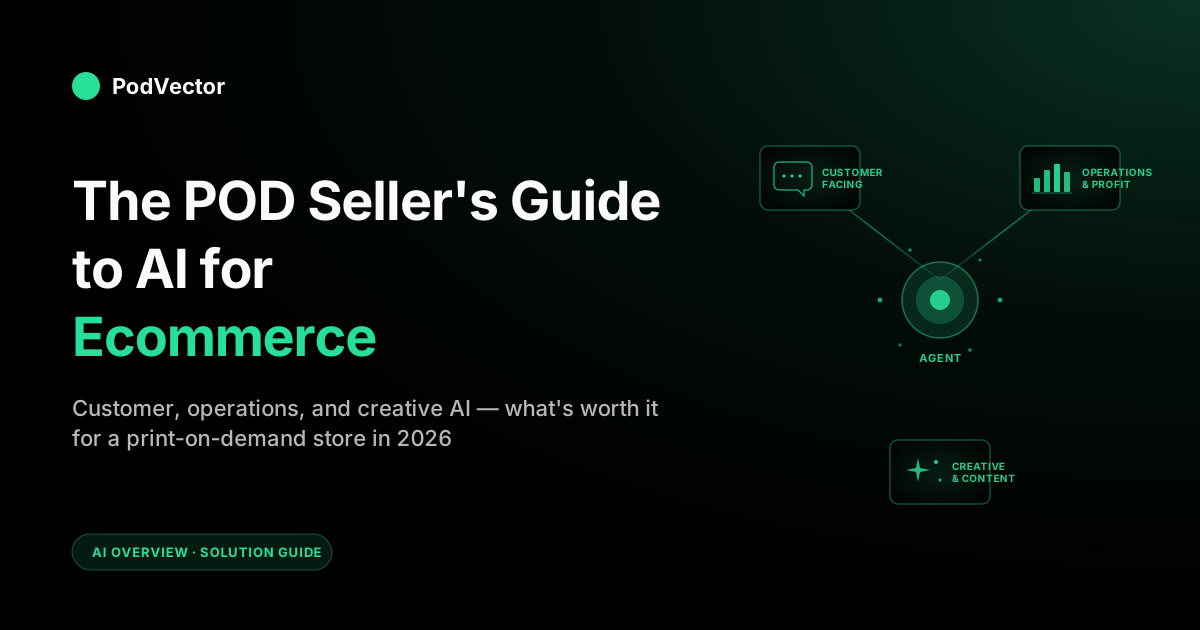
Quick Answer: "AI for ecommerce" is software that uses machine learning and large language models to run jobs that used to need human attention — recommending products, generating descriptions and ads, detecting fraud, forecasting demand, and increasingly taking actions on a store's behalf. For POD sellers it breaks into three useful buckets: customer-facing AI (chat, recommendations, visual search, retention), operations AI (profit tracking, pricing, inventory, fraud), and creative AI (designs, copy, ads). The generic guides lump these together because they're written for storefront brands with fixed COGS.
POD sellers have per-order variable costs, design-as-SKU economics, and a supplier routing layer, so the same AI features have very different ROI. This guide walks through what actually earns back the subscription cost on a print-on-demand store in 2026 — and where the category is heading as "agentic commerce" takes over from chatbots.
What AI for ecommerce means in 2026
"AI for ecommerce" used to mean one of two things: a product recommendation widget on the storefront, or a chatbot answering shipping questions. In 2026 it means something much bigger.
It means large language models that read your product catalog and write descriptions. Computer vision that turns a customer's phone photo into a shoppable lookalike.
Agents that research and compare options on a shopper's behalf. Analytics agents that watch your numbers in real time and flag what a human dashboard misses. Creative tools that produce a hundred ad variants in minutes.
The market has roughly doubled since 2024, with most estimates putting ecommerce AI spend somewhere between $8B and $10B globally and projected to hit the tens of billions well before 2030. The bigger number that gets cited now is downstream of it: McKinsey estimates agentic commerce — AI agents researching and buying on shoppers' behalf — could orchestrate on the order of $1 trillion in US B2C retail revenue by 2030. That growth is not uniform: a handful of high-leverage use cases are absorbing most of the budget, while a long tail of "AI-washed" features produce marginal value. The job of any seller — POD or otherwise — is to figure out which bucket each feature falls into before paying for it.
For POD specifically, the stakes are sharper. POD margins are thinner than wholesale ecommerce, fulfillment costs are variable per order, and the design catalog grows faster than anyone can manually audit.
That combination means AI features either earn back their subscription in the first month by protecting margin and accelerating creative — or they sit unused in a tab you forgot about. This guide is the filter.
What changed between "AI for ecommerce" in 2022 and 2026
Four things shifted:
- Large language models moved from novelty to workflow. In 2022, GPT-style tools were toys. In 2026, they sit behind product description generators, customer service copilots, and SEO writing workflows that used to take freelancers a week.
- Agentic commerce arrived. AI agents are beginning to take actions on behalf of shoppers (research, comparison, checkout) and on behalf of merchants (campaign adjustments, inventory reorders, anomaly response). See the complete guide to AI agents for ecommerce analytics for the merchant side of that shift.
- Search behavior changed. A growing share of product discovery happens through AI answers, not traditional search results. Optimizing for generative engines (sometimes called GEO) is now a serious line item, especially for long-tail POD niches.
- Good data makes AI useful. AI is only as good as the information it can see. Stores now keep their numbers clean and connected, so an AI helper like Victor can answer real questions about your business instead of guessing.
Why POD is a different planet from "ecommerce in general"
Most articles about AI for ecommerce are written with DTC wholesale brands in mind: companies that buy inventory, hold it, and ship it from a warehouse. Print-on-demand inverts almost every assumption in that model. If you apply a generic AI-for-ecommerce playbook to a POD business, you'll either over-invest in tools that don't move your numbers, or you'll miss the one change that would have.
Your COGS is computed per order, not per SKU
A wholesale brand sets a unit cost when it orders inventory. A POD seller doesn't find out what an order cost until the supplier invoice prints, and the number varies by product, print method, garment color, shipping destination, and which supplier fulfilled it.
A Printify hoodie shipped from the Midwest to the East Coast doesn't cost the same as the identical hoodie shipped to Oregon. This single difference breaks every generic ecommerce analytics tool that assumes COGS is a number you type in a settings field.
AI tools that pull your real supplier costs from Printify or Printful for every order — not a rough average you type in — give you a profit number you can trust. Everything else is a guess. For the full breakdown of how this changes what "profitable" means, see the complete guide to AI analytics for print-on-demand.
Design is the SKU, and there are thousands of them
A wholesale brand has maybe 50 SKUs. A working POD store has hundreds or thousands of designs, each applied across a handful of product types and color options.
That combinatorial explosion means spreadsheet-scale analysis falls apart quickly. It also means "which design is eating my ad spend without returning orders" is a question you literally cannot answer without an analytics layer that reasons at the design level.
AI tools that handle this granularity earn their keep fast. Tools that only report at the store level miss the entire decision surface.
Two suppliers, different pricing, different strengths
Most POD stores run both Printify and Printful, or at least consider the tradeoff. Printful tends to win on quality and customer experience.
Printify tends to win on cost and catalog breadth. Routing products between them by geography, product type, or margin target is a legitimate optimization lever.
A generic AI tool won't know either supplier exists. A POD-native tool reads both. (Background: Printify alternatives comparison and the complete Printful review.)
Ad attribution matters more, not less
POD margins are tight enough that a 4x ROAS campaign can still be unprofitable if fulfillment costs are high. Generic ecommerce analytics compute ROAS as revenue divided by ad spend.
POD-appropriate analytics compute contribution margin: revenue minus ad spend minus itemized fulfillment cost minus Shopify fees minus payment processing. If your AI tool isn't reconciling those four data sources, it's handing you a vanity number. For the full framework, the Meta Ads ROAS and attribution guide for POD walks through the math and the setup.
The three categories of AI for ecommerce
Every feature marketed as "AI for ecommerce" falls into one of three buckets. Knowing which bucket matters, because each one has a different ROI curve for a POD store.
1. Customer-facing AI
This is what most shoppers notice: personalized product recommendations, search-bar replacements, visual search, AI chat agents, conversational shopping. Adjacent to it sits the marketing layer the big guides now group here — AI-driven email and SMS lifecycle (abandoned-cart recovery, win-backs), customer retention, and churn/lifetime-value prediction. The value lever is conversion rate, AOV, and repeat-purchase rate.
For POD stores, these features are table stakes on Shopify but rarely the biggest win; the conversion rate ceiling on a well-designed POD storefront is usually set by traffic quality and creative, not by recommendation logic. Retention AI matters more once you have a catalog repeat buyers come back to, but for most POD stores the first-order problem is still finding the next winning design. Useful, not transformational.
2. Operations AI
This is what merchants notice: analytics, profit tracking, inventory forecasting, fraud detection, dynamic pricing and revenue optimization, supplier routing. The value lever is margin — finding money that would otherwise have leaked. (One caveat on dynamic pricing: the generic guides pitch it as auto-adjusting prices against competitors and demand, which makes sense for fixed-COGS retail. On POD it's safer as a margin-floor check — "is this price still profitable after this order's fulfillment cost?" — than as an aggressive repricing engine.)
For POD, this is where the needle actually moves, because operations AI is the layer that handles per-order variable costs, multi-supplier reconciliation, and design-level profitability. If you're a POD seller picking one category to invest in first, this is it.
3. Creative AI
This is what your team notices: design generators (Midjourney, DALL-E, Firefly), copywriting tools, ad creative generators, video tools. The value lever is speed — shipping more creative variants for less cost.
POD is uniquely well-positioned to benefit here because the product is the creative: faster, cheaper designs mean more SKUs, which means more tests, which means more winners. Creative AI is a productivity multiplier for POD operators who already know what sells.
Most guides to "AI for ecommerce" focus on category 1 because that's where storefront brands want help. POD sellers should usually weight categories 2 and 3 higher. Shopify's overview of AI in ecommerce covers the generic customer-facing use cases well — the POD-specific operations layer is where this guide adds value beyond that starting point.
The 8 AI use cases that actually earn their keep for POD
Narrowing the landscape: these are the eight AI-powered capabilities that routinely pay for themselves on a working POD store. Everything else is either nice-to-have or not yet mature enough for most sellers.
1. Profit intelligence per order, per design, per campaign
An AI analytics layer that reads your Shopify orders, Printify or Printful cost lines, and Meta or Google ad spend, then answers questions like "what was my margin on Design X in April after fulfillment and ads" in real time. This is the single highest-leverage AI feature for POD sellers, because it unlocks the decisions you otherwise can't make: which designs to scale, which to kill, which campaigns to turn off. A comparison of AI tools for ecommerce data analysis walks through the category.
2. Anomaly detection on margin and ROAS
When true ROAS drops 20% in two days, or a design's return rate spikes, or supplier costs jump on a routing lane, you want to know within hours, not next week. AI monitoring watches the metrics that matter and surfaces anomalies proactively.
In a dashboard-only world, you catch these when you happen to look at the right chart. In an AI-monitored world, you get a message.
3. Natural-language queries against live store data
Instead of building a dashboard for every question you might want to ask, you just ask. "Which hoodie designs had a positive profit margin in Q1?" "Compare Printify vs Printful shipping cost on small orders to California." An AI helper like Victor can answer questions like these right away, using your own store's numbers — work that used to take a person a day.
4. AI-generated product descriptions and variants
A POD store with a thousand designs needs a thousand product descriptions, each with enough keyword specificity to rank. Done by hand, that's a quarter of work.
Done with an LLM that reads your design metadata, it's an afternoon. The tradeoff is quality control: set a prompt template that matches your brand voice, then human-review a sample every batch.
5. AI-driven ad creative generation
Static image ads, lifestyle mockups, short vertical video for TikTok and Reels — all are dramatically cheaper in 2026 than they were two years ago, thanks to generative creative tools. For POD specifically, the ability to spin up ten variants per design without a photographer or designer tightens the feedback loop between "launched a design" and "know if it sells."
6. Conversational shopping and search replacement
Shoppers increasingly use chat interfaces to find and evaluate products instead of scrolling category pages. Embedding a conversational AI agent on your storefront that can answer "do you have this design in youth sizes?" or "what shirts have this color palette?" raises conversion rate for the subset of shoppers who engage. Less transformational than operations AI for most POD stores, but worth setting up if traffic volume justifies it.
7. Fraud detection tuned for POD-specific risk signals
Chargebacks on POD are particularly painful: you already paid the supplier, you can't restock the item, and the customer keeps the shirt. AI fraud tools that catch risky orders before supplier fulfillment prevent real losses. Shopify's built-in fraud analysis handles the basics; specialized tools add value once order volume crosses a threshold where the false-positive / false-negative tradeoff starts mattering.
8. Forecasting for seasonal and trend-driven demand
POD demand is spiky — niche holidays, meme cycles, fandom moments — and forecasting helps you preemptively scale ad spend before supplier fulfillment capacity or creative readiness becomes the bottleneck. AI demand forecasting isn't as mature for POD as it is for wholesale inventory (where it's world-class), but it's usable for directional signal on campaigns and design themes.
The agentic shift: from AI that answers to AI that acts
The defining shift in ecommerce AI for 2026 isn't smarter chatbots. It's agents — AI systems that don't just answer questions but take actions on behalf of a user or a business. The trajectory has two sides: shopper-side agents and merchant-side agents, and both matter for POD.
Shopper-side: agentic commerce
Shoppers are beginning to delegate purchase research to AI agents. "Find me a custom t-shirt for a friend who loves trail running, under $30, delivered by Thursday." The agent searches, compares, and presents options — and in some cases completes checkout directly. This is agentic commerce, and it changes how your products get discovered.
This isn't speculative plumbing anymore: Shopify and other platforms are building the infrastructure that lets AI agents read merchant catalogs and assemble carts across stores, which means your product titles, descriptions, and structured data are now being read by LLMs, not just human shoppers. Optimizing for that readership is a real line item (sometimes framed as GEO — generative engine optimization).
Merchant-side: agentic analytics and operations
On the merchant side, agents are beginning to act on your store's behalf: pausing a campaign that's burning through spend at a terrible true ROAS, flagging a supplier cost spike, drafting the weekly summary, running a playbook to reorder low-stock apparel blanks if you hold any, responding to routine customer service tickets. The common pattern is "read data, reason, take a bounded action, report back." This is where Victor is built to go.
Victor answers questions with your live, up-to-date numbers. He's also built so that taking action — like pausing a Meta Ads campaign or turning a Google Ads campaign back on, once you approve it — is simple to add, not a whole new build. For the current state of the agent category and where it's heading, see the complete guide to AI agents for ecommerce analytics.
Why this matters for POD specifically
POD operators are almost always lean teams — solopreneurs, small studios, or pairs splitting design and operations. Every hour spent on dashboard maintenance, campaign monitoring, or cost reconciliation is an hour not spent on the two things that actually grow a POD business: new designs and new audiences. Agents that absorb the repetitive operational overhead don't just save time — they change the ceiling on how much store one person can run profitably.
What a realistic AI stack looks like for a POD store
You don't need every tool in the category. A working POD AI stack in 2026 looks roughly like this:
- Storefront AI (Shopify-native or apps): recommendations, search, basic chat. Shopify's built-in tools plus one or two apps cover this layer. Not where you spend most of your attention.
- Analytics / profit intelligence: a POD-aware AI analytics tool (Victor, or a generic DTC tool if it can handle per-order supplier costs). This is the layer that earns back the entire stack. Comparison here: best AI agents for ecommerce 2026 compared.
- Creative / content AI: a design generator (Midjourney or a hosted alternative), an LLM for product copy (ChatGPT, Claude, or the built-in Shopify Magic), and an ad creative tool if you run Meta or TikTok at scale.
- Ad-platform native AI: Meta Advantage+ campaigns, Google Performance Max. These use AI under the hood regardless of whether you "turn AI on" — what matters is feeding them clean conversion data.
- Email / lifecycle AI: an email and SMS tool (Klaviyo and similar) with AI-driven flows for abandoned carts, win-backs, and send-time optimization. Low effort, compounding return once you have repeat buyers — but it earns its place after the analytics and creative layers, not before.
- Optional specialist tools: fraud detection app, inventory forecasting (if you hold any blanks), customer service copilot. Add these when volume justifies them, not before.
Most POD stores doing under $500K annually get more out of focusing on the analytics and creative layers than on every possible app. Category sprawl kills more POD operations than undersupply ever did. For a comparison of POD-appropriate analytics options, see best AI for ecommerce compared.
How to implement AI in your POD store without breaking it
The pattern that works: deploy one layer at a time, measure against a baseline, keep human oversight on anything that takes money-moving actions.
Step 1: Establish your real profit baseline first
Before any AI tool can help, you need to know what your margin actually is — not what Shopify shows, not what a manual COGS field guesses, but the real per-order contribution margin after supplier cost, ad spend, and fees. If you haven't done this, every "AI insight" downstream will be calibrated against a wrong starting number. The guide to AI analytics for POD walks through the setup in detail.
Step 2: Connect your supplier data to your analytics layer
The single highest-leverage integration in a POD stack is pulling itemized Printify and Printful costs into your analytics tool automatically. If your tool can't do that, the profit numbers it shows you are guesses. Fix this before layering on anything else.
Step 3: Add the creative layer where you have the bottleneck
If your bottleneck is "not enough designs to test," bring in a generative design tool. If your bottleneck is "descriptions take too long," bring in an LLM for product copy. Don't add creative AI everywhere — add it exactly where the bottleneck is, measure the throughput change, then decide whether to expand.
Step 4: Layer in automations with human approval loops
Once you have clean data and faster creative, add automations that require approval for any action that moves money: pause-campaign rules, design-level ROAS alerts, supplier routing suggestions. Don't auto-approve anything in month one. Human-in-the-loop until you trust the signal.
Step 5: Graduate to agentic, one action at a time
When a specific automation has been reliable for 30+ days with 100% human approval, try letting it run bounded actions autonomously: pausing a single campaign type, sending low-stakes emails, drafting customer responses. Expand the agent's scope one action at a time. Never give an agent access to the entire account without step-wise trust-building.
Mistakes POD sellers make adopting AI
Buying AI before cleaning the data
The most common mistake. Sellers sign up for an AI tool without connecting their real supplier costs, then are surprised when the "AI insights" are no better than before. The AI is fine; the numbers feeding it are wrong. Fix that first.
Treating generic ecommerce AI as if it understands POD
Most ecommerce AI tools are built for wholesale brands. They'll let you enter a COGS number, run their recommendations, and tell you you're profitable when you're not.
If the tool doesn't automatically pull in your Printify or Printful cost for every order, it's not really a POD tool — it's a DTC tool you're stretching to fit. Either check with the vendor that it handles POD costs, or pick a tool built for POD.
Stacking AI tools instead of integrating them
Six subscriptions, each with its own dashboard, each answering a piece of the question. The point of AI is to reduce the surface area of attention you spend on your business, not expand it. If a new tool doesn't reduce the total number of tabs you open, reconsider whether it belongs in the stack.
Trusting AI outputs without audit loops
AI models can get things wrong. An AI helper answering a question can make a mistake. A product description generator can invent specs that aren't true. Check its work: spot-check answers against your real numbers and flag anything off. Good vendors build this checking in; others leave it up to you.
Waiting until you're "big enough" to start
The decisions you make at $5K/month — which designs to scale, which niches to enter, which campaigns to fund — compound over the next twelve months. Starting with real profit visibility at small scale changes what "big enough" looks like. The cost of not knowing is paid in margin, not in SaaS bills.
Skipping the agentic question
Most AI tools are priced and pitched as "answer things faster." That's fine for 2024. In 2026, the question to ask every vendor is: what actions are you on the roadmap to take autonomously on my behalf, and how does your architecture enforce that the agent only acts within bounds I set? If they don't have a credible answer, they're building yesterday's product.
FAQs
What is AI for ecommerce in plain English?
It's software that uses machine learning or large language models to do jobs that used to require human attention — from recommending products to shoppers, to generating product descriptions, to watching your margins in real time and flagging when something breaks. For POD sellers specifically, it's the layer that turns a thousand designs, two suppliers, and four traffic channels into a manageable operation run by one or two people.
Is AI worth it for a small POD store?
Yes, in the categories that matter. Operations AI (analytics, profit intelligence) earns back its subscription fast at any revenue level, because the decisions it unlocks compound.
Creative AI is usually worth it once you're past the design-naming stage. Customer-facing AI is optional until traffic volume justifies it. The only wrong answer is not doing any of it at the moment your store starts scaling.
Will AI replace POD sellers?
Not anytime soon. AI is extraordinary at pattern recognition and execution within defined bounds. It's weak at taste, niche instinct, and creative direction — the things that determine which POD niches win. What AI will do is compress the operational overhead of running a POD store, which means one seller can run more store. Leverage expands; the seller stays.
What's the difference between AI analytics and AI design tools for POD?
Design AI (Midjourney, DALL-E, Firefly) generates images and mockups. Analytics AI reads your store data and answers profit and performance questions. They do different jobs and you need both, but they're usually confused because both are sold as "AI for POD." The category with higher ROI for most sellers is analytics, because it's the layer that tells you whether your designs are profitable after fulfillment and ads.
How do I know if an AI tool actually understands POD?
Ask it one question: does it pull in your real per-order cost from Printify and Printful automatically, or does it ask you to type in a cost number yourself? If it's the second one, it's not a POD tool. It's a generic DTC tool you're stretching to fit. That one test filters the category fast.
Where is AI for ecommerce heading in the next two years?
Toward agents. Today's AI answers questions; tomorrow's AI takes bounded actions (pausing campaigns, adjusting prices, drafting responses, routing orders).
Shopper-side, agents will research and purchase on behalf of customers, which changes how product content needs to be structured. Merchant-side, agents will absorb operational overhead.
Both shifts are already in motion. Vendors without a credible agent roadmap will be left behind. BigCommerce's overview covers the agentic commerce shift in generic terms; the POD-specific implementation is what matters for this audience.
Do I need to learn to code to use AI for ecommerce?
No. The useful tools for POD sellers are built for operators, not engineers. You connect your accounts, ask questions in plain English, and read the output.
The only time coding enters the picture is if you decide to build a custom system to track all your numbers — which most POD stores under $2M/year don't need. Start with purpose-built tools, and only upgrade to custom infrastructure if you outgrow them.
What does AI for ecommerce cost?
Anywhere from $20/month for a profit-tracking app to a few hundred per month for a full AI analytics agent, plus whatever your creative AI subscriptions add (typically $10–50/month per tool). The more expensive stacks aren't always better — they're usually paid for by larger stores because they include team features, not because the core AI is more capable. Most POD sellers doing under $500K/year can cover operations + creative AI for under $200/month total.
Skip the generic ecommerce AI and get POD-native profit intelligence
Victor reads itemized Printify and Printful costs line by line, reconciles against your Shopify orders and ad spend, and answers profit questions in plain English against your live data. No manual COGS fields, no dashboard sprawl, no DTC-tool-by-analogy.
Try Victor free