
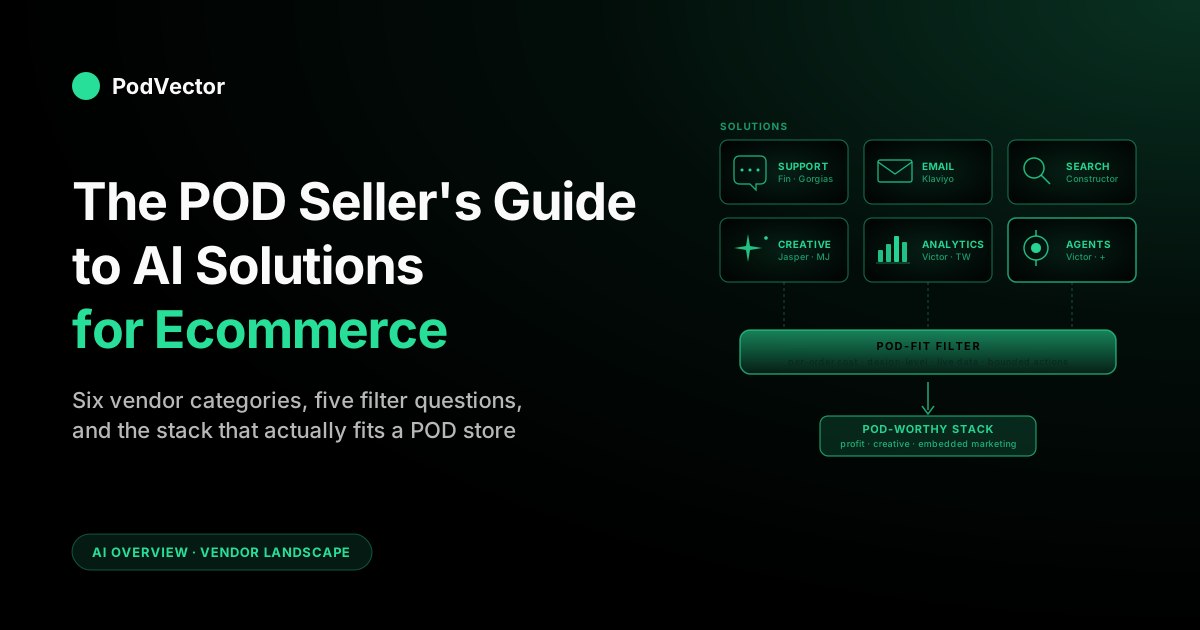
Quick Answer: "AI solutions for ecommerce" covers six vendor categories: customer support agents, marketing automation, search and personalization, content and creative generation, analytics and profit intelligence, and the emerging agentic-operations layer. Every generic roundup names the same 15 tools — Klaviyo, Gorgias, Constructor, Jasper, Triple Whale, and so on.
Most of those tools were built for wholesale DTC brands with fixed costs and real inventory sitting in a warehouse. For POD sellers, they either fall short (because they can't pull in your exact Printify or Printful cost per order) or give you features you don't need, like inventory forecasting for a business with no inventory. This guide maps out the solution landscape, tells you which categories actually move your bottom line, and gives you five quick questions to filter vendor pitches fast.
The AI solutions for ecommerce landscape in 2026
The AI-for-ecommerce category has matured enough that the word "solutions" now means something specific: vendors selling packaged products that apply machine learning, large language models, or generative AI to a concrete job in a merchant's operation. The global market for these tools is projected to hit roughly $11B in 2026 and more than triple by 2032, and three out of four ecommerce operators now use at least one AI tool according to Shopify's merchant data. The newer signal is volume: the typical ecommerce team now runs five to eight AI tools spread across support, marketing, personalization, content, and analytics. That is exactly the problem — the category has fragmented faster than most operators can evaluate it, and the question is no longer whether to buy AI solutions but which ones, in what order, for what job.
The complication is that "AI solutions for ecommerce" is a category-of-categories. A customer-support agent like Fin, a personalization engine like Bloomreach, a creative generator like Jasper, and a profit-intelligence agent all share the label but do radically different jobs.
A vendor pitch deck will collapse them into one pillar chart. A buyer with a limited budget has to un-collapse them back into discrete decisions. For print-on-demand operators specifically, that un-collapsing matters more than in any other ecommerce vertical, because POD's economics break most of the assumptions the category was built on.
This guide walks through the landscape one layer at a time: what the six vendor categories look like in 2026, who the named players are, which categories move the needle on a POD P&L, and how to filter a solution pitch in five questions or less. For the capability-level perspective — what AI can actually do for a store, separate from the vendors selling it — see The POD Seller's Guide to AI for Ecommerce.
How the category expanded between 2022 and 2026
Four shifts redrew the map. First, large language models turned single-purpose tools (product-description generators, chatbots) into general-purpose copilots embedded across workflows.
Second, the tools behind the scenes got better. Big data storage systems became standard for any serious analytics tool, so vendors could work with your real, up-to-date store data instead of old summary reports. Third, AI agents arrived — tools that don't just answer questions but take real actions, like pausing ad campaigns, drafting responses, or switching suppliers. Fourth, the big platforms caught up: Shopify, BigCommerce, and Salesforce started building AI right into their platforms. That raised the bar for what "AI solutions" include by default, and pushed standalone vendors to offer something extra on top.
The discovery layer is moving to AI answers
The newest shift the 2026 roundups all flag sits upstream of every category below: a growing share of product discovery now starts inside an AI assistant instead of a search bar. Over half of US shoppers say they've used ChatGPT or Gemini to research a purchase, and "agentic checkout" — where the assistant completes the buy — is moving from demo to pilot. That adds a surface none of the six tool categories was built to optimize: generative engine optimization (GEO), the practice of making your catalog legible to AI answer engines.
For POD operators the takeaway is narrow but real. You don't need a separate GEO product yet — you need clean, structured product and cost data and designs worth surfacing. The same data discipline that makes a POD profit agent accurate is what makes your store legible to these new discovery surfaces. Treat GEO as a watch-this-space layer, not a line item.
Why POD sellers need a different evaluation lens
Most AI-for-ecommerce solutions were designed for the median ecommerce buyer: a DTC brand that buys inventory at a wholesale cost, stores it, and ships from a warehouse. Print-on-demand inverts the core assumptions. Without a POD-specific evaluation lens, you end up paying for features that don't apply and missing the one feature that would have earned back the entire stack.
Your cost of goods is variable per order, not fixed per SKU
A generic AI analytics tool asks for a COGS number. On a POD store, there is no single COGS number.
An identical hoodie shipped from a different supplier, in a different color, to a different zip code, costs a different amount. AI solutions that assume fixed-cost COGS produce profit numbers that are off by 10–40% on a POD catalog.
Tools that pull in the exact cost of each order from Printify or Printful give you numbers that match your actual bank statement. That difference decides whether an AI solution is useful or just for show. The full breakdown lives in the complete guide to AI analytics for print-on-demand.
Your "inventory" is a design, not a unit
Generic ecommerce AI spends a lot of its value proposition on inventory forecasting, stockout prevention, and reorder automation. On a POD store, none of that applies — the supplier prints on demand.
What matters instead is design-level profitability: which design, across which products, on which channels, produced which margin. AI solutions that can't disaggregate to the design level are reporting on the wrong unit of analysis entirely. See why your print-on-demand store isn't as profitable as you think for what this looks like in practice.
Two suppliers and a routing decision
Most working POD stores run Printify and Printful, sometimes with SPOD or Gelato as a third. Cost, quality, and geography differ per supplier.
Routing is a real optimization lever — and a generic AI tool doesn't know either supplier exists, let alone that the routing choice affects margin. POD-native solutions read both APIs and reason across them. For the comparison, see Printify alternatives: the complete comparison for POD sellers.
Your margins are tighter, so attribution matters more
A wholesale DTC brand with 60% gross margin can absorb attribution inaccuracy; a POD store with 25–35% gross margin cannot. Contribution margin after ads and supplier costs is the actual metric, not ROAS.
AI solutions that show headline ROAS without reconciling itemized supplier cost and ad spend per order are handing POD operators a vanity number. See why GPAM matters more than gross profit for the POD-specific math.
The 6 categories of AI solutions for ecommerce
Every AI solution sold into ecommerce in 2026 falls into one of six categories. The categories have different vendor density, different price ranges, and — critically — very different ROI curves for a POD store.
1. Customer support and service automation
AI agents that resolve support tickets end-to-end using knowledge bases, order data, and historical conversations. Named vendors: Fin, Gorgias AI, Tidio, Zendesk's AI suite.
Typical use cases: order status questions, refund requests, sizing and shipping inquiries, return policy clarification. For POD stores with meaningful ticket volume (often above 1,000 orders/month), these tools pay for themselves by absorbing repetitive tickets. Below that volume, a template-based helpdesk plus a copilot-style assistant inside your existing email client usually covers it.
2. Email and lifecycle marketing
AI-powered segmentation, send-time optimization, subject-line generation, and predictive flows for abandoned cart, post-purchase, and winback. Named vendors: Klaviyo, Omnisend, Mailchimp, GetResponse.
The AI layer here isn't separate from the platform — it's how the platform decides who to email and when. For POD, these are workhorse tools; the AI adds marginal lift on top of well-designed flows but doesn't change the strategic direction. Pick the platform based on fit with Shopify and fees, not on AI feature claims.
3. Search, discovery, and personalization
AI-powered site search, product recommendations, and behavioral personalization. Named vendors: Constructor, Bloomreach, Algolia with AI, Nosto, Klevu.
Use case: shoppers who land on your catalog find relevant products faster, which lifts conversion and AOV. For POD, this category is valuable only when the catalog is large enough that browsing is a real problem (usually 500+ SKUs).
Under that threshold, curated collections and good navigation often outperform personalization engines. Overspending here is a common POD mistake.
4. Content and creative generation
Generative AI for product descriptions, ad copy, images, mockups, and short video. Named vendors: Jasper, Copy.ai, Photoroom, Flair.ai for product images, Midjourney and DALL-E for original art.
For POD specifically, this is a top-two category by leverage — because the product is the creative. Faster design generation means more SKUs, which means more tests, which means more winners. See the complete guide to AI tools for POD sellers for POD-specific creative workflows.
5. Analytics, optimization, and profit intelligence
AI that reads your sales, ad, and cost data, answers profit questions, and flags anomalies. Named vendors: Triple Whale, Polar Analytics, FullStory, Peel, Varos, and POD-native tools like Victor.
The key question in this category is whether the vendor automatically pulls in your exact Printify and Printful costs. A generic DTC analytics tool that makes you type in one cost by hand is the wrong tool for POD, no matter how fancy the rest of the product looks. For the category comparison, see best AI tools for ecommerce data analysis compared.
6. Agentic operations (emerging)
The newest and fastest-growing category. Agents that don't just analyze but take bounded actions: pausing a campaign running under a margin threshold, drafting customer replies, rerouting a product from one supplier to another, triggering a restock alert.
Named players: Victor on the POD-native side, plus broader agent platforms that connect to Shopify and ad platforms. This category is where the next two years of competitive advantage will be won, because it compresses operational overhead on lean teams. For the full picture, see the complete guide to AI agents for ecommerce analytics.
Vendor landscape by category
Naming the vendors makes the landscape concrete. Every roundup on page one of Google lists more or less the same tools — what changes between guides is the curation. Here is how the named vendors cluster by category, with a POD-relevance note on each.
Customer support
- Fin (Intercom). End-to-end resolution agent. Strong for stores with complex support flows. POD-relevant once ticket volume passes ~1k/month.
- Gorgias AI. Shopify-native helpdesk with AI resolution. Common choice for DTC brands; works on POD.
- Tidio. SMB-focused chat + AI bot. Lower cost, lighter capability. Reasonable starting point for POD under $100K/year.
- Zendesk AI. Enterprise-level; usually overkill for POD.
For POD-specific chat, see what an AI chatbot for ecommerce looks like for POD sellers.
Email and lifecycle
- Klaviyo. Default for Shopify. AI features embedded in segmentation and send-time logic. Strongest ecosystem fit.
- Omnisend. Competitive Klaviyo alternative; cheaper at low send volume.
- Mailchimp. General-purpose; weaker Shopify integration than Klaviyo.
- GetResponse. Mid-market, not Shopify-first.
For POD sellers, Klaviyo is the default unless budget explicitly forces a cheaper option. The AI inside the platform is incremental to the flows you build — don't let vendor claims drive the platform choice.
Search, discovery, personalization
- Constructor. Behavior-based search and merchandising. Strong on large catalogs.
- Bloomreach. Combined discovery + personalization + content platform. Enterprise-leaning.
- Algolia. Search-as-a-service with AI ranking layer. Good middle-ground.
- Nosto / Klevu. Shopify-friendly personalization apps; approachable pricing.
POD stores with fewer than 500 active designs usually don't need this category as a standalone spend. Shopify's built-in search plus a recommendation app often covers it.
Content and creative
- Jasper / Copy.ai. LLM-driven copy. Useful for product descriptions at scale and ad copy drafts.
- Midjourney / DALL-E / Firefly. Generative image tools. Core to POD design production.
- Photoroom / Flair.ai. Product imagery and mockup generation. Useful for lifestyle-style POD ads.
- Shopify Magic. Built-in generative text across admin — free with Shopify plans.
Creative is the category where POD stores over-invest last and under-use first. Start with Shopify Magic plus one image generator; expand only if you hit a real throughput ceiling.
Analytics and profit intelligence
- Triple Whale. DTC-focused analytics with strong ad attribution. Generic COGS handling — verify POD fit directly.
- Polar Analytics. Similar positioning to Triple Whale; solid for multi-channel DTC.
- Peel Insights. Subscription-and-retention analytics; less relevant unless running subscription POD.
- Victor. Built for POD sellers. Pulls in your exact Printify and Printful costs automatically. Answers your profit questions in plain English using your store's live data.
- FullStory. Session analytics, not profit analytics. Complementary, not a replacement.
This is the category where POD-specificity changes the answer. See best AI for ecommerce compared for the tradeoff breakdown.
Agentic operations
- Victor. POD-native analytics agent today; bounded operational actions on the roadmap.
- Ad-platform native agents. Meta Advantage+ and Google Performance Max act autonomously within campaign rules once configured.
- Shopify Sidekick. Shopify's built-in operator assistant; useful for admin tasks, not deep profit reasoning.
Still early — agentic operations is where the category is heading but not yet crowded with mature vendors. For the trajectory, see what AI agents for ecommerce look like for POD sellers.
5 questions that filter POD-worthy AI solutions fast
Vendor decks all sound the same: "enterprise-grade," "AI-powered," "trusted by leading brands." Five questions cut through the noise and tell you whether a solution actually fits a POD operation.
1. Does it automatically pull in the exact cost of each order from Printify and Printful?
If the answer is no, or "you can enter a COGS number in settings," the tool is a DTC tool you'd be using by analogy. The resulting profit numbers will be wrong — not by 1%, by 10–30%.
This is the single most decisive filter question in the category. Good POD analytics tools and agents read supplier costs line by line, per order.
2. Can it report at the design level, not just the product or order level?
POD's unit of analysis is the design. If the tool only shows you revenue and margin at the store or SKU level, it's missing the key decision surface: which designs to scale, which to kill, which to promote. A POD-worthy solution pivots its analytics to "by design" as a first-class dimension.
3. Does the AI reason against live data, or pre-aggregated summaries?
Some tools run AI over snapshots that refresh daily. Others reason against a live warehouse (Snowflake) on every query. For catching anomalies and answering questions about today's activity, live-data tools win by a wide margin. Ask the vendor where the AI is querying from, and how fresh the data is when it answers.
4. What bounded actions can the AI take autonomously, and how are those actions governed?
In 2026, "AI that answers" is a floor, not a ceiling. The question for vendors is: what's on the roadmap for taking actions (pausing campaigns, rerouting suppliers, adjusting prices), and how does the architecture constrain the agent to safe bounds? Vendors without a credible answer are selling yesterday's product.
5. Is the data isolated tenant-by-tenant, or pooled across customers?
For any AI tool that touches your sales and cost data, keeping your data separate from other stores is a basic safety requirement. Ask how your data stays private from other merchants, how the AI's access is limited, and how the vendor stops someone from tricking the AI into leaking information. For a store owner, the wrong answer here is a data-leak risk.
Building a realistic AI solution stack for a POD store
You don't need every category. A working POD AI stack for a store doing under $1M/year looks roughly like this, in priority order.
Layer 1: Profit intelligence (the foundation)
Before anything else, know your actual profit per order. An AI tool built for POD that pulls in your Printify and Printful costs, matches them up with your ad spend, and shows profit by design is the first AI solution worth paying for. Everything else is calibrated on this number.
Layer 2: Creative (the throughput multiplier)
Next: the generative tools that compress your design-to-listing cycle. Midjourney or DALL-E for original art, Shopify Magic for product descriptions, an ad creative tool if you're running Meta or TikTok at meaningful scale. Don't stack three image tools; pick one and learn it well.
Layer 3: Marketing platform AI (embedded, not bought separately)
Klaviyo for email, plus whatever AI features your ad platforms embed natively (Meta Advantage+, Google Performance Max). The AI here is part of the platform you'd use anyway. Don't overpay for "AI marketing" as a separate line item.
Layer 4: Customer support AI (add when volume justifies it)
Below ~1k tickets/month, a copilot inside your existing helpdesk is enough. Above that, a resolution agent (Fin, Gorgias AI) starts to pay back.
Layer 5: Specialist tools (conditional)
Search/personalization if your catalog is large enough to justify it; fraud detection as order volume climbs; subscription analytics if you run a membership. Most POD stores under $500K/year don't need these.
Fin's roundup of AI tools for ecommerce covers the full vendor landscape from the DTC perspective; the POD-specific stack above trims it aggressively to what actually moves a print-on-demand P&L.
The agentic shift: from point solutions to operating systems
The defining trajectory for AI solutions in ecommerce is the shift from point tools ("this one does product descriptions, that one does email") to agents that take bounded actions across multiple systems. For POD operators — who are often solo or two-person teams — this matters more than any single feature release.
Today: AI that answers
Most AI solutions in 2026 answer questions faster than a dashboard could. Profit-tracking tools take a question like "what was my margin on Design X in April" and dig through your data to answer it. Creative tools generate variants. Support tools resolve tickets. All useful, all still a step short of the end state.
Tomorrow: AI that acts
The next step is bounded autonomous action. An agent that pauses a campaign running under its margin threshold.
An AI that switches an order to a cheaper supplier if it saves you enough money. An AI that drafts a customer reply for you to approve, or sends it directly for simple cases. Victor is built for this shift: because he already works safely with your live store data, turning on new actions is simple — not a rebuild. BigCommerce's overview of AI in ecommerce covers this trend in general terms; what matters for POD is which vendors are actually built to get there, not which vendors just use the word on their marketing page.
Why POD wins disproportionately from this
POD teams are lean. Every hour spent on dashboard refreshes, campaign checks, and cost reconciliation is an hour not spent on new designs and new audiences — the two actual growth levers.
Agentic solutions compress operational overhead, which raises the ceiling on how much store one person can run profitably. That's a business-model-level advantage, not a feature-level one.
Mistakes POD sellers make buying AI solutions
Buying the "best AI tool" without filtering for POD fit
The most common failure. A seller reads a roundup that ranks Triple Whale #1 and subscribes — then discovers the COGS field is a single number, not a per-order ingestion from Printify. The tool isn't bad; it just wasn't built for this business model. Filter for POD fit first; rankings are noise until that filter passes.
Stacking overlapping solutions instead of integrating
Klaviyo has AI. Shopify has AI. Your analytics tool has AI. Your ad platforms have AI. Buying three more AI products on top doesn't compound — it fragments attention across more dashboards. The point of AI is to reduce the surface area of your operation, not expand it.
Treating generative AI as a replacement for operator judgment
A product description generator writes fast. It doesn't know which niches you're building for. An ad copy tool drafts variants; it doesn't know your brand voice or the community you sell to. Generative AI is a throughput multiplier on top of operator taste. Without taste, throughput just ships more mediocre content faster.
Paying for customer support AI before the volume justifies it
Resolution agents are worth real money at 2,000 tickets/month. At 200, the configuration time outweighs the savings. POD sellers under ~1k tickets/month usually get more value from a well-templated helpdesk plus an LLM copilot than from a dedicated resolution agent.
Ignoring the employee roadmap when picking a long-term vendor
Any vendor sold on "we answer questions faster" is selling a 2024 product. The 2026+ winners will be the vendors architected to take bounded actions on your behalf. When evaluating a tool you plan to use for years, ask about the action roadmap and the governance model. No credible answer means no long-term fit.
FAQs
What are AI solutions for ecommerce in plain English?
They're packaged software products that apply machine learning, large language models, or generative AI to a concrete job in an ecommerce operation — customer support, email marketing, product search, content generation, profit analytics, or autonomous operations. Together they form six vendor categories, and picking the right mix depends on what your business model actually needs.
Which AI solution category should POD sellers invest in first?
Profit intelligence. Until you can see per-order, per-design contribution margin after supplier cost and ads, every other AI insight is calibrated on a wrong baseline. Start with a POD-native analytics agent; add creative AI next; add everything else when volume justifies it.
Are generic ecommerce AI solutions like Triple Whale or Klaviyo useful for POD?
Some yes, some no. Klaviyo is fine for POD email because it doesn't depend on knowing your COGS structure.
Triple Whale and similar DTC analytics tools often struggle because they can't automatically pull in the exact cost of each order from Printify or Printful. Always ask the filter question: does it read my supplier data automatically, or does it assume one lump cost number?
How much should a POD store spend on AI solutions per month?
For a store doing under $500K/year, roughly $100–300/month covers the useful stack: one analytics agent, one or two creative tools, and whatever AI is embedded in Klaviyo and Shopify. Above $500K, add customer support AI and specialist tools as volume justifies. Overspend usually happens on personalization and enterprise tools that aren't yet earning their keep.
Is it worth building custom AI solutions for my POD store?
Almost never under $2M/year. The off-the-shelf category is mature enough that custom builds rarely justify the engineering cost. Where custom work does pay off: unusual data sources, proprietary supplier networks, or highly specific creative workflows. For the median POD store, purpose-built tools plus the LLM subscription of your choice is the right stack.
What's the difference between AI solutions and AI agents for ecommerce?
"AI solutions" is the broader category — any software that applies AI to an ecommerce job. "AI agents" are a subset: solutions that take bounded autonomous actions rather than just surfacing information. Every AI agent is an AI solution; not every AI solution is an agent. The agents subset is the fastest-growing segment of the category in 2026.
Do AI shopping assistants like ChatGPT change how POD stores get found?
Increasingly, yes. A growing share of shoppers now research and even buy through assistants like ChatGPT and Gemini rather than a search bar, which adds generative engine optimization (GEO) to the discovery picture. For POD sellers the practical move isn't buying a GEO tool yet — it's keeping product data clean and structured so AI answer engines can read your catalog accurately. The same data discipline that powers a POD profit agent is what makes your store legible to these surfaces.
How do I avoid buying AI solutions that are just hype?
Run every vendor pitch through the five filter questions: does it pull in your exact supplier cost per order, does it show profit by design, is it using live data instead of old summaries, does it have a real plan for taking actions, and does it keep your data safe and separate from other stores. A solution that fails any of those for a POD use case is worth skipping. The solutions that pass are a small shortlist; pick from there.
Will AI solutions eventually replace the need for a POD analytics dashboard?
Partly. The trajectory is from dashboard to agent: instead of clicking through reports to find answers, you ask questions in plain English and the agent returns the answer with the underlying data. Dashboards won't disappear entirely — they're still the right interface for at-a-glance monitoring — but the primary mode of interaction shifts from "read charts" to "ask the agent." Vendors built for this shift will look different from the dashboard tools of 2020–2024.
Skip the generic AI solutions and get a POD-native profit agent
Victor is built for the exact gap this guide describes: he automatically pulls in your exact Printify and Printful costs, shows margin by design, answers your plain-English questions using your live store data, and takes action on those answers — with your approval.
Try Victor free