
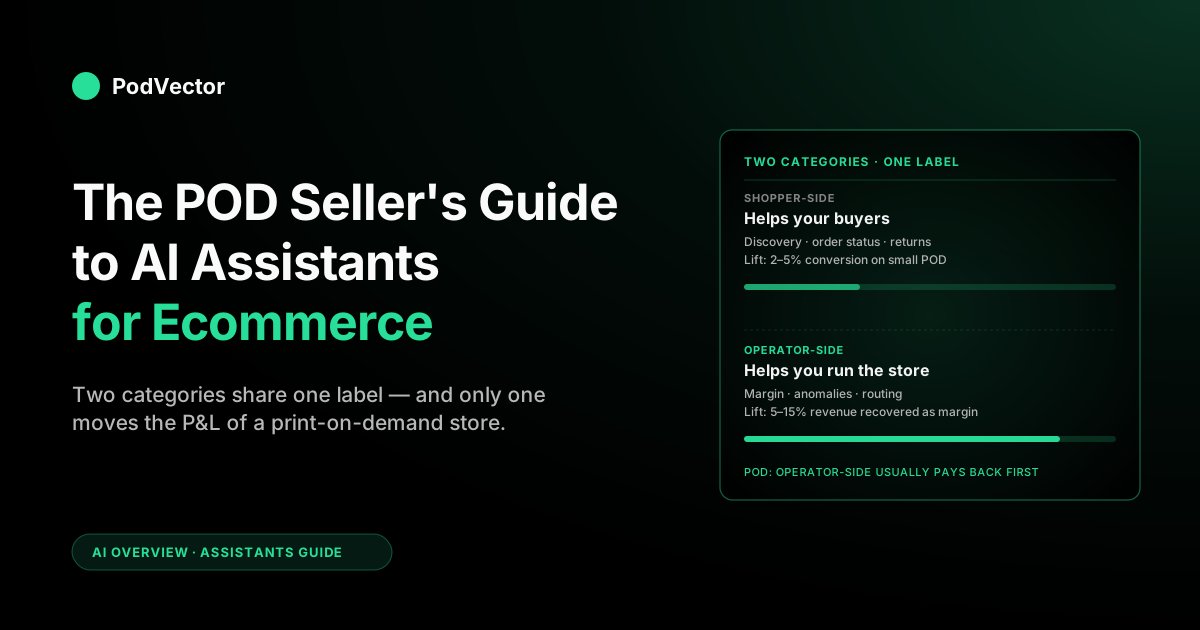
Quick Answer: "AI assistants for ecommerce" splits into two distinct categories: shopper-facing assistants that help buyers find and purchase products, and operator-facing assistants that help you run the store. For a print-on-demand seller, the operator-side assistant is the higher-leverage starting point — it reads live Printify, Printful, Shopify, and ad-platform data and answers the margin questions no storefront chatbot ever will. Start there, then add a shopper-side tool once revenue and ticket volume justify it.
What an AI assistant for ecommerce actually is in 2026
Search "AI assistants for ecommerce" and you get a stream of roundups about consumer-facing shopping helpers — Amazon Rufus, Walmart Sparky, Perplexity Shopping, Tidio Lyro, Salesforce Agentforce, Alhena, Bloomreach Loomi, Rep AI. Read enough of them and you'd think "AI assistant" only means one thing: a conversational layer on the storefront that answers shopper questions and recommends products. That definition is incomplete in 2026, and using it as an employee leads you to spend money on the wrong category.
The honest definition is broader: an AI assistant for ecommerce is any AI-driven interface that helps a person make a decision or take an action inside an ecommerce workflow — whether that person is a shopper deciding what to buy, or an operator deciding what to ship, price, promote, or pause. Those are two very different products with two very different ROI profiles, and a print-on-demand operator needs to think about both.
The distinction matters because the loudest segment of the market is the shopper-side category, and it gets disproportionate coverage in the guides. For POD specifically, the more important category is the operator-side one — the assistant that reads your supplier invoices, ad-platform data, and Shopify orders to answer the questions that actually move profit. Most POD operators don't have a dedicated analyst; they need an assistant for themselves before they need one for their customers.
How the assistant category split happened
In 2023 and 2024, "AI assistant for ecommerce" almost always meant a chatbot bolted to the storefront. The technology stack — large language models, retrieval, basic tool use — was good enough to answer shopper FAQs and recommend products, but not yet good enough to read live business data and reason over it reliably. So the entire category was shopper-facing.
By 2026, two things had changed. First, AI tools got a lot better at actually doing things for you — making real changes in Shopify, your ad accounts, and your suppliers — not just answering questions. Second, companies started building assistants that work inside your daily routine, answering questions like "what's my actual margin on the trending design from last week" instead of "do you have this hoodie in blue." Both kinds exist now; only one of them shows up consistently in the best-of lists you'll find online.
A third development worth noting: the line between "assistant" and "agent" is collapsing. The 2026 crop of operator-side tools increasingly proposes and executes bounded actions — repricing, discount creation, collection management — not just answers. The distinction between a conversational analytics tool and an AI employee is now more a spectrum than a binary.
The two categories nobody separates: shopper-side vs operator-side
Holding both categories side by side is the single most useful framing for an ecommerce operator evaluating AI in 2026. Each is a different purchase decision, with a different buyer persona and a different success metric.
Shopper-side AI assistants
The user is your customer. The interface is a chat widget on your storefront, an external shopping agent (Perplexity, ChatGPT shopping mode), or a marketplace-native assistant (Rufus on Amazon, Sparky on Walmart).
Success metrics are conversion rate, AOV, support deflection, and time-to-resolution on common shopper questions. Pricing is typically per-conversation, per-message, or seat-based on your support team. The 2026 field includes Tidio Lyro, Gorgias AI (which added a dedicated Shopping Assistant alongside its Support Agent in 2026), Zendesk AI, Alhena, Rep AI, Manifest AI, Bloomreach Loomi, Intercom Fin, and Salesforce Agentforce. Discovery, cart recovery, and support deflection each map to different categories within this space — a support-first platform like Gorgias excels at deflection, while a conversion-first platform like Loomi or Alhena pushes harder on guided discovery and proactive cart recovery.
Operator-side AI assistants
The user is you, the operator, and your team. The interface is a conversational analytics tool that reads live data from your store and the systems around it — fulfillment, ads, fees, returns — and in the most advanced cases proposes and executes bounded write actions on your behalf.
Success metrics are decisions made faster, margin recovered, and operator time freed. Pricing is typically per-store or per-data-source. The field is sparser because the category is younger: Shopify Sidekick (admin side), Triple Whale's Moby, Glew's AI assistant, Polar Analytics, and the agentic-analytics tools positioning at POD operators specifically — Victor (PodVector AI) being one of them, designed to read live Printify, Printful, Shopify, Meta Ads, and Google Ads data.
Both have a place in a serious operator's stack. The shopper-side assistant pays back through conversion and reduced support load; the operator-side assistant pays back through margin recovery and avoided hires. For a solo or small-team POD operator, the operator-side one usually pays back faster — the conversion lift from a chat widget on a small store is real but modest, while a margin question answered correctly can move meaningful net profit on the same revenue.
Why POD operators get the framing wrong
Most AI-assistant guides treat ecommerce as a single business model. A wholesale brand with 50 SKUs, predictable per-unit costs, and a warehouse has different needs than a POD operator running 800 designs across two suppliers and shipping zones that change unit economics order by order. Three concrete mismatches show up:
Shopper-side AI assumes high AOV and predictable margin
The conversion-lift case for a shopping assistant is strongest when basket sizes are large and margins per order leave room for software fees. POD baskets are typically smaller — a t-shirt, a hoodie, a mug — and the margin per order is already thin after Printify or Printful fulfillment, shipping, and ad spend.
A conversion lift from a chat widget on a low-AOV store is worth real money, but usually not as much as margin recovered from a single operator-side analysis of underpriced products or over-spent ad campaigns. Picking the storefront chatbot first because it's the most-covered choice in the SERP means leaving the larger lever untouched.
For a detailed look at how to price products so margin survives fulfillment costs, see the Printify t-shirt cost and profit breakdown.
Operator-side AI assumes per-order itemized data
Generic operator-AI tools are built for stores with one fulfillment cost per SKU — set the cost when you onboard a product, the system uses it forever. POD doesn't work that way.
The same hoodie shipped from Texas to California costs different from the same hoodie shipped to New York, and the only true cost is the supplier invoice for that specific order. AI assistants that ignore that itemization give you a number that looks like margin but isn't. The deeper analytics argument for why this matters is in how to get contribution margin for a POD store.
POD-aware assistants pull the per-order Printify or Printful line items and reconcile them against the Shopify order. Generic-ecommerce assistants almost universally fail this test — they either rely on manual COGS entry or skip fulfillment-cost reconciliation entirely.
Design count breaks the catalog assumptions
A working POD store has hundreds or thousands of designs. Shopper-side AI assistants struggle to recommend across that catalog without explicit merchandising rules — they're trained on stores with smaller, curated SKU sets.
Operator-side AI assistants, by contrast, thrive on the volume: "which 12 designs out of 800 lost money in the last 30 days after fulfillment and ad spend" is an unanswerable spreadsheet question and a one-line query for a POD-aware analytics agent. The combinatorial volume is where the operator-side ROI lives.
Shopper-side AI assistants for an ecommerce store
If you're going to add a shopper-side assistant — and most POD stores at meaningful monthly revenue eventually should — it helps to understand what the category is actually doing. There are four functional patterns, and most products combine two or three of them.
Conversational product discovery
The shopper types or speaks a query in natural language ("a t-shirt with a vintage motorcycle on it for my dad's birthday"), and the assistant returns matching products from your catalog. This is where shopping assistants outperform conventional search for POD specifically: catalogs are huge, design titles are inconsistent, and shoppers describe what they want in language that doesn't match the product titles. A strong shopping assistant needs current merchant data and enough product expertise to guide a decision all the way to a cart action in one conversation — the 2026 tools from Alhena and Bloomreach Loomi are both purpose-built for this guided-discovery pattern.
Order status and post-purchase support
"Where is my order" is the single highest-volume support question for any ecommerce store. POD adds a layer because tracking comes from Printify or Printful, not from your own warehouse, and it can take several days before a meaningful tracking number exists. An AI assistant that reads order status across Shopify and the supplier API can deflect the majority of these tickets without escalating to a human.
Returns and exchanges
POD return policies are usually limited (most suppliers don't accept consumer returns on custom products), but exchanges for sizing and damaged-on-arrival cases still happen. An assistant that walks the customer through the policy, confirms eligibility, and triggers the right replacement workflow saves significant operator time. For the expanded view of how this works on Shopify specifically, see the POD seller's guide to the Shopify AI assistant.
Personalized recommendations and cart recovery
Cross-sells, related-design suggestions, and "complete the look" prompts. Bloomreach Loomi and similar platforms extend this to proactive abandoned-cart recovery within the shopping session rather than after the fact — a meaningful upgrade over email-based recovery flows. The lift here is real but smaller than the discovery and support cases for most POD stores, mostly because POD shoppers typically browse for a single design rather than building a multi-product basket.
Operator-side AI assistants for running an ecommerce store
This is the category most POD operators underestimate, and it's where the higher leverage usually sits. An operator-side AI assistant lives inside your daily workflow. Instead of opening five dashboards, you ask it questions and it pulls answers from the underlying systems. In the most advanced implementations it also proposes and executes bounded write actions — with your explicit approval. Four functional patterns matter:
Live margin and profit answers
"What was my net profit yesterday after Printify cost, ad spend, and Shopify fees" is a question your existing dashboards probably cannot answer cleanly. An operator-side AI assistant that reads all four cost layers reconstructs that answer from live data. It is the single highest-impact question category for a POD operator, because every other decision — which campaigns to scale, which designs to retire, which supplier to route to — descends from accurate per-order profit. See also how to get contribution margin for the mechanics behind this calculation.
Anomaly and trend surfacing
"A specific design's cost-per-acquisition jumped materially over the last 72 hours" is a surfacing problem, not an analysis problem. You need to know it happened; you don't need a chart to investigate. An assistant that monitors the underlying data and proactively flags anomalies converts a daily multi-dashboard scan into a few targeted alerts. For the ad-side diagnosis workflow this feeds into, see how to avoid ad fatigue and what is ad frequency.
Ad-hoc cohort and segmentation queries
"Show me all customers who bought from the Halloween collection in October and haven't returned" is a one-line query for an AI assistant connected to your customer data, and a half-day spreadsheet exercise without one. POD stores accumulate a long tail of these questions, and most never get asked because the friction is too high.
Bounded write actions with approval
The most advanced operator-side tools in 2026 don't stop at answering questions — they propose and execute changes. Victor (PodVector AI) is built on this model: after reading your live data, it can propose repricing a product to a target margin, bulk-repricing across your store, setting up a buy-one-get-one or free-shipping discount, raising your free-shipping threshold, creating a customer-specific discount, organizing products into a collection, or reverting a price change — and it executes any of those only after you explicitly approve. The Shopify Admin API powers those writes; the full automation context is in Shopify Admin API store modifications and automation.
The full operator-side category overview is in the complete guide to AI agents for ecommerce analytics.
The AI assistants POD operators actually evaluate
The roundups in the broader SERP cover the consumer-side category well. Here's the operator-relevant cut, with the POD-specific evaluation criteria attached.
Shopify Sidekick (operator-side, native)
Shopify's built-in AI assistant for the admin. Strong on tasks that live entirely inside Shopify — drafting product descriptions, segmenting customers, summarizing orders.
Weak on questions that require data outside Shopify, which for POD is most of them: real fulfillment cost, ad spend reconciliation, supplier comparison. Useful as a productivity layer; not a substitute for a POD-aware analytics assistant. Detailed POD walkthrough: the POD seller's guide to Shopify Sidekick AI.
Tidio Lyro / Gorgias AI / Zendesk AI / Intercom Fin (shopper-side)
Mature, well-supported chatbots for the storefront and inbox. Tidio's accessible pricing makes it a practical choice for smaller stores that want AI-assisted chat without enterprise complexity. Gorgias added a dedicated Shopping Assistant in 2026 alongside its Support Agent, extending its coverage from support-deflection into guided discovery. Intercom Fin handles complex resolution workflows end-to-end including voice — better suited to large operations with high ticket volumes. Zendesk repositioned in 2026 as a "Resolution Platform," with its Shopify app syncing order and customer data directly into tickets.
None of these read your supplier-side costs, so margin and operations work is outside their scope. POD operators usually adopt one once support volume crosses meaningful weekly ticket counts. A newer crop of Shopify-native shopping assistants — Rep AI, Manifest AI, Alhena, Bloomreach Loomi, and Klaviyo's AI shopping assistant — pushes harder on conversion and guided discovery; the evaluation logic is the same.
Triple Whale Moby / Glew AI / Polar Analytics (operator-side, generic-ecommerce)
Conversational analytics built on top of a general ecommerce data system. Good at the questions Shopify-only stores ask. POD-specific gap: Printify and Printful costs per order aren't pulled in automatically, so margin numbers come from estimates you type in by hand, not the real supplier invoices. Polar Analytics positions itself as a governed, owned analytics layer where you build and audit the agents your brand needs, which is a sound approach but still requires you to enter the right cost data yourself. Useful if you also sell wholesale or hold inventory; less useful if you're pure POD.
Salesforce Agentforce / SAP CX AI Toolkit (enterprise)
Powerful but priced for the enterprise — implementation costs alone typically rule them out for POD operators below mid-seven-figure revenue. Good to know they exist; rarely the right pick at POD scale.
Victor (PodVector AI, operator-side, POD-native)
An AI employee built just for POD sellers. Victor looks at your real Shopify orders, Meta Ads, Google Ads, Printify, and Printful data together — no manual cost entry needed — so your margin numbers come from the actual supplier cost on each order, not a guess.
On the write side, Victor proposes typed actions with rationale and executes them only after you approve: repricing products to a target margin, bulk-repricing, setting up discounts (BOGO, free shipping, customer-specific), raising the free-shipping threshold, organizing collections, reverting price changes. Ad-platform reads (Meta, Google) surface what's working and what isn't; the merchant executes those changes on the ad platform directly, since ad-platform writes aren't built yet. The approach is human-approval-first throughout — Victor never acts without your explicit sign-off.
Victor's only proactive surface is a Weekly Health Report; all other interactions are query-driven. Comparison shopping is in best AI chatbot for ecommerce, compared.
Perplexity Shopping / Amazon Rufus / Walmart Sparky / ChatGPT Shopping Mode (off-platform)
You don't choose these; your shoppers use them. The category keeps expanding — Rufus, Sparky, Perplexity Shopping, and ChatGPT shopping mode are all live in 2026, and each reads your product titles, descriptions, and structured data on behalf of buyers. The operator implication is that your product feed and metadata are now being evaluated by AI agents making purchase recommendations. Optimizing for that audience — often called generative engine optimization or GEO — is becoming a standalone discipline distinct from traditional SEO.
How to choose an AI assistant for a POD store
Three questions, in order:
1. Which side of the assistant split has the bigger leverage right now?
If support load is consuming meaningful operator hours, the shopper-side assistant pays back fastest. If you suspect margin leakage but can't prove it, the operator-side assistant pays back faster. For most POD stores below meaningful monthly revenue thresholds, the operator-side question is more lucrative — you almost certainly have margin leakage, and you likely don't yet have enough support volume to justify a full chatbot subscription. See ecommerce checkout conversion rate optimization for the conversion-side levers that don't require a chatbot at all.
2. Does the operator-side option read your real data?
The litmus test: does it ask you to type in a unit cost, or does it pull the per-order line item from your supplier? If the former, you're getting an estimate dressed up as data. If the latter, the assistant's answers are as accurate as the underlying invoices. For POD this difference is the entire ROI question — generic ecommerce assistants almost universally fail this test.
A related limit worth knowing: if you have no completed orders yet, per-order cost reconciliation can't run — there are no supplier invoices to read. Operator-side tools that rely on order-side COGS can't give you a margin answer pre-sales, so the operator-side tool is most valuable once you have order history to work with.
3. What is the upgrade path from assistant to agent?
An assistant answers questions. An agent takes bounded actions on your behalf. Vendors with a clear roadmap from the first to the second will compound in value over 12-24 months; vendors that are still pitching a better dashboard will be replaced. For the broader argument, see agentic AI for ecommerce, what it looks like for POD sellers.
If you're also evaluating financing to fund inventory or ad spend while scaling, how to get Shopify Capital and does Shopify Capital check credit cover the funding side of the operator toolkit.
Implementing AI assistants without breaking the store
The implementation failure mode for shopper-side assistants is the same one that's killed every chatbot wave since 2018: launching with too few guardrails, the assistant says something wrong about a product or policy, the customer screenshots it, and the store eats a refund and a public complaint. Three guardrails matter:
Constrain the knowledge base
The assistant should answer from your actual product catalog, your actual policies, and your actual order data — not from the model's general training. Modern assistants do this with retrieval over your structured data; the failure mode is when retrieval is misconfigured and the model produces a product specification or return policy that isn't yours.
Restrict actions to bounded ones
The shopper-side assistant should be allowed to look up orders, suggest products, and start a return workflow that a human approves — not to issue refunds autonomously, change addresses, or modify orders. Same logic on the operator side: read everything, propose clearly, write nothing until the operator explicitly approves. That human-approval-first principle is the core of how Victor is designed — it proposes a typed action with rationale, and executes only on your go-ahead.
Have a human escalation path
The single most expensive thing an AI assistant can do is keep talking when it should hand off. Configure escalation triggers explicitly: certain question types, certain sentiment thresholds, certain order values. POD customers tolerate AI well when the handoff to a human is one click away.
For the implementation pattern on the operator side specifically — what to connect first, how to check your numbers are right, what to ignore — see the POD seller's guide to AI for ecommerce business.
From assistant to agent: the next 18 months
The largest practical shift between 2026 and 2027 is the move from assistants that answer questions to agents that take bounded actions. Both shopper-side and operator-side assistants are tracking toward this, and the vendors who get there first will look very different from the ones who don't.
On the shopper side, the trajectory is toward agents that complete a purchase end-to-end on the shopper's behalf. The first wave is already live in Perplexity, ChatGPT shopping mode, and Walmart's Sparky. By late 2026 most major marketplaces will have a checkout agent, and the practical operator implication is that your product feed, structured data, and pricing need to be machine-readable in formats those agents understand — traditional SEO and generative engine optimization are converging.
On the operator side, the trajectory is toward agents that don't just identify a problem but route it to a resolution. An assistant that flags a cost-per-acquisition spike on a specific campaign becomes an agent that proposes the bid adjustment or creative swap, waiting only for human sign-off before executing. An assistant that identifies a design with negative contribution margin becomes an agent that adjusts the price, creates a discount to clear existing inventory, or surfaces a creative rotation — all pending your approval.
The vendors building toward this — Victor on the POD side, Triple Whale and Polar Analytics on the generic-ecommerce side — are the ones to watch over the next 18 months. The strategic case for the operator-side category is in the POD seller's guide to AI for ecommerce.
Mistakes POD operators make with AI assistants
Picking the storefront chatbot before the AI employee
Easiest mistake to make because it's the most-covered category in the SERP. The conversion lift on a small POD store is real but usually smaller than the margin lift from operator-side AI. Solve the bigger problem first.
Trusting margin numbers from a tool that doesn't read supplier line items
Manual COGS fields are not data. If the assistant cannot pull your Printify or Printful per-order invoice, its margin answers are estimates. Estimates are worse than no number because they encode false confidence into decisions. The right way to think about this is in how to get contribution margin.
Letting a shopper-side assistant write without guardrails
Hallucinated product specs, wrong return policies, and incorrect order updates are unforced errors. Constrain the knowledge base, restrict actions, and configure escalation before launch.
Picking a vendor without an employee capability or clear agentic roadmap
An AI assistant that's only an assistant in 2026 will be replaced by an agent in 2027. Buy with the upgrade path in mind — ask vendors specifically what write actions are shipped today versus on the roadmap.
Ignoring the off-platform shopping agents
Amazon Rufus, Walmart Sparky, Perplexity Shopping, and ChatGPT shopping mode are already routing your potential buyers through AI-mediated discovery. Your product titles, descriptions, and structured data are inputs to those agents. Operators who treat this as a future concern are already behind.
Adding three assistants instead of one
The rookie maximalism of "more AI is better." A single well-configured operator-side assistant plus a single well-configured shopper-side one beats a tab graveyard of half-implemented tools every time. Ad-side discipline applies too — see how to avoid ad fatigue for the same principle applied to creative.
FAQs
What is the best AI assistant for an ecommerce store?
There's no single answer because the category splits two ways. For shopper-side support and discovery, Tidio Lyro, Gorgias AI, Alhena, and Rep AI are mainstream choices in 2026 — Gorgias added a Shopping Assistant this year to complement its Support Agent, while Alhena and Bloomreach Loomi push harder on guided discovery and conversion.
For operator-side analytics and decisions, Triple Whale Moby and Polar Analytics cover generic ecommerce; Victor covers POD specifically with live Printify and Printful cost reconciliation that generic tools don't do. The right answer depends on which side has the bigger leverage in your current operation.
Are AI shopping assistants worth it for small POD stores?
Below a meaningful monthly revenue threshold, the conversion lift from a shopper-side chatbot is usually too small to justify the monthly fee. Operator-side AI assistants have a different payback curve — they can recover value at much smaller revenue because margin leakage is structural and present at every scale. The margin recovery on a small-revenue month is structurally similar to recovery on a high-revenue month, just at smaller absolute dollars.
Will an AI assistant replace my customer support team?
For a small POD operation that's already a one-person support team, an AI assistant raises the ceiling on how many tickets you can handle without hiring — strong deflection on common questions like order status. It rarely replaces the operator entirely because the remaining tickets are the high-judgment ones (refund disputes, design issues, lost packages) where the human escalation path matters most.
What's the difference between an AI chatbot and an AI assistant?
The line is blurring, but in 2026 most vendors use "chatbot" to mean a rule-based or scripted conversational interface and "assistant" to mean an LLM-driven one with retrieval, reasoning, and limited tool use. The practical difference is that an assistant can answer questions it wasn't explicitly programmed for. In 2026, the more meaningful distinction is between an assistant (answers questions) and an agent (takes bounded actions) — the operator-side category is actively crossing that line.
Do I need an AI assistant if I'm already using ChatGPT?
ChatGPT is a general-purpose assistant and doesn't have access to your store's data. An ecommerce-specific assistant — shopper-side or operator-side — connects to the data sources that matter (your catalog, your orders, your supplier invoices, your ad accounts) and answers questions against them. The two are complementary, not substitutes.
How does an AI assistant handle Printify and Printful at the same time?
Most generic AI assistants don't — they assume one fulfillment source per product. POD-aware assistants connect to both APIs, reconcile the per-order line items, and let you query across them ("which products would be cheaper to route to Printful in this geography"). This is the single most POD-specific capability to evaluate when comparing options. Note that catalog-level cost data (pre-order pricing from Printify or Printful) isn't available this way — only completed-order COGS is reconciled, so the analysis requires order history to be meaningful.
What can Victor actually do vs. just read?
Victor reads Shopify, Meta Ads, Google Ads, Printify, and Printful. On the write side — Shopify only — Victor can propose and execute (with your approval): repricing a product to a target margin, bulk-repricing, setting up a BOGO discount, creating a free-shipping discount, raising the free-shipping threshold, creating a customer-specific discount, organizing products into a collection, and reverting a price change. Ad-platform actions (pausing Meta campaigns, changing Google Ads budgets) are not built — Victor reads those surfaces and proposes moves that you execute on the platform directly. Printify and Printful writes are also not built. Victor never acts without your explicit approval on each proposed action.
Want an AI assistant built for the operator side, not the storefront?
Victor is PodVector AI's AI employee for POD sellers — it reads your live Printify, Printful, Shopify, Meta Ads, and Google Ads data and answers the margin questions your dashboards can't. No manual COGS entry. And where analysis leads to action, Victor proposes the move and executes it only after you approve.
Try Victor free