
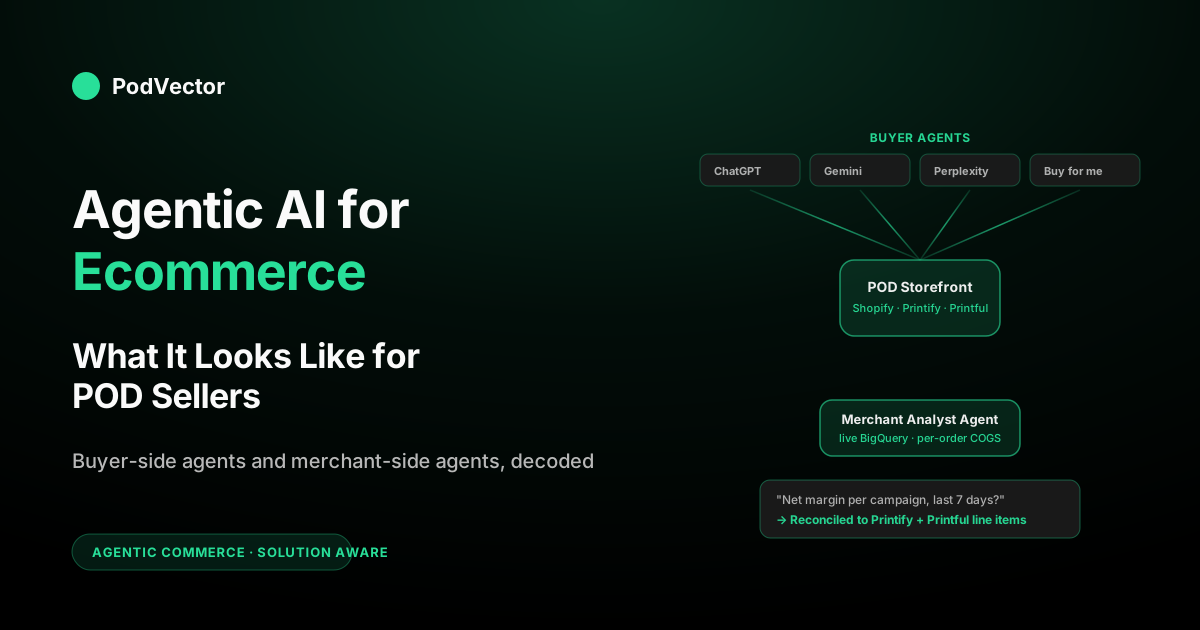
Quick Answer: Agentic AI for ecommerce is software that takes a goal and acts on it across multiple steps — either on the buyer's side (an AI shopping for the consumer) or on the merchant's side (an AI running operations for the seller). In 2026, agentic commerce has moved from experimental concept to commercial reality, with AI shopping agents now autonomously browsing, comparing, and purchasing products without human intervention. AI-driven orders increased 15-fold in 2025, with major platforms like ChatGPT, Microsoft Copilot, and Google AI Mode now completing purchases autonomously.
Print-on-demand sellers face two problems most generic 2026 agentic-commerce guides skip: agentic buyers can't read POD variant catalogs cleanly, and merchant-side agents can't model POD margin without itemized supplier costs. Both problems are infrastructure issues, not model issues.
What is agentic AI for ecommerce?
Agentic AI for ecommerce is software that combines a large language model with tools and a goal, then runs a multi-step workflow without a human stepping through each step. The cleanest one-line distinction making the rounds in 2026: generative AI creates, agentic AI does. A generative tool drafts your product copy; an agentic one plans, calls APIs, evaluates the result, and decides what to do next. The "agentic" part is the autonomy: instead of the model answering a question and stopping, it acts. The "for ecommerce" part is what those tools are wired into — Shopify, Printify, Printful, Meta, Google, Klaviyo, your support stack, and now buyer-side surfaces like ChatGPT and Gemini.
Two things changed in 2025–2026 to make this category real. Models got reliable enough at long-horizon tool use that operators started trusting them with multi-step jobs. And the protocol layer (Anthropic's MCP, OpenAI's function calling, Google's A2A, and the emerging Agentic Commerce Protocol) standardized how agents talk to other systems.
The result is what analysts now call "agentic commerce" — a pattern where AI runs work on either side of the transaction, not just chats about it. Morgan Stanley predicts that nearly half of online shoppers will use AI shopping agents by 2030, accounting for approximately 25% of their spending. Winning in agentic commerce requires a "trust stack" approach: foundation (structured data), monitoring (agent traffic visibility), and governance (fraud defense). Shopify's overview of agentic commerce is a useful vendor-neutral primer if you want the broader market context.
For print-on-demand, the framing matters more than the buzzword. Agentic AI is two distinct shifts hitting at once: a buyer-side shift (consumers shopping through AI assistants) and a merchant-side shift (operators running their stores through AI agents). The two need different responses, and most 2026 coverage conflates them.
The two sides: buyer-agents and merchant-agents
Almost every agentic-commerce article in 2026 talks about one side and ignores the other. The full picture has both.
Buyer-side agents (the new shopping channel)
An agent acting for the consumer. The user asks ChatGPT for "a soft cotton crewneck under $35 in navy, ships in a week," and the agent searches across stores, compares specs, evaluates shipping windows, and either presents options or completes the purchase via "Buy for me" flows.
Google's agentic checkout in Search and Gemini, OpenAI's checkout-via-ChatGPT, Perplexity's "Buy with Pro," Microsoft Copilot, and Amazon's Rufus are all live versions of this in 2026. Merchants must optimize for structured product data, machine-readable policies, and emerging protocols like the Agentic Commerce Protocol (ACP) and Universal Commerce Protocol (UCP) to remain discoverable. If your product data is messy, agents skip you.
Zero-click commerce is set to disrupt retail in 2026 as shoppers may never need to click, search, or visit a website to make a purchase. For POD sellers, this means your structured product data has become a distribution channel in itself.
Merchant-side agents (the new operations layer)
An agent acting for the seller. The operator asks "which Meta campaigns lost money last week after Printify costs," or sets a goal like "respond to all sizing tickets and deflect what you can." The agent plans, queries the right systems, takes the action or returns the answer, and logs the trail. This is what most "AI agents for ecommerce" tools are — a category we cover in depth in AI Agents for Ecommerce: What It Looks Like for POD Sellers.
The two sides are not symmetric. Buyer-side agentic AI is mostly a product-data and discoverability problem for the merchant. Merchant-side agentic AI is mostly a workflow and integration problem. POD sellers usually need to invest in both, but the merchant side pays back faster and is more under your control. The buyer side is closer to "make sure your product feed is clean enough that an agent can read it" and less about buying new tools.
What agentic buyers mean for POD storefronts
A recent study found that 73% of consumers are already using AI in their shopping journey — embracing AI assistants for product ideas (45%), summarizing reviews (37%), and comparing prices (32%). While only 13% say they've completed a purchase after being referred by an AI assistant, 70% are at least somewhat comfortable with an AI agent making purchases on their behalf. For a POD store, that shift creates four concrete asks.
1. Clean, structured product data
Agents don't browse — they parse. They read your product feed, your structured-data markup (Schema.org Product, AggregateOffer, ShippingDetails), and increasingly the agent-native protocols Shopify and Salesforce are rolling out. Dropshippers who adapt now will capture market share before competitors establish dominance in AI agent discoverability.
POD product data is uniquely fragile: variants explode quickly (5 sizes × 8 colors = 40 SKUs per design), and the supplier-side data (production time, base provider) usually doesn't make it to the storefront. Agents need it. If your product schema doesn't surface the production time and the variant-specific shipping window, the agent will either skip your listing or quote it wrong.
This is also why feed-syndication platforms are showing up in 2026 agentic-commerce coverage — they push a normalized product feed out to the surfaces where agents actually read, keeping your catalog consistent across ChatGPT, Gemini, Perplexity, and Google's AI Mode. For POD the syndication is only as good as the underlying variant and supplier data, so fix the schema first.
2. Honest, AI-readable shipping promises
The most common reason an agentic checkout fails on a POD store is that the shipping estimate the agent quotes doesn't match what the store actually delivers. Generic "5–7 business days" copy in your storefront isn't enough.
The agent wants a per-variant production estimate plus a shipping zone calculation. Wire that out via your structured data and your APIs, and your conversion rate from agentic-buyer traffic goes up. Skip it and you'll see a high cancellation rate from agents whose users complained about delivery slipping. See our Printful delivery time and free-shipping breakdown for the shipping-promise data you need to surface accurately.
3. AI-visible reviews and quality signals
Agents weight reviews more heavily than humans do because reviews are the most reliable signal of objective quality. Make sure your review widgets emit Schema.org Review markup, that your average rating is in your product structured data, and that you handle misprint complaints quickly enough that the long tail of one-star reviews stays small. POD has a higher misprint rate than inventoried DTC and agents will notice.
4. A merchant identity AI assistants can verify
Agents need to trust who they're buying from. That increasingly means a verified merchant identity in the agentic protocols (Shopify's verified storefront program, Stripe's agentic-payments tokenization, Mastercard's agent-aware credentials).
For a small POD seller in 2026, the lift is mostly "make sure your Shopify is verified, your domain has clean WHOIS data, and your return policy is published in a machine-readable format." Get that right and you're a candidate for agent-led purchases. Skip it and agents downrank you against verified competitors.
What agentic AI looks like on the merchant side
The merchant-side category — agents that run work for the operator — is where most POD sellers will spend money in 2026. The categories that show up across the SERP:
- Customer support agents. Tier-1 deflection on WISMO, sizing, returns. Tools: Gorgias AI Agent, Intercom Fin, Tidio, Octane AI. Gorgias has the deepest action surface (refund, edit, cancel, discount, return) directly inside the ticket. More on customer-facing chatbots for POD here.
- Cart-recovery agents. Detect abandonment, pick channel, draft message, sometimes pre-authorize a discount inside margin tolerance. Built into most chatbot platforms; Klaviyo's AI flows are the most-used standalone version.
- Recommendation agents. Real-time product suggestions based on browsing behavior, purchase history, and (for the good ones) per-SKU margin. Rebuy and Klaviyo AI for POD stores.
- Marketing and ad-creative agents. Draft copy, generate variants, rotate creatives. Meta Advantage+ at the platform level; AdCreative.ai or Pencil at the workflow level. Note: ad-platform writes (pausing campaigns, changing budgets) remain a merchant action — current agents read and propose, but execution is yours.
- Inventory forecasting agents. Less critical for POD because there's no inventory to hold, but still useful for predicting which designs deserve more ad spend. Treat this as "design demand forecasting" rather than classic inventory.
- Fraud detection agents. Signifyd, NoFraud, Shopify's built-in fraud analysis. Worth turning on if your ASP is above $50 and you ship internationally.
- Analytics and profit agents. The category most under-served in the 2026 roundups, and the highest leverage for POD. Covered in detail in The Complete Guide to AI Agents for Ecommerce Analytics.
If you're picking from the menu for the first time, start with customer support and analytics. Both pay back quickly for any POD store doing meaningful monthly volume. The rest are either nice-to-haves or require enough traffic that the lift is measurable.
Why the generic playbook breaks for POD
Bain, Shopify, Salesforce, McKinsey, and the rest of the analyst-grade 2026 coverage all assume an inventoried DTC merchant. Print-on-demand breaks four of the assumptions baked into that coverage.
COGS isn't a static product attribute
Generic ecommerce stores buy inventory at a known unit cost. POD stores have a variable cost per order — the same SKU costs differently from Printify Choice versus a premium provider, with a different shipping zone, on a different production timeline. Agents that model COGS as a number on the product (which is most of them) will quote you margin numbers that can be materially off on a typical order. See the Printify Bella+Canvas 3001 base price breakdown for a concrete example of how POD costs vary by provider and region.
Margins are thin enough that wrong actions hurt
A typical POD net margin after ad spend is thin. That's small enough that a single wrong autonomous discount or pricing decision can erase a day's profit. Generic agents tuned for high-cost-of-goods, high-retail products have margin headroom to be wrong. POD agents have to be precise — especially the ones that take actions on margin (cart recovery, dynamic pricing, ad budget shifts).
Shipping windows are non-deterministic
Production time at Printify or Printful varies by base provider, region, and day of week. Customer-service agents that quote a single shipping window will be wrong a meaningful portion of the time. The agents that work for POD have an integration layer that pulls live production estimates per variant before answering. If you sell across both fulfillment providers, see how integration setup affects shipping promise accuracy.
The fulfillment supplier is a separate system
Printify and Printful aren't Shopify. Their data — order status, production stage, shipping carrier, claims — lives in their own APIs. Any agent that operates only inside Shopify is missing half the operational context. Shopper bots can't see your Printify/Printful margin or your Meta ROAS per variant — they weren't designed to. POD-aware agents either webhook in or poll the supplier APIs and reconcile back into the customer-facing answer.
The AI employee (agent): where POD operators get the most leverage
The gap nobody covers in the agentic-commerce 2026 conversation is the merchant-side AI employee — the one that sits in your back office, answers the business questions you'd otherwise spend hours on, and acts on those answers with your approval. For POD operators, this is the highest-leverage agent you can deploy, because the questions are the ones that block decisions.
What it looks like in practice: you ask, in plain English, "Which campaigns lost money last week after Printify costs and shipping?" Victor looks at your Shopify orders, your Printify and Printful costs, and your Meta and Google ad spend together, and gives you a clear answer with the campaigns, the loss per campaign, and why it happened. No dashboard click-through. No code to write. No waiting for Monday's report.
That workflow is what Victor — PodVector AI's AI employee — is built for. Victor reads your live data across Shopify, Meta Ads, Google Ads, Printify, Printful, and Klaviyo, proposes a next profit move as a structured action, and executes it only after you approve. The differentiator versus a horizontal AI dashboard is that Victor pulls itemized fulfillment costs from both Printify and Printful per line item (not a static estimated COGS), then reconciles them against attributed ad spend in real time. The result is a profit number you can act on: per campaign, per SKU, per design, per supplier.
On the Shopify side, Victor can already act with your approval: repricing products to a target margin (single or bulk), creating or updating discounts (including BOGO, free-shipping, and customer-specific), creating collections, and raising or setting a free-shipping threshold. Victor also acts inside Google Ads and Meta Ads with your approval — pausing or turning campaigns back on, changing budgets and bids, writing new ads, and more. Every change is shown to you as a card first, and nothing runs until you say yes. That's the honest line in 2026.
The reason this is its own category and not a feature of an existing platform: every horizontal "AI for ecommerce" tool models COGS as a static number on the product. That model breaks for POD. For most operators — and especially most POD operators — the right answer in 2026 is two specialized agents, not one generalist. The AI employee has to be built around your real, live supplier costs from the start, not bolted on later.
If you run Meta or Facebook ads alongside this stack, see how to run Facebook ads for your Shopify POD store for the campaign structure that pairs best with operator-level profit visibility. And if you're evaluating whether to bring in outside help on the ads side, what POD operators should know about Facebook ads agencies covers the tradeoffs.
A working agentic stack for a POD store in 2026
A realistic stack for a $20k–$200k/month Shopify POD store, ordered by where to start:
- Customer-support agent. Gorgias AI Agent, Tidio, or Octane AI. Highest immediate ROI from ticket deflection.
- AI employee agent. Victor (POD-specific) or a stitched-together combination of Triple Whale plus a custom dashboard. Target: replaces the weekly profit-reporting spreadsheet and surfaces actionable Shopify moves.
- Cart-recovery agent. Usually built into the chatbot platform; Klaviyo with AI flows is the standalone option.
- Recommendation agent. Rebuy or Klaviyo AI. Target: measurable AOV lift on engaged sessions.
- Ad-creative agent. Meta Advantage+ at minimum. AdCreative.ai or Pencil if you're scaling creative volume. Target: faster iteration, not lower CAC.
- Buyer-side preparation. Not a tool you buy — a checklist you complete. Clean structured data, accurate variant-level shipping promises, verified merchant identity, AI-readable reviews. Target: discoverable and quotable to ChatGPT, Gemini, Perplexity, and Google's agentic checkout.
What's not on this list and probably shouldn't be: dynamic pricing agents (POD margins are too thin), classic inventory forecasting agents (POD doesn't hold inventory), and most of the all-in-one "agentic commerce suites" that promise to do everything — they're shallow on the POD-specific data layer that matters.
If you're evaluating your Printify setup as part of this stack, the complete Printify review covering quality, costs, and real margins is the right pre-read before wiring fulfillment costs into any analytics agent.
The employee roadmap — answers your questions and acts on them with approval
The interesting question in 2026 isn't "which agent should I buy" — it's "where's the autonomy line going to move next." Today's AI employee answers questions and takes actions on what it finds — with your approval. The trajectory looks like this:
- Today. Agent reads data across Shopify, Meta, Google, Printify, Printful, and Klaviyo; answers questions; surfaces problems. Agent takes Shopify write actions (repricing, discounts, collections, shipping threshold) only after operator approval. Operator decides what to do on ad platforms.
- Next. Agent recommends specific ad actions ("consider pausing this campaign — it lost money last week after fulfillment cost"). Operator approves or denies, then executes on the ad platform.
- Next-next. Agent takes actions in pre-authorized lanes across more platforms. Operator reviews after the fact.
- Eventually. Agent runs the full ad-buying loop autonomously within margin and budget constraints, escalating only edge cases.
That's the trajectory Victor and the rest of the AI-employee category are moving along. The pace is gated by trust, not capability — operators want a few months of "agent answered correctly" before they hand it the keys to the ad account. The platforms that win here will be the ones that build the trust layer (auditable decisions, clear undo, conservative defaults) as carefully as the action layer.
For buyer-side agentic AI the trajectory is parallel but on a different axis: today agents present options for the user to confirm, next they complete purchases inside known constraints, eventually they'll handle the entire buying journey including returns and warranty claims. Merchants who treat their product data and shipping promises as machine-first today will have a multi-quarter lead.
If you're on TikTok Shop, note that Victor doesn't read TikTok Shop data right now — but the channel setup itself is covered in the TikTok Shop + Printify setup guide. Similarly, Squarespace sellers can find integration guidance in the how to connect Printify to Squarespace guide.
How to prepare a POD store for the agentic shift
A short list of work that pays off whether you adopt merchant-side agents this quarter or not:
- Audit your structured data. Schema.org Product, Offer, AggregateRating, ShippingDetails. Use Google's Rich Results Test on a representative product. Fix every missing field. Agents read this; humans don't.
- Surface variant-level production time. Either as structured data or as a GraphQL field your storefront exposes. The default Shopify product feed doesn't carry this for POD.
- Wire COGS from your supplier APIs into your back office. Per-order, per-line-item. Without this no merchant-side agent will give you accurate margin answers.
- Adopt the emerging agentic protocols. Merchants must optimize for machine-readable policies and emerging protocols like the Agentic Commerce Protocol (ACP) and Universal Commerce Protocol (UCP) to remain discoverable.
- Pick a customer-support agent and run it for 60 days. Even a basic deployment will show you which questions can be deflected and which need human judgment. That data informs everything else you do with agents.
- Pick an AI employee and run it parallel to your existing reports. Compare the agent's answers to your weekly spreadsheet for a month. If the agent matches, retire the spreadsheet. If it doesn't, you've found the gap in your data to fix first.
- Verify your merchant identity in the agentic-payments programs. Shopify's verified storefront, Stripe's agentic-payments tokenization. The lift is small; the downside of being un-verified will compound.
The thing to internalize: agentic AI for ecommerce isn't a product category you can opt out of by not buying anything. The buyer side is happening regardless. The merchant side is where you choose how much leverage to capture.
Common mistakes POD sellers make
- Treating buyer-side agentic AI as a problem for someone else. If your product data isn't readable by agents, you're invisible to a growing share of intent. The fix is technical work on your storefront, not a tool purchase.
- Buying horizontal merchant-side agents and assuming they'll handle POD. Most "AI agents for ecommerce" tools are built for traditional inventoried DTC. The POD edge cases — supplier cost, production time, replacements vs. returns — are exactly the ones that determine whether the agent is helpful or harmful.
- Skipping the AI employee because it's not in the roundup articles. Customer-facing agents get all the coverage; AI employees are where the operating leverage actually is for a 1–3 person POD team.
- Letting agents act autonomously before they've earned trust. Run any new agent in "recommend, don't act" mode for 30+ days. The cost of a wrong autonomous decision in your ad account is much larger than the cost of you clicking "approve."
- Confusing vendor agentic-commerce marketing with actually deployable capability. Most 2026 vendors market the word "agent"; the real test is whether the tool can execute a multi-step task on your behalf, not just send the right message. Ask what specific actions the agent takes — get a list, not a paragraph.
- Not tracking which agents earn their cost. Each agent in your stack has a separate ROI. Lump them and you can't tell which to renew. Compare the cost-per-month against a baseline of "what would I have paid a human for this work."
- Assuming your agentic stack covers all your channels. Victor can read data from Shopify, Meta Ads, Google Ads, Printify, Printful, and Klaviyo — he can't read Etsy, Amazon, or TikTok data yet. Build your reporting baseline around what's actually connected.
FAQs
What's the difference between agentic AI and an AI chatbot?
A chatbot has a conversational UI and primarily handles dialog. Agentic AI has tools and a goal — it can take actions, run multi-step workflows, and operate without a human in the loop on each step. Nearly every vendor that used to call itself a "chatbot" now markets the word "agent." The practical test is unchanged: can it take a multi-step action you didn't rule-code — not just send the right message? More on the chatbot side here.
Will agentic AI buyers actually replace human shoppers for POD?
Partially, and faster than most operators expect. 73% of consumers are already using AI in their shopping journey, and while only 13% say they've completed a purchase after being referred by an AI assistant, 70% are at least somewhat comfortable with an AI agent making purchases on their behalf.
For POD specifically, agentic buyers tend to do well on commodity-style items (basic apparel, mugs, accessories) and worse on heavily creative or novelty designs where human curation still drives discovery. Optimize your structured data for the commodity layer; lean on social and influencer for the creative layer.
How do I make my POD store discoverable to ChatGPT and Gemini?
Three things: clean Schema.org Product markup with variant-level data, a public sitemap that AI crawlers can index, and a robots.txt that allows OpenAI's GPTBot, Google's Google-Extended, and Anthropic's ClaudeBot. Merchants must also adopt emerging protocols like the Agentic Commerce Protocol (ACP) and Universal Commerce Protocol (UCP) to remain discoverable. The hard part is keeping the product schema current — for POD with frequent design drops, that's an integration task between your design pipeline and your storefront's structured data layer.
Can ChatGPT or Claude be my merchant-side ecommerce agent directly?
Not really. The model is the cheap part. The hard parts are the integrations to Shopify, Printify, Printful, your ad platforms, and your support stack — plus the orchestration logic that ties them together, the auth, the rate-limit handling, and the audit logging. You can prototype an agent in a weekend with the OpenAI or Anthropic API. Operating one in production for a real POD business is months of work or a vendor purchase.
How much does an agentic AI stack for POD cost?
Customer-support agent: pricing varies widely by conversation volume — check each vendor's current pricing page as this changes frequently. AI employee agent: POD-specialized options like Victor are available at a flat monthly rate; horizontal platforms tend to be significantly more expensive. Cart-recovery and recommendation agents are usually included in your chatbot or email tool. Ad-creative agents: self-serve options exist at various price points. A sensible multi-agent stack for a mid-market POD store can range meaningfully depending on volume and vendor selection.
Are agentic-buyer purchases worth optimizing for if they're still a small share of revenue?
Yes — for two reasons. First, the share is growing fast. Morgan Stanley predicts that nearly half of online shoppers will use AI shopping agents by 2030, accounting for approximately 25% of their spending. Second, the work is mostly technical hygiene that benefits human shoppers too: clean structured data improves your Google rankings, accurate shipping windows reduce refund requests, verified merchant identity raises trust signals across all channels. You're not building a separate funnel for agents; you're cleaning up the data your existing funnel already needs.
Will agentic AI replace my customer-support team?
Not if you're serious about CSAT. Agents deflect a significant share of routine questions and free your team for the cases that need judgment — sizing edge cases, complaint escalations, B2B inquiries. Teams that fully replace humans usually crater their CSAT inside 90 days and have to rebuild trust the hard way.
What's the right order to add merchant-side agents to a POD stack?
Customer-support agent first (fastest payback), then AI employee (highest leverage for the operator's hours), then cart-recovery and recommendation agents (require traffic to be useful), then ad-creative and fraud last. Skip dynamic pricing and classic inventory forecasting — neither fits POD's constraint set.
Are agentic AI tools safe to give access to my Shopify and ad accounts?
Most reputable vendors use scoped OAuth permissions and read-only access by default, with action permissions opt-in per workflow. The risk model is the same as any SaaS integration. The new agentic risk is autonomous decisions — make sure the vendor has an audit log, an undo mechanism, and conservative defaults before you turn on any "act on my behalf" feature. For Victor specifically, write access is Shopify-only and every action requires your explicit approval before execution. Our chatbot comparison covers the audit-trail criteria for the customer-facing side.
Does Victor work with Printify and Printful both?
Yes. Victor sees your itemized costs from both Printify and Printful, together with your Shopify orders and your Meta and Google ad spend. That lets him answer "show me my real net margin per SKU, per campaign, per design, with both fulfillment suppliers included." That's the question every horizontal ecommerce agent gets wrong because they treat product cost as one fixed number. Victor can also act on Printify and Printful orders and products, and on Shopify, once you approve the change.
What Shopify actions can Victor take today?
Victor's current shipped write capabilities (all require your approval before execution): repricing products to a target margin — single or bulk; creating or updating discounts including BOGO, free-shipping, and customer-specific; creating collections; and raising or setting a free-shipping threshold. Ad-platform writes, Printify/Printful writes, email/Klaviyo actions, and refund execution are not built yet. The write surface is expanding — check the PodVector AI changelog for what ships next.
Buyer agents shop your store. Victor runs your store.
Agentic AI is hitting both sides of your POD business at once — buyers shopping through ChatGPT and Gemini, and you running your store with the help of agents. Victor is built for your side: the AI employee that reads your live data across Shopify, Meta Ads, Google Ads, Printify, and Printful, answers your business questions about what's profitable and what's losing money, and makes approved Shopify changes to protect your margin — no spreadsheets, no code.
Try Victor free