
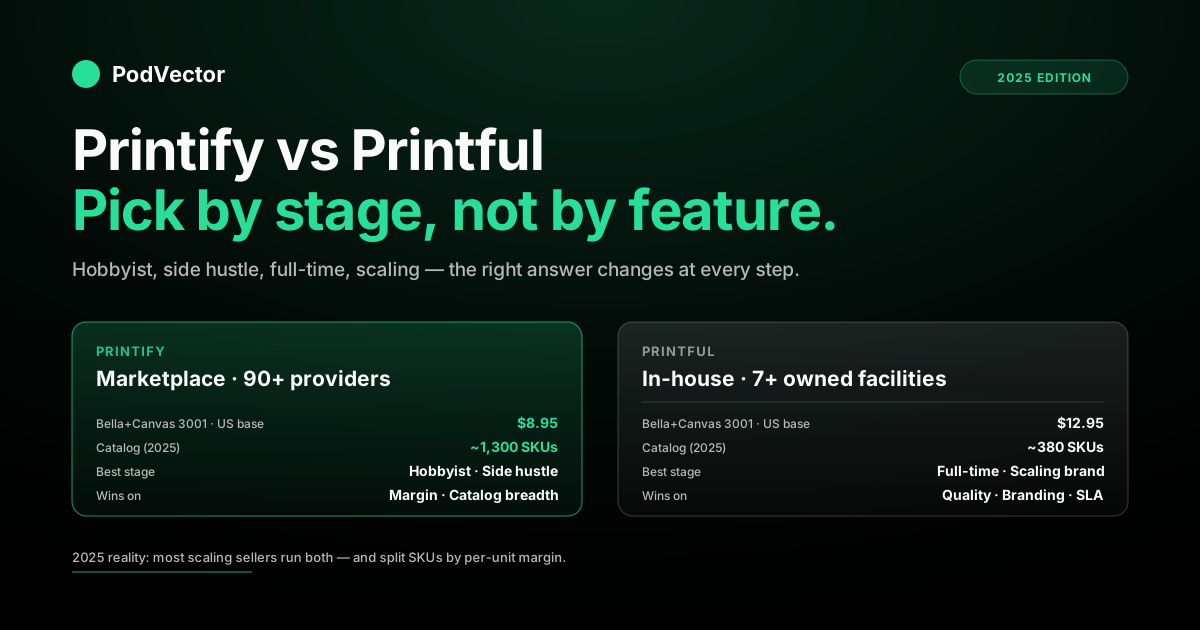
Quick Answer: Pick Printify for the lowest base costs and the widest catalog (~1,300 SKUs). Pick Printful for the most consistent print quality, deeper branding, and faster, set-and-forget international shipping. The right answer depends on your stage of business, not a generic feature checklist.
Hobbyists and side hustlers usually want Printify. Full-time, ad-driven, and scaling sellers usually want Printful — or both, split by SKU and region.
Most 2025 comparisons stop at sticker price. That's why they keep producing the wrong answer for any seller whose unit economics include refunds, ad spend, and per-region shipping. The right comparison weighs every dimension against your specific catalog and traffic mix.
Below is the 2025-current breakdown — what changed this year, where each platform leads, and the per-stage decision rules sellers actually use.
What changed in 2025
Most Printify vs Printful articles are recycled from 2023. The 2025 picture is different in three specific ways that change the math.
1. The merger is now operational reality. Printful and Printify merged on November 5, 2024 as equal partners under a single parent company. Through 2025 and into 2026, both platforms still ran separate accounts, separate dashboards, and separate pricing — but they began sharing fulfillment centers and backend technology behind the scenes. The strategic implication: a single corporate parent now controls both options, which weakens the case for treating "Printful or Printify" as a real diversification choice.
2. Tariff and freight pass-through hit base costs. 2025's tariff environment raised landed costs on imported blanks across the industry. Printify's marketplace model passes those changes through faster (different providers reprice on different timelines). Printful's owned-facility model absorbs more of the volatility into pricing tiers. Sellers checking base costs in Q4 2025 saw different numbers than they did in Q1.
3. AI design tools changed the SKU-launch ceiling. Midjourney, DALL·E, and Adobe Firefly made it trivial to generate dozens of niche designs per week. The bottleneck moved from making designs to knowing which ones to scale. That shift puts a premium on platforms with broad catalog coverage (Printify) and on per-SKU profitability data, which neither platform provides natively.
The rest of this guide reflects late-2025 pricing and policy. We'll flag the few places the merger has already changed something concrete.
Side-by-side snapshot
The 30-second version. Each line is unpacked in its own section below.
| Dimension | Printify | Printful |
|---|---|---|
| Business model | Marketplace, 90+ providers | In-house, 7+ owned facilities |
| Bella+Canvas 3001 (US base) | $8.95 (Premium tier) | $12.95 |
| Catalog size | ~1,300 SKUs | ~400–500 SKUs |
| Subscription | Free; Premium $29/mo | Free; Growth $24.99/mo; Business $49.99/mo |
| Median production time | 2–7 business days (provider-dependent) | 2–5 business days (97%+ within 5) |
| Defect / reprint rate | 1–5% (provider-dependent) | ~1% (consistent) |
| Branding (inside-collar, inserts) | Provider-dependent, limited | Full stack, all SKUs |
| Native integrations | Shopify, Etsy, WooCommerce, eBay, TikTok Shop, Wix, Squarespace, Amazon | Shopify, Etsy, WooCommerce, BigCommerce, TikTok Shop, Wix, Squarespace, Amazon, eBay |
| Strongest fit | Margin-led, breadth-led, trend-driven catalogs | Brand-led, ad-led, premium-positioned catalogs |
Pricing and subscription tiers
Printify is cheaper at the unit level on most apparel SKUs. That's the headline most articles lead with — and it's true on average — but the gap depends on which tier you're on, which provider you pick, and which garment you're listing.
Printify pricing in 2025: the free tier gives full access to the catalog at standard prices. Printify Premium runs $29/month and unlocks ~20% off the catalog, paying back at roughly 200 orders/month. There's no commission per order on either tier.
Printful pricing in 2025: the free tier has no commitment. Growth runs $24.99/month and discounts apparel by ~7% plus other category-specific perks. Business is $49.99/month with deeper discounts and additional API limits. No per-order commission.
On a Bella+Canvas 3001 unisex tee — the most-listed POD SKU — Printify Premium is roughly $4 cheaper per unit than Printful Growth in late 2025. On a heavyweight hoodie, the gap widens to $5–8. On premium-fabric Bella+Canvas blanks where Printful curates a tighter provider list, the gap narrows.
The gotcha: shipping. Printify routes each order to whichever provider was assigned to that SKU, and shipping is calculated against that provider's rate card. Printful auto-routes from the closest of its 7+ regional facilities. For US-domestic orders the difference is small. For international orders it can flip the total — a US-printed Printify tee shipped to Germany costs more than an EU-printed Printful equivalent on most rate cards.
For the full breakdown of Printful's tier structure, see the complete guide to Printful costs and fees. For the equivalent on Printify, see Printful vs Printify — same pricing, different framing.
Product catalog
Printify wins on catalog breadth — by a lot.
Printify's catalog hits ~1,300 SKUs across apparel, drinkware, home decor, accessories, pet products, and a growing list of niche categories. Because it's a marketplace, Printify can add a new product type as soon as one provider supports it. New niche SKUs arrive constantly.
Printful's catalog sits at ~400–500 SKUs heading into 2026, growing slower because every new product has to be qualified across Printful's owned facilities. The catalog is curated rather than exhaustive. Printful skips long-tail items — most pet products, most wall art categories, most drinkware variants Printify carries.
The implication is strategic, not just numeric. If your store is a 50-SKU branded apparel line, Printful's catalog covers it. If your store is testing 200+ trend-driven SKUs across categories, Printify is the only practical option — Printful simply doesn't carry enough of the catalog.
2025-specific note: AI-generated design pipelines have pushed many sellers toward higher SKU counts. That tilts the catalog axis toward Printify for any seller running a "test 100 designs, scale the 5 winners" playbook.
Print quality and consistency
This is where Printful wins, but the win is about variance, not the absolute ceiling.
Printful's owned facilities run standardized DTG and embroidery equipment with the same calibration across locations. Defect rates sit around 1% across volumes. The variance between an order from the LA facility and an order from the Riga facility is small.
Printify's quality is a function of which provider you pick. Top-tier providers — Monster Digital, SwiftPOD, OPT OnDemand — are competitive with Printful on print quality. Lower-tier providers vary. Across the marketplace, defect rates run 1–5% depending on provider, season, and SKU.
The practical Printify discipline is: pick top-rated providers, order samples before listing, lock SKUs to specific providers rather than letting the system route to the cheapest available. Sellers who do this hit Printful-comparable quality at Printify pricing. Sellers who don't get the spread.
For the full quality picture on Printful — including DTG vs DTF process specifics — see the complete Printful review.
Fulfillment and shipping
Printful is faster on production. Printify is more flexible on routing.
Printful's median production time runs 2–5 business days, with 97%+ of orders shipped within 5 days and many US orders moving in 2–3. The owned-facility network handles regional auto-routing — a Spanish customer's order prints in Riga; a Japanese customer's order prints in Tokyo. Shipping inside each region is fast and predictable.
Printify's median production time runs 2–7 business days, varying by provider. Top-tier providers match Printful's SLA; some lower-tier providers run slower in seasonal peaks. Printify Premium's Express Delivery option promises faster print-and-ship on eligible SKUs.
For Etsy and TikTok Shop sellers, the production-time gap matters. Both marketplaces weight on-time shipping in their ranking algorithms. A Printful default tends to clear those thresholds without configuration. A Printify default works only if the seller curates providers carefully.
For a deeper dive into Printful's shipping zones, rates, and SLA structure, see the complete guide to Printful shipping.
Integrations and ease of use
Both platforms cover the same major channels. The differences are in onboarding friction and ad-stack integration depth.
Native integrations both platforms support: Shopify, Etsy, WooCommerce, Wix, Squarespace, Amazon, eBay, TikTok Shop. Shopify is the most polished integration for both — install the app, connect, push products, sync inventory.
Printful-specific: deeper BigCommerce integration, native Walmart Marketplace support, and a slightly more reliable API for headless commerce setups. Printful's mockup generator outputs higher-resolution images than Printify's by default.
Printify-specific: broader catalog inside the same Shopify app means fewer "I have to use a second supplier for X" moments. Printify's Pop-Up Store gives sellers without a Shopify subscription a free hosted storefront.
For paid-advertising sellers, both platforms feed product data to Meta and Google catalogs through Shopify natively. Neither platform gives you per-SKU acquisition cost back — that's still a separate analytics layer. For more on Printful's full integration surface, see the complete guide to Printful integrations.
Design tools and customer support
Both platforms ship a free design editor that handles uploads, text, and mockups. The 2025 gap is generative AI.
Printify's built-in AI Image Generator turns a text prompt into print-ready artwork inside the editor — the easiest path for non-designers who want original graphics without leaving the dashboard. Printful's design suite is solid and polished, but its AI features are thinner; most Printful sellers still bring artwork in from an outside tool.
On support, Printful runs live chat, email, and a help center localized into multiple languages, with generally faster response times. Printify offers live chat, email, and a large community forum, plus Printify Connect for sellers who want to outsource buyer support. For an English-speaking solo operator either is fine; for a team scaling into the EU, Printful's localized support is the practical edge.
One operator note: neither design tool tells you which generated SKU will actually earn a contribution dollar. AI makes 50 designs in an afternoon; the hard part is killing the 45 that lose money on ad spend, which is a data problem, not a design problem.
Branding and customization
Printful wins this axis cleanly.
Printful supports inside-collar labels, custom packaging, branded inserts, custom packing slips, and per-product wash tags across most of its catalog. The branding stack runs on Growth and Business tiers, with Business unlocking the deepest options.
Printify supports inside-collar labels and limited inserts on a subset of providers — typically Monster Digital, SwiftPOD, and a few others — but not across the full marketplace. Custom packaging is rare. Branded inserts are provider-by-provider.
For a hobby store this doesn't matter. For a brand pursuing repeat customers, branded packaging is a measurable lift on review scores and second-order rates. The 2025 data from sellers running both still favors Printful on this axis by a meaningful margin.
Decision by stage of business
The platform-level "which is better" framing produces a useless answer for most sellers. The real answer changes by stage.
Stage 1 — Hobbyist or first store (0–20 orders/month): Pick Printify. Lower base costs preserve margin while you're still learning. Wide catalog gives you room to test SKU types. Free tier is enough — no need for Premium until you cross ~150 orders/month.
Stage 2 — Side hustle, profit-targeting (20–500 orders/month): Still usually Printify, now on Premium ($29/mo). At this stage, the ~20% Premium discount pays back on volume and the catalog breadth still matters as you're actively testing SKUs. Lock to top-tier providers (Monster Digital, SwiftPOD) to manage quality variance.
Stage 3 — Full-time, ad-driven (500–5,000 orders/month): Lean toward Printful. At this stage, defect-driven refunds compound across thousands of orders, and each refund chips at LTV/CAC. Printful's consistency is worth the higher base cost when paid traffic is doing the work. Branding starts paying back in repeat-customer rates.
Stage 4 — Scaling brand (5,000+ orders/month): Run both. At this volume, splitting SKUs between platforms based on per-SKU margin and per-region routing is straightforward to operate and meaningfully more profitable. We'll cover the run-both pattern in the next section.
For the deeper profitability lens at each stage, how to make money with Printful walks through the unit economics by volume.
When sellers run both
Most established POD sellers we've seen at the 5,000+ orders/month tier run both Printful and Printify in the same store. The pattern is consistent enough to be worth documenting.
Routing rule 1 — by garment. List each SKU with whichever supplier delivers higher per-unit contribution after fees, shipping, and refund cost. This usually means Printful for premium-fabric apparel and Printify for trend-driven, lower-margin SKUs.
Routing rule 2 — by region. Some sellers list the same SKU on both platforms, then route order fulfillment by ship-to region. Printful is set-and-forget for international auto-routing; Printify is cheaper if you list the same SKU through multiple regional providers.
Routing rule 3 — by channel. Etsy listings often default to Printful (faster SLA, lower defect rate matters for Etsy reviews). Shopify and TikTok Shop listings often default to Printify on margin-led SKUs.
The setup cost: per-supplier mockup generation, per-supplier sample ordering, and a routing layer in your storefront app. Most run this through Shopify's built-in fulfillment routing or a small custom script. The payback shows up in a 3–8 percentage-point lift in blended contribution margin for sellers who do it well.
For the full alternatives picture — including non-merged third options worth piloting in 2025 — see Printful alternatives. For other recent framings of the same comparison, see Printful vs Printify Comparison and Printify vs Printful.
The comparison every seller is actually doing
Every comparison guide above — including this one — frames the choice at the platform level. That framing produces a platform-level answer: pick A for breadth, pick B for branding.
The actual question every POD seller has to answer in 2025 is per-SKU. On your Bella+Canvas 3001 in heather grey, shipping to your top region, with your ad-blended customer acquisition cost, which supplier produces a higher contribution dollar per order? The answer flips by garment, region, volume, and season.
None of the 2025 comparison articles fill that gap. They quote averages — $4 base-cost difference, 99% accuracy, 1–3 day fulfillment — and stop there. Your P&L runs on specifics, not averages.
Closing that gap takes three pieces working together. Every order's supplier-charged cost has to flow into a single source of truth alongside revenue, ad cost, refunds, and processor fees. The math has to run per-SKU and per-supplier, so a tee profitable on Printify and a hoodie profitable on Printful both show up clearly. And the answer has to turn into an action fast enough to matter — switching a single SKU's supplier weekly is high-leverage if it actually gets done, useless if it sits in a spreadsheet.
That last step is what PodVector AI built Victor to do. Victor is an AI employee, not a dashboard: he runs on a unified data warehouse that ingests Shopify, Printful, Printify, Meta, and Google per-order data, then acts on it — re-routing a hoodie SKU to the supplier with the higher EU contribution margin, pausing the ad sets feeding a money-losing design, updating the listing — and asks for your approval before each material change. The answer isn't always Printful or always Printify. It's per-SKU, and a seller without per-SKU supplier economics is guessing on the most expensive lever in the business.
FAQs
Is Printify cheaper than Printful in 2025?
On most apparel SKUs, yes — Printify Premium beats Printful Growth by $1–4 per unit on tees and $5–8 per unit on hoodies. The gap narrows on premium-fabric SKUs where Printful's curated catalog edges out Printify's lower-tier providers.
Did the Printful-Printify merger change which platform I should pick in 2025?
Not yet, materially. Both platforms still ran separate accounts, dashboards, and pricing through 2025. The merger has not yet collapsed into a single product. The downstream implication: treating "Printful or Printify" as a real diversification hedge no longer holds — both flow back to the same parent.
Which is better for Etsy sellers in 2025?
Printful for new Etsy sellers. The tighter SLA and lower defect rate help with Etsy's ship-on-time and review-score ranking. Experienced Etsy sellers with mature listings and review buffers usually shift trend-driven SKUs to Printify for the margin advantage.
Which is better for Shopify sellers running paid ads?
Printful tends to win on paid social. The lower defect and reprint rate compounds across thousands of orders, and each return chips at LTV/CAC. For paid search and Google Shopping, where margin is more decisive, Printify's lower base costs often pull ahead — especially on lower-AOV SKUs.
Which has better international shipping economics?
Printful for low-config international shipping — auto-routing to EU, MX, JP, AU, and CA facilities is set-and-forget. Printify can be cheaper if you list the same SKU through multiple regional providers and route by ship-to region, but the setup is meaningfully more work.
Can I run both Printful and Printify in 2025?
Yes — most established POD sellers do. Both apps run in Shopify without conflict. Route different SKUs to different suppliers based on margin, geography, or quality requirements. The added work is per-supplier mockup generation and per-supplier sample ordering.
Did 2025 tariffs hit Printify or Printful harder?
Both saw upward pressure on imported blank costs. Printify's marketplace passes changes through faster — different providers reprice at different times — so sellers see more volatility on Printify base costs. Printful absorbs more of the volatility into pricing tiers, giving more stable per-unit cost month-over-month.
Which integrates better with TikTok Shop?
Both have native TikTok Shop integrations as of 2025 and both work. Printful's mockup generator is slightly more polished, which matters for TikTok Shop's image-heavy product cards. Printify's catalog breadth matters more if you're testing trend-driven SKUs Printful doesn't carry.
How do AI design tools change the Printify vs Printful decision?
They tilt the catalog axis toward Printify. AI tools like Midjourney and Adobe Firefly have made it trivial to generate dozens of niche designs per week, so the bottleneck moves from making designs to scaling the winners. Printify's wider catalog gives more room to test those designs across product categories Printful doesn't carry.
Let Victor run your supplier routing — with your approval.
The right Printify vs Printful answer changes by garment, region, and season. Spreadsheet comparisons go stale within weeks. Victor is an AI employee that pulls every order, supplier cost, ad spend, and refund into one live data layer — then acts: re-routing SKUs to the more profitable supplier, pausing losing ad sets, and updating listings, asking before each change. Hand off the busywork, keep the call.
Try Victor freeFor another recent take on the same axes, the 2025 comparison from Spocket covers similar ground with different weighting. To go broader on Printful, see the complete Printful guide. The full Printful comparison cluster lives at the Printful comparison hub, and the broader Printful topic at the Printful topic hub.