
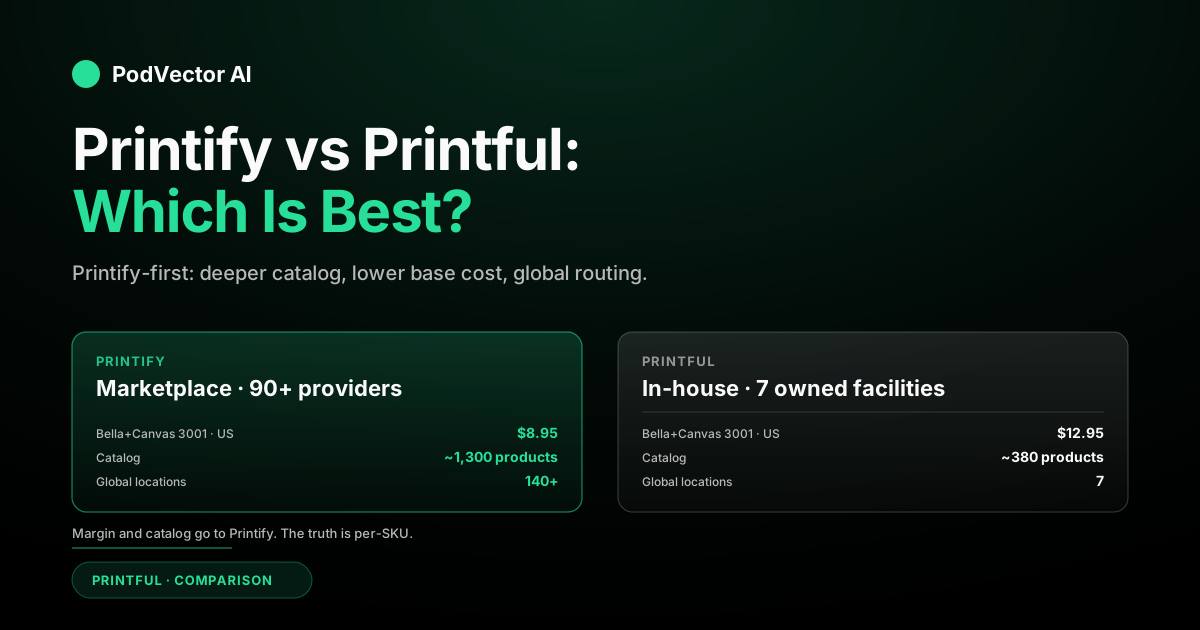
Quick Answer: If you're starting from Printify and weighing Printful, Printify usually wins on margin and catalog — a Bella+Canvas 3001 tee runs $8.95 on Printify Premium versus $12.95 on Printful, and the catalog is roughly 1,300 products versus 380.
Printful wins back the comparison only when you need predictable in-house quality, polished branding inserts, or tight Shopify-native workflows. The 2024 merger put both brands under one owner, but the two products still feel like different platforms in day-to-day use.
The honest answer is per-SKU, not per-platform. Some of your products will be more profitable on Printify, some on Printful — and the only way to know which is which is to look at real margin data, not list-price spreadsheets.
Printify vs Printful: 30-second comparison
This table is the fast answer. Every row is unpacked in its own section below.
| Axis | Printify | Printful |
|---|---|---|
| Bella+Canvas 3001 tee, US base cost | $8.95 (Premium) / $10.95 (Free) | $12.95 |
| Catalog size (2026) | ~1,300 products | ~380 products |
| Production model | Marketplace (90+ providers, 140+ locations) | In-house (owned facilities) |
| Median production time | 2–7 business days (provider-dependent) | 2–5 business days |
| Quality consistency | Variable — depends on which provider routes the order | High — same machines, same staff |
| Subscription tier | Premium $24.99/mo (up to 20% off) | Growth $24.99/mo (up to 33% off) |
| Branding inserts | Limited — varies by provider | Full — packing slips, stickers, custom labels |
| Best for | Margin-led catalogs, niche product hunters, global routing | Brand-led stores, premium presentation, US/EU mainstream |
What is Printify?
Printify is a print-on-demand marketplace. You design a product, pick a print provider from a list (often 5–15 options for the same blank), and Printify routes each order to that provider for production and shipping.
Printify itself doesn't print anything. It's a software layer between you and a global network of independent print shops — Monster Digital, Duplium, SwiftPOD, Print Geek, Dimona Tee, OPT OnDemand, and dozens more.
That model is why Printify can offer a Bella+Canvas 3001 tee for $8.95 on Premium. The providers compete with each other, and Printify takes a cut of the markup.
What is Printful?
Printful is a print-on-demand vertically integrated supplier. The same company that takes your order also runs the printing facility, hires the staff, owns the equipment, and handles every step through to the carrier handoff.
Printful operates fulfillment centers in the US, Mexico, Latvia, Spain, Australia, Canada, and Japan. Every order from your store routes to one of those facilities — there's no third-party provider in the loop.
That model is why Printful charges $12.95 for the same tee. You're paying for control, consistency, and a single point of accountability when something goes wrong.
Pricing and real margin math
Pricing is the loudest part of this comparison, and it's where Printify's marketplace model bites hardest.
Here's a Bella+Canvas 3001 tee priced at $24.99 retail, sold to a US buyer, with $4.99 flat shipping charged at checkout:
| Line item | Printify Premium | Printify Free | Printful Growth | Printful Free |
|---|---|---|---|---|
| Retail price | $24.99 | $24.99 | $24.99 | $24.99 |
| Customer-paid shipping | $4.99 | $4.99 | $4.99 | $4.99 |
| Base product cost | $8.95 | $10.95 | $8.68 | $12.95 |
| Actual fulfillment shipping | $4.45 | $4.45 | $4.69 | $4.69 |
| Subscription cost (per 100 orders) | $0.25 | $0 | $0.25 | $0 |
| Payment processing (~2.9% + $0.30) | $1.17 | $1.17 | $1.17 | $1.17 |
| Net per order, before ads | $15.16 | $13.41 | $15.19 | $11.17 |
Read that last row twice. The headline gap of "$8.95 vs $12.95" shrinks dramatically once you stack on subscriptions, fulfillment shipping, and payment fees. Printify Premium and Printful Growth land within $0.03 per order on this specific SKU.
The real difference is at the unsubsidized tier — Printify Free still beats Printful Free by $2.24 per order, which compounds to real money once you ship volume.
For more on which costs the headline number hides, our deeper Printful vs Printify breakdown walks through the same math from the Printful side.
Product catalog: 1,300 vs 380
Printify's catalog is roughly 3.4x bigger than Printful's. That's the clean number; the messier number is what actually matters to your store.
Printify carries product types Printful doesn't touch: doormats, beach towels, jigsaw puzzles, garden flags, ornaments, weighted blankets, mason jar lids, custom flags, niche pet products. If your brand lives in the long-tail accessory space, Printful simply doesn't have the SKUs.
Printful's catalog is curated. Tees, hoodies, sweatshirts, mugs, posters, hats, embroidery, premium bags. Inside that narrower selection, Printful tends to carry the higher-spec versions — heavier hoodie weights, embroidered labels, all-over print options that look retail-grade.
If you're a niche-hunter testing 30 SKUs across 8 product categories, Printify wins by default. If you're a brand-led store running 6 hero products in heavy rotation, Printful's curation is a feature, not a limit.
Provider routing — Printify's superpower and its tax
Provider routing is the single most important Printify concept and the one most comparisons skip.
When a customer orders a tee from your Printify-connected store, Printify checks which providers carry that exact SKU and routes the order to the one you've selected (or to its default). Different providers means different prices, different print methods, different shipping costs, and different production speeds — for the same shirt.
This is Printify's superpower. The same Bella+Canvas 3001 tee with the same artwork can be $6.49 from one provider and $9.95 from another. You can pick the cheapest, the fastest, the closest to your customer, or the highest-quality — your choice.
It's also Printify's tax. Quality varies by provider. Production time varies by provider. Customer service varies by provider. If your customer hates the print, you can't always assume the next reorder won't have the same issue — unless you switch providers, which means re-publishing the product.
Printful eliminates this entirely. You order, Printful prints, Printful ships. There's no provider to choose, no routing decision, no variability. You're paying $4 more per tee for that simplicity.
Print quality and consistency
Both platforms produce solid prints. Both occasionally produce duds. The difference is the shape of the variability.
Printful's quality curve is narrower. Same DTG (direct-to-garment) presses, same color profiles, same QC team. Your 200th order looks like your 1st. When something goes wrong, it's usually a one-off — a smudge, a misload, a missed stain check.
Printify's quality curve is wider, because every provider has its own equipment, ink stack, and QC process. Monster Digital is excellent on Bella+Canvas tees. Some smaller providers are inconsistent on dark garments. The provider list ranks providers by a quality score, but the score is a starting point, not a guarantee.
The fix on Printify is to order samples from your specific provider before launching a SKU. If the print holds up across 3 wash cycles, you've validated that combo. Don't extrapolate from one provider to all providers.
Fulfillment speed
Printful's median production time is 2–5 business days, and their in-house SLA keeps the spread tight — roughly 97% of orders ship within 5 days, and US orders frequently hit "shipped" status inside 48 hours of placement.
Printify's median is 2–7 business days, but the spread depends entirely on which provider routed your order. Top providers (Monster Digital, SwiftPOD) regularly hit 2 days. Slower providers can stretch to 7+ in peak season.
For US Q4 traffic, the safer bet is Printful or a top-tier Printify provider you've already validated. If you're routing through a random new Printify provider in November, you're taking a risk.
For more detail on Printful's shipping speed and zones, see our complete guide to Printful shipping. For Printify, see the complete guide to Printify shipping.
Shipping rates and global reach
Printify wins on global routing. With 140+ printing locations across the US, Canada, the UK, EU, Australia, and Asia, Printify can ship a UK order from a UK provider, a US order from a US provider, and so on — keeping shipping cheap and avoiding cross-border duties.
Printful has 7 fulfillment centers globally. That's enough to cover most major regions, but you'll occasionally see orders cross-shipped — a Canadian order ships from the US facility, an Australian order ships from Mexico — and the customer pays the time and customs cost.
For US-only stores, the difference is small. For stores selling globally, Printify's network meaningfully reduces shipping cost and delivery time.
Branding and customization
Printful is the clear winner on branding. Custom packing slips with your logo, branded tear-out labels, custom neck labels (DTG and embroidered), pack-in stickers, premium polybag inserts. The package looks like it came from your brand, not a fulfillment center.
Printify's branding is provider-dependent. Some providers offer branded inserts, some don't. Custom neck labels are inconsistent. The packing slip is generic on most providers, with the customer's order details and a small Printify mark.
If you're building a direct-to-consumer brand where unboxing matters — gift items, premium niches, repeat customers — Printful's branding alone can justify the higher base cost. If you're running a margin-first operation where the customer cares about the product, not the packaging, Printify's gap doesn't hurt.
Integrations and ease of use
Both platforms integrate with Shopify, Etsy, eBay, Walmart, TikTok Shop, WooCommerce, BigCommerce, Squarespace, Wix, and Amazon. Both have direct API access for advanced workflows.
Printful's integrations feel slightly more polished. The Shopify app is faster, the order sync is more reliable, and the design upload tool handles edge cases (like very large transparent PNGs) more gracefully.
Printify's integrations work well for 95% of cases but show their seams more often. Some users report syncing delays on high-volume Shopify stores during product update batches, and the Etsy integration occasionally requires a manual relink.
For a deeper look at how integrations affect day-to-day operations, see our complete guide to Printful integrations.
When Printify wins, when Printful wins
Printify wins when:
- You're testing 20+ SKUs and need a deep catalog to find winners
- Margin matters more than packaging — you're optimizing for profit per order
- You sell globally and need region-routed fulfillment
- You're price-sensitive and the $24.99/mo Premium subscription pays for itself in 4–5 orders
- Your niche needs products Printful doesn't carry (puzzles, doormats, weighted blankets, garden flags)
Printful wins when:
- Brand presentation matters — gifts, premium niches, repeat customers, unboxing-driven categories
- You can't tolerate quality variance — every order needs to look identical
- Your catalog is narrow (5–15 hero products) and you want curated, premium versions
- You're US/EU-focused and don't need Asia/Pacific routing
- You'd rather pay $4 more per tee than manage provider-routing decisions
Most stores end up using both. The right answer depends on the SKU, not the company.
The Printful + Printify merger — what it means for you
Printful and Printify officially merged on November 5, 2024, bringing both brands under one parent company. More than a year on, the two brands still operate as separate products with separate dashboards, catalogs, and pricing — the merger changed the corporate ownership, not the day-to-day seller experience.
The two platforms remain meaningfully different. The data table at the top of this article still applies. Different catalogs, different pricing, different production models, different account onboarding — you sign up for, and run, each one independently.
The longer-term question is whether the combined entity will eventually rationalize products, prices, or providers. As of mid-2026, no major pricing changes or catalog cuts have been announced, and both apps install side by side in the same Shopify store. We'll update this section if that changes.
The practical takeaway: don't switch platforms or freeze your decision because of the merger. Pick the one that matches your store today.
The per-SKU truth most comparisons skip
Every Printify-vs-Printful comparison ends with a verdict like "use Printify for margin, Printful for branding." That advice is fine for choosing a default. It's wrong for running a profitable store.
Here's what actually plays out once you're shipping volume:
Tees with simple front prints: Printify wins. Bella+Canvas 3001 at $8.95 vs $12.95 is a $4 unit-margin gap that's never going to flip on quality.
Heavy hoodies and zip-ups: Often Printful wins. The premium gildan/independent trading hoodies on Printful are higher GSM than most Printify equivalents, and customers can feel the difference.
All-over-print products: Printify wins by default. Printful only offers AOP on a limited subset; Printify has dozens of AOP options across providers.
EU-bound orders: Printify often wins. Their EU provider network keeps shipping cost down vs. Printful's Latvia-only EU facility.
Mug and ceramic orders: Mixed. Provider quality on Printify mugs varies — some are better than Printful, some are worse. You have to test.
This is the answer most comparison guides won't give you, because they don't have your real margin data. The truthful version is: some of your products will be more profitable on Printify, some on Printful, and the only way to know is to look at the numbers per-SKU.
That's a hard problem to solve manually. You'd need to pull base costs, real fulfillment shipping, ad spend, refund rate, and processing fees per SKU per supplier — and refresh it as supplier prices and provider routing change.
This is exactly the gap Victor closes for PodVector AI users. Victor is an AI employee connected to your store, ad accounts, and POD suppliers. He sees your orders, ad spend, and supplier costs together, so you can ask "which supplier is more profitable for my Bella+Canvas 3001 tees in the US over the last 60 days?" in plain English and get the answer with real margins, not list prices.
Victor answers the question. Tomorrow's roadmap is acting on it — flagging SKUs that should switch suppliers, simulating margin lift before you swap, and routing future runs to whichever supplier the data says wins.
Pros and cons summary
| Pros | Cons | |
|---|---|---|
| Printify | Lower base costs, ~1,300 product catalog, global provider network, EU fulfillment, deeper niche selection | Quality varies by provider, longer median production time, weaker branding, integration occasionally flaky |
| Printful | Consistent quality, faster fulfillment, premium branding inserts, polished integrations, single point of accountability | $4+ higher base cost on most tees, smaller catalog, fewer EU/global locations, no AOP across full catalog |
Verdict: which to pick in 2026
If you're starting from scratch and want one platform: Printify. The margin advantage is real, the catalog is deeper, and the quality gap has narrowed substantially. You can always layer Printful in later for hero products that need premium presentation.
If you're running a brand where unboxing matters and your customers are repeat buyers: Printful. The branding inserts and quality consistency justify the cost.
If you're already running a real store: both, mixed by SKU. Run Printify for margin-led SKUs, Printful for premium-led SKUs, and use the per-SKU profit data to decide which goes where.
For a complementary view starting from the Printful side, see our companion Printful vs Printify breakdown. For the broader category landscape including Gelato, Gooten, and CustomCat, our Printful alternatives roundup is the place to go next. The full Printful guide and Printify alternatives roundup cover each platform end-to-end. The full Printful comparison cluster lives at the Printful comparison hub, with the broader Printful topic at the Printful topic hub. For an outside perspective, PrintOnDemandBusiness ran their own 5,500-word breakdown of the same matchup in 2026.
FAQs
Is Printify cheaper than Printful?
Yes, on most tees and standard apparel. A Bella+Canvas 3001 is $8.95 on Printify Premium versus $12.95 on Printful — a roughly 31% lower base cost. The gap shrinks when you account for subscriptions, fulfillment shipping, and payment fees, but Printify is still cheaper per order in almost every category.
Is Printful better quality than Printify?
Printful is more consistent. Quality on Printify varies by provider — top providers (Monster Digital, SwiftPOD) match or beat Printful, while smaller providers can underperform. If consistency matters more than the absolute peak, Printful wins. If you're willing to validate per-provider, Printify's best providers hold up.
Can I use Printify and Printful together?
Yes. Most established POD stores run both — Printify for margin-led SKUs, Printful for premium-led SKUs. Both integrate with Shopify, Etsy, and the major sales channels independently. There's no conflict between the two apps in the same Shopify store.
Did Printful and Printify merge?
Yes — they officially merged on November 5, 2024, putting both brands under one parent company. The two products still operate as separate platforms with separate pricing and dashboards. Day-to-day seller experience hasn't materially changed, and we'd recommend not letting the merger weigh into your platform choice today.
Which is better for beginners — Printify or Printful?
Printful is gentler for absolute beginners because there's no provider-routing decision to make. You upload a design, pick a product, set a price — done. Printify requires picking a provider for each product, which is a smarter long-term skill but adds a step on day one.
Which has better Shopify integration, Printify or Printful?
Printful's Shopify integration is slightly more polished — faster sync, cleaner edge case handling, more reliable for high-volume stores. Printify's Shopify integration is solid for most stores but occasionally lags on bulk product updates. Neither is bad; Printful is just smoother.
How do I know which platform is more profitable for my products?
Don't trust list-price spreadsheets — look at real per-SKU margins. Pull base cost, real fulfillment shipping, ad spend, processing fees, and refunds per SKU per supplier. PodVector AI's Victor agent does this automatically by reading your live store, ad, and supplier data and answering plain-English questions like "which supplier is more profitable for my best-selling tees?"
Stop guessing which POD supplier wins. Ask Victor.
Printify and Printful both have spreadsheets that say they're cheaper. Your real margin data — base costs, real shipping, ad spend, refunds, fees — tells the actual story. Per-SKU. Per-region. Per-month.
Victor connects to your store, ad accounts, and POD suppliers, sees all of it together, and lets you ask the question in plain English: which supplier is most profitable for my Bella+Canvas tees in the US right now?
Try Victor free