
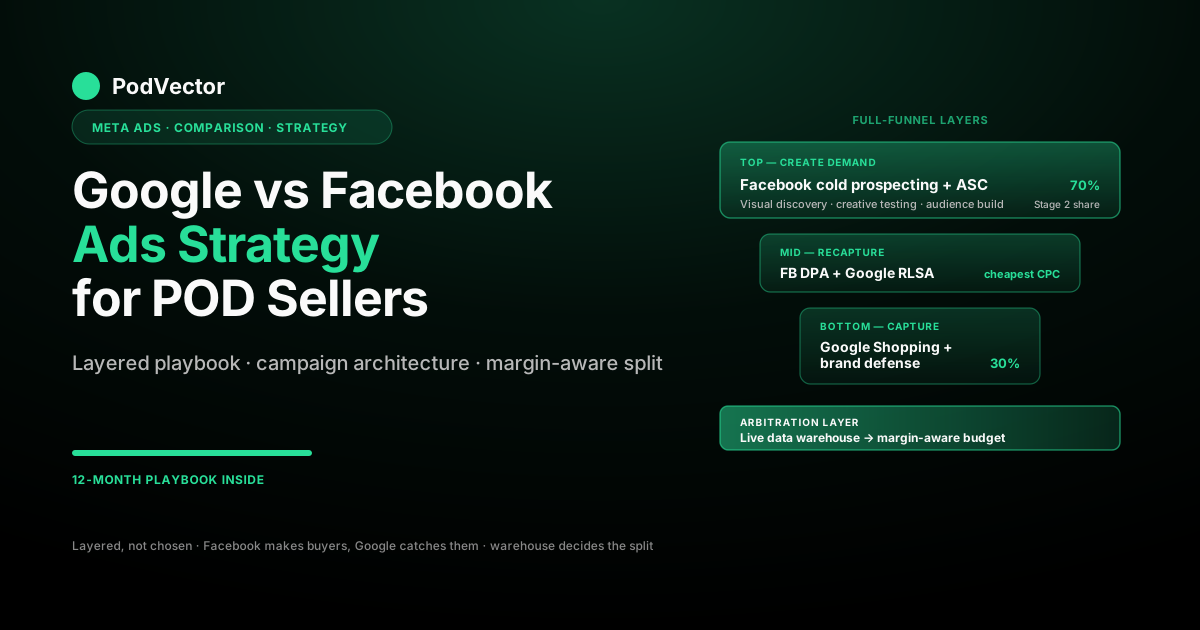
Quick Answer: The best strategy isn't picking one platform. It's a layered playbook: Facebook owns the top of the funnel (visual discovery, design testing, audience build), Google owns the bottom (high-intent capture, brand defense, retargeting cleanup), and your warehouse owns the budget arbitration between them.
For POD sellers specifically, that layered strategy has to be tuned for slim margins. Each campaign role earns its slot only when the unit economics actually clear after Printify or Printful supplier cost. The layered approach without the margin overlay is generic ecommerce advice, not POD strategy.
This guide lays out the full strategic playbook: campaign architecture, budget allocation method, sequencing, measurement, and the POD-specific adjustments that change which campaign types deserve real spend.
The strategic frame: full-funnel, not platform-vs-platform
Most "Google vs Facebook" advice frames the comparison as a choice. That framing only matches reality at the very smallest stage, where you can fund exactly one channel.
Past that stage, the strategic question changes. It stops being "which platform" and becomes "which platform owns which job in my funnel."
The two jobs in any ecommerce funnel
Every ecommerce funnel has two structural jobs: create demand and capture demand. Create-demand work convinces a stranger that your product is worth wanting. Capture-demand work serves the storefront when wanting becomes intent.
Facebook is structurally a create-demand system. Its placements run inside scrolling feeds where nobody asked for your product, so the algorithm has to invent the want from visual signal and audience overlap.
Google Shopping is structurally a capture-demand system. Its placements run inside search results where the wanting already exists. The algorithm only has to win the comparison among storefronts the buyer is already considering.
Why "vs" is the wrong frame past hobby stage
If you only run create-demand work, every customer you make goes shopping at a competitor's storefront when wanting hardens into intent. You paid to create a buyer for someone else.
If you only run capture-demand work, you fight for the small slice of buyers whose want already exists. You're priced into a comparison auction, not building net-new demand.
The strategic answer is layering, not choosing. Facebook makes buyers, Google catches them at intent, and the question is what share of budget goes to each layer at your stage.
Campaign architecture: which campaigns play which roles
"Run both" is too vague to act on. The specific campaign types matter more than the platform.
Facebook's campaign roles
Inside Facebook, three campaign archetypes do most of the work for POD stores. Each plays a different strategic role.
Advantage+ Shopping (ASC) is the catalog-driven workhorse. It serves dynamic ads from your product feed across Facebook, Instagram, Reels, and Marketplace placements. Its strategic role is scaled prospecting once you have 30+ creative assets and a working pixel.
Cold prospecting with broad audiences is the creative-testing layer. Static budgets at $25–50/day, broad targeting, fresh creative every week. Its role is funneling new audiences and learning which design hooks convert.
DPA retargeting closes the loop. Dynamic Product Ads served to cart abandoners and product-page visitors. Its role is recovering 8–14% of would-be lost sales for the cheapest CPC in your account.
Google's campaign roles
On Google, four campaign archetypes earn slots in a POD strategy. Each does something the others can't.
Standard Shopping is the controllable workhorse. Manual product groups, manual bidding, real reports on which SKUs profit. Its role is winning the auctions on named-product searches without PMax black-box behavior.
Performance Max (PMax — Google's all-in-one auto-targeted campaign type) is the scale lever once Standard Shopping has proven product-market fit. PMax expands into Display, YouTube, and Gmail inventory; it earns its slot when you can afford to give up channel transparency for incremental volume.
Brand defense is the cheapest revenue protection in the entire ad stack. A $5–10/day exact-match Search campaign on your store name and SKU names blocks competitors from buying traffic you already earned organically.
Search remarketing (RLSA) bids harder on warm audiences when they search relevant terms. Its role is recapturing cart abandoners at the moment they re-engage from a different device.
The strategic map
The right way to look at this is by funnel role, not by platform.
| Funnel role | Best campaign | Why |
|---|---|---|
| Create demand for a new design | Facebook cold prospecting (broad) | Visual signal + algorithm finds new audiences |
| Scale a proven design | Facebook ASC + Google Standard Shopping | ASC compounds, Shopping captures the search demand created |
| Defend brand SERP | Google brand-defense Search | Exact-match, cheapest defense available |
| Recover cart abandons | Facebook DPA + Google RLSA | Multi-touch retargeting beats single-platform |
| Test five new designs fast | Facebook cold prospecting only | Lower CPC, faster signal on creative |
| Capture late-stage comparison shopping | Google Standard Shopping | Comparison happens in search, not feed |
Notice that "platform" never appears as a row by itself. Every row is a job. The platform is a consequence of the job.
Budget allocation strategy by stage
The strategic budget split changes as your store grows. The rule isn't a fixed ratio — it's a function of which funnel jobs your unit economics can afford to fund.
Stage 1: $0–5K MRR
One platform. Facebook only, $25–75/day. This is not a "both platforms" strategy because you cannot fund both at their respective learning floors.
The strategic role is creative testing and audience discovery. You are paying to learn which designs convert and what your buyer looks like. Brand defense doesn't matter yet — you don't have branded search volume worth defending.
Stage 2: $5–20K MRR
Layered, 70/30 Facebook lead. Facebook still does the bulk of demand creation; Google shows up as Standard Shopping ($50/day) plus brand defense ($5–10/day).
The strategic logic: you now have searchable demand for a handful of named SKUs and a small but real branded search volume. Both deserve capture. The 70/30 split keeps Facebook's create-demand engine funded while not leaving searchable conversions on the table.
Stage 3: $20–50K MRR
Layered, 60/40 Facebook lead. Facebook ASC takes over from cold prospecting as the main scale lever. Google Shopping splits between Standard Shopping for transparency and PMax for incremental scale.
The strategic shift: organic non-branded search has crossed 20–25% of revenue, which means the searchable demand for your category has grown enough to justify pulling Google's share up. Facebook ASC handles the volume that creative testing built.
Stage 4: $50K MRR+
Margin-driven, roughly 50/50 with weekly shifts. The split is no longer set by stage rule. It's set by warehouse-attributed margin per channel.
If Google margins ran 1.4x Facebook margins last week, Google gets more this week. If Facebook produced 70% of acquisitions while Google captured the cheapest re-engagement traffic, that's the new base case. The dashboard ROAS numbers don't decide this — your warehouse data does.
Sequencing strategy: which platform first, when to add the second
Order of operations is a strategy decision in itself. Get it wrong and one of the platforms looks broken when really it was underfunded.
The sequencing rule
Start with the platform that matches your bottleneck. For most POD stores, the bottleneck at hobby and side-hustle stage is "nobody knows my designs exist." That's a create-demand problem, which is Facebook's job.
If your bottleneck is "people search for products like mine but find competitors first" — typical for licensed designs in a popular fandom or hobby-specific gear with named SKUs — the bottleneck is capture-demand. That's Google's job, and you start there.
The trigger to add the second platform
The trigger isn't a calendar date. It's a structural condition.
For Facebook-first stores, add Google when you cross $5K MRR and non-branded organic search clears 10% of monthly sessions. That second condition matters more than the revenue threshold. Sessions from organic search prove that demand has become searchable.
For Google-first stores, add Facebook when your AOV is below $40 and single-purchase Google math no longer covers acquisition cost. Facebook's multi-item DPA carts are the path to mathematically defensible CAC at sub-$40 AOV.
The reverse-trigger nobody talks about
Sometimes the strategic move is removing a channel, not adding one. If your Facebook account has been at sub-1.0x net margin (after Printify or Printful supplier cost) for three consecutive months despite creative refresh and audience tests, the platform isn't fit for your product right now.
Pause it cleanly, route the budget to Google, and revisit Facebook in two quarters when you have new design seasonality data. Strategic discipline includes turning off what doesn't work.
Creative and feed strategy
Strategy isn't only budget allocation. The creative pipeline and feed quality each platform requires is a separate strategic decision.
Facebook's creative cadence
Facebook fatigues. The same image at the same audience hits a CTR ceiling in 7–14 days, and ROAS slides as the algorithm exhausts the highest-converting portion of its addressable audience.
Strategically, this means you need a creative pipeline producing 8–15 fresh variants per week to feed an ASC campaign at scale. If your design pipeline can only produce 2 variants per week, Facebook is going to grind, and the right strategic move is staying on Google Shopping where creative is the product image and doesn't fatigue the same way.
Google's feed quality work
Google Shopping's lever is feed quality, not creative volume. Title structure, GTIN attribution (a Global Trade Item Number — the barcode-style product ID Google uses for identity matching), product type taxonomy, custom labels for bidding tiers, and per-SKU images all change auction performance.
Strategically, every hour spent improving your Merchant Center feed compounds across every Google campaign. Every hour spent on a Facebook creative serves one ad before fatigue starts. Both are real work, but they're different categories of work.
The creative-vs-feed allocation
POD operators with limited time should allocate roughly 70% of their non-budget creative time to Facebook variants and 30% to Google feed quality. The reason is fatigue: feed work compounds, but Facebook's fatigue clock keeps ticking whether or not you produce.
Measurement strategy: the warehouse view
The reason Google vs Facebook strategies fail in practice isn't bad targeting or weak creative. It's bad measurement.
The double-counting problem
Both platforms claim 100% credit for the same conversion when you run both. Sum the dashboard ROAS columns and you'll typically see 40–80% more "ad-attributed revenue" than your Shopify total.
Strategy decisions made on inflated numbers are wrong by construction. The first measurement work is honest reconciliation against your actual order ledger.
The warehouse-attributed strategy
The right architecture is a unified data warehouse — Snowflake, Redshift, BigQuery, or Databricks all work — that pulls raw event logs from Facebook and Google, joins them against Shopify order IDs, and applies a multi-touch attribution model.
That gives you a single source of truth for which channel actually contributed to a sale, with deduplicated touch credit. Budget decisions made against that view stop being arguments and start being calculations.
What Victor does for POD operators specifically
PodVector AI's Victor agent answers questions like "what was Facebook's net margin last week after Printify supplier cost?" and "which Google campaign produced the highest-margin orders, not just the highest-revenue orders?" against your live data warehouse.
Today, Victor answers; tomorrow, Victor will act — pausing campaigns and shifting budget when the math says the platform stopped earning its share. The point of the architecture is taking budget decisions off platform-reported ROAS and onto warehouse-attributed margin. Try Victor free to see your true cross-channel ROAS in 60 seconds.
POD-specific strategic adjustments
Generic ecommerce strategy assumes 50–75% contribution margin. POD doesn't have that, so several "best practice" rules from generic-ecommerce guides actively lose POD operators money.
The margin reality
A $26 unisex t-shirt sold through Printify carries roughly $11–13 in supplier cost, $4.50–5.50 shipping, and $1.20 in Shopify platform fees. That leaves $5.50–9.30 of contribution margin per unit before any ad dollar touches the math.
That changes the maximum tolerable customer acquisition cost. A generic ecommerce advisor recommending a $15 target CPA is recommending a money-losing strategy at POD margins.
The strategic adjustment
Instead of CPA targets, POD strategy should use multi-purchase-aware MER targets (marketing efficiency ratio — total revenue divided by total ad spend, blended across all paid channels).
For a typical POD store with $5–9 contribution per unit and 1.4 items per order on Facebook, the strategic blended MER target is 2.0–2.4x. Below 2.0x, the math doesn't survive. Above 2.4x, you're under-spending and leaving growth on the table.
Printify vs Printful supplier-cost variance
Printify routes orders to whichever supplier is cheapest for a given garment, so per-SKU margin varies inside a single Facebook ASC. Printful uses one in-house production network with consistent base costs.
The strategic implication: Printify-based stores need per-SKU margin tracking before they can run a credible Google Shopping strategy. A $26 tee from one Printify provider can carry $11 cost while the same tee from another provider carries $14 — that's a 30% margin gap inside the same campaign. Our Printify vs Printful cost comparison walks through the per-SKU math that has to underlie any multi-channel strategy.
Strategic mistakes that quietly leak margin
The five mistakes that show up in nearly every POD strategy audit.
1. Treating PMax and Advantage+ Shopping as equivalent
They're both "automated all-in-one" campaign types, but PMax expands into Display, YouTube, and Gmail inventory that has no Shopping intent, while Advantage+ stays within Meta's feed and Reels placements where catalogs perform. Comparing them as equivalents hides a 2–3x placement-quality gap.
2. Optimizing on platform ROAS instead of warehouse margin
A campaign at 3.0x reported ROAS can lose money once you net out Printify supplier cost, shipping, and platform fees. Strategic decisions made on platform-reported numbers are wrong by construction at POD margins.
3. Splitting a small budget across both platforms
$50/day split 25/25 starves both algorithms. Each platform has a learning floor — roughly $25–50/day for Facebook ASC and $50–100/day for Google Shopping smart bidding. Underfunded learning produces noise, not data.
4. Skipping brand defense once branded search exists
Once your monthly branded search volume crosses 200, competitors will buy your store name for $0.30–0.50 per click. A $5/day exact-match Search campaign blocks them. Most stores never run it, and the leak compounds month over month.
5. Running creative tests on warm audiences
Testing new creative against retargeting pools produces inflated CTRs that don't survive when the same creative runs to cold. Creative testing belongs on cold prospecting; ASC's job is scaling what already proved itself, not screening it.
The 12-month strategic playbook
For a typical POD operator selling original designs, here's the strategic sequence that works.
Months 1–3 (Stage 1): Facebook only, $25–50/day. Cold prospecting with broad targeting. Goal: 30–50 conversions of pixel learning + creative-fit signal.
Months 3–6 (late Stage 1, early Stage 2): Facebook scales to $75–150/day. Add Google brand defense at $5–10/day once branded search clears 200/month. Standard Shopping pilot at $30/day on the 5–10 SKUs with strongest named-search demand.
Months 6–9 (Stage 2): Layered 70/30 split. Facebook ASC takes over from cold prospecting as main scale lever, with cold prospecting at $25/day for ongoing creative testing. Google Standard Shopping at $50/day, brand defense at $10/day, RLSA recovery layer at $15/day.
Months 9–12 (Stage 2 to Stage 3 transition): Layered 60/40 split. PMax pilot at $50/day for incremental scale once Standard Shopping has 60+ days of clean data. Continuous creative pipeline producing 8–15 weekly Facebook variants. Warehouse-attributed margin reporting feeding weekly budget decisions.
Year 2+: Margin-driven 50/50 with weekly shifts. Both platforms running their full archetype lineup. Budget moves come from warehouse data, not from either dashboard's ROAS. Victor or equivalent agent surfaces the next-dollar question every Monday morning.
For the broader cluster context, the Meta Ads comparison cluster hub covers every Meta vs alternative breakdown, and the Meta Ads topic hub spans strategy, attribution, integrations, and ad types end-to-end. The strategic foundation for the whole comparison lives in our Google Ads vs Facebook Ads for POD sellers guide, and the timing-trigger view is in our when to use Google Ads vs Facebook Ads breakdown. The Meta-side strategic anchor is the complete Meta Ads playbook for print-on-demand sellers. For the cost math underneath the strategy, see Google Ads vs Facebook Ads cost for POD.
External reference for the generic ecommerce framing this strategy adapts: Shopify's Google Ads vs Facebook Ads guide.
FAQs
What's the single most important strategic principle for POD operators?
Layer, don't choose. Past Stage 1, Facebook and Google do different jobs in the same funnel — Facebook makes buyers, Google catches them. The strategic decision is the budget split between the two layers, not picking a winner.
How should I split budget between Google and Facebook?
By stage. Hobby ($0–5K MRR): Facebook only. Side hustle and early business ($5–20K): 70/30 Facebook lead. Established ($20–50K): 60/40 Facebook lead. Scaled ($50K+): roughly 50/50 with weekly margin-driven shifts. The exact ratio matters less than letting warehouse data adjust it once you have data.
Should I run Performance Max or Standard Shopping first?
Standard Shopping. PMax is a black box — it expands into Display, YouTube, and Gmail without granular reporting, which makes it impossible to debug at POD margins. Run Standard Shopping for 60+ days first to establish per-SKU profitability, then add PMax for incremental scale once you know which SKUs deserve the spend.
How does Advantage+ Shopping fit into a POD strategy?
ASC is the scale lever once cold prospecting has produced 30+ creative assets and a working Conversions API setup. Don't run ASC as your starter campaign — it needs creative volume and conversion signal that hobby-stage stores haven't built yet. Cold prospecting first, ASC second.
What's the right brand defense strategy?
One Google Search campaign on exact-match keywords for your store name and 5–10 top SKU names, $5–10/day, separate ad copy mentioning your store explicitly. Run it once your monthly branded search volume crosses 200. It's the cheapest revenue protection in the entire ad stack.
How should I measure cross-channel performance?
Not by summing platform-reported ROAS — both platforms claim full credit for the same conversion. Use a unified data warehouse that pulls raw event logs from both, joins against Shopify order IDs, applies a multi-touch attribution model, and nets out Printify or Printful supplier cost to give you margin-aware channel performance.
Does the strategy change for Printify vs Printful sellers?
Yes. Printify's routing across multiple suppliers means per-SKU margin varies inside a single campaign, so per-SKU bidding and per-SKU custom labels matter more for Printify-based Google Shopping. Printful's consistent in-house cost lets you treat the catalog as one margin tier, which simplifies the Google Standard Shopping setup.
When does the layered strategy fail?
Three cases. First, when one platform has been at sub-1.0x margin for three months — pause it, don't keep funding. Second, when your creative pipeline can't produce 8+ weekly variants — Facebook will grind, run Google-only. Third, when your AOV is above $50 and single-purchase Google math already covers CAC — Facebook's multi-item advantage matters less, so a Google-heavy split makes more sense.
What's the role of email and SMS in this strategy?
Email and SMS aren't part of the Google vs Facebook layer — they're the retention layer underneath. Both paid channels feed first-purchase customers; email/SMS deliver second and third orders that turn break-even acquisition into profitable LTV. A working Klaviyo flow can lift POD store contribution margin per customer by 30–50%, which is what makes the paid layer's CAC math survivable.
See the warehouse view of your Google vs Facebook strategy
Facebook says one number. Google says another. Your bank account says a third. Victor joins both platforms' raw event logs against your Shopify orders and Printify or Printful supplier costs, and gives you a single source of truth for which channel is actually earning its share.
Today, Victor answers questions like "what was Facebook's net margin last week?" and "which Google campaign produced the highest-margin orders?" Tomorrow, Victor will act — pausing underperformers and shifting budget when the math says it's time. And see your true cross-channel ROAS in 60 seconds.
Try Victor free