
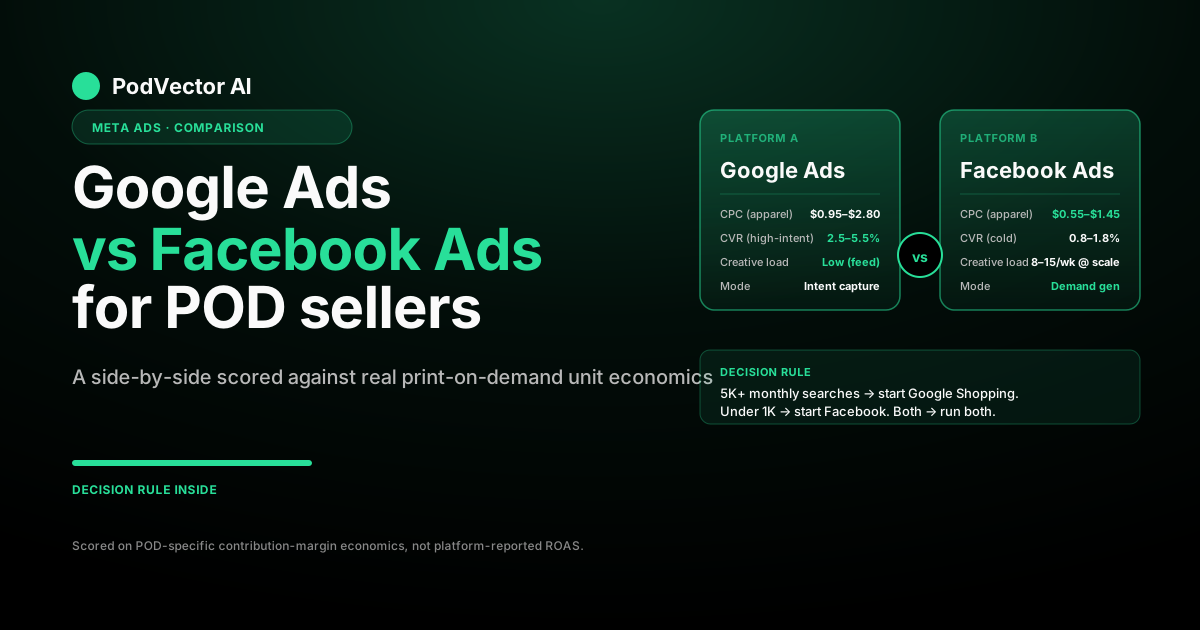
Quick Answer: For most print-on-demand sellers in 2026, the honest answer is "start with Facebook Ads, layer Google Ads as soon as you have branded search volume." Facebook wins for POD on creative breadth, interest-and-lookalike targeting that finds niche audiences nobody is searching for, and lower minimum efficient spend (about $30/day vs Google Shopping's roughly $50–$100/day floor). Google wins on attribution honesty, conversion rate inside high-intent niches, and shoppable feeds that don't need new creative every week.
The platform that "wins" depends on three things specific to POD: whether your niche has real search volume on Google, whether your contribution margin after Printify or Printful supplier costs absorbs platform CPCs, and whether your design pipeline can keep up with Meta's creative-volume treadmill. This guide walks the comparison through real POD unit economics, names the niches where each platform actually wins, and gives you a decision rule you can apply on a Friday afternoon.
Why this comparison is different for POD
Almost every "Google Ads vs Facebook Ads" comparison published this year — including the well-circulated Shopify breakdown — is written for a brand with fixed COGS, healthy 60–80% gross margins, and a small SKU lineup. Print on demand is the opposite shape.
Your supplier cost varies by garment, supplier, color, size, and ship-to country. Your contribution margin after the Printify or Printful base, shipping, payment processing, and platform fees lands somewhere between 20% and 35% on a normal month. Your SKU count is in the hundreds, and you launch new designs faster than any single platform's algorithm can fully learn them.
That structural mismatch matters because it changes the arithmetic of the comparison. A direct-to-consumer brand with $8 cost on a $30 product can absorb Google's average $2.69 CPC on a 1.5% conversion rate and still come out ahead.
A POD seller selling a $26 hoodie with $14 supplier cost, $5.50 shipping, and a $1.20 platform fee has roughly $5.30 of contribution before any ad cost — meaning the same $2.69 CPC at the same 1.5% conversion rate burns roughly $179 in ad cost to generate $5.30 of contribution per sale. The comparison stops being "which platform has cheaper clicks" and starts being "which platform's economics survive a 20–35% margin wrapper."
The second thing POD changes is the relative value of each platform's strongest signal. Google's strength is intent capture: somebody already typed "german shepherd dad t-shirt" into the search bar, which means click-through-to-conversion in high-intent POD niches frequently runs 2.5–5.5%. Facebook's strength is demand generation against interest and lookalike audiences — great when your niche-design appeal is broad but visually interrupting, less useful when you need to find people already shopping. The "best" platform isn't the one with cheaper CPCs in some abstract benchmark — it's the one whose structural strength matches the shape of your specific designs' demand.
The third thing POD changes is the cost of the wrong bet. A DTC brand spending $5,000 on a channel that doesn't work has burned a test budget against healthy margins.
A POD seller burning the same $5,000 on the wrong platform without a baseline of true contribution margin can end the month with negative contribution and no way to know whether the channel is structurally wrong or just under-optimized. That's why this comparison leads with economics. Every section below holds Google and Facebook against the unit economics POD operators actually face.
Head-to-head: the comparison table
Here is the full side-by-side, scored against POD's specific structural needs. Numbers are 2026 ranges from public benchmark data and our own client cohort; the verdicts column is the POD-specific call.
| Factor | Google Ads | Facebook Ads | POD verdict |
|---|---|---|---|
| Avg CPC (apparel/accessories) | $0.95–$2.80 | $0.55–$1.45 | Facebook cheaper, but Google converts harder |
| Avg CPM (apparel/accessories) | $3–$9 (Display) / $30–$60 (Search) | $11–$26 | Apples-to-oranges; use CPA instead |
| Conversion rate, prospecting | 2.5–5.5% (high-intent search) | 0.8–1.8% (cold prospecting) | Google wins where search volume exists |
| Minimum efficient daily spend | ~$50–$100 per Shopping campaign | ~$30 per ad set | Facebook lower floor — better under $5K MRR |
| Creative volume burden | Low (feed = creative) | High (8–15 net-new creatives/week at scale) | Google massively easier for high-SKU POD |
| Attribution reliability post-iOS | Cleaner (last-click, less event-based) | Drift of 15–40% common | Google more honest for thin-margin POD |
| Demand generation strength | Weak (only captures existing demand) | Strong (interest + lookalike) | Facebook required for novelty designs |
| Niche/audience targeting depth | Keywords only | Detailed targeting + lookalikes | Facebook for hobby/identity niches |
| Retargeting quality | Solid (RLSA, dynamic remarketing) | Best on the open internet | Facebook still wins retargeting |
| Shopify integration maturity | High (Google & YouTube channel) | High (Meta sales channel + CAPI) | Tie |
| Time-to-first-profitable-campaign | 2–6 weeks (Shopping) | 3–8 weeks (prospecting) | Google often faster for searched niches |
| Scaling ceiling | Capped by search volume | Effectively uncapped | Facebook for $50K+ MRR ambition |
Read row by row, this looks like a draw. Read against your specific niche and MRR stage, it isn't. The next sections walk each axis in detail and end with a decision rule.
Cost: CPC, CPM, and what they mean at 25% margin
The cost story most comparison articles tell is "Facebook clicks are cheaper, Google clicks convert harder." That's true at the headline level. For POD it's incomplete because the only number that matters is cost per acquisition divided by contribution margin, not raw CPC.
Run the math on a representative POD product. Take a $26 t-shirt with $9 supplier cost, $4.50 shipping, $1.10 payment processing, and a $0.40 platform fee. Contribution before ads is $11. Now fold in ads.
- Facebook prospecting at $0.85 CPC and 1.2% landing-page conversion. $0.85 ÷ 0.012 = $70.83 cost per acquisition. Net contribution per sale: $11 − $70.83 = −$59.83. Profitable only if AOV is much higher or the cohort buys repeat.
- Google Shopping at $1.65 CPC and 3.4% conversion in a high-intent niche. $1.65 ÷ 0.034 = $48.53 cost per acquisition. Net contribution per sale: $11 − $48.53 = −$37.53. Better, but still negative on first order.
- Facebook retargeting at $0.55 CPC and 4.5% conversion. $0.55 ÷ 0.045 = $12.22 cost per acquisition. Net contribution per sale: $11 − $12.22 = −$1.22. Roughly break-even; profitable with any LTV uplift.
The headline "Facebook is cheaper" misses what's actually happening. Facebook prospecting is the most expensive cohort on this hypothetical product.
Google Shopping is mid-pack. Facebook retargeting is the only profitable layer at $0 LTV — which is exactly why every scaled POD store ends up running both platforms in concert rather than picking a winner. We walk this in more detail in the cluster's Google Ads vs Facebook Ads cost comparison for POD.
The real cost question for POD is: at my contribution margin, what blended CPA can I afford? If your contribution margin is 30%, your maximum first-order CPA on a $30 AOV is $9 — which neither Google nor Facebook prospecting hits in apparel. That gap is why POD sellers have to either operate with negative first-order economics and recoup via repeat purchase or LTV, or restrict their spending almost entirely to retargeting and bottom-of-funnel campaigns where conversion rates fold the platform's CPC down to something workable.
Intent capture vs demand generation
The clearest mental model for choosing between Google and Facebook is the intent-versus-demand distinction. Google captures existing demand. Facebook creates demand among people who weren't shopping. For POD, both modes matter, but they fit different niches very differently.
Google Shopping wins outright for POD niches with real search volume. If your niche revolves around an identifiable interest term — "german shepherd mom shirt," "nurse practitioner christmas mug," "veteran flag hoodie" — Google has people already searching those exact phrases, and Shopping lets you put a product image and price directly in front of them.
The conversion rate is high because the buyer self-selected. The attribution is clean because the click is one tap from the product page. The creative burden is essentially zero because Google generates the visual from your feed.
Facebook wins outright for POD niches without search volume. The viral inside-joke t-shirt, the niche identity hoodie that targets a community nobody searches for in those exact words ("dachshund yoga teacher" only resonates if Facebook surfaces it to the right interest-cluster lookalike), the trending news-cycle quote design — Google has zero search volume for any of these in their first six weeks of life. Facebook is the only platform that can build demand for a product nobody knew existed.
The mistake POD sellers make is assuming their niche fits one mode. Most niches fit both, in different proportions.
A "firefighter spouse" t-shirt niche has roughly 8,000 monthly searches on long-tail variants — small but real, which makes it a Google candidate at modest spend. The same niche has roughly 400,000 people in identifiable Facebook interest clusters and lookalike-eligible communities — much bigger reachable audience, but cold and requires creative to interrupt their feed. The right answer is usually "Google for the searchers, Facebook for the lurkers, and let retargeting catch the overlap."
If you want a structured way to decide, the when to use Google Ads vs Facebook Ads piece walks the decision tree by niche size and MRR stage. The short rule: if your top three keyword clusters have 5,000+ combined monthly searches, start Google Shopping first.
If they have under 1,000, start Facebook first. If they're in between, run both at minimum efficient spend and let CPA decide the budget split inside thirty days.
Targeting: keywords vs interests, lookalikes, and creators
Google's targeting is one-dimensional in a useful way: it shows your ad to people who type a thing. The targeting "model" is the keyword list plus the match types you bid on.
That makes it shallow but predictable. You're not guessing whether a 28-year-old male in Ohio who liked a firefighter Facebook page is interested — you know the searcher typed "firefighter wife shirt." For POD niches with dense keyword volume, that one-dimensional targeting is a feature, not a limitation.
Facebook's targeting is multi-dimensional and getting blurrier. iOS-driven signal loss has eaten a lot of Meta's historical interest precision since 2021. Detailed targeting still works for hobby and identity niches — POD's bread-and-butter — but the layers that used to compound (interest plus behavior plus household income) have collapsed into broader matching. Lookalike audiences from a high-quality customer file are now the most reliable POD targeting on Meta, and they require enough first-party purchase data to seed (typically 500+ customers, or 1,000+ for a 1% lookalike that performs).
The targeting features unique to each platform shift the answer further:
- Google's RLSA (Remarketing Lists for Search Ads) lets you bid more aggressively on people who already visited your site when they search again — a clean retargeting path with much lower abandonment than Facebook display retargeting.
- Google's Performance Max finally became workable for POD in 2025 with brand exclusions and audience signals, though it still over-rotates into branded search if you don't fence it.
- Facebook's Advantage+ Shopping Campaigns automate most ad-set work and have moved the needle for many POD stores — but require tight pixel and CAPI setup to deliver, and their broad-audience approach burns budget against impressions outside your niche if your creative isn't tight.
- Facebook's creator and Spark Ads paths let you whitelist organic creator content as paid ads. For POD stores with creator partnerships, this is a structurally cheaper creative source than Meta has any equivalent for on Google.
For a deeper walk on targeting structures specifically for POD on Meta, see the complete Meta Ads playbook for POD sellers. For Meta's full ad-format range, the complete guide to Meta ad types for POD covers what each format actually does in production.
Creative: the volume treadmill nobody warns POD sellers about
The single biggest hidden cost in choosing Facebook over Google for a POD seller is creative production. Meta's algorithm chews through ad creative at a rate that surprises every operator the first time they scale past $2K/day in spend. The benchmarks we see across our POD client cohort:
- $1K/day spend on Meta: 4–6 net-new creative variants per week to keep CPA stable
- $3K/day spend: 8–15 net-new variants per week
- $8K/day spend: 20–30 net-new variants per week
"Net-new" here means structurally distinct creatives — different hooks, different formats, different angles. Color-swaps and aspect-ratio crops don't count.
Producing that volume without an in-house creator or a dedicated agency relationship is the number one scaling bottleneck POD stores hit on Meta. Google has no such requirement.
A Google Shopping campaign uses your product feed images directly and learns against the bid, not the creative. A Search campaign uses up to 15 headlines and 4 descriptions in Responsive Search Ads, which take an afternoon to write once and roughly thirty minutes a month to refresh.
This is the single biggest argument for "start with Google" if your niche has search volume. The hidden labor cost of running Meta is real and rarely priced into POD's per-design profitability math. We see it most clearly in the complete guide to Meta Ads ROAS and attribution for POD — when a Meta-only POD store finally tracks creative cost as a line item in COGS, reported ROAS that looked acceptable often turns out to be break-even or worse.
The exception is if you or a co-founder are comfortable on camera and can produce native UGC-style video at volume. In that case Meta's creative treadmill becomes a feature: you have a marginal-cost-near-zero creative pipeline that almost no other POD store can match, and Meta's algorithm rewards that volume disproportionately. If the founder isn't comfortable on camera and doesn't have a creator relationship, Google is structurally cheaper to operate.
Attribution: which platform lies less to a POD seller
Attribution drift is where most "Facebook beat Google in our test" claims fall apart at the bank-statement level. Meta's default 7-day click + 1-day view attribution model overstates true incremental revenue more than Google's last-click model because it claims credit for view-based conversions Google would attribute elsewhere. The drift varies by category, but for POD apparel and accessories we see 15–40% overstatement consistently when comparing Meta-reported ROAS to bank-deposit revenue cross-checked against orders.
For a 30% contribution margin POD store, a 25% attribution overstatement is the difference between profitable scale and slow margin erosion. Reported 2.4x ROAS that's actually 1.8x means a campaign you thought was earning $1.40 of contribution per dollar is actually earning $0.54. Multiply that across a $5K/day budget and you're losing $4,300 a month while the dashboard says you're winning.
Google is not innocent here — Performance Max in particular is opaque about which placements drove which conversions, and Search ads claim credit for branded searches that would have happened anyway. But the magnitude is smaller. The platforms differ structurally:
- Google uses a tag-based last-click model that's relatively iOS-resilient and matches third-party analytics tools more closely.
- Meta uses an event-based pixel that lost a chunk of its iOS signal in 2021 and now relies heavily on modeled conversions and Conversions API server-side feeds to fill the gap. Properly configured CAPI helps significantly; many POD stores haven't deployed it correctly.
The practical fix for a POD seller running both platforms is to never trust either dashboard's reported revenue. Reconcile against your Shopify or BigCommerce post-purchase order data weekly, calculate true contribution margin with itemized supplier costs from Printify or Printful, and treat the platforms' reported ROAS as a directional signal rather than a financial number.
Product feeds: where POD breaks Google Shopping
One of Google Shopping's structural advantages — auto-generating creatives from your product feed — is also where many POD stores trip. A clean Google Shopping feed needs accurate GTINs (or correct identifier_exists flags), valid Google product taxonomy, complete availability and pricing signals, and unique titles and descriptions per variant. Many Printify and Printful Shopify apps export incomplete feeds that Google penalizes or disapproves outright.
Specific POD feed problems we see most often:
- Trademark and brand name disapprovals. Designs that reference protected brands ("Disney," "NFL," team names) get Shopping listings disapproved. Even non-infringing designs sometimes trigger automated reviews.
- Missing GTINs on POD products. Most POD garments don't have GTINs. The fix is setting
identifier_exists: noin the feed, which many Shopify Google channel apps don't do correctly without manual intervention. - Product taxonomy mismatches. Google's taxonomy is granular ("Apparel & Accessories > Clothing > Shirts & Tops"). POD apps often default to a generic category that triggers low-quality scoring.
- Price-supplier mismatches. If you price aggressively and your supplier base raises rates, your live retail price can drift below your supplier base — Google Shopping doesn't catch that, but your contribution margin does.
Facebook's Catalog has its own version of these problems, but they bite less hard because Facebook doesn't reject feed entries the way Google does. A misformatted Facebook Catalog product still serves; a misformatted Google Shopping entry gets disapproved and produces zero impressions.
For a POD seller deciding between platforms, the operational reality is that Google Shopping requires roughly 10–15 hours of feed cleanup work per quarter to keep clean. Facebook Catalog requires about 3–5 hours.
The decision rule by niche and MRR stage
Here is the rule we apply with our own POD client cohort, based on niche search volume and current MRR. Treat it as a starting point, not a law.
- Pre-revenue / under $2K MRR, no proven design winner yet. Start Facebook Ads. Minimum efficient spend is lower, you need creative discovery to find a winner, and Google Shopping requires SKUs that have proven they sell to be worth feed work. Use $30/day across two creative-test ad sets.
- $2K–$10K MRR, niche has 5K+ monthly searches. Add Google Shopping at $50–$100/day on your top 5 SKUs. This is usually the highest-leverage channel addition a POD store under $10K MRR can make.
- $2K–$10K MRR, niche has under 1K monthly searches. Stay Facebook-primary. Layer Facebook retargeting and Advantage+ Shopping. Don't fight Google for traffic that doesn't exist.
- $10K–$50K MRR, multi-niche store. Run both. Facebook for prospecting and creative discovery, Google Shopping for high-intent capture, and a small Google Brand campaign to defend your branded-search SERP from competitors.
- $50K+ MRR. Both platforms plus TikTok Ads. Meta's scaling ceiling and Google's search-volume cap individually constrain growth past this revenue band; the answer is platform diversification, not platform optimization.
For a structured walk through every channel POD operators consider — not just Google and Facebook — the cluster's pillar guide on Meta Ads vs alternatives for POD compares all eight realistic options against POD unit economics.
Running both: the integrated playbook
Most scaled POD stores end up running both platforms because they cover different parts of the funnel. The integrated playbook we deploy and recommend has four moving pieces.
Facebook does prospecting and creative discovery. Top-of-funnel cold audiences, broad lookalikes, interest-cluster targeting, Advantage+ Shopping for proven SKUs. The job here is finding new customers and validating which creative angles work. Budget allocation is typically 50–65% of paid spend at $5K–$15K MRR, dropping toward 35–45% as Google scales.
Google Shopping captures the demand Facebook creates. When a Facebook prospecting creative goes well, branded searches and category-adjacent searches spike on Google within days. Google Shopping should be running on those queries before the Facebook campaign starts so the spillover converts cleanly. Budget allocation: 25–40% at most MRR stages.
Facebook retargeting plus Google RLSA catch the overlap. Visitors who saw a Facebook creative and didn't convert often search Google in the next 24–72 hours for variations. Google RLSA bids more aggressively on those repeat searchers; Facebook retargeting catches the ones who scroll back. Budget allocation: 10–15%.
Google Search defends branded keywords. Once your store has any meaningful brand recognition, competitor stores and POD aggregators bid on your brand terms. A small ($150–$400/month) branded-search campaign is the cheapest defensive moat available. Budget allocation: 2–5%.
The hard part of running both platforms isn't the campaign structure — it's reconciling which channel actually drove which sale, since both platforms claim credit for the same conversions. The cluster's complete guide to Meta Ads + Shopify integration for POD walks the integration plumbing, and the Meta Ads ROAS and attribution guide covers how to reconcile both platforms' reported numbers against actual bank-deposit revenue.
Five mistakes POD sellers make in this comparison
Across hundreds of POD sellers we've reviewed, five mistakes show up over and over when picking between these two platforms.
- Comparing reported ROAS as if both numbers mean the same thing. A 3.0x reported on Meta and a 3.0x reported on Google are not the same. Meta's drift is larger. Reconcile both against bank-deposit revenue weekly before comparing.
- Underestimating Meta's creative-volume burden. Stores benchmarking Meta against Google on dollars-in-dollars-out frequently exclude the labor cost of producing 8–15 creatives a week. When that cost gets folded back into per-design profitability, Google often wins outright in searched niches.
- Trying Google Shopping with a Printify-default product feed. Default exports from POD apps typically include disapproval-triggering elements. Cleaning the feed before launching is the difference between Shopping working and Shopping rejecting half your catalog.
- Picking one platform and refusing to add the second. Past $5K MRR, the two platforms cover different parts of the funnel. Refusing to add the complement leaves money on the table that competitors who run both will capture.
- Not pricing in true contribution margin per channel. A campaign hitting 2.5x reported ROAS on a 25%-margin POD product needs reported ROAS of about 4.0x to be break-even after itemized Printify or Printful supplier costs. Most POD sellers who think they're profitable on Meta haven't run that math.
For a structured walk through Meta-specific economics, the complete Meta Ads playbook covers the campaign structures we recommend across MRR stages. The Meta Ads topic hub indexes every supporting article in this cluster, and the Meta Ads comparison cluster has the platform-by-platform deep dives.
FAQs
Is Google Ads or Facebook Ads cheaper for print on demand?
Facebook is cheaper on raw CPC ($0.55–$1.45 vs Google's $0.95–$2.80 in apparel). Google is cheaper on cost-per-acquisition in niches with real search volume, because its conversion rate is roughly 2–3x higher. The "which is cheaper" answer depends entirely on whether your niche has searches, which is why the platform comparison can't be answered without naming the niche.
Should a new POD seller start with Facebook or Google?
If you have less than $2K in MRR and no proven design winners yet, start with Facebook. The minimum efficient daily spend is lower (~$30 vs Google Shopping's ~$50–$100), and Facebook's creative-discovery feedback loop helps you find your winning designs faster than Google can capture searches you don't yet have. Add Google Shopping once you have proven SKUs and a niche with measurable search volume.
What's the realistic ROAS to expect on each platform?
For POD apparel and accessories in 2026, prospecting Meta campaigns typically report 1.6x–2.4x ROAS, retargeting reports 4.5x–8x, and Google Shopping in proven niches reports 2.8x–4.2x. Reported numbers overstate true ROAS by 15–40% on Meta and 5–20% on Google. Your real contribution-margin ROAS — the only number that matters for thin-margin POD — is whatever those reported numbers minus the drift, divided by your true CAC, not the platform's claimed CAC.
Can I run both platforms on a $1,500/month budget?
Yes, but barely. A practical $1,500/month split is roughly $900 on Facebook (one prospecting ad set + one retargeting ad set, $30/day combined) and $600 on Google Shopping ($20/day on your top 3 SKUs). Below this budget, focus on a single platform first — splitting too thin under-funds both into noise.
How does iOS attribution affect this comparison?
iOS-driven signal loss hurt Meta more than Google because Meta's attribution model relied more heavily on third-party-cookie-equivalent event signals. Properly configured Conversions API recovers a meaningful portion, but Meta's reported ROAS still drifts more than Google's. For POD sellers with thin contribution margin, that drift is a large practical reason to lean Google when search volume permits.
Does Facebook Ads still work for POD in 2026 with all the iOS changes?
Yes, but the bar is higher than it was in 2019. Facebook Ads still works for POD when you have a strong creative pipeline (8+ net-new creatives a week at scale), CAPI configured correctly, and a clear understanding that reported ROAS overstates true ROAS by a meaningful margin. The stores most successful on Meta in 2026 are the ones who treat creative volume as a core operating discipline rather than an afterthought.
What about Google Performance Max for POD?
Performance Max became legitimately workable for POD in 2025 with brand exclusions and audience signals. The catch is that it over-rotates into branded search if you don't fence it, and its placement opacity makes it hard to know where your spend actually goes. For POD stores under $20K MRR, we recommend starting with standard Google Shopping rather than Performance Max — the diagnostic clarity is worth more than PMax's marginal automation gains at that scale.
Stop arguing platform CPC. Track real contribution by channel.
Every POD seller arguing Google vs Facebook is arguing platform-reported numbers. The number that actually matters — true contribution margin per channel after itemized Printify or Printful supplier costs — almost nobody tracks live. Victor connects directly to your Shopify, Printify, Printful, Meta, and Google ad accounts and puts your orders, supplier costs and ad spend side by side, so he can answer "which platform earned me a dollar today?" instead of "which platform claimed it earned me a dollar." and see your real channel-level profit before your next ad-budget reallocation.
Try Victor free