
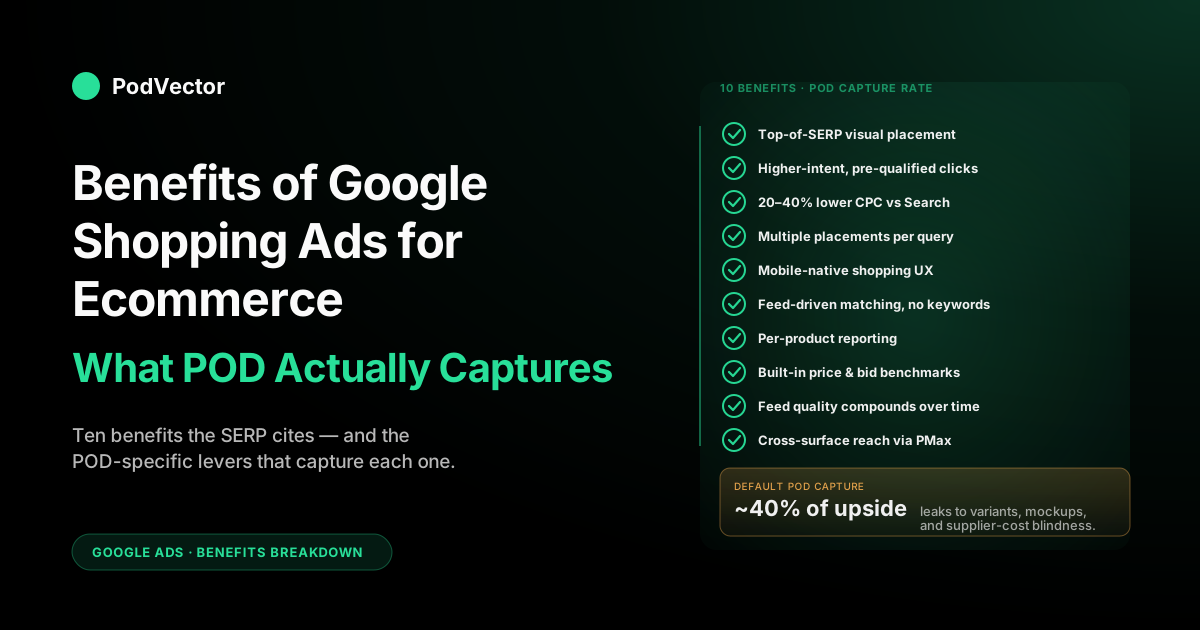
Quick Answer: Google Shopping Ads give ecommerce sellers higher-intent traffic, richer pre-click product display, lower CPCs than text Search, and a cleaner mobile-buy path — all of which translate to a 30–63% lift over traditional Search for typical retailers. For print-on-demand stores those benefits are real but conditional. Variant explosion, mockup-only imagery, and Printify and Printful's per-order supplier costs each absorb a slice of the upside unless you engineer the feed, the bidding, and the measurement loop around POD economics. This guide walks the ten benefits the SERP cites, what each one looks like for a POD store specifically, and how to actually capture it instead of leaving it on the table.
What Google Shopping Ads are in 2026
Shopping Ads are product-listing units that surface on Google Search, the Shopping tab, Images, YouTube, Gmail, the Display Network, and — increasingly — inside AI Mode and Gemini result panels. They're triggered by user queries Google's models read as commercial intent and matched against your product catalog rather than against keywords you bid on directly. The unit shows a photo, title, price, and store name before the click; the shopper sees what they're getting, decides whether they want it, and clicks only if they do.
That last sentence is the entire reason Shopping Ads outperform text Search for retail: the ad does pre-qualification work that, in a text-only ad, the landing page has to do. The benefits below all derive from that one structural difference.
The complication for POD is that the same display format that helps a brand with unique photography hurts a store using supplier mockups identical to fifty other Printify resellers. We'll get there.
1. Visual product placement at the top of the SERP
Shopping units occupy the carousel above the organic results — and frequently above the Search ads too — for any query Google judges to be product-shaped. For "men's funny dad hoodie" or "engineer coffee mug," that's prime real estate that text ads simply can't compete for visually. The shopper sees your product image, your price, and your brand name without scrolling.
For a POD store, this benefit is real but conditional. The carousel rewards images that look like products in use, not blank-supplier flat-lay renders. If your store-app sync is pulling Printify or Printful's default mockup, you're getting impressions but ceding click share to the seller two slots over who replaced the supplier image with a Placeit lifestyle render. The visibility is granted; the CTR is earned by the image.
2. Higher-intent clicks (and what that means for POD)
Because a Shopping Ad shows the price and the photo before the click, shoppers self-filter. They don't click your $34 hoodie if their intent maps to a $19 Amazon basic; they don't click the matte mug if they wanted glossy. The traffic that reaches your product page has already decided it's interested in your specific product at your specific price.
The standard ecommerce data point is up to a 63% improvement in campaign performance over text Search; conversion rates on Shopping traffic typically run 1.5–2× the text-Search baseline for the same product. POD stores see that same ratio, but the lifted conversion rate is masking a quieter problem: Google reports that performance against revenue, not contribution after supplier cost.
A 4% conversion rate at a $30 AOV looks great until you subtract the $14 Printify base, $5.50 shipping, and $1.50 in fees and find the per-order contribution is $9 — which has to clear ad spend before a dollar of profit lands. The intent quality is genuinely higher; the question is what you do with it. The Google Shopping Ads ecommerce strategy guide for POD walks the breakeven math in detail.
3. Lower CPCs than text Search
Across most retail categories, Shopping CPCs run 20–40% below the text-Search equivalent for the same query. The mechanic is straightforward: the auction includes feed quality and image relevance signals on top of bid and Quality Score, so a well-optimized product listing can win placement at a lower bid than a text ad targeting the same intent. For a POD seller, that delta is the difference between profitable and breakeven on thin-margin SKUs.
The asterisk: Shopping CPCs in apparel — the dominant POD category — have crept up 15–25% year over year as more sellers move into the surface and more dropshippers compete on the same blanks. The 2026 floor for "men's t-shirt" intent is around $0.85–$1.40 on Standard Shopping in the US, materially higher than it was in 2023.
The benefit is real; the moat is shrinking. Tight feed engineering and strict bid floors per margin tier are how you stay ahead of the CPC creep instead of being ground down by it.
4. Multiple placements per query
For a single shopper query, more than one of your Shopping Ads can appear simultaneously, and a Shopping unit and a text Search ad from the same advertiser can co-occur. That doubles the possible reach for a given search compared to text Search's one-ad-per-domain-per-query rule.
For POD, this benefit can backfire if you ignore the variant problem. A single design in six colors and five sizes generates 30 SKUs in your feed — Google can serve multiple of them in the same auction, and unless you've set item_group_id correctly, your color variants will compete against each other and inflate your effective CPC for the same conversion.
The fix is feed architecture, not bidding. Set the item_group_id to the design SKU, pick a canonical color (typically black for apparel, white for mugs), and suppress the secondary variants in Shopping via the excluded_destination attribute. You keep the multi-placement benefit; you stop paying for it twice.
5. A mobile-native shopping experience
The vast majority of US ecommerce traffic now comes from mobile, and Shopping Ads are designed for mobile-first display: tappable product cards, in-line price comparison, and the 2026 in-line checkout for participating retailers in AI Mode. A shopper who searches "funny mom mug" on their phone in a Costco checkout line can see your product, tap it, and complete the purchase without a desktop session.
POD sellers benefit from this disproportionately because gift purchases — a huge share of POD demand — are mobile-impulse-driven. The Father's Day surge, the teacher-appreciation week spike, the dog-mom holiday: those are mobile traffic events.
Shopping Ads capture them better than any other Google ad format. The constraint is checkout: if your Shopify or storefront mobile checkout is a six-step disaster, the prequalified mobile click converts at half the rate of the same desktop click. Mobile checkout audit is upstream of any Shopping benefit you'll see.
6. Automation that doesn't require keyword lists
Standard Search needs a keyword list, match types, negative-keyword maintenance, and ad copy variants per ad group. Shopping needs a feed; Google reads the title, description, attributes, and category and matches your products to queries it judges relevant. For a POD catalog with hundreds of designs, that's a labor-cost reduction worth real money.
The trap for POD: the automation only works as well as the feed. Auto-generated titles from Printify and Printful — "Unisex Heavyweight Cotton Hoodie" — read identically to fifty other stores selling the same blank.
Google's matching algorithm has nothing to differentiate them and falls back on bid and historical CTR, both of which favor incumbents. Spending a weekend rewriting your top 30 SKU titles with design intent and gift-occasion language ("Funny Dad Joke Hoodie | Father's Day Gift | Unisex Heavyweight") typically lifts CTR 30–60% from the baseline. The automation is a benefit; the feed is the lever you actually pull.
7. Granular per-product reporting
Shopping reports drill down to the individual SKU level: impressions, clicks, click-through rate, cost, conversions, and conversion value, segmented by item ID and date. Combined with Merchant Center diagnostics, you can identify which products are getting served, which are getting suppressed by feed warnings, and which are converting at what cost.
For POD, that granularity is genuinely useful — and dangerously incomplete. Google's reporting stops at revenue.
It doesn't subtract Printify's per-unit base cost, Printful's shipping, the platform fees, or the rejection-and-reprint cost on damaged orders. The "winning" product in Google's interface can be the one losing you the most money in your bank account.
The honest reporting loop has to combine Google's per-SKU spend with Printify or Printful's per-order supplier cost from the supplier API or CSV export. Most stores skip this reconciliation and discover six months in that their best Shopping campaign was bleeding $0.50–$1.50 per order. The complete guide to Google Ads + Shopify integration for POD covers the data plumbing.
8. Competitive benchmarking inside the platform
Google Ads exposes price benchmarks (your price vs the average price for similar products on Shopping), bid benchmarks (the typical winning bid for your category), and product benchmarks (how your CTR compares to category peers). For a category as crowded as apparel, this is the cheapest competitive intelligence available.
POD-specific use: the price benchmark tells you instantly whether you're priced into a margin trap. If Google reports the average price for "men's hoodie" in your category is $24 and you're at $34, you're competing against blanks-only sellers who can sustain prices you can't match.
Either move your design positioning upmarket (gift, occasion, niche audience) so price isn't the comparison point, or accept that you need to differentiate on creative and image quality enough to justify the premium. Either path is a strategy decision the benchmark surfaces faster than any external research would.
9. Feed quality compounds over time
Unlike Search, where a new keyword starts fresh every time, Shopping rewards feeds that have history. Products that have accumulated impressions, clicks, and conversions earn impression share that new SKUs in the same category have to fight for. A POD store that has run the same hero product for 18 months will see materially better CPCs on it than a dropshipper launching the same design today.
This is structural moat for POD sellers willing to commit to a curated catalog. The instinct in print-on-demand is to spam the feed with hundreds of designs and hope something catches.
The Shopping algorithm punishes that approach: low-impression products dilute the feed-quality signal for the whole account, and the products you actually care about get less impression share than they would have if they were the only thing in the catalog. Pruning ruthlessly — keeping only the top quartile of designs in the active feed and graveyarding the rest — typically lifts the active SKUs' impression share 20–40% within 60 days. Same ad spend, more from the products you actually want to scale.
10. Cross-surface reach via Performance Max
Performance Max bundles Shopping placements with YouTube, Display, Gmail, Discover, and Search partner inventory into one campaign Google optimizes across all surfaces. For a brand with tested creative and stable margins, PMax is the strongest scaling tool the platform has shipped.
For POD, PMax has three specific failure modes worth flagging because the benefit is real once you avoid them: (1) it optimizes to revenue not contribution, so it'll happily push your $14-supplier-cost hoodie to scale at a 3× ROAS that's cash-negative for you; (2) it pulls budget toward your worst margins because mugs and stickers convert at higher rates than apparel even when they're loss leaders; (3) it's a black box on query data, which makes diagnosis impossible. The hybrid that works: Standard Shopping for testing and low-margin floor enforcement, PMax only for SKUs with 30+ days of clean positive contribution. That's the framework the Google Shopping Ads Shopify strategy guide for POD walks in detail.
What changes for print-on-demand
The standard ecommerce article ends here, with a "you should be running Shopping Ads" pep talk and a contact form. For POD, the more useful frame is: which of these benefits do you actually capture, and which ones leak away?
- Variable per-order supplier cost. Printify and Printful's costs change per product, per supplier swap, per destination. Google's bidder doesn't know this. Every benefit above is conditional on you reconciling Google's reported numbers against the actual supplier invoices.
- Variant explosion. One design in 6 colors × 5 sizes is 30 SKUs. Without item_group_id discipline, half your impression budget cannibalizes itself.
- Mockup-only imagery. Supplier flat-lay mockups are CTR-ceilinged. The visibility benefit gives you the carousel slot; the lifestyle render earns the click.
- Crowded categories. Apparel and mugs are the two most-saturated Shopping categories in 2026. The benchmark and feed-quality benefits matter more for POD than for almost any other vertical because the margin for error is smaller.
- Mockup uniqueness scores. Google's image quality models in 2026 surface a "uniqueness" signal that penalizes near-identical product images across multiple advertisers. Two Printify stores serving the same Generic Brand mockup of the same blank end up sharing impression share rather than competing for it independently.
None of these break Shopping for POD; they break the default playbook. For sibling guides on adjacent ad-type decisions (Search, Demand Gen, Performance Max breakdowns), browse the Ad Types cluster, and the Google Ads topic hub indexes every related guide we've published.
How to actually capture the upside
If you take one thing away from this guide, take this checklist. Each item maps to one of the benefits above, with the POD-specific action that lets you actually realize it:
- Rewrite your top 30 SKU titles by hand. Front-load design intent and gift-occasion language. Captures benefits 1, 2, 6, and 9.
- Replace supplier flat-lay mockups with lifestyle renders on those same 30 SKUs. Placeit subscriptions are $9/month and pay back in a week. Captures benefits 1, 2, and 9.
- Set
item_group_idon every variant and exclude secondary colors from Shopping. Captures benefit 4 properly and stops cannibalization. - Bucket your catalog by margin tier with
custom_label_0. Run separate campaigns per tier with tROAS that matches each tier's breakeven math. Captures benefit 7 and prevents PMax from over-spending on losers. - Reconcile Google's reported revenue against Printify or Printful supplier cost weekly. Either build a spreadsheet that pulls both feeds, or use a tool that does it for you. Captures benefit 7 honestly instead of by what Google's interface shows.
- Audit Merchant Center diagnostics weekly. "Limited" or "disapproved" items don't bid at all and silently drag your active product count down. Captures benefit 9.
- Start with Standard Shopping; graduate winners to PMax only after 30 days of positive contribution. Captures benefit 10 without the failure modes.
- Prune the catalog ruthlessly. Keep the top 25% of designs in the active feed; graveyard the rest. Captures benefit 9 by concentrating the feed-quality signal where it matters.
That checklist takes a competent operator about a week to execute end to end. Each item is reversible.
None of them require a six-figure ad budget; the leverage is feed and measurement, not spend. For an external 2026 view that covers cross-vertical Shopping patterns this article deliberately doesn't, Webappick's roundup of 20 Shopping Ads benefits is a useful contrast — most of the benefits land the same way, but the standard playbook leaves money on the table for POD specifically.
FAQs
Are Google Shopping Ads worth it for a print-on-demand store specifically?
Yes, with caveats. The benefits — higher-intent clicks, lower CPCs, mobile-native UX, granular reporting — apply to POD as well as any other ecommerce vertical. But they're conditional on solving the variant, mockup, and per-order-cost problems that the standard ecommerce playbook doesn't address.
POD stores that run Shopping with the default Printify or Printful sync and a single global tROAS typically lose money for six months before they figure out why. Stores that engineer the feed and reconcile against supplier cost from day one see Shopping outperform Meta on contribution within 60 days.
What's the typical ROAS lift versus text Search ads for a POD store?
Industry benchmarks across retail show 30–63% improvement in campaign performance for Shopping over text Search. POD stores tend to land at the lower end of that range — call it 25–40% — because the variant cannibalization and mockup uniqueness issues absorb part of the upside. The lift is real, just not as large as a brand with unique photography would see.
How much budget do I need to test Google Shopping Ads for POD?
Realistically $1,000–1,500/month for Standard Shopping. Below that, you don't generate enough conversion data per SKU to learn anything statistically meaningful.
PMax requires more — Google's own threshold is 50 conversions/month before Smart Bidding stabilizes, which is roughly $2,500–3,500 at typical POD price points. The integration guide covers the budget pacing in detail.
Do Shopping Ads work for one-off seasonal POD designs, or only for evergreen?
Both, but differently. Evergreen designs accumulate the feed-quality history that compounds the CPC advantage over time.
Seasonal designs (Father's Day, holidays, niche events) need to be loaded into the feed 4–6 weeks before the demand spike to give Google's algorithm time to learn them. Launching a Mother's Day design two weeks out almost always underperforms because the bidding system hasn't gathered enough conversion signal to trust the SKU.
Can Google Shopping replace Meta as my primary POD ad channel?
For some catalogs, yes; for most, no. Shopping captures bottom-funnel intent ("men's funny dad mug") that Meta is structurally bad at.
Meta captures discovery and audience-driven demand that Shopping is structurally bad at. The right portfolio for most POD stores in 2026 is roughly 60/40 Shopping/Meta on contribution-after-supplier-cost basis, weighted toward Shopping for gift and occasion-driven categories and toward Meta for novel design discovery.
How does the new in-line checkout in AI Mode affect POD sellers?
In the next 12 months, minimally. Eligibility for in-line checkout is currently limited to retailers Google has explicitly partnered with (Etsy, Wayfair, and a slowly growing list).
Most independent POD stores aren't eligible yet. The trend matters — feed quality is becoming the storefront — but operationally, Shopify or your storefront remains the checkout and the source of truth for the foreseeable future.
What's the single highest-leverage thing I can do this week to improve Shopping performance?
Rewrite the titles of your top 10 SKUs by impression volume. The default Printify and Printful auto-generated titles are near-duplicates of every other store using the same blank, so Google's matching algorithm has nothing to differentiate them.
A title that front-loads design intent and gift-occasion language ("Funny Dad Joke Hoodie | Father's Day Gift | Unisex Heavyweight" instead of "Unisex Heavyweight Cotton Hoodie") typically lifts CTR 30–60% on those SKUs within two weeks. That's a free CPC reduction at scale, and it's the single most under-pulled lever in POD Shopping.
See which Shopping campaigns actually make money
Victor reads your Printify, Printful, Shopify, and Google Ads data into one place and tells you exactly which Shopping campaigns and which SKUs are profitable once supplier cost is subtracted — the number Google's dashboard never shows you. Connect once, see the truth in minutes.
Try Victor free