
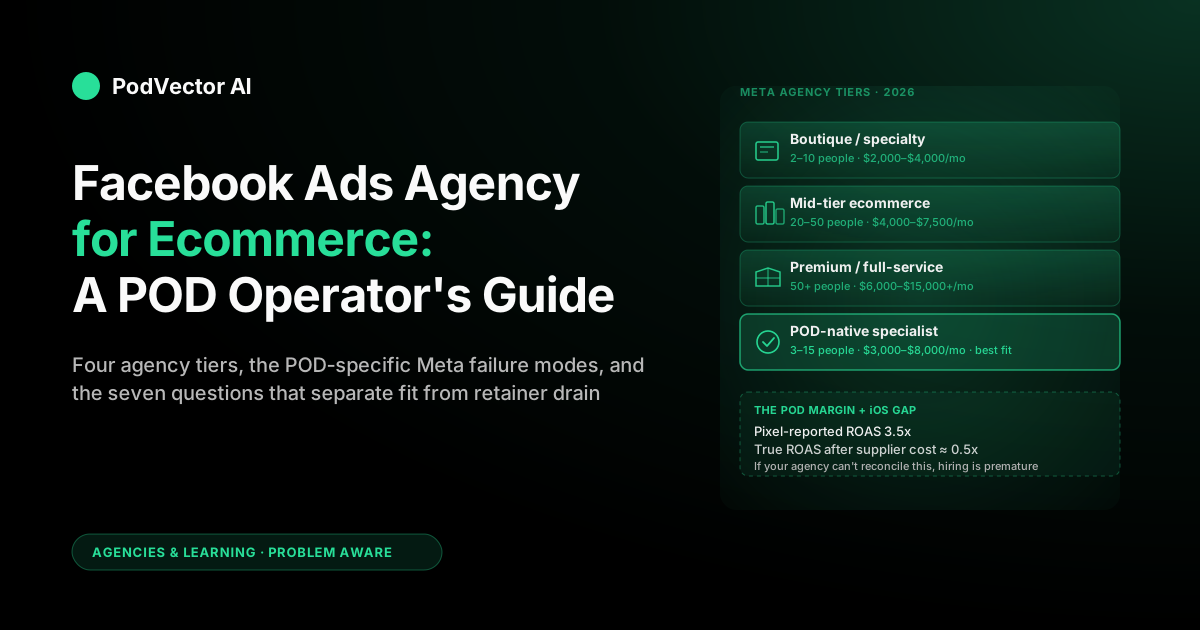
Quick Answer: A Facebook ads agency for ecommerce is a team-based firm that runs your Meta paid social — Advantage+ Shopping Campaigns, retargeting, prospecting, and creative production — for a $2,000–$10,000+ monthly retainer. For most print-on-demand operators, hiring one is premature below $30K MRR — the retainer plus the creative production budget eat more contribution than the agency can plausibly recover, especially because most ecommerce agencies optimize toward Pixel-reported ROAS, which silently ignores Printify or Printful supplier costs and the post-iOS 14 attribution gap.
Above $30K MRR with confirmed unit economics, a POD-aware Meta agency can pay for itself, but only about one in ten ecommerce agencies has the operational fluency to deliver true ROAS instead of dashboard ROAS. This guide covers the real cost of a Facebook ads agency in 2026, what's in (and out of) a typical retainer, the POD-specific failure modes nobody else writes about, and the vetting framework that tells you which agencies will earn the retainer.
What a Facebook ads agency for ecommerce actually does
An ecommerce Facebook ads agency manages your Meta paid social — Advantage+ Shopping Campaigns (ASC), Advantage+ Audiences prospecting, retargeting, catalog ads, and creative production — on retainer. The team usually splits into a media buyer (the person clicking around in Ads Manager), a strategist or account manager (your point of contact), and a creative producer or two (the people producing the static and video assets that Meta now consumes faster than any other channel). At higher tiers the team adds a measurement specialist for Conversions API, server-side tracking, and incrementality testing.
The pitch is straightforward: you outsource Meta expertise, the team handles bid strategy and audience structure, the creative producer keeps your asset library fresh enough that frequency doesn't tank performance, and you get back hours every week to spend on product and brand. For a DTC apparel brand with stable cost-of-goods and 60–70% gross margins, that pitch holds up — the agency's optimization plus creative velocity usually exceeds the retainer at $20K+/month in ad spend, and the brand can absorb a few learning quarters while the relationship matures.
For a print-on-demand operator running variable supplier costs through Printify or Printful, the same pitch routinely loses money. Not because the agency is bad, but because the math the agency optimizes against has very little to do with whether your store actually made money this month.
That gap between "good ecommerce agency" and "good ecommerce agency for POD" is the entire point of this guide. The 2026 roundups that rank for this query — including the Extuitive 2026 list of Facebook ads agencies for ecommerce — are written for the DTC-brand reader, not the POD operator. They're useful for understanding what's available; they're misleading as a buying framework if your business runs on per-order supplier reconciliation.
The 4 agency tiers in 2026 (and where POD sellers fit)
The ecommerce Facebook ads agency market in 2026 stratifies into four price-and-scope bands. Each one targets a different size of operator, and only two of them work for POD-shaped businesses without serious modification.
Tier 1: Boutique / specialty shops — $2,000–$4,000/month
Two to ten people, often a former agency lead who went independent with a couple of senior media buyers and a freelance creative producer. Limited in-house creative production, no in-house developer, retainer covers about 8–15 hours per month of senior attention plus a small monthly creative output (4–8 static iterations, 1–2 short video edits). This is where most POD operators between $30K and $80K MRR find their fit — small enough to actually pay attention to your account, sometimes willing to learn POD specifics, and priced where a 10–15% lift on $20K+/month of ad spend covers the retainer with margin to spare.
Tier 2: Mid-tier ecommerce agencies — $4,000–$7,500/month
Twenty to fifty people with named departments — paid media, creative, analytics, sometimes CRO and lifecycle. These are the firms that publish case studies on their site and rank in roundups.
Strong on Advantage+ Shopping, dynamic catalog ads, and UGC video production at scale. Almost always built around DTC-brand assumptions: stable COGS, predictable refund rate, single-channel attribution.
Your account is one of fifteen or twenty in a given strategist's book, and the daily attention is correspondingly distributed. Suitable for POD only above $80K MRR with a P&L disciplined enough to push back on optimization choices that look good on the Meta dashboard.
Tier 3: Premium / full-service growth agencies — $6,000–$15,000+/month
Fifty-plus people, often with offices in multiple cities, branded service lines, retainers that include UGC creator networks, full-funnel video production, and frequently a separate CRO or lifecycle arm. The sales process feels like a B2B SaaS demo. POD operators rarely belong here — the retainer math doesn't pencil out below $200K MRR, and the agency's optimization muscle is calibrated for brands with stable, single-digit COGS percentages and the capital to run paid social, paid search, lifecycle, and influencer simultaneously.
Tier 4: POD-native or POD-adjacent specialists — $3,000–$8,000/month
The smallest tier in the market and the one most worth finding. These are agencies — usually three to fifteen people — that have explicitly run Shopify + Printify or Shopify + Printful stacks for clients before, understand variable supplier cost, report on contribution margin rather than Pixel-reported ROAS, and treat creative velocity as a product line rather than an extra.
They charge a 30–60% premium per hour over generalist agencies and earn it in two months. The hard part is finding them; they don't always self-identify in their marketing because the POD niche is small. Operator referrals from 7-figure POD networks are the highest-signal source.
What's in (and out of) a typical retainer
The single biggest source of post-signing surprise is scope. Most agency proposals describe their service in marketing language ("end-to-end Meta ads management") that obscures what's actually included. The honest list, mapped to what mid-tier ecommerce agencies typically do and don't include in a $4,500–$6,500/month retainer:
Usually included
- Account optimization, weekly or biweekly — bid strategy adjustments, audience consolidation under Advantage+ Audiences, ad-set pruning, frequency monitoring, placement reviews.
- Monthly or quarterly strategy review — typically a 60-minute call with slide deck, walking performance against KPIs and proposed next-quarter changes.
- 4–10 creative iterations per month — usually static images, short-form video edits, and minor copy variants from existing brand assets and approved UGC.
- Catalog health monitoring — Meta Catalog error resolution, disapproval triage, basic feed validation. Note: error resolution, not catalog redesign.
- Pixel and CAPI maintenance — keeping the existing Conversions API and Pixel events firing. Not initial server-side setup.
- Standard reporting dashboard — Looker Studio or proprietary template, refreshed daily, accessible to you on demand.
Usually extra (project fees on top of retainer)
- Conversions API and server-side GTM implementation — initial CAPI setup, server-side GTM, deduplication wiring, Advanced Matching configuration. Typical project fee: $2,000–$6,000.
- Catalog rebuild or feed automation — restructuring product titles, attributes, custom labels for dynamic product ads. Typical project fee: $2,000–$7,500.
- UGC creator sourcing and net-new video production — anything beyond static refreshes and minor video edits typically becomes a per-asset or hourly fee. Plan for $400–$1,500 per finished UGC video on top of retainer.
- Landing page CRO — usually a separate retainer or referred to a partner agency.
- Audit of a previous agency's account — frequently scoped as a separate $1,500–$3,500 deliverable before retainer kicks off, and usually worth paying for.
Almost never included (and easy to forget to ask)
- Supplier-cost reconciliation — almost no generalist ecommerce agency does this. Without it, all reported ROAS is wrong for POD.
- Incrementality testing — geo holdouts, conversion lift studies, or in-platform conversion-lift tests are an extra fee at almost every agency.
- P&L review — they may glance at your numbers in onboarding; they will not reconcile against them quarterly unless you make it contractual.
- Cross-channel coordination — if you also run Google Ads, the agency will not coordinate unless you pay for it.
- Inventory or SKU rationalization — you own the SKU list; they manage what's in it.
For a comprehensive comparison of agencies, freelancers, courses, in-house hires, and tooling for POD, see our complete Meta ads agencies and courses guide for POD, which covers all five service options against the same margin math.
Why most ecommerce agencies quietly fail POD clients
This is the section nobody else writing about Facebook ads agencies covers, and it's the most expensive blind spot for POD operators. The problem isn't agency incompetence — most mid-tier ecommerce agencies are technically competent at the platform. The problem is that POD breaks four of the assumptions baked into how the agency runs Meta accounts.
Assumption 1: Pixel-reported ROAS approximates profit
For a DTC brand with $8 COGS on a $30 product, a 3.5x Pixel-reported ROAS means about $22 of contribution per $8.60 of ad spend — call it $13.40 net per order. Healthy.
For a Printify hoodie with $18.50 supplier cost, $5.20 shipping, and a $1.95 platform fee, the same 3.5x reported ROAS leaves about $4.35 of contribution per $8.60 ad spend — a true ROAS around 0.50x. The agency reports a winning month.
The bank balance disagrees. Until the agency has a process that nets supplier costs against ad-attributed revenue, every campaign decision they make is built on the wrong baseline. This is the same gap we cover in detail in the complete guide to Meta ads ROAS and attribution for POD.
Assumption 2: iOS 14 attribution gap is "noise"
Since Apple's App Tracking Transparency rollout, Meta's own reported conversions can over- or under-attribute by 15–40% depending on iOS share, browser mix, and refund timing. Generalist ecommerce agencies treat this as residual error to monitor.
POD operators with thin per-order contribution and slow-to-update product analytics often can't absorb the variance — a 25% attribution swing in a month with 12% true contribution margin can flip the sign of profit. POD-aware agencies design around this with server-side CAPI plus Aggregated Event Measurement priorities tuned for the SKU mix, and validate with periodic geo-holdout tests rather than trusting Meta's modeled conversions alone.
Assumption 3: Advantage+ Shopping is uniformly better
For fixed-COGS brands, Advantage+ Shopping (ASC) tends to outperform manual structures because the product catalog is uniformly profitable and the algorithm can pick winners. For POD with variable per-SKU supplier costs, ASC pushes spend toward the highest-revenue products, which are systematically the worst-margin ones — oversized hoodies with $26+ supplier cost, all-over-print sublimation items with $22+ cost, premium substrates with thin contribution.
The agency moves you to ASC in week three "to scale," and your true ROAS quietly inverts over the next thirty days. POD-aware agencies either segment the catalog feed before exposing it to ASC or run ASC alongside a margin-aware manual structure for the lowest-contribution SKUs.
Assumption 4: Creative is the only lever
The dominant 2024–2026 narrative in ecommerce paid social is "creative is the only meaningful lever; the algorithm handles the rest." For DTC brands with stable margins, that's mostly true. For POD, creative is a necessary but insufficient lever — the missing layer is post-campaign reconciliation between Pixel-reported revenue and supplier-adjusted contribution.
Agencies that lean entirely on the creative thesis ship you 30 new ad variants a month and report on dashboard ROAS while your contribution margin compresses. The fix isn't less creative; it's creative plus reconciliation.
The fix isn't to find a better agency — the fix is to walk into agency conversations with your real numbers in hand, push for supplier-cost reconciliation as a contractual deliverable, and treat any agency that resists as disqualified.
When hiring an agency makes sense for POD
Three conditions, all required, before a Facebook ads agency is worth the retainer for a POD operator:
Condition 1: Ad spend large enough that small lifts pay back
A $4,000/month agency needs to lift your true ROAS by enough to cover $4,000 plus generate some net positive over what you'd do yourself. At $5,000/month ad spend, that's an 80% true-ROAS improvement, which essentially never happens.
At $20,000/month ad spend, it's a 20% lift, which is plausible. At $50,000/month ad spend, it's an 8% lift, which a competent agency should clear regularly. The break-even ad spend for most retainers is somewhere between $15K and $30K monthly, which corresponds roughly to $40K–$80K MRR for a typical POD store.
Condition 2: Unit economics are confirmed
Agencies optimize against the numbers they see; they do not validate whether those numbers reflect a profitable business. If your product mix is still shifting, your supplier strategy is still being negotiated, or your design pipeline is still finding traction, an agency will optimize against today's numbers and miss tomorrow's reality. Confirm unit economics in a profitable DIY or freelancer phase before paying for an agency to scale them.
Condition 3: Creative production capacity to be a good Meta client
Meta consumes creative faster than any other channel — winning ads typically fatigue in 2–6 weeks at scale. Agencies deliver best when they have a working asset library, an approved UGC creator pool or a willingness to source one, basic brand guidelines, an operator who responds within 48 hours, and tracking that doesn't constantly break. If half your time with the agency will be spent feeding them assets they should be producing or fixing CAPI events that should already be live, the agency is effectively a consultant on your foundational systems — and that's not what you're paying retainer for.
If any of these three is missing, fix it before signing. The article on Facebook ads courses for POD operators covers the lower-cost path most stores should travel before they're ready for an agency relationship.
The 7-question POD-specific vetting framework
Most agency sales calls are designed to make you feel comfortable. The questions below are designed to make you informed. Ask all seven. The combination of answers separates the agencies that can run a POD account from the ones that will bill retainer while your contribution margin silently collapses.
- "How do you handle the divergence between Pixel-reported ROAS and actual profit after supplier costs?" The right answer involves a concrete process — a tool, a reporting layer, a quarterly reconciliation against the client's P&L. Any answer involving "we report platform numbers and the rest is internal to you" is disqualifying for POD work.
- "Walk me through how you'd structure an Advantage+ Shopping launch for a 200-SKU store with 15 design niches." POD-aware answers segment the catalog feed by margin tier or niche before exposing it to ASC, exclude thin-margin SKUs explicitly, and pre-build a manual control structure to keep the lowest-contribution products out of automated bidding. "One ASC campaign, all products" answers indicate the agency has not run POD-shaped catalogs.
- "What's your process when Meta flags a trademark or community-standards concern on a SKU?" POD-native answers describe immediate catalog exclusion of disputed SKUs while the appeal works through Meta support, plus a process for preventing repeat appeals from triggering broader account scrutiny or business-asset restrictions. Generic answers stop at "we'd file an appeal."
- "Show me a client report for an account where Pixel-reported ROAS and contribution margin disagreed materially." Agencies that have done POD work have these reports and can redact them for sharing. Agencies that haven't will offer a different example or demur.
- "What's your minimum commitment, and what's the first 90-day exit clause?" Reasonable: 3-month minimum, 30-day notice after that. Aggressive but workable: 6-month minimum with quarterly review. Disqualifying: 12-month lockups, especially with auto-renewal.
- "Who specifically would be running my account day-to-day, what's their tenure at the firm, and how many other accounts do they own?" You want a named human with at least 18 months of agency tenure carrying no more than 12–15 concurrent accounts. Higher account loads make daily attention impossible — and on Meta, daily attention to creative fatigue and frequency is the difference between scale and quiet collapse.
- "Can you give me one current POD client reference and one client you've parted ways with in the last six months?" The willingness to share a churned client says more about agency honesty than any case study. "We've never lost a client" is rarely true and usually a signal of either a small client base or a willingness to say convenient things.
Red flags and green flags in the sales process
Patterns from POD operators who've signed and unsigned several Meta agencies. The signals don't predict outcomes perfectly, but the red flags reliably correlate with bad fits and the green flags reliably correlate with good ones.
Red flags
- "We guarantee X ROAS." Nobody can guarantee ROAS, especially on an account they haven't seen. Guarantees are sales theater.
- No questions about supplier costs in discovery. Disqualifying for POD. The agency doesn't know enough about POD to ask the question that matters most.
- Case studies with no margin context. "Scaled from $50K to $250K/month" is meaningless without "and contribution margin held at 28%." Push for the second number; if they can't produce it, the case study is decoration.
- Pressure to sign before the end of the month. Quota-driven sales urgency is a sign the agency's incentives sit with new client acquisition, not retention.
- Vague scope language in the SOW. "End-to-end Meta ads management" is not a scope. Hours, deliverables, creative output counts, and call cadence should all be specified.
- Creative deliverables described in revenue terms, not output terms. "We'll drive $200K/month in revenue" is not a creative scope. "8 static iterations and 4 short-form video edits per month, plus 2 net-new UGC concepts per quarter" is.
Green flags
- POD-specific discovery questions. "What's your blended supplier cost per order?" or "How are you handling the iOS attribution gap against your refund-adjusted P&L?" are the questions that signal a partner who's lived the problem.
- Specific scope in writing. "10 hours of weekly account work, 8 static creative iterations, 4 video edits, 2 UGC concepts per quarter, 2 strategy calls per month, quarterly reconciliation against your supplier-cost data" — that's a contract you can hold them to.
- Two or three current clients available for reference calls. Not a curated reference page; actual phone numbers.
- Transparent pricing logic. The agency can explain why their retainer is $5,500 and not $4,500 — usually tied to team composition, creative output counts, or specific deliverable cadence.
- An honest discussion of what they don't do. "We don't handle landing-page CRO; we'll refer you to two firms we trust" is more credible than "we do everything."
- Willingness to start with a paid audit before the retainer. A $1,500–$3,500 audit deliverable in the first month tests fit both ways and de-risks the larger commitment.
Agency alternatives worth pricing first
The retainer math for a Meta agency rarely works below $30K MRR for a POD operator, but the work still needs doing. The two alternatives worth pricing before you sign with an agency:
Specialist freelancer at $1,000–$3,000/month
For most POD stores in the $10K–$30K MRR band, a specialist Meta freelancer at $1,500–$2,500/month outperforms any agency. You're paying for one senior media buyer's part-time attention rather than agency overhead, sales, and software tooling — usually paired with a separate UGC creator on a per-asset fee.
The trade-off is bus factor — if the freelancer takes a week off, your account doesn't move and frequency creeps up. For accounts that aren't running net-new launches every week, that's an acceptable trade.
Hourly consultant at $200–$400/hour plus a creator network
For accounts where you mostly want a senior practitioner's eyes on the account a few hours a month, an hourly consultant frequently beats a $4,000 retainer. Four hours of senior consultant time at $300/hour is $1,200 — a third the cost of a small agency retainer, and frequently more useful because you're explicitly paying for thinking rather than ongoing optimization. Pair it with $800–$1,500 a month in UGC creator output and you've reproduced 70% of what a Tier 1 agency delivers at less than half the cost.
For a head-to-head comparison of specific named agencies operating in the ecommerce Meta space and how each holds up under POD margin analysis, see the upcoming best Facebook ads agency for ecommerce comparison. For the Shopify-specific agency landscape, the upcoming Meta ads agency for Shopify guide covers platform-specific considerations. The full landscape of options sits in our Meta ads agencies and learning hub, and the broader topic context is in the Meta ads for POD topic hub.
The 30/60/90-day evaluation framework
Once you've signed, the question shifts from "is this the right agency" to "is this engagement working." The honest evaluation cadence:
First 30 days: foundation
What you should see: a complete audit of the existing account with documented findings, a 90-day roadmap with named tests and hypothesized lift ranges, a CAPI / server-side tracking validation report, a creative testing matrix for the first cycle, and a weekly standing call with the named account lead. Performance shouldn't move materially in the first 30 days — Meta needs 7–14 days per significant campaign change to exit learning, and your account history has to settle. Holding the agency to ROAS performance in this window is statistically unfair.
Days 31–60: execution
The roadmap from week one should be in motion. You should see at least 8–12 net-new ad variants shipped against the testing matrix, at least one structural campaign change (consolidation, split, or audience strategy shift), and documentation of the hypothesis behind each.
Pixel-reported ROAS may move; true ROAS (after supplier costs) is a more honest read. If the agency hasn't shipped anything material by day 45, the engagement is already drifting.
Days 61–90: results
True ROAS should be measurably better than baseline, or you should have a concrete explanation for why not (seasonal headwinds, an iOS privacy change, a Meta policy event affecting an entire SKU category). The first formal quarterly review should reconcile reported performance against your P&L, with a written delta analysis. If the agency cannot produce that reconciliation, they cannot legitimately measure their own value.
Day 91 and after
The decision: continue, restructure, or part ways. Agencies that have demonstrated POD literacy and shipped measurable improvement get continued.
Agencies that have shipped optimization but missed the margin reconciliation should be restructured — usually narrower scope plus a clearer reconciliation deliverable. Agencies that have produced reports but not results should be replaced. Sentiment is not a signal at this stage; the P&L is.
FAQs
How much does a Facebook ads agency for ecommerce cost in 2026?
Realistic 2026 ranges: boutique specialty shops $2,000–$4,000/month, mid-tier ecommerce agencies $4,000–$7,500/month, premium full-service growth agencies $6,000–$15,000+/month, and POD-native specialists $3,000–$8,000/month. UGC creator output is usually a separate line item at $400–$1,500 per finished video.
Most POD stores under $30K MRR pay retainers that consume more than 100% of contribution margin — the single most common mistake in POD paid-acquisition hiring. As a rough ceiling, retainer plus media management overhead should not exceed 20% of monthly contribution margin.
Is a Facebook ads agency worth it for a POD store doing under $30K MRR?
Almost never. The retainer math doesn't pencil out — a $4,000/month agency needs to lift your true ROAS by a percentage that rarely happens at small ad-spend levels.
Below $30K MRR, the higher-ROI spend goes to a $500–$1,500 ecommerce-focused course, a one-time audit from a specialist freelancer ($1,000–$3,000), or ongoing freelancer engagement at $1,500–$2,500/month plus a UGC creator on a per-asset fee. Agencies become viable when ad spend is high enough that single-digit-percentage improvements clear the retainer.
What's the difference between a Facebook ads agency and a freelancer for ecommerce?
Freelancers are individual specialists managing your account part-time at $1,000–$3,000/month with no in-house creative team and limited bus-factor coverage; agencies are team-based firms with $2,000–$15,000+/month retainers offering specialist depth across media buying, creative production, analytics, and CAPI engineering. Freelancers trade team breadth for direct ownership and lower cost; agencies trade higher cost for redundancy and creative throughput.
For POD stores between $10K and $30K MRR, freelancers paired with a UGC creator almost always win on value. Above $80K MRR, agencies become competitive again because you can absorb the retainer overhead and you need the creative cadence at scale.
How do I know if a Facebook ads agency understands print-on-demand?
Three tests, in order of signal strength. First, ask them to walk you through how they'd report on an account where supplier costs vary per order — a POD-aware agency answers fluently with a process; a generic ecommerce agency deflects.
Second, ask if they've run a Printify or Printful client account specifically, and request to speak with that client. Third, ask how they'd structure Advantage+ Shopping for a 200-SKU catalog with 15 niches; POD-aware answers segment the feed by margin or niche, generic answers describe one ASC campaign with everything. If an agency fails the first test, they're not a fit, regardless of how they answer the others.
Should I pay percentage of ad spend or a flat retainer to an ecommerce Facebook ads agency?
Flat retainer for POD, in almost every case. Percentage-of-spend misaligns incentives — the agency earns more when you spend more, regardless of whether your contribution margin is healthy.
For POD with thin variable margins, that misalignment is genuinely dangerous. If percentage-of-spend is the only option, cap it at 10% with a minimum fee floor and require quarterly reconciliation against your P&L.
How long should I commit to a Facebook ads agency?
3-month minimum, 6-month maximum for an initial commitment. After the first 90 days you should have enough data to evaluate fit. 12-month minimums were standard a decade ago; in 2026 they signal an agency that can't retain on results alone. The honest contract is a 3-month minimum with 30-day notice afterward, plus a quarterly review built into the agreement.
Can a Facebook ads agency replace knowing the platform myself?
Not really. The operators who scale paid social reliably are the ones who understand the platform well enough to evaluate whoever runs the account — agency, freelancer, or employee.
A POD operator who can't read a Meta ad-set frequency report or a creative-fatigue chart is a worse client of any agency than one who can. The $500–$1,500 you spend on a serious ecommerce-focused course returns more than the equivalent spend on agency retainer at every stage below $30K MRR.
What's the role of AI in Facebook ads agency work in 2026?
Meta's campaign-side AI (Advantage+ Shopping, Advantage+ Audiences, automated placements, dynamic creative) now handles most of the tactical optimization work. What you're paying an agency for in 2026 has shifted from "audience and bid management" to "creative direction, UGC sourcing, catalog engineering, measurement reconciliation, and exception handling." The biggest leverage gain for POD operators specifically is post-campaign analysis — the layer that reconciles Pixel-reported performance against actual supplier-adjusted profit, including the iOS attribution gap. Most agencies have not built this layer; the operators who have it (whether self-built, with tooling, or via a POD-native agency) make better decisions across the board.
What if I've already signed with an agency and I think it's not working?
Run the 30/60/90 evaluation framework retrospectively. If Pixel-reported ROAS has moved but true ROAS hasn't, the issue is measurement reconciliation — fixable with a clear contractual deliverable for supplier-cost reporting.
If neither has moved by day 90 and there's no concrete explanation, give 30 days notice and reallocate the retainer to a freelancer plus tooling. The sunk-cost trap (continuing because you've already paid three months) is real and expensive.
Walk into every Meta agency interview with your real numbers
Most Facebook ads agency sales pitches start with the platform's reported ROAS — a number that, for POD sellers, ignores Printify or Printful supplier cost, the iOS 14 attribution gap, refunds, and platform fees. Agencies will optimize toward whatever baseline you accept, which is why operators who walk in with their true contribution margin per campaign get materially better engagements. PodVector AI's AI employee, Victor, brings together your Shopify, Printify, Printful, and Meta Ads data, so he can answer questions like "what did my Facebook campaigns actually make this month after every cost" in plain English. Stop letting agencies set the baseline. And bring your own numbers to every conversation.
Try Victor free