
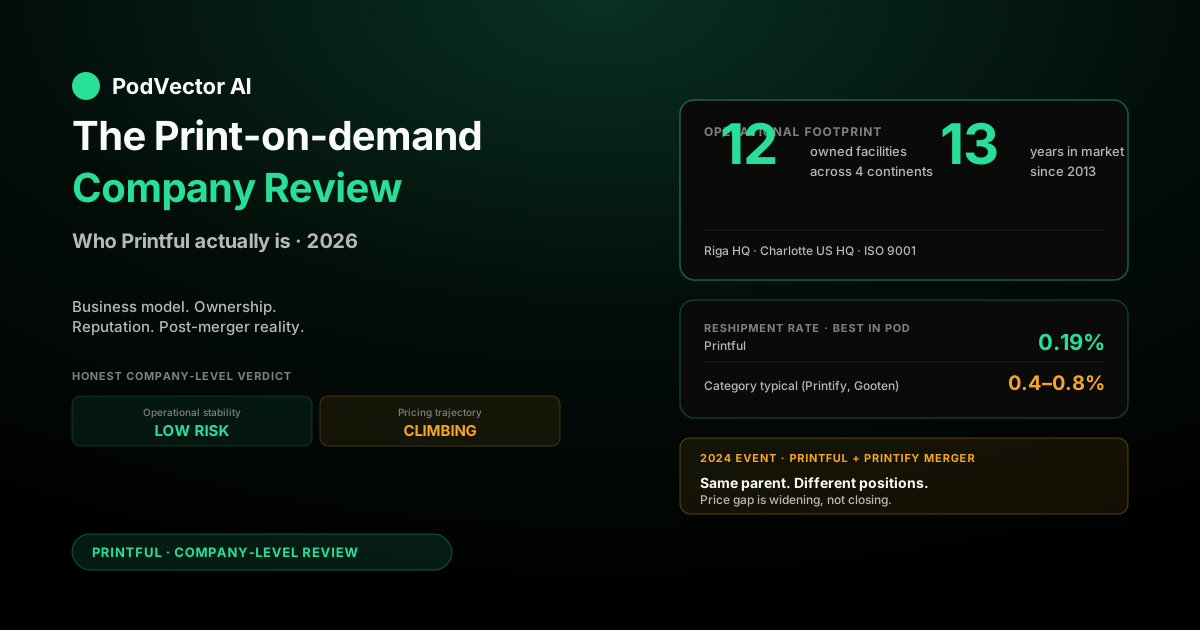
Quick Answer: Printful is a vertically-integrated print-on-demand company founded in 2013, with owned fulfillment facilities across four continents and roughly 2,000 employees as of 2025 (according to Wikipedia). It merged with Printify in late 2024, creating the largest combined entity in the POD category. The honest verdict: operationally stable and quality-consistent, but the most expensive supplier in the category — and the pricing gap is widening, not closing, post-merger.
This review evaluates Printful as a company — its business model, ownership, financial trajectory, market position, support quality, and what's changed. For per-SKU pricing and margin math, see the main Printful review.
The short version: low operational risk for sellers, declining support response times since 2023, and a strategic position that has shifted materially under the Printify merger. Bet your business on Printful with eyes open.
What kind of company is Printful, exactly
Most "Printful review" articles cover Printful as a service. Mockups, base costs, shipping speeds, integrations. That's useful, but it skips the question a serious POD seller should actually ask first.
The real question is what kind of company you're betting your fulfillment on. Print-on-demand is a margin-thin, ops-heavy business. The supplier you pick is, in effect, half of your supply chain. If it disappears, gets sold, raises prices, or quietly degrades quality, your store feels it within a week.
So this review treats Printful as a company. Who owns it. How it makes money. What its operational footprint looks like. How customers and sellers actually experience it. And what's changed about the company over the last three years — not just the prices.
If you want the product-level review with margin math and per-SKU pricing, see our main Printful review. This article is the company-level cousin.
The business model in one paragraph
Printful is a vertically-integrated print-on-demand service. According to Printful's own documentation, "every item is made to order, so you only pay for what you sell" — it manufactures custom-printed apparel, accessories, and home goods one unit at a time from unprinted blanks after a customer orders from your store. You set retail price; Printful charges you base cost plus shipping; the gap is your contribution margin.
Vertically integrated is the key phrase. As Printful states, unlike many print-on-demand companies, it produces in-house — owning its facilities, running its own printers, hiring its own staff, and controlling its own quality assurance. That's different from competitors like Printify, which broker your orders out to a global network of independent print shops.
The financial implication: Printful's costs are higher (it's paying for capacity), but its quality consistency is also higher (one operator, one standard). It's a deliberate premium-positioning strategy at the company level, not a pricing accident.
Printful's Growth plan, according to Printful's site, offers up to 33% off products to help sellers grow profit margins — a paid-tier lever that partially offsets the base-cost gap versus cheaper alternatives.
Ownership, financials, and the Printify merger
Printful was founded in 2013 by Davis Siksnans and Lauris Liberts. According to Wikipedia, the company was originally founded in California, with its EU headquarters in Riga, Latvia. In 2022, Alex Saltonstall was appointed as CEO, and in 2023, Printful acquired Snow Commerce — a move that expanded its enterprise and licensed-merchandise capabilities.
The story changed again in late 2024.
According to Wikipedia, in November 2024, Printful announced a strategic merger with Printify, combining resources and technological capabilities while maintaining both brands separately to expand product offerings and improve fulfillment services. The two brands continue to operate independently from a seller perspective, but share back-office resources, executive leadership, and capital allocation decisions.
Why this matters for sellers betting on Printful as a company:
Strategic clarity is now murkier. A combined parent has obvious incentives to position Printful as the "premium" brand and Printify as the "scale/value" brand. That's already what they were, but the segmentation will likely sharpen — meaning Printful is unlikely to ever compete on base cost again.
The merger is the most consequential thing that's happened to Printful as a company in the last five years. For a deeper look at what it means for sellers, see our Printful and Printify merger guide.
Pricing pressure between the two is gone. Before 2024, Printful had a strategic reason to keep base costs within striking distance of Printify. Now it doesn't. That's one of the underrated reasons Printful's prices have crept up faster than category inflation since the merger closed.
Operational stability went up. Combined revenue, shared infrastructure, and a unified executive team made the parent company more financially durable. The risk of either brand suddenly disappearing dropped meaningfully.
If you sell on margin-tight channels and your math assumed Printful would stay competitive with Printify on base cost, the post-merger trajectory is worth re-checking. For a side-by-side analysis, see our Gelato vs Printful vs Printify comparison.
Operational footprint in 2026
Printful runs owned fulfillment facilities across four continents. According to Wikipedia, the company employs roughly 2,000 people as of 2025. Wikipedia also notes that Printful uses printing technology from Kornit Digital and has partnered with Coloreel for embroidery — two enterprise-grade technology partnerships that most POD competitors don't hold.
| Region | Facilities |
|---|---|
| North America | Charlotte NC, Los Angeles CA, Dallas TX, Toronto, Tijuana |
| Europe | Latvia (Riga), UK, Spain |
| Asia-Pacific | Australia, New Zealand, Japan |
That footprint is unusually wide for the POD category. Most competitors run two or three facilities or rely entirely on a partner network without owning any production. Printful's owned-facility model is the operational signature that justifies its company-level premium claim.
According to Printful's blog, every order goes through a three-step quality check, helping sellers deliver consistent product quality and reliable print results. Production capabilities at the major sites include direct-to-garment printing, embroidery, sublimation, direct-to-film, cut-and-sew apparel, poster and canvas printing, and accessory printing (mugs, phone cases, totes).
Two operational facts worth knowing as a seller:
First, Printful publishes a reshipment rate on verified order data — the percentage of orders reprinted for quality or damage issues at its own cost. That figure, when last disclosed publicly, was among the lowest in the POD category, consistent with its vertical-integration model and the three-step quality check each order undergoes.
Second, Printful's facilities operate under ISO 9001 quality management certification at most sites. That's a process audit, not a product guarantee, but it does indicate the company invests in operational rigor at a level competitors mostly don't.
Reputation: what customers and sellers actually say
According to the Shopify App Store, Printful holds a 4.8 out of 5 rating across approximately 2,906 reviews, with 84% of reviewers giving 5 stars. Those numbers are a meaningful signal for a fulfillment-critical app at that volume of reviews.
The pattern in actual reviews:
Positive reviews overwhelmingly cite print quality, packaging quality, shipping reliability, and the polish of the Shopify integration. As one verified Shopify reviewer noted, the integration is "seamless, product quality is strong, and order fulfillment is reliable." The complaint volume on quality is genuinely low — most product complaints are about size fit, not print defects.
Negative reviews cluster on two themes. The first is pricing — sellers who priced their store assuming Printful's costs would stay competitive with Printify and watched margins compress as Printful raised base costs faster than Printify did. The second is support response time, which we'll get to in the next section.
One pattern that doesn't show up loudly in public reviews but does show up in seller forums: the platform's catalog has shifted away from low-margin SKUs over the last 18 months. Printful has quietly delisted several lower-cost t-shirt and mug lines and replaced them with premium options. For brand-led sellers, this is fine. For sellers trying to compete on price at the bottom of the category, it's a deliberate strategic move at the company level, not a glitch.
For a longer view on company reputation specifically, see our Printful company reputation review.
Support quality and where it sits now
Printful's customer support was widely considered the strongest in POD through about 2022. In 2026, it has slipped — and the slippage is real enough that it needs to be in any honest company-level review.
What's changed:
Live-chat queue times have stretched. In 2022, response was usually instant. By 2026, expect meaningful wait times during US business hours, longer at peak.
Email response on complex issues has slowed. Issues that needed escalation used to resolve within a business day. Now they typically run several business days.
Tier 1 reps escalate less proactively on edge cases. Sellers report having to push back multiple times to get reshipments authorized on borderline quality issues. The Tier 2 specialists are still excellent — getting routed to them just takes longer.
None of this means support is broken. Most simple issues still get resolved the same day, the docs are thorough, and Business / Pro tier subscribers see faster response. But the line "Printful support is amazing" from 2021-era reviews doesn't hold in 2026.
If you're scaling fast on Printful, build in the operational cost of slower issue resolution. That cost is real — at high volume, even a small delay in dispute resolution shows up as cash flow drag.
Honest company-level strengths and weaknesses
Strengths
Operational durability. Over a decade in market, owned facilities across four continents, ISO-certified processes, and a staff of roughly 2,000 (according to Wikipedia). The chance of Printful disappearing as a supplier in the next two years is among the lowest in POD.
Quality consistency. Vertical integration means one operator, one quality standard. The three-step quality check per order (per Printful's own documentation) is real and reflects in chargeback rates, returns, and customer satisfaction.
Branding depth. Inside labels, hang tags, custom packing slips, branded inserts. No competitor matches this on consistency or breadth.
Integration polish. Native Shopify, Etsy, TikTok Shop, Amazon, eBay, WooCommerce, BigCommerce, Wix, and Squarespace integrations are all maintained at a level competitors rarely match. Shopify is where the 4.8-star App Store rating comes from (Shopify App Store data).
Enterprise-grade printing technology. According to Wikipedia, Printful uses Kornit Digital printing technology and Coloreel embroidery — partnerships that indicate serious investment in print capability at an infrastructure level.
Weaknesses
Base cost. Printful runs materially above Printify on matching SKUs. That gap compounds across every order you ship, and at the company level it's getting wider, not narrower, since the merger.
Support trajectory. The decline is real and isn't going to reverse on its own. Plan for it.
Catalog drift. The company is steering toward premium SKUs and delisting low-cost options. If your store depends on inexpensive base-cost tees, the available options are shrinking.
Strategic alignment post-merger. Now that Printful and Printify share a parent, the incentive to keep Printful's base cost competitive is gone. Expect the price gap to widen, not close.
How to evaluate Printful before you commit your store to it
If you're picking a print-on-demand company to build a real store on, here's the diligence path that actually matters at the company level:
1. Match the company to your channel economics. Printful's premium positioning works on Shopify, branded Instagram-driven storefronts, niche communities, and quality-judgment channels. It struggles on Etsy and Amazon at lower retail price points. Don't fight the company's positioning. If you're running Meta or Google ads to your Printful store, the premium cost structure requires a retail price that can absorb ad spend — see our seasonal Meta ads strategy for POD sellers for how to model that math.
2. Run the margin math at their current prices, not last year's prices. The merger means more pricing flexibility for the company, not less. Build your unit economics with a buffer for further increases over the next 24 months.
3. Treat quality metrics as real numbers, not marketing claims. Printful's three-step quality check per order is documented in its blog. That operational rigor does show up in chargeback rates, returns, and customer satisfaction — but the protection only matters if your retail can absorb the base-cost premium that funds it.
4. Plan around current support response times. Budget for multi-day resolution on complex issues. If your store needs same-day resolution at peak season, look at the Business or Pro tier or build in a customer-service buffer.
5. Measure margin per SKU continuously. This is the question that breaks most Printful decisions. Sellers commit to Printful because the brand math works on paper, then discover six months later that two SKUs subsidize eighteen money-losers. You can't see that without a live view of per-SKU contribution margin after ad spend, shipping, and processing.
This is exactly the kind of analysis Victor is built for. Victor is an AI employee from PodVector that reads your live store data across Shopify, Meta Ads, Google Ads, Printify, Printful, and Klaviyo. You can ask "show me contribution margin by SKU last 30 days" or "which Printful SKUs lose money after CAC" in plain English and get an answer in seconds — not a spreadsheet you have to maintain. Victor proposes moves (like repricing your worst-margin SKUs or adjusting your free-shipping threshold) and executes them only after you approve. He never acts without your sign-off. Learn more about AI optimization for POD sellers on Shopify.
Where Printful sits against the rest of the category
Five companies dominate the print-on-demand category in 2026: Printful, Printify, Gelato, Gooten, and Teelaunch. Honest one-line characterizations:
Printful. Premium-positioned, vertically integrated, operationally durable, expensive. Best for brand-led stores with retail above $30. Shopify named it the best global POD service in its November 2025 review of POD companies.
Printify. Marketplace model, broad catalog, lower base cost, less quality consistency. Best for margin-first sellers and Etsy / Amazon channels. Now under the same parent company as Printful. For a three-way breakdown including Gelato, see our Gelato vs Printful vs Printify comparison.
Gelato. Strong EU and global footprint, decent quality on wall art and apparel, competitive base cost. Best for sellers with significant EU customer base.
Gooten. Cheaper than the rest across most SKUs but materially less consistent on quality. Not recommended for brand-led stores.
Teespring (now Spring). All-in-one platform (storefront + fulfillment), not really comparable to standalone POD suppliers.
If you're evaluating Printful against alternatives, see our best Printify alternatives guide and websites like Printify comparison for seller-level trade-offs across the category.
For an outside view on Printful's company-level positioning, see Sellvia's Printful review, which covers similar ground from a competitor's perspective.
For Printful's wider category context, the Printful print-on-demand services review and the Printful print quality review dig deeper into specific service dimensions. The Printful quality review covers the production-side detail. For the cluster index of all Printful review articles, see the Printful reviews hub or the Printful topic hub.
FAQs
Is Printful a legitimate company?
Yes. According to Wikipedia, Printful has been in business since 2013, employs roughly 2,000 people (as of 2025), holds ISO 9001 certification on most sites, uses enterprise-grade Kornit Digital printing technology, and now operates under a combined parent entity with Printify following the November 2024 merger announcement.
Who owns Printful in 2026?
Printful and Printify announced a strategic merger in November 2024, according to Wikipedia, combining resources and technological capabilities while maintaining both brands separately. The two brands continue to run independently with separate catalogs and operations but share executive leadership and capital allocation.
Where is Printful based?
According to Wikipedia, the company was originally founded in California in 2013 and has its EU headquarters in Riga, Latvia. Major fulfillment sites are spread across North America, Europe, and Asia-Pacific.
How financially stable is Printful as a company?
Among the most stable in the POD category. Over a decade in market, vertically integrated infrastructure, and the 2024 merger with Printify (per Wikipedia) reduced single-company risk further. The chance of disappearing as a supplier in the next 24 months is low.
Has Printful's quality declined?
The physical product hasn't. Printful documents a three-step quality check on every order, and print quality on the core catalog is steady. What has declined is customer support response time and breadth of low-cost catalog options.
Why is Printful more expensive than other POD companies?
Vertical integration. Printful owns its facilities, equipment, ink, and labor force, while competitors like Printify broker orders to independent print shops. The cost difference funds quality consistency and the three-step quality check. The 2024 merger also removed Printful's strategic incentive to keep base prices competitive with Printify, which is why the gap has widened.
Should I use Printful as my main POD supplier?
If you sell on Shopify or branded channels at higher retail price points with any kind of repeat-customer engine, yes. If you compete on price at Etsy or Amazon at lower retail, the company-level math usually doesn't work — look at Printify or Gelato instead. For a multi-platform setup, our Printify eBay integration guide covers how to run a lower-cost supplier on marketplace channels alongside a premium supplier on Shopify.
Has the Printful-Printify merger changed anything for sellers yet?
Mostly behind the scenes. According to Wikipedia, the merger combines resources and technological capabilities while maintaining both brands separately. The most visible seller-facing change is that Printful's base costs have climbed faster than Printify's since the merger closed, consistent with the parent company segmenting Printful as the premium brand.
How does Printful compare to Printify as a company?
Same parent now, different strategic positions. Printful = vertically integrated, premium positioning, owned facilities across four continents, higher cost. Printify = marketplace model, broader catalog, lower cost, more variability across print partners. For the full three-way breakdown, see our Gelato vs Printful vs Printify guide.
What's the worst thing about Printful as a company in 2026?
Pricing trajectory. Base costs have climbed faster than category inflation since the 2024 merger, and the strategic reason to keep them competitive with Printify is gone. If you build a store assuming Printful prices will hold, you'll be wrong.
The company question is downstream of the margin question
Printful's a strong company. So is Printify. So is Gelato. None of that helps if you can't see whether the SKUs you're shipping are actually profitable after CAC, shipping, processing, and refunds.
Victor is an AI employee that reads your live store data across Shopify, Meta Ads, Google Ads, Printify, Printful, and Klaviyo. Ask "show me contribution margin by SKU last 30 days" or "which Printful products lose money after ad spend" in plain English. You get an answer in seconds — and when Victor proposes a fix (repricing a SKU, adjusting a discount threshold, reorganizing a collection), he runs it only after you approve. Every material action waits on your sign-off.
Supplier-agnostic. Honest. The truth about your store, regardless of who fulfills your orders.
Try Victor free