
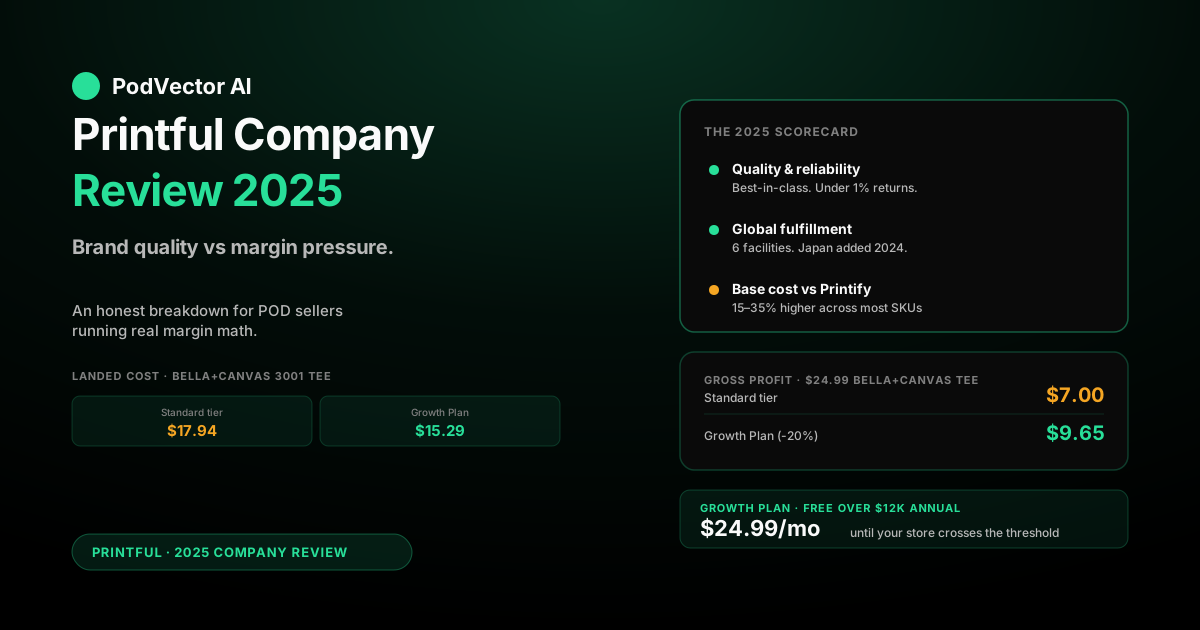
Quick Answer: Printful is the most reliable in-house POD operator for brand-driven stores — print quality is consistent, fulfillment is fast in North America and the EU, and the platform integrates cleanly with Shopify, Etsy, and Amazon. According to Printful's own contacts page, customer support is available 24/7 via chat, email, and social media.
The trade-off is price. Base costs run higher than Printify's network model, and the Growth Plan only unlocks meaningful discounts once you cross a threshold of annual sales.
Best fit: brand-led stores selling at $28+ retail with strong design and audience. Worst fit: pure-margin operators on cheap listings competing against Printify-on-Etsy sellers.
2025 Verdict at a Glance
Printful is still the print-on-demand company most sellers default to when they want consistent quality without managing a supplier. In-house production across global facilities means the t-shirt you sample in March ships the same way in November.
That consistency has a price tag. Base costs are higher than what you'll pay through a Printify print-partner network, and the gap matters once you're running paid ads.
For 2025, the honest answer is this: Printful won the quality and reliability war. Printify is winning the margin war. Which one is right for you depends on whether your store competes on brand or on price.
What Printful Actually Is in 2025
Printful is a print-on-demand and warehousing company that prints, embroiders, packs, and ships your products only after a customer orders. You upload designs, connect a storefront, and Printful handles the rest.
It's been around since 2013 and has grown into one of the larger POD operators globally, with fulfillment centers in the US (North Carolina, California, Texas), Mexico, Canada, Latvia, Spain, and Japan. The Japan facility went live in 2024 and is making the Asia-Pacific shipping story noticeably better.
The product catalog has grown to roughly 400 customizable items. T-shirts, hoodies, hats, mugs, posters, and wall art remain the bulk of what sellers move.
What separates Printful from most competitors is that it owns the printing operation. You're not booking capacity across a network of unrelated print shops — you're ordering from one company that runs the equipment.
Print and Product Quality
This is where Printful earns its reputation. DTG (direct-to-garment) prints on Bella+Canvas, Gildan, and Comfort Colors blanks are consistently sharp, with good color saturation and minimal cracking after a dozen washes.
Embroidery is the standout. Threading is dense, alignment is clean, and the digitization team will reach out if your file isn't going to embroider well rather than ship a mangled hat.
The 2024–2025 product expansion added all-over-print apparel, premium hoodies (Champion, Lane Seven), and a wider eco-friendly line using Stanley/Stella and AS Colour blanks. These higher-tier blanks materially improve the perceived quality of finished items.
Return rates are low. Seller forum data and Printful's own public reporting consistently show defect-related reprints are a small fraction of shipped orders. Most issues that do come up are address errors and customer-side preference returns, not print defects.
If you want a deeper look at how the apparel itself holds up after washing, our Printful t-shirt quality review goes garment-by-garment.
Fulfillment, Shipping, and Production Times
Production averages 2–5 business days for most items. Embroidery and all-over-print typically sit at the longer end of that range.
Shipping is the real value. Once an order leaves the facility, US domestic shipping is generally 3–4 business days. EU delivery from the Latvia or Spain facilities is 4–6 days. Asia-Pacific delivery from the Japan facility is now under a week for most destinations.
Compare that to drop-shipping from overseas and the difference is night and day. You can credibly tell US customers "ships in a week, arrives within two" and not be lying.
Shipping costs are straightforward. Printful does not surprise you with hidden surcharges at checkout. The catch is that shipping cost is built into your retail price whether you charge for shipping or absorb it — if you offer free shipping, that cost comes out of your margin on every order.
Pricing, Margins, and the Growth Plan
This is the section most reviews soft-pedal. Printful is more expensive than its main competitor, and the math matters.
For a basic unisex tee, your landed cost (base product plus US shipping for the first item) determines your floor margin. Sell at a low retail price with free shipping and your gross profit per unit can compress quickly. Subtract a Shopify or Etsy transaction fee and any ad spend, and the margin gets thin fast.
Printful's Growth Plan is the lever. It cuts product costs by up to 20% on most items and adds free design transfers and other perks. That per-unit saving is the difference between a barely-viable margin and a healthy one. Most experienced Printful sellers consider Growth mandatory once they're past test mode.
For a full breakdown of what Printful actually charges — base product costs, plan fees, and how the Growth Plan math changes your numbers — see our dedicated guide: How Much Does Printful Cost Per Month.
The full Printify vs Printful cost picture is in our Printify pricing model breakdown.
Platform, Integrations, and Design Tools
The Printful dashboard is one of the easier POD interfaces to learn. Mockup generation, design uploads, and product publishing are clean, fast, and don't require third-party tools for most use cases.
Integrations cover what you'd expect for 2025:
- Shopify, WooCommerce, Wix, Squarespace, BigCommerce, Ecwid, Webflow
- Etsy, Amazon, eBay, Walmart, TikTok Shop
- Storefronts: Storenvy, Big Cartel, Square Online
- API access for custom integrations
The Shopify and Etsy integrations are the most mature. Product publishing is two-way (push to store, sync inventory back), and order routing is automatic. Amazon and Walmart integrations work but have more setup friction because of marketplace rules.
The design tool gets a real-world test once you start producing variants. Mockup generator outputs are clean enough to use directly on listings without external editing for most apparel and accessories. Posters, framed prints, and home decor items often benefit from custom lifestyle photography.
Printful also offers branding options — branded inside labels, packaging inserts, branded packing slips, and a packaging program for higher-volume sellers. The label fee can erode margins on lower-priced items, but for stores building a real brand it's worth the cost.
If you're running Shopify and want to automate store-side operations beyond what Printful's dashboard offers, see our guide on Shopify Admin API store modifications and automation.
Customer Support in 2025
Printful's official contacts page states that customer support is available 24/7 via chat, email, and social media. According to Printful's customer service benefits page, the team's stated goal is a first response time of 2 hours, which they describe as "15 hours faster than the industry average."
In practice, seller forum reports suggest live chat wait times have stretched beyond those targets during busy periods — particularly at month-end. Email response for non-urgent issues typically lands within a business day for most sellers.
Reprint approvals for clear print defects are usually one round of email with a photo and done — no extended back-and-forth. Printful notes that including photos with your initial problem report avoids delays.
You can also reach Printful by phone at +1 (818) 351-7181 or by email at support@printful.com, per the company's published contact information.
The pattern most experienced sellers report is consistent: Printful support is solid when something goes wrong with a real order. For general how-to questions, the Help Center and community resources often get you there faster. Build your store knowing you'll handle most customer-facing questions yourself.
For a broader look at how Printful's reputation has shifted over the last two years, see our company reputation review.
Pros and Cons
Pros
- Best-in-class print and embroidery consistency across regions
- Fast fulfillment in North America, EU, and now Asia-Pacific
- Clean integrations with every major ecommerce platform
- No monthly fees on the base tier — you only pay per order
- Strong branding options (inside labels, packaging, packing slips)
- Predictable shipping costs with no hidden surcharges
- 24/7 customer support via chat, email, and social media
- Free Growth Plan after hitting the annual sales threshold
Cons
- Base product costs are among the highest in POD
- Margins are tight on lower retail price points
- Product catalog (~400 items) is smaller than Printify's network
- Live chat wait times can stretch beyond stated targets during busy periods
- Branded labels and premium add-ons stack into per-unit cost
- No option to shop across multiple print shops for the cheapest unit cost
Who Printful Is Best For
Printful makes sense when brand consistency is worth paying for.
Strong fit: Established brands with an audience, agencies producing merch for clients, creators selling premium designs at $30+ retail, and stores in apparel categories where embroidery or premium blanks are part of the value prop.
Weak fit: Brand-new sellers testing many designs at low retail prices. The base cost will eat margin before the product proves itself. Even with the Growth Plan, low retail prices leave too little room for ad spend.
Bad fit: Sellers running pure-margin plays on price-sensitive marketplaces. If you're competing on a low-price listing against another Etsy seller running Printify, you'll lose on landed cost every time.
The decision usually comes down to which side of the trade-off you're on. Premium brand at premium price, or low price at high volume. Printful is built for the first. For the second model, see our guide on does Printify work with Shopify to understand how Printify's network model connects.
Alternatives Worth Comparing
Printify. Network model with hundreds of print partners and lower base costs on most items. Quality varies by partner, which means more legwork to find consistent suppliers. Strong choice for margin-driven stores. See our full Printify pricing model breakdown for the cost comparison.
Gelato. Strong in posters, frames, and stationery with a globally distributed fulfillment network. Apparel catalog is smaller. Good fit if you sell wall art and want fast EU shipping.
SPOD. Owned by Spreadshirt, focuses on fast turnaround (48-hour production). Limited catalog. Worth a look if speed matters more than catalog depth.
Gooten. Mid-tier network, decent for home goods. Less polish on the dashboard side, slower integration support.
None of these dethrone Printful on the brand-consistency axis. Several beat Printful on price or specific categories.
If you're running Shopify with a Magento background or evaluating platform-specific POD apps, see our guide on Magento print-on-demand apps for Shopify.
The Question Most Reviews Skip: Is Printful Profitable for Your Store?
Every Printful review on the internet answers the same question: "Is Printful a good company?" Yes, with caveats. You can stop reading review articles now — that question is settled.
The question that actually decides whether Printful makes sense for your business is different. It's "Are my Printful products profitable, by SKU, after ads, after refunds, after fees?"
That question never has a generic answer. Two stores using identical Printful products can have wildly different real margins because of ad efficiency, refund rates, product mix, and shipping zone distribution. A seller with high average ad spend per sale on a lower-priced tee can be losing money on every unit — while the seller next to them with much lower acquisition cost on the same product makes it work comfortably.
The hard part is that POD stores rarely have a clean picture of per-SKU margin. Shopify shows revenue. Printful shows COGS. Meta and Google ads sit in another tab. Etsy fees are on a separate dashboard. By the time you reconcile across four screens, the data is already stale.
This is the gap most reviews don't address. Picking a good POD company is the easy step. Knowing whether your store is making money on the specific Printful catalog you've built — that's the question that determines whether the business survives.
If you want to go deeper on running a profitable POD operation, our Shopify automation guide for POD sellers and the POD seller's guide to generative AI for ecommerce cover the operational levers most store owners overlook. For AI-assisted shopping on Shopify, see the POD seller's guide to Shopify AI shopping assistants.
Browse all our Printful reviews on the Printful reviews hub, or see everything we've covered on the supplier at the Printful topic page.
FAQs
Is Printful worth it in 2025?
For brand-driven stores selling at $28+ retail with strong designs, yes. Quality and reliability are still best-in-class. For low-margin, low-retail-price stores or beginners testing many designs, the higher base cost can eat margin faster than Printify's network model.
How much does Printful actually cost per shirt?
Base product costs vary by blank and size. With the Growth Plan, costs drop by up to 20% on most items. See our full breakdown: How Much Does Printful Cost Per Month.
Is Printful better than Printify?
Printful wins on quality consistency and fulfillment reliability. Printify wins on base cost and catalog size because of its multi-partner network. The right answer depends on whether your store competes on brand or on price. See our Printify pricing breakdown for a side-by-side cost look.
How long does Printful take to ship?
Production is 2–5 business days for most items. US shipping adds 3–4 days, EU 4–6 days, and Asia-Pacific around a week from the Japan facility. Total delivery is typically 1–2 weeks from order to doorstep.
Does Printful have monthly fees?
The base tier is free — you only pay per order. The Growth Plan has a monthly cost and becomes free once you cross a set annual sales threshold. The Business Plan exists for larger operations with additional perks. Full details at our Printful cost guide.
Does Printful have 24/7 customer support?
According to Printful's contacts page, support is available 24/7 via chat, email, and social media. Printful's stated goal is a first response within 2 hours. In practice, wait times during peak periods may be longer. You can also reach the team by phone at +1 (818) 351-7181 or email at support@printful.com.
Can I sell Printful products on Etsy and Amazon?
Yes. The Etsy integration is mature and widely used. Amazon integration works but has more setup friction because of marketplace rules. Walmart and TikTok Shop are also supported.
Where does Printful manufacture and ship from?
Main facilities include the US (North Carolina, California, Texas), Mexico, Canada, Latvia, Spain, and Japan. Orders are auto-routed to the closest facility with capacity for the product.
How does AI help POD sellers manage Printful profitability?
AI business intelligence tools like PodVector can read live data from Shopify, Printful, Meta Ads, Google Ads, and Printify to surface per-SKU margin, ad-spend efficiency, and pricing opportunities — without requiring manual spreadsheet reconciliation. Victor, PodVector's AI employee, reads your store data, proposes actions like repricing a product to a target margin, and executes only after you approve. For more, see /articles/ai-analytics/ai-agents/best-ai-chatbot-for-shopify-compared.
Picking a good POD company is the easy part. Knowing if your store is profitable is the hard part.
Shopify shows revenue. Printful shows COGS. Meta sits in another tab. Etsy fees on yet another. By the time you reconcile, the data is stale.
Victor is the AI employee that gives you the truth about your store — per-SKU margin, ad-spend efficiency, the leaks costing you money — all from one place.
Try Victor free