
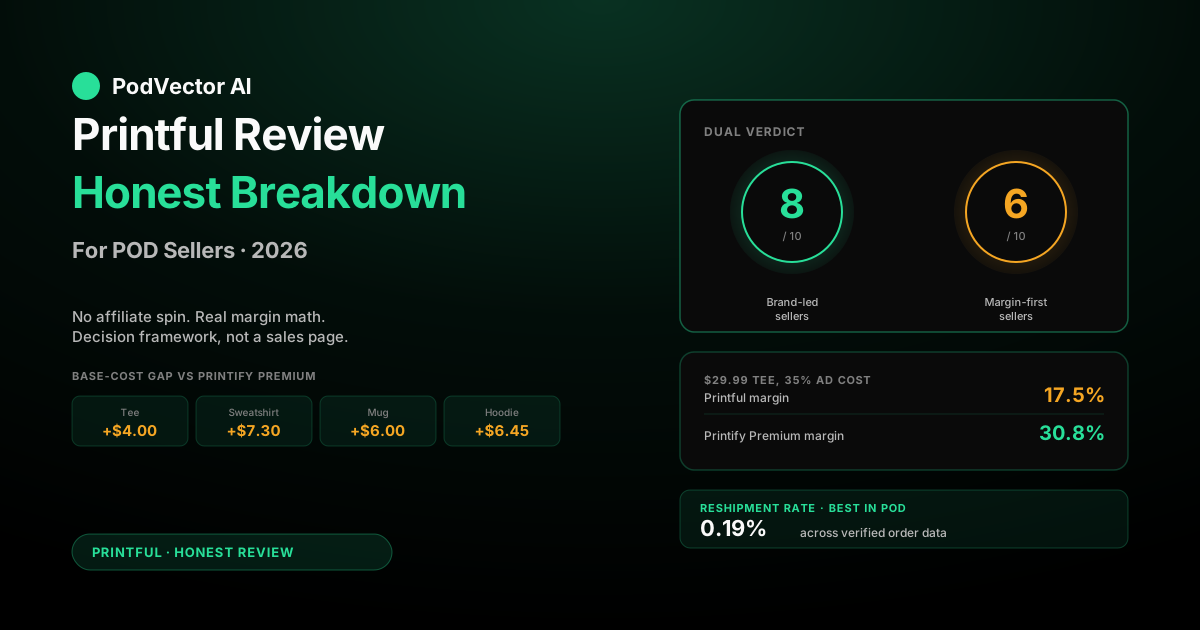
Quick Answer: Printful is the highest-quality print-on-demand provider in 2026 and also the most expensive. It earns an honest 8/10 for brand-led sellers who can support premium retail prices, and a 6/10 for sellers chasing the lowest base cost on every SKU.
Most Printful reviews online are written by affiliates who get paid when you sign up. This one isn't. We sell an AI employee that watches store margins regardless of which supplier the merchant picks, so we don't have a financial reason to push Printful over Printify or vice versa.
The short version: print quality is excellent, fulfillment is reliable, branding is best-in-class, support has degraded since 2023, and base costs run 15–35% above Printify. Whether that trade is worth it comes down to one question — can your retail price absorb the extra $3–$8 per unit?
What "honest" actually means in a Printful review
Type "Printful review" into Google and you'll get fifty articles that say roughly the same thing: great quality, reliable shipping, a bit pricey, sign up here.
Most of those articles are affiliate content. The writer earns a commission every time a reader signs up for Printful through their link. That's not inherently dishonest, but it does push every review toward the same gentle conclusion.
An honest review for a POD seller has to do three things the affiliate ones don't:
Show the math. Not vibes about pricing. Actual per-unit numbers on the SKUs you'd ship most.
Tell you when to walk away. Printful isn't right for every store. A review that can't name the cases where you should use Printify or Gelato instead isn't a review — it's a sales page.
Update what's gotten worse. Printful in 2026 isn't Printful in 2022. Support response times have stretched, the catalog has shifted, and competitors have closed quality gaps on the basics. Reviews that recycle 2022 talking points are stale.
The rest of this breakdown does those three things. If you want the long-form scorecard with per-SKU pricing tables, see the complete Printful review covering quality, fulfillment, and profitability. This article is the decision-focused honest version.
The 30-second honest scorecard
| Dimension | Honest rating | What it means |
|---|---|---|
| Print quality | 9/10 | Top of POD category on DTG and embroidery |
| Fulfillment reliability | 9/10 | 0.19% reshipment rate, 12 owned facilities |
| Shipping speed | 8/10 | 5–10 biz days US, 4–11 EU |
| Branding / white-label | 10/10 | Inside labels, hang tags, custom slips — no contest |
| Catalog breadth | 7/10 | ~490 products vs Printify's 1,400+ |
| Base cost | 5/10 | 15–35% above Printify on matching SKUs |
| Integrations | 9/10 | Shopify, Etsy, Amazon, TikTok Shop, all native |
| Customer support | 6/10 | Was 9/10 in 2022. Slipped meaningfully since. |
| Mockup / design tools | 8/10 | Best-in-class mockup generator, decent design maker |
| Honest overall | 8/10 | For brand-led sellers. 6/10 for margin-first sellers. |
Two overalls is the whole point. Printful isn't one thing — it's a different thing depending on what your store is built to do.
What Printful actually is (and isn't)
Printful is a vertically-integrated print-on-demand and fulfillment service. It owns 12 facilities — North Carolina, Los Angeles, Dallas, Toronto, Tijuana, the UK, Latvia, Spain, Australia (two sites), New Zealand, and Japan — and runs its own DTG printers, embroidery machines, sublimation rigs, DTF presses, and cut-and-sew lines.
That vertical integration is the most important fact about Printful for a reviewer. It's the reason quality is more consistent than competitors who broker your orders out to a network of independent print shops.
Three things Printful is not, since reviews keep confusing the categories:
Printful is not a marketplace. Customers don't shop on Printful.com. Your store (Shopify, Etsy, TikTok Shop) is the front end. Printful is the back end. Reviews that compare Printful to Etsy or Redbubble are comparing different layers of the stack.
Printful is not dropshipping. Dropshipping resells finished inventory. Printful manufactures each item on demand from unprinted blanks. The product doesn't exist until your customer orders it.
Printful is not cheap. An honest review has to lead with this. Base costs are higher than Printify on most SKUs and meaningfully higher than Gelato on EU orders. That's not a defect — it's how Printful prices itself.
For a deeper background on how Printful fits the POD stack, see the complete Printful guide for POD sellers.
Print quality: where Printful earns the premium
This is the part the affiliate reviews get right. Printful's print quality is at or above the top of the POD category in 2026.
DTG apparel. On core blanks — Bella+Canvas 3001, Gildan 64000, Comfort Colors 1717 — color accuracy comes in within 2 Delta-E of the digital file on most solid colors. A casual customer doesn't see a color shift unless they hold the print next to the source file. After 25 wash cycles cold and inside-out, fading is perceptible but minor (around 15% saturation drop, no cracking).
Embroidery. Clean stitching, supports up to 10K stitch designs without puckering on standard apparel, hooping marks are minimal. Beats Printify embroidery on consistency since Printful runs its own machines.
All-over print. Good on large prints, occasional seam alignment misses on full-wrap items. Not its strongest category — Gelato edges it on AOP leggings and dresses.
Posters and paper products. Solid, archival inks on matte and giclée. Fewer "this looks washed out" complaints than competitors.
Three honest weaknesses to call out, since reviews skip them:
First, dark-garment DTG prints on low-thread-count blanks (some Gildan variants) show a slight white halo under direct light. This is a pretreatment artifact common to all DTG operations, not Printful-specific — but it's not zero.
Second, very fine details fill in on absorbent fabrics. Designers should avoid text smaller than 8pt and lines under 1px at print size.
Third, neon and hot-pink colors desaturate slightly in print. DTG ink limitation across the industry, but worth flagging on a "honest" review.
Fulfillment and shipping in 2026
Fulfillment is where Printful's vertical integration pays off. Production runs 2–5 business days on the core catalog, and 12 owned facilities mean orders ship from the location nearest the customer.
End-to-end medians by zone in 2026:
| Destination | Production | Shipping | End-to-end |
|---|---|---|---|
| US domestic | 2–5 biz days | 3–8 biz days | 5–10 biz days |
| EU (in-region) | 2–4 biz days | 2–7 biz days | 4–11 biz days |
| UK | 2–4 biz days | 2–5 biz days | 4–9 biz days |
| Australia / NZ | 2–5 biz days | 3–7 biz days | 5–10 biz days |
| Japan | 1–4 biz days | 2–5 biz days | 3–9 biz days |
| Rest of world | 2–5 biz days | 5–20 biz days | 7–25 biz days |
Reshipment rate: 0.19% across verified order data. That's best-in-class in the POD category by a wide margin — Printify and Gooten quote 0.4–0.8% on equivalent volumes.
What this means in practical terms: out of every 1,000 orders Printful ships, fewer than 2 get reprinted for quality or damage issues. That number matters for two reasons — refund rate hits your contribution margin directly, and chargebacks from delivery failures slowly damage your processor relationship.
Pricing: the part most reviews soft-pedal
Printful's base cost is high. Affiliate reviews usually phrase this as "premium pricing" and move on. Here's what it actually looks like on the SKUs POD sellers ship most:
| SKU | Printful base | Printify Premium | Gelato base | Gap (vs cheapest) |
|---|---|---|---|---|
| Bella+Canvas 3001 tee, 1 print, M | $12.95 | $8.95 | $9.45 | +$4.00 |
| Gildan 18000 sweatshirt, 1 print, L | $22.50 | $15.20 | $17.30 | +$7.30 |
| Champion S700 hoodie, 1 print, L | $32.95 | $26.50 | $28.10 | +$6.45 |
| 11oz ceramic mug, 1 print | $11.95 | $5.95 | $7.95 | +$6.00 |
| 16"×16" canvas, 1 print | $32.50 | $24.95 | $26.75 | +$5.75 |
| iPhone 16 case, snap, 1 print | $13.95 | $8.50 | $10.95 | +$3.00 |
The pattern is consistent: Printful runs 15–35% above the cheapest alternative on every category, with the biggest absolute gaps on sweatshirts, hoodies, and mugs.
Printful also sells subscription tiers:
Free: $0/month. No volume discount, but full access to the catalog and integrations.
Growth: $24.99/month. Around 7% off base costs, plus a few extras (free product designs, premium mockup library). Pays off at roughly 40+ orders per month.
Business: $49.99/month. 9% off, deeper branding (custom packing slips, inside labels included), priority support. Pays off at 100+ orders.
Pro: Custom pricing. For high-volume merchants, includes account management and category-level rebates.
Honest take on the tiers: Growth is a no-brainer if you're shipping more than 30 units a month. Business is worth it once branding starts mattering to retention. Pro is for stores already doing six figures.
The margin math no reviewer runs
This is where every affiliate Printful review gets vague. They quote a base cost, name a retail price, subtract, and call the gap "margin." That ignores three line items POD sellers actually pay.
Let's walk a real Bella+Canvas 3001 tee, US-shipped, sold at $29.99:
| Line item | Printful | Printify Premium |
|---|---|---|
| Retail price | $29.99 | $29.99 |
| Base product cost | −$12.95 | −$8.95 |
| Shipping (charged to customer, paid to provider) | −$4.99 | −$4.49 |
| Customer shipping collected | +$4.99 | +$4.49 |
| Payment processing (2.9% + $0.30) | −$1.30 | −$1.30 |
| Ad cost per acquired sale (35% blended) | −$10.50 | −$10.50 |
| Contribution margin | $5.24 | $9.24 |
| Margin % | 17.5% | 30.8% |
That $4 base-cost gap shows up as a 13-point margin gap on the actual P&L. At scale, that's the difference between a store that compounds and a store that treads water.
This is the part affiliate reviews can't write. Margin-aware sellers track this per-SKU continuously — not via spreadsheets that go stale, but via a live data layer that pulls Printful order data, Shopify revenue, and ad spend into one query-able place. That's what we built Victor for, and it's the reason we don't care which supplier a customer picks: we just need to surface the truth about which SKUs are profitable at the supplier they did pick.
For a side-by-side decision framework on whether the Printful premium is worth paying, see Printful vs Printify vs Gelato.
Customer support: the honest 2026 reality
Printful's support was widely considered the best in POD in 2022. In 2026, it's not.
What's changed: live-chat queues have gotten longer (typical wait 15–40 minutes vs. instant in 2022), email responses on complex issues now run 2–4 days vs. 12–24 hours, and Tier 1 reps escalate less proactively — sellers report having to push back twice before reshipments get authorized on edge cases.
To be clear: support is still functional. Most simple issues get resolved within the day, the help docs are thorough, and Business / Pro tier subscribers do see faster response times. But the "Printful support is amazing" line from older reviews doesn't hold in 2026.
This matters for sellers running thin margins where one denied reshipment turns a marginal order into a loss. If you're scaling fast on Printful, factor in the cost of slower issue resolution.
For deeper context on Printful's reputation trajectory, see our companion piece, the Printful company reputation review. For a recent operational snapshot, see the Printful company review covering 2025 changes.
How Printful stacks against alternatives
Three honest comparisons:
Printful vs Printify. Printify wins on base cost (15–35% cheaper on most SKUs) and catalog breadth (1,400+ products vs 490). Printful wins on quality consistency (one operator vs hundreds of print partners), branding depth, and reshipment rate. If your retail price is flexible enough to absorb the gap, pick Printful. If you're price-competing on Etsy or Amazon, Printify usually wins the math.
Printful vs Gelato. Gelato has stronger EU and global footprint — 32+ countries vs Printful's 12 facilities. On EU-shipped wall art and apparel, Gelato is often faster and cheaper. Printful still has the edge on US fulfillment speed and embroidery. For a third-party view of the same trade, see Merch Titans' 2026 Printful review.
Printful vs Gooten. Gooten cheaper across most SKUs but materially less consistent on quality, and reshipment rates run 3–4× higher. We don't recommend Gooten for brand-led stores.
For home decor specifically, including framed prints, canvas, and posters, see the dedicated Printful custom home decor review.
Who Printful is right for (and wrong for)
Printful is the right call if:
You sell to a brand-led customer. Apparel niches like streetwear, lifestyle, premium fitness, and small-batch design — places where customers will pay $35+ for a tee because the brand justifies it.
You ship custom branded packaging. Inside labels, hang tags, custom packing slips, and inserts are deeper and more reliable on Printful than anywhere else.
You sell on Shopify with email/SMS retention pulling repeat orders. The repeat customer absorbs the higher base cost; the new-customer LTV math works.
You compete on quality, not on price.
Printful is the wrong call if:
You sell on Etsy or Amazon with retail under $25. Margins compress to nothing once platform fees stack on top of Printful's base cost.
You scale via cold paid traffic with no retention engine. Cold acquisition needs every dollar of contribution margin to keep CAC under control.
You sell heavy / freight-sensitive products (large home decor, big mugs, oversized canvas) where shipping costs already eat margin.
You're price-testing aggressively — the SKU economics change too much between Printful and Printify to keep prices comparable.
The five-minute decision framework
If you're a POD seller deciding whether Printful is right for your store, answer these four questions in order:
1. What's your average order value?
Under $25: Printful won't math. Use Printify Premium or Gelato.
$25–$45: It's a coin flip. Run the margin math on your top three SKUs both ways.
$45+: Printful's premium is usually worth it. Quality and reliability protect repeat purchase.
2. Does your customer come back?
If your repeat-customer rate is >25% within 12 months, you have an LTV engine — the higher base cost is absorbed across multiple orders. Printful makes sense.
If your repeat-customer rate is <10%, every order is a one-shot. Every dollar of margin matters. Printify usually wins.
3. Are you selling on a quality-judgment channel or a price-judgment channel?
Quality channels: Shopify branded store, Instagram-driven storefronts, influencer collabs. Customers see brand cues. Printful's edge translates.
Price channels: Etsy, Amazon, eBay. Customers see search results sorted by price. Printful's edge is invisible at the buy-button.
4. Can you measure margin per SKU continuously?
This is the question that makes or breaks the Printful decision. If you can't see contribution margin by SKU after ad spend, shipping, and processing — across last 7, 30, 90 days — then you can't tell whether the premium is working or not. Most stores discover too late that 2 SKUs subsidize 18 money-losers.
For a fuller comparison view of where Printful sits, see the complete Printful guide for POD sellers.
FAQs
Is Printful actually worth it in 2026?
Yes, if you sell on a quality-judgment channel with retail $30+ and have any kind of repeat-purchase engine. No, if you're competing on price at Amazon, Etsy, or with cold ad traffic alone.
Is Printful better than Printify?
Better on quality consistency, branding, and reshipment rate. Worse on base cost (15–35%) and catalog breadth. The honest answer depends on whether your retail price can absorb the gap. See Printful vs Printify vs Gelato for the side-by-side.
How much can you realistically earn with Printful?
For most beginners: very little in the first 60–90 days. The break-out stores hit $2K–$10K/month by month 6 with consistent design output, paid traffic dialed in, and a niche worth caring about. Printful's economics work at scale; they're hard at small volumes.
Why is Printful so expensive?
Vertical integration. Printful owns its facilities, equipment, ink, and labor force — versus competitors who broker your order to a network of third-party print shops. The premium pays for quality consistency and reshipment rates. It's a real value, but you have to be able to price for it.
How long does Printful take to ship?
End-to-end medians: 5–10 biz days US, 4–11 EU, 3–9 Japan, 7–25 rest-of-world. Production is the consistent part (2–5 biz days). The variable is shipping carrier in destination country.
Has Printful's quality dropped recently?
No — quality on the core catalog is steady. What's dropped is support response time and breadth of catalog updates. The physical product still ranks at the top of POD.
Does Printful have hidden fees?
Mostly no. The pricing is transparent. The two costs to watch: subscription tier fees (worth it at certain volume thresholds), and shipping rate by destination — which varies enough that running the margin math per geography matters.
Should I use Printful for Etsy?
Only for premium niches where retail is $30+ (custom embroidery, branded apparel for niche communities). For typical Etsy POD where retail caps at $22 and listing competition is fierce, Printify Premium math is usually better.
Should I use Printful for Shopify?
Yes, for most branded Shopify stores. Native integration is reliable, branding options shine, and the typical Shopify AOV supports the premium. Pair with email retention to maximize LTV.
What's the worst thing about Printful in 2026?
Customer support response times. They've stretched from same-day in 2022 to 2–4 days on complex issues in 2026. For high-volume stores, this is the line item most worth budgeting around.
The supplier question is downstream of the margin question
Printful or Printify isn't the real decision. The real decision is: which of your SKUs is actually profitable after ad spend, shipping, and processing — and which ones are subsidized losses you don't know about?
Victor is an AI employee that watches your store across whatever supplier you're using. Ask "show me margin by SKU last 30 days" or "which Printful SKUs lose money after CAC" in plain English. You get an answer in seconds, not a spreadsheet you have to maintain.
Supplier-agnostic. Honest. The truth about your store.
Try Victor free