
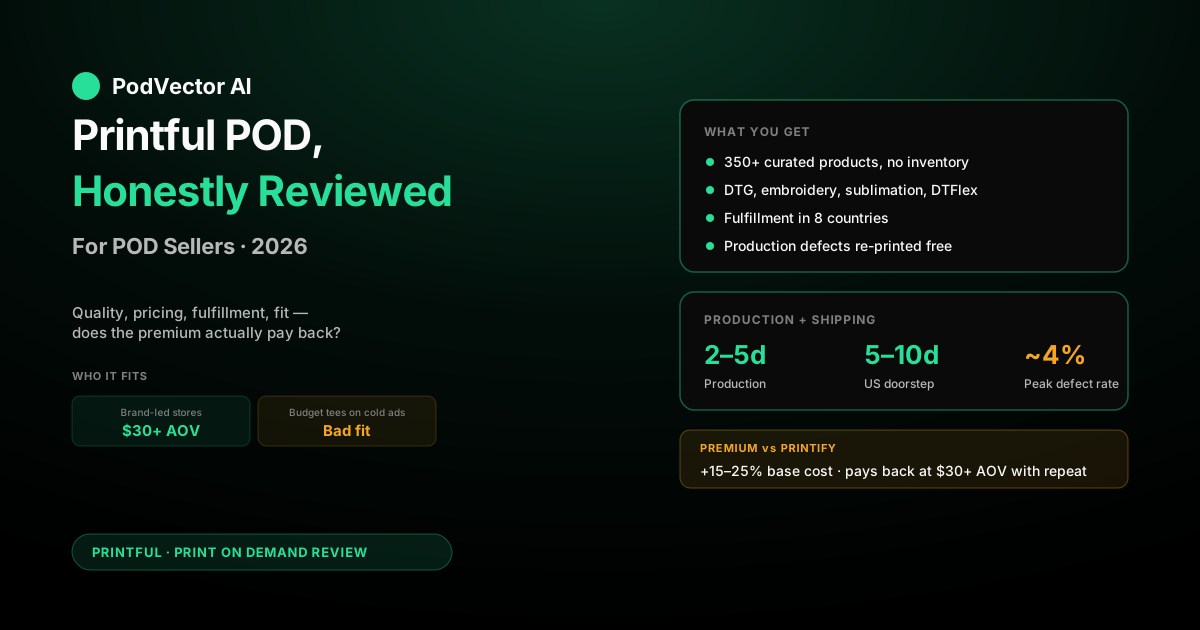
Quick Answer: Printful is the most reliable, highest-quality print-on-demand supplier in 2026. It owns and operates its fulfillment centers — not outsourced third-party printers — so quality control is consistent batch-to-batch. DTG, embroidery, and sublimation output genuinely lead the POD category.
The trade-off is base cost. According to checkthat.ai's 2026 pricing analysis, a Bella+Canvas 3001 tee runs $11.69 on Printful versus $9.04 on Printify Premium — a roughly 23% gap. For a 1,000-unit month that difference is real money.
Good fit for brand-led stores at $30+ AOV with repeat-purchase mechanics. Bad fit for $19.99 t-shirt operators chasing cold-traffic winners.
What Is Printful in 2026
Printful is a print-on-demand and warehousing-and-fulfillment company. Founded in 2013, it has grown into one of the world's leading POD providers. You upload a design, list a product in your store, and Printful prints and ships it to your customer when an order comes in.
You don't hold inventory. You don't print anything yourself. You don't ship anything yourself. Your job is the store, the designs, and the marketing. Printful's job is everything physical.
The core pitch has been consistent since its founding, but what has changed is the depth of the catalog, the breadth of integrations, and — quietly — how much more expensive Printful has gotten relative to price-first POD suppliers. As of February 2026, Printful also pushed through a targeted price increase on Cotton Heritage products (hoodies, heavyweight tees, sweatshirts, sweatpants), according to Ecommerce CEO's 2026 pricing review.
This review walks the platform from a POD operator's perspective — not a feature regurgitation. The question we answer is whether Printful actually pays back on your P&L.
Product Range and Print Methods
Printful's catalog covers around 460–526 products depending on your region, spanning apparel, accessories, home and living, and wall art, according to multiple 2026 comparison sources including Merch Titans and Style Factory Productions. That's smaller than Printify's catalog — Style Factory reports Printify at 2,000+ products — but Printful's catalog is curated, not raw.
Curated matters. Every product on Printful has been vetted by their fulfillment team. You're not gambling on a third-party print shop's quality. Printify, by contrast, exposes you to dozens of print providers per product, each with different quality outcomes.
Print methods supported
- DTG (direct-to-garment): The core method. Ink is sprayed onto the fabric like an inkjet for shirts. Works best on 100% cotton.
- Embroidery: Stitched designs on hats, polos, hoodies. Commercial-merch grade quality, consistently cited as a category leader.
- Sublimation: Dyes polyester fabric directly. Used for all-over-print apparel, mugs, and home decor.
- DTFlex (direct-to-film transfers): Unlocks polyester and blends that DTG can't print cleanly.
- Cut and sew: Custom apparel where panels are printed before sewing — used for all-over leggings, joggers, and full-print tops.
- UV print: Used on hard goods like phone cases, mugs, and water bottles.
Print Quality, Honestly
Quality is where Printful earns its premium. The key structural advantage: Printful operates primarily through its own fulfillment centers, according to Merch Titans — "the same equipment, the same ink, the same quality control process on every order." That's not how Printify or Gelato work.
What Printful gets right
DTG output on combed-and-ringspun cotton runs sharp, vibrant, and durable. According to Merch Titans' 2026 Printful review, "Printful's DTG prints hold up better after multiple washes, and their color accuracy is above average."
Embroidery is the standout. Stitch density, edge cleanness, and color separation hit commercial-merch level. Embroidered hats, polos, and hoodies command premium retail prices, which is where the quality premium most clearly pays back.
Sublimation output is at category top — vibrant, photo-realistic prints designed to last the product's lifetime.
On repeat-order consistency: because Printful standardizes production across its own centers, a customer reordering their favorite shirt months later gets an identical product, per Merch Titans. Third-party-routed providers can't make that guarantee.
Where quality slips
Dark-fabric DTG requires a white underbase layer, and that underbase is the single biggest quality variable. According to Sellvia's Printful review, "DTG printing on dark fabrics sometimes looks different from what the mockup shows." Sample every dark-fabric SKU before listing — there's no way around it.
All-over print seam alignment is mathematically impossible to perfect. A repeating pattern jumps at side seams. That's not a Printful defect — it's an industry-wide limit of cut-and-sew. Plan for an AOP-specific return buffer in your margin model.
The Pantone problem
Printful does not offer true Pantone color matching. The DTG process uses CMYK inks, so brand colors are approximated, not matched exactly. For illustrative designs this is fine. For licensed merch or strict-brand apparel, this is a real limitation.
Pricing and Unit Economics
Here's where the honest part of this review gets uncomfortable. According to checkthat.ai's 2026 Printful pricing analysis, a Bella+Canvas 3001 t-shirt costs $11.69 on Printful versus $9.04 on Printify Premium — a gap of roughly 23%. On mugs, Printful runs $7.56 versus Printify's $3.68.
Printful's base cost is also the largest line in the cost stack, and the line most sellers underestimate when sketching out their first product page, per the PodVector Printful costs guide.
A note on recent changes: as of February 26, 2026, Printful pushed through a targeted price increase on Cotton Heritage products, according to Ecommerce CEO. The most popular products (Bella+Canvas, Gildan, mugs, posters) and standard apparel shipping rates were not affected. Always confirm against the live product page before setting retail prices.
The subscription tiers
Printful currently operates three tiers, according to Style Factory Productions' 2026 review: Free, Growth, and Enterprise.
- Free: Full catalog access (around 526 products), automatic fulfillment, integrations with 20+ ecommerce platforms, and up to 10 Quick Stores. Fully functional for launching and testing.
- Printful Growth ($24.99/month — waived when annual sales reach $12,000): According to G2's 2026 pricing data, Growth unlocks up to 33% off product pricing, 9% off branding, 25% off sample orders, and exclusive print options. Per Merch Titans, the paid tier starts making financial sense above roughly 50 orders per month.
- Printful Enterprise: Custom pricing, dedicated support, tailored infrastructure. Notable enterprise clients include Coca-Cola, MTV, CBS, NBC, and the Star Trek franchise, per Style Factory Productions. Pricing is negotiated directly with Printful's sales team.
Note: the old "Business" tier ($49.99/month) has been restructured. The current lineup is Free → Growth → Enterprise. Confirm the live pricing page before building margin models around specific tier costs.
Shipping fees
Standard US apparel shipping runs in the $3.99–$8.99 range depending on product weight, with steeper international rates. According to Ecommerce CEO, phone case shipping bumped from $4.59 to $4.99 in February 2026, and sticker/postcard shipping rose from $3.99 to $4.29. Seasonal surcharges also apply — checkthat.ai notes a holiday surcharge was applied October 15, 2025 through January 17, 2026.
Bake shipping into your retail price or offer free shipping above an AOV threshold — never present shipping as a line item at checkout in POD. For how to model your free-shipping threshold correctly, see our guide on raising your free-shipping threshold and its cash flow impact.
When the premium pays back
The math works when Printful's quality measurably reduces your refund rate and lifts your repeat-purchase rate. As Sellvia's review notes, "one bad review about a faded print or a thin fabric can damage a new store's reputation quickly" — Printful's consistent quality standards reduce that risk. When quality prevents even a handful of refund/replacement cycles per month, the per-unit premium narrows substantially.
If neither refunds nor repeat purchase improve (cold-traffic one-shot store, no email, no repeat purchase mechanism), the quality premium is pure margin compression. For a precise read on your actual contribution margin per SKU — including COGS from Printful orders — see our contribution margin guide.
Fulfillment and Shipping
Printful operates fulfillment centers across multiple countries including the USA (multiple facilities), Mexico, Canada, UK, Latvia, Spain, Australia, and Japan. Orders auto-route to the closest center with capacity for your product type.
Production time runs 2–5 business days for most apparel, longer for embroidery (3–7 days) and all-over print/cut-and-sew (up to 7 business days). Shipping adds 3–5 business days domestic, 7–14 international. Total order-to-doorstep for a US shopper is typically 5–10 business days.
Peak season planning
November–December production windows stretch. Seasonal shipping surcharges apply — checkthat.ai documented a $0.40 holiday surcharge running October through mid-January in the most recent cycle. Plan to communicate longer fulfillment times to customers in your store policies and email confirmations during peak. Underpromising and overdelivering is the only way to keep refund and dispute rates manageable through Q4.
The fulfillment-center variance reality
Your US-printed shirt and your EU-printed shirt of the same SKU come from different facilities. Quality is overall consistent — Printful's owned-center model is specifically designed to minimize this variance — but color rendering and fabric sourcing can differ slightly between regions. For EU stores running EU fulfillment: order EU samples, not US samples.
Integrations and Store Setup
According to G2, Printful "connects directly to major e-commerce platforms and marketplaces, including Shopify, Etsy, WooCommerce, Squarespace, and more." Style Factory Productions confirms 20+ platform integrations on the free plan. Additional channels include eBay, Amazon, TikTok Shop, Wix, BigCommerce, and select other marketplaces. The Shopify integration is the most mature — designs sync to product pages, order events trigger fulfillment automatically, and tracking flows back to the customer.
The Etsy integration works but carries more rough edges. Listing fees, transaction fees, and Etsy's own promoted listings ad costs are real line items that have to be modeled separately from Printful base costs. Operators who skip the modeling tend to discover negative-margin SKUs in their bestseller list six months later. If you're running Shopify-side automation on top of Printful, our Shopify Admin API automation guide covers what's programmable at the store layer.
What the integration actually automates
- Product creation and sync to your store
- Mockup generation from your design files
- Order capture and fulfillment trigger
- Shipping label and tracking handoff to your store
- Refund and replacement order flow (mostly — see support section)
What it doesn't automate: profit tracking, multi-supplier margin comparison, or telling you which SKUs are bleeding margin. That's on you, or on whatever analytics layer you bolt on top. If you want to see your actual Printful COGS against your Shopify revenue in one place, that's exactly what Victor does — see the CTA section below.
Customer Support and Returns
Printful handles production defects on its own dime — wrong print, misaligned graphic, damaged stitching — your customer gets a free replacement or refund through Printful, and you pay nothing. That's the deal that makes the cost premium feel less painful.
What Printful doesn't cover: customer-side returns. Wrong size, didn't like the color, changed their mind — that's on you to handle. Plan for a customer-side return reserve in your margin model regardless of supplier.
Support responsiveness
Support is reachable via chat and email. Response times run 4–24 hours during normal periods, longer during Q4 peak. Trustpilot reviews show the usual mix — most operators have no issues, a vocal minority report slow resolution on edge cases. Capterra reviewers in April 2026 broadly confirm that "reliability, ease of use, and quality make it a dependable choice," while the most common complaint is base cost, not support quality.
For high-volume sellers, Printful offers dedicated account managers above certain monthly volume thresholds. Worth asking for if you're shipping at significant scale.
Pros and Cons
What Printful gets right
- Print quality at the top of the POD category across DTG, embroidery, and sublimation
- Vertical integration — owned fulfillment centers — means batch-to-batch consistency you can promise to repeat customers
- Multi-region fulfillment cuts shipping time and cost for international customers
- Mature integrations with 20+ store platforms, best-in-class Shopify integration
- Production defects reprinted free with minimal back-and-forth
- Curated ~460–526 product catalog eliminates the third-party-provider quality variance you get on Printify
- Growth plan fee waived when annual sales hit $12,000 — cost structure rewards scale
Where it falls short
- Base costs higher than Printify on equivalent SKUs — material margin compression at volume
- No true Pantone color matching
- Dark-fabric DTG requires per-SKU sampling without exception
- Peak-season defect rates and support response times both worsen in Q4
- Quality premium only pays back when your store has repeat-purchase mechanics
- Catalog smaller than Printify's 2,000+ products — niche SKUs may not be available
- Seasonal shipping surcharges add unpredictability to Q4 margin models
Printful vs the Alternatives
Three names come up whenever Printful is on the table: Printify, Gelato, and (less often) CustomCat. Quick orientation:
Printify
Cheaper base costs across most SKUs and a dramatically larger catalog — Style Factory Productions puts Printify at 2,000+ products versus Printful's ~526. Quality varies by print provider: you can match Printful-level output on Printify with the right provider, but you have to vet them per SKU. According to checkthat.ai, Printify offers 20–30% lower costs on standard products, making it the right choice when margin is your primary constraint and you have the time to manage provider relationships.
For the full cost breakdown on Printify t-shirts specifically, including what margins actually look like per SKU, see our Printify t-shirt cost and profit breakdown.
Gelato
According to Merch Titans, Gelato "produces 90% of orders locally across 32 countries for faster international shipping and lower costs." That local-fulfillment model is brilliant for shipping speed but introduces quality variability — the print from a facility in Germany might differ slightly from one in Australia. Right choice if international fulfillment speed is your primary driver. Not the right choice if you need Printful-level quality consistency.
CustomCat
According to checkthat.ai, CustomCat offers competitive pricing on commodity items like Gildan t-shirts. Their single fulfillment center means consistent quality but limited product selection. A niche option for high-volume commodity apparel.
Stay with Printful when…
Quality is part of your brand. You sell at AOVs that absorb the premium. You're building a repeat-purchase asset, not chasing single-design winners. Embroidery is a meaningful share of your catalog — Printful's embroidery is the category leader, per checkthat.ai.
Switch away when…
You're testing designs at volume looking for a winner — base cost matters more at the discovery stage than print quality does. You're running budget price points on cold paid traffic. Your customers don't repeat-purchase and you have no email or community flywheel.
The Hybrid Supplier Strategy
The either-or framing is increasingly outdated. According to Merch Titans, "the most successful POD sellers in 2026 are not loyal to one provider." checkthat.ai documents a common hybrid approach: "use Printful for premium and embroidered items while routing basic apparel through Printify or CustomCat." This optimizes margins without sacrificing quality on flagship products.
The practical split for a Shopify store: Printful handles embroidered hats, premium hoodies, and sublimation products where the quality premium is visible to your customer. Printify handles commodity basics — standard tees, mugs — where base cost drives profitability. Running both suppliers simultaneously requires margin monitoring per SKU and per supplier to catch drift before it compounds. That's exactly the kind of multi-supplier margin read that makes the difference between a profitable POD operation and a busy one that breaks even.
If you're running paid Meta or Google traffic to a hybrid-supplier Shopify store, contribution margin per SKU is the right metric to optimize — not revenue, not ROAS. Our contribution margin guide explains how to calculate it correctly when Printful and Printify COGS are both in play. For the ad-side of that equation — diagnosing when paid traffic is dragging margins down rather than lifting them — see our guides on avoiding ad fatigue and checkout conversion rate optimization.
Who Printful Is Right For in 2026
Good fit:
- Brand-led stores at $30+ AOV where quality is part of the product promise
- Embroidered apparel businesses — hats, polos, hoodies — where embroidery quality is the edge
- Stores with repeat-purchase flows (email, loyalty, community) where customer satisfaction compounds into LTV
- Operators selling on Shopify or an owned platform where margin isn't eaten by marketplace fees on top
- Sellers with disciplined paid acquisition who model contribution margin correctly before scaling spend
- Hybrid-supplier operators using Printful for premium SKUs alongside Printify for commodity basics
Bad fit:
- Budget t-shirt stores — quality premium compresses margin without compensating wins
- Cold-traffic one-shot stores with no email or repeat mechanism
- Beginners testing many designs to find a winner — Printify's lower base cost is right for the discovery phase
- High-volume commodity basics where customers compare on price, not feel
- Marketplace-only sellers (Etsy, Amazon) where transaction fees stack on top of POD costs and squeeze margin below sustainable levels
For more context on tracking whether Printful's premium is actually paying back on your specific store, see our guide on how to calculate contribution margin for POD sellers, and our ad frequency guide for diagnosing when paid traffic is burning margin rather than building it.
FAQs
Is Printful worth it in 2026?
Yes if your store has $30+ AOV and repeat-purchase mechanics. The quality and fulfillment reliability pay back in lower refund rates and higher LTV. No if you're running budget price points on cold paid traffic — the base cost premium compresses margin without compensating wins elsewhere.
How much does Printful actually cost?
According to checkthat.ai's 2026 pricing analysis, a Bella+Canvas 3001 t-shirt runs $11.69 on Printful versus $9.04 on Printify Premium — roughly a 23% gap. Mugs run $7.56 on Printful versus $3.68 on Printify. The Growth plan at $24.99/month is waived when you hit $12,000 in annual sales. Always confirm prices against the live Printful catalog before setting retail prices — there were targeted increases in February 2026.
How long does Printful take to ship orders?
Production runs 2–5 business days for most apparel, 3–7 for embroidery, up to 7 for all-over print and cut-and-sew. Shipping adds 3–5 days domestic, 7–14 international. Total US order-to-doorstep is typically 5–10 business days. Peak season (Nov–Dec) stretches both windows, and seasonal shipping surcharges apply.
Is Printful's print quality really better than Printify's?
Yes, on average and on consistency. Printful is vertically integrated — it owns its fulfillment centers — so quality is consistent batch-to-batch. Printify uses a network of third-party providers; quality varies by provider. You can reach Printful-level output on Printify with the right provider, but you have to vet them per SKU. Printful eliminates that vetting work and guarantees a repeat customer gets an identical product months later.
Can I make money with Printful in 2026?
Yes, but margins require deliberate management. The path that works: AOVs above $30, owned-store traffic (not pure marketplace), repeat-purchase flow built around email and community, paid traffic only when contribution margin is positive at scale. Skip any of those and Printful turns into a margin trap.
What's the best Printful alternative?
Printify for cost-conscious sellers and the discovery phase — 20–30% lower costs on standard products, per checkthat.ai. Gelato for international fulfillment speed — 90% of orders produced locally across 32 countries, per Merch Titans. CustomCat for high-volume commodity apparel on a budget. Each is a different trade-off against Printful's quality-consistency and branding edge.
Does Printful cover refunds?
Production defects, yes — Printful reprints or refunds at no cost to you. Customer-side returns (wrong size, changed mind) are on you. Reserve a buffer in your margin model for customer-side returns regardless of supplier.
Which Printful subscription tier should I pick?
Free until you're shipping consistently. Growth ($24.99/month — waived at $12,000 in annual sales) above roughly 50 orders monthly, per Merch Titans, where per-item discounts exceed the subscription cost. Enterprise for large-volume operations needing custom infrastructure and dedicated support. The old "Business" tier has been retired; the current structure is Free → Growth → Enterprise.
Should I use Printful and Printify together?
Yes, if your catalog spans both premium and commodity products. According to checkthat.ai, many successful sellers route Printful for embroidered and premium items and Printify for commodity basics. The key is tracking per-SKU and per-supplier contribution margin so quality improvements actually show up in your P&L. See our Printify t-shirt cost breakdown alongside Printful's numbers to model the split correctly.
Find out if Printful's premium is actually paying back on your store
Printful's quality is real. Whether it's worth the base cost premium on your specific store is a different question — and one that's buried in your store data, ad data, refund logs, and supplier invoices.
Victor is the AI employee built for POD sellers. Connect your Shopify store, Meta Ads, Google Ads, Printify, and Printful accounts, and Victor reads your live data to surface the truth: whether Printful is paying for itself in lower refunds and higher repeat-purchase rate, or quietly eating your margin. He can also reprice products to a target margin, bulk reprice across your store, and set up discounts — with your approval before anything executes.
No dashboards to wire up. Ask in plain English, get the answer. Try Victor free.