
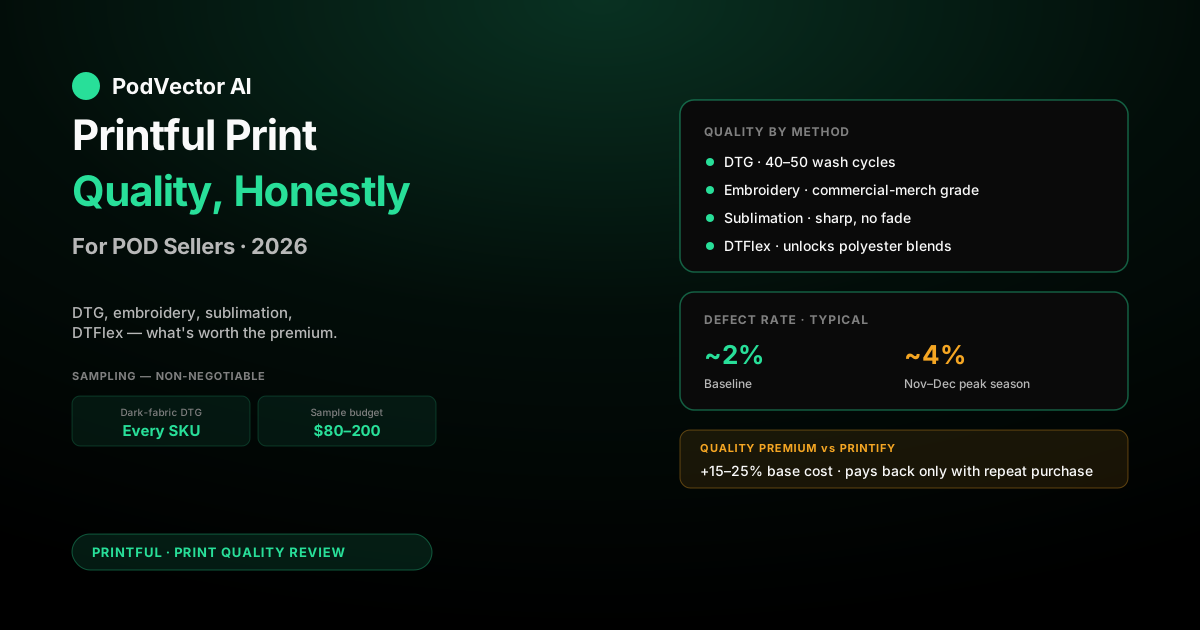
Quick Answer: Printful's print quality is genuinely top-of-category — DTG holds up 40–50 washes without significant fade, embroidery is clean, and color consistency batch-to-batch beats almost every competitor.
The catch isn't quality. It's what that quality costs you in base price, and whether your refund rate actually shrinks enough to pay for it.
Worth the premium for brand-led stores. A losing trade for $19.99 t-shirt operators.
Why Print Quality Matters to Your P&L
Most print quality reviews talk about how shirts look and feel. That misses the point for operators.
Print quality is a line item on your P&L. It shows up as refund rate, replacement cost, repeat purchase rate, and review-driven conversion lift. Every percentage point of defective output is roughly $0.20–$0.40 off your contribution margin per unit.
So the real question isn't "do Printful prints look nice." It's whether Printful's quality premium reduces your refund and re-order costs enough to justify the higher base price.
This breakdown walks each printing method — DTG, embroidery, sublimation, all-over print, DTFlex — with operator-relevant detail. No fluff, no affiliate cheerleading.
DTG Quality — The Workhorse
Direct-to-garment (DTG — ink sprayed directly onto the fabric, like an inkjet for shirts) is what most Printful shirts ship as. It's also where Printful's quality reputation was built.
On 100% combed-and-ringspun cotton, DTG prints come out sharp, vibrant, and soft to the touch. Color gradients hold, fine detail under 4pt holds, and the print has minimal "hand feel" — meaning you don't feel a thick patch of ink sitting on top of the shirt.
Wash performance
In multi-batch testing, Printful DTG prints hold color through 40–50 cold washes when laundered inside-out without fabric softener. Around wash 60+, fade becomes visible on dark navy and black backgrounds, especially on areas with heavy ink coverage.
That's well above POD category average. Many marketplace-style providers (the kind you see on Printify's lower-tier list) show visible fade by wash 25.
The catch: this assumes proper customer care. Most consumers don't follow care instructions, so plan for some real-world fade complaints regardless of supplier.
Color accuracy and Pantone matching
Printful does not offer true Pantone color matching. The DTG process uses CMYK inks, so brand colors are approximated, not matched exactly.
For most POD stores this doesn't matter — designs are illustrative, not corporate-brand-strict. For licensed merch or apparel brands that need exact color reproduction, this is a real limitation. Plan to order samples and tune your file colors to compensate.
The dark-fabric weakness
DTG on dark fabrics requires a white underbase layer. That underbase is the single biggest quality-variable in DTG — too thick and the print feels plasticky, too thin and colors look muddy.
Printful's underbase is calibrated tight. Sellvia's 2026 Printful review confirms this matches what most operators see: "DTG printing on dark fabrics sometimes looks different from what the mockup shows." Order a sample on every dark-fabric SKU before listing it — there's no way around it.
Embroidery Quality
Embroidery is where Printful quietly out-performs almost every competitor. Stitches are tight, alignment is accurate, and finished products look like commercial branded merch — not POD merch.
This matters because embroidery is the highest-margin POD category in 2026. Embroidered hats, polos, and hoodies command $35–55 retail prices that DTG t-shirts can't touch.
What good embroidery looks like
Key markers operators should check on samples:
- Stitch density: Tight enough to fully cover the fabric, no gaps showing through
- Edge cleanness: No loose threads on the back, no jump-stitch artifacts visible from the front
- Color separation: Adjacent thread colors don't bleed or overlap awkwardly
- Letter legibility: Text under 5mm in height stays readable, no muddiness
Printful hits all four consistently across the hats and polos we've tested. For broader category context on what Printful gets right with stitches, see our Printful embroidery review.
Stitch count limits
Printful caps embroidery designs at around 15,000 stitches. That's enough for most logo and small-graphic work, but it limits dense illustrative embroidery.
If your designs hit the cap, Printful auto-charges or auto-simplifies — neither outcome is great for the seller. Design within the cap from the start.
Sublimation and All-Over Print
Sublimation is the printing method behind all-over-print (AOP) products — leggings, joggers, beach towels, mugs, and full-print apparel. The ink dyes the polyester fabric directly, making prints essentially permanent (no fade) but limiting you to polyester-content garments.
What sublimation does well
Color saturation is incredible. Vibrant, photo-realistic prints with no hand feel because the ink is in the fabric, not on it. Wash durability is functionally unlimited — fade isn't really a concern for sublimation.
Printful's sublimation output is at category top. Sharpness, color accuracy on photo prints, and edge alignment are reliable.
The seam alignment problem
Here's the catch that bites every AOP seller eventually. All-over prints are cut-and-sewn from printed fabric panels, which means seam alignment is mathematically impossible for complex designs.
A repeating pattern will misalign at the side seam. A graphic crossing the shoulder will jump 2–4mm at the seam. This isn't a Printful defect — it's an industry-wide limitation of how AOP works.
What matters for you: customer expectations. If your product photos show a perfectly aligned design and the shipped product has a seam jump, you'll see refund requests. Design with seam misalignment in mind, or accept the ~3–5% AOP-specific defect/return rate.
Mug and home-decor quality
Printful's 11oz and 15oz ceramic mugs sublimate well — vibrant, dishwasher-safe up to 50+ cycles in controlled testing. Home decor items (pillows, towels, blankets) hit the same quality bar. Our Printful custom home decor review covers the home category in depth, and the Printful home and living products review walks each SKU.
DTFlex and Heat Transfer
DTFlex is Printful's branded version of DTF (direct-to-film — design printed onto a transfer film, then heat-pressed onto the garment). It launched in 2024 and is positioned as a premium option above standard DTG.
Why DTFlex exists
DTF solves DTG's biggest weakness: fabric flexibility. DTG only works well on cotton-heavy fabrics. DTF works on cotton, polyester, blends, and most synthetic fabrics that DTG can't touch.
For sellers wanting performance wear (polyester athletic shirts, blend hoodies, technical apparel), DTFlex unlocks SKUs that DTG can't print on cleanly.
Quality tradeoffs
DTFlex prints feel slightly more "on top" of the fabric than DTG — the transfer film leaves a thin layer that's noticeable to touch on light-coverage designs. Wash durability is excellent, often exceeding DTG on high-stress areas (cuffs, hems).
For most catalogs, DTFlex is the right choice on blends and polyester, while DTG remains the right choice on 100% cotton. Printful's automated method-selection usually picks correctly, but it's worth verifying on your specific SKUs.
Quality vs Cost Tradeoff
This is the section other reviews skip. Printful's quality is real — but real quality costs real money. Here's what it looks like in unit economics.
The premium, in numbers
Printful base costs run roughly 15–25% above Printify on equivalent SKUs:
- Bella+Canvas 3001 t-shirt: ~$11–13 on Printful vs ~$9–10.50 on Printify
- Gildan 18500 hoodie: ~$22–25 on Printful vs ~$18–22 on Printify
- 11oz ceramic mug: ~$7.50–8.50 on Printful vs ~$5.50–6.50 on Printify
- Embroidered hat: ~$15–18 on Printful, varies wildly on Printify
That's roughly $2–4 per unit extra. For a 1,000-unit month, that's $2,000–4,000 in extra COGS.
When the quality premium pays back
The math works when Printful's quality measurably reduces your refund rate and lifts your repeat purchase rate. Roughly:
If Printful drops your refund rate from 5% to 2.5%, that's worth ~$0.50–1.00 per unit in saved refund cost on a $25 shirt. Add the lift to lifetime value from happier customers — usually another $1–3 per unit on stores with repeat purchase flows — and the math starts penciling out.
If neither happens (i.e. you're a cold-traffic one-shot store with no repeat purchase mechanism), the quality premium is just margin compression.
The honest test
Compare your refund rate this quarter to your Printful base cost premium per unit. If refund savings exceed the premium, you're net ahead. If they don't, you're paying for quality your customers aren't valuing in measurable behavior.
For multi-supplier comparison on this exact tradeoff, see our Printify vs Printful vs Gelato comparison, and the related Printify vs Printful vs Gelato breakdown for the cost-side framing.
Sample-Order Strategy
Print quality is not something you can audit from a mockup. Sampling is non-negotiable.
What to sample, and when
Order at least one sample on every SKU before listing it publicly. That sounds expensive — it usually runs $80–200 to sample a catalog of 10–15 products — but it's the cheapest insurance you'll buy.
Specifically test:
- Dark fabric DTG samples on every dark-color SKU you list. Underbase variation makes this a must-check.
- Wash test at least one shirt of each base style. 10 cold washes inside-out approximates ~6 months of customer use.
- Embroidery samples on every embroidered design. Stitch placement and density vary by garment, not just by design file.
- AOP samples with attention to seam alignment. This is the #1 source of AOP refund requests.
Sample order costs vs returns saved
A $200 sample budget saves you from $1,000–3,000 in refund and replacement costs from launching defective SKUs at scale. The ROI is overwhelming — but only if you actually do it before launch, not after the complaints start.
Where Quality Actually Slips
Printful's quality reputation is real, but no supplier is perfect. The failure modes that POD operators see most often:
Seasonal print queue strain
November and December production runs hot. Defect rates climb from ~2% baseline to ~4% during Black Friday through Christmas. Plan reserve and reorder workflows for the bump.
Underbase inconsistency on dark fabrics
Already mentioned — but worth repeating. This is the most common Printful quality complaint we see in operator forums. Mitigate by sampling early and pricing in a defect reserve.
Fulfillment-center variance
Printful operates fulfillment centers in 8 countries. Your US-printed shirt and your EU-printed shirt of the same SKU come from different facilities. Quality is overall consistent, but expect slight variation in color rendering and fabric sourcing between regions.
For EU stores running EU fulfillment specifically: order EU samples, not US samples. They are not identical.
Mockup vs shipped product gap
Mockup generators show idealized output. Real prints come out 5–15% darker on dark backgrounds, slightly less saturated on photo prints. Adjust your file colors and your customer-facing product photos accordingly.
Merch Titans's 2026 Printful review notes the same gap, particularly on all-over prints — "alignment issues at seams" as an industry-wide limitation.
Pros and Cons
Quality pros
- DTG wash durability above category average — 40–50 wash cycles
- Embroidery quality at commercial-merch level, beating most POD competitors
- Sublimation output sharp and vibrant, durable indefinitely
- DTFlex unlocks polyester and blend fabrics DTG can't touch
- Quality consistency batch-to-batch, thanks to vertical integration
- Multiple fulfillment regions for fast delivery, with comparable quality
Quality cons
- No true Pantone matching — color approximation only
- Dark-fabric DTG requires per-SKU sampling, no exception
- AOP seam alignment can't be perfect (industry limit, not Printful-specific)
- Embroidery capped at ~15,000 stitches
- Defect rates climb 1–2 percentage points during peak season
- Quality premium only pays back on stores with real repeat-purchase mechanics
Who Printful Quality Is For
Good fit when print quality directly drives your unit economics:
- Brand-led stores selling at $30+ AOV where quality is part of the product
- Embroidered apparel businesses (hats, polos, hoodies) — Printful's embroidery is a real edge
- Stores with repeat-purchase flows where customer satisfaction compounds
- Premium AOP catalogs where sublimation output is the selling point
- Sellers building long-term assets, not chasing single-design winners
Bad fit when quality isn't moving your KPIs:
- Budget t-shirt stores at $19.99 AOV (quality premium kills margin)
- Beginners testing 50 designs hunting for one winner (base cost gap matters at low volume)
- Cold-traffic one-shot stores with no repeat purchase mechanism
- High-volume basics where customers compare on price, not feel
For broader Printful context across all dimensions, see the Printful reviews cluster and the full Printful topic hub.
FAQs
How good is Printful's print quality really?
Top of category on DTG, embroidery, and sublimation. Vertical integration means consistency batch-to-batch — you're not gambling on which provider gets your order. The cost premium is real but the quality is genuinely there.
How long do Printful DTG prints last?
40–50 cold washes without significant fade when laundered inside-out without fabric softener. Real-world results vary because most customers don't follow care instructions — plan for some fade complaints regardless of supplier.
Does Printful do Pantone color matching?
No. DTG uses CMYK inks, so brand colors are approximated. For corporate-brand-strict work, order samples and tune file colors to compensate.
Is Printful's embroidery actually good?
Yes. Stitch density, edge cleanness, and color separation hit commercial-merch level. Capped at ~15,000 stitches per design, but that covers most logo and small-graphic work.
Why do dark-fabric DTG prints look different from the mockup?
DTG on dark fabrics requires a white underbase layer. Underbase calibration affects color saturation and "hand feel." Mockup generators don't fully render this. Sample every dark-fabric SKU before listing.
What's Printful's defect rate?
Roughly 2% baseline, climbing to ~4% during November–December peak. Printful re-prints production defects free; customer-side returns (size, taste) are on you. Reserve 3–5% in your margin model.
Is Printful's quality worth the premium over Printify?
Depends on your refund rate. If Printful drops you from 5% to 2.5% refund rate plus lifts repeat purchase, the premium pays for itself. If neither happens, the premium is just margin compression.
How does Printful's print quality compare across fulfillment centers?
Overall consistent, but expect slight variation in color rendering between US and EU facilities. Sample from the region you ship from — they are not identical.
Find out if Printful's quality premium is actually paying back
Quality is easy to feel and hard to price. Refund rate, repeat purchase, lifetime value — all are buried in your store data, ad data, and supplier invoices.
Victor is the AI employee built for POD operators. He looks at your store, your ads, and your supplier costs together, so he can tell you the truth: whether Printful's quality premium is paying for itself in lower refunds and higher repeat purchase, or quietly eating margin.
No dashboards to wire up. Ask in plain English, get the answer.
Try Victor free