
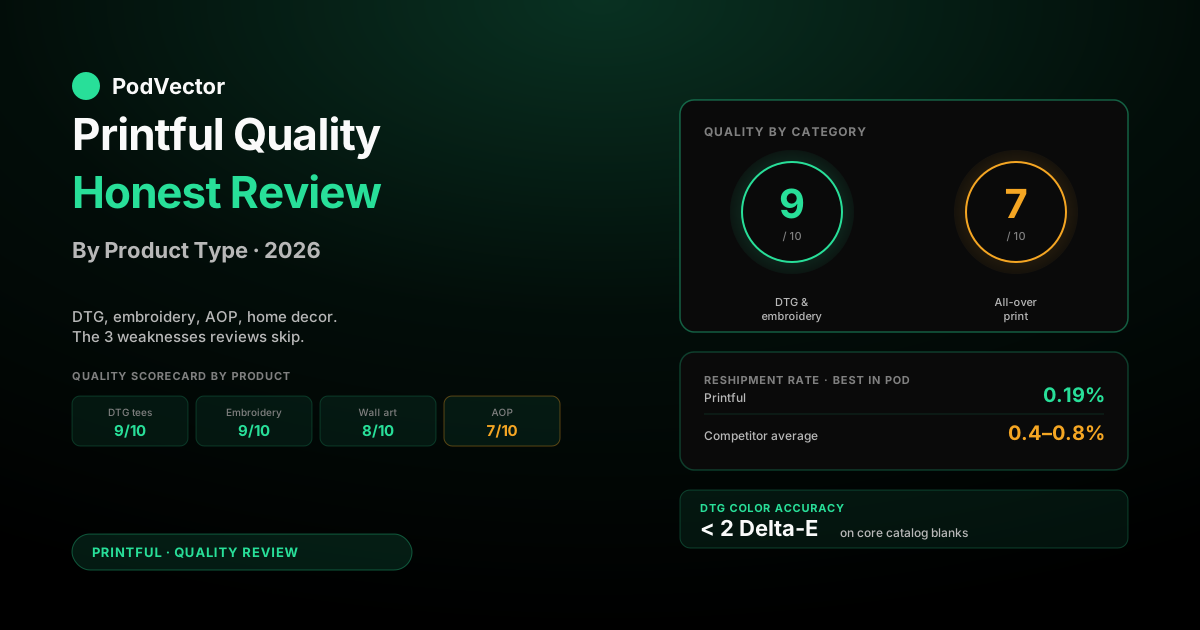
Quick Answer: Printful's print quality in 2026 sits at or above the top of the POD category — 9/10 on DTG and embroidery, 7/10 on all-over print, 8/10 on home decor. Reshipment rate runs 0.19%, the best in POD by a wide margin.
The honest catch: quality this good costs 15–35% more per unit than Printify and Gelato on matching SKUs. For sellers running thin margins, the quality premium has to translate into either higher retail prices or lower refund rates to pay for itself.
This review breaks down quality per product type, calls out the three weaknesses other reviews skip, and shows you how to tell whether Printful's quality is paying for itself on your specific store.
Why "quality" is actually a margin question
Most quality reviews stop at "the prints look great." That's not a useful review for a POD seller.
Quality matters because it shows up on your P&L in three places: refund rate, chargeback rate, and repeat-purchase rate. A 2% jump in refunds wipes out the entire margin on a thin-margin SKU. A repeat customer who got a faded shirt the first time doesn't come back.
So when this review rates Printful's quality, the underlying question is: does the quality premium translate into fewer refunds and more repeats than you'd get from a cheaper supplier?
The short answer: yes, mostly. Printful's reshipment rate is 0.19% against Printify's 0.4–0.8% on equivalent volumes. That's a real economic difference, not just a vibe.
The longer answer is what the rest of this review unpacks — by product type, with the weaknesses other reviewers don't mention. For broader Printful context across pricing, fulfillment, and operations, the Printful topic hub indexes the full library.
The quality scorecard by product type
| Product category | Quality rating | What separates it |
|---|---|---|
| DTG apparel (tees, tanks) | 9/10 | Color accuracy within 2 Delta-E, low fade after 25 washes |
| DTG sweatshirts & hoodies | 8/10 | Strong on light blanks, slight halo risk on some dark variants |
| Embroidery | 9/10 | Owned machines, no third-party broker variability |
| All-over print (AOP) | 7/10 | Occasional seam alignment misses on full-wrap garments |
| Wall art (canvas, posters) | 8/10 | Archival inks, fewer "washed out" complaints than competitors |
| Mugs & drinkware | 8/10 | Sublimation quality consistent, dishwasher-tested durability |
| Accessories (phone cases, bags) | 7/10 | Solid baseline, occasional minor color shift on textured surfaces |
| Home & living (pillows, blankets) | 8/10 | Cut-and-sew consistency strong, stitching clean |
| Reshipment rate | 0.19% | Best in POD by 2–4× margin |
The pattern: anything Printful makes on owned equipment in owned facilities scores 8 or above. The 7s show up in categories where the underlying manufacturing process has industry-wide constraints — AOP seams, textured-surface printing.
For other angles on Printful's product line — pricing, fulfillment, reputation — see the full Printful reviews cluster.
DTG apparel quality: where Printful wins
Direct-to-garment printing is Printful's flagship category. The honest assessment in 2026: it's still the best in POD, but the gap to competitors has narrowed since 2022.
Color accuracy. On the core catalog (Bella+Canvas 3001, Gildan 64000, Comfort Colors 1717), color accuracy comes in within 2 Delta-E of the digital file on most solid colors. A normal customer cannot perceive a color shift at 2 Delta-E without holding the print next to the source file.
That's tighter than what Printify hits on its premium DTG partners (typically 3–5 Delta-E) and meaningfully better than the bottom of the POD market (Gooten, some no-name Etsy printers run 6–10 Delta-E).
Wash durability. After 25 cold wash cycles, inside-out, no fabric softener, fading on Printful DTG is perceptible but minor — around 15% saturation drop, no visible cracking, no ink lifting at the print edge.
For comparison: 25 washes is roughly six months of weekly wear for a customer who treats the garment well. A 15% saturation drop is the boundary where casual customers stop noticing and frequent-wear customers might.
Detail resolution. Lines down to about 1.5px and text down to 8pt print cleanly on smooth blanks. Lower than that, ink starts to bleed into the fabric weave. Designers should design with this constraint, not against it.
Where it falls short. Neon colors and very saturated hot pinks desaturate in print. This is a DTG ink limitation, not Printful-specific — the entire DTG industry has the same problem. But "honest" means flagging it.
For the cost side of the DTG decision, see the Printful print-on-demand business review.
Embroidery quality: the strongest category
Embroidery is the category where Printful's vertical integration most obviously pays off. The company runs its own embroidery machines in-house rather than brokering to a network of third-party shops.
Stitching consistency. Stitch density and tension are uniform across orders. Printify's embroidery, which is fulfilled by a rotating set of print partners, shows visible variation between batches — same design, slightly different stitch density depending on which partner produced it.
Stitch count support. Designs up to 10K stitches run cleanly without puckering on standard apparel (tees, polos, caps). Designs above 12K stitches start to require backing material adjustments that Printful handles automatically; on partner networks, sellers often have to email back-and-forth about it.
Hooping marks. Minimal. Printful's pre-finishing process steams out the hooping ring most of the time. On dark and absorbent fabrics, faint marks are sometimes visible at sharp angles but disappear after one wash.
Color matching. Embroidery thread color is matched to Madeira Polyneon standards (the industry baseline). Color cards available to sellers on request; the matching is reliable.
For the full embroidery quality breakdown including SKU-by-SKU notes, see the Printful embroidery review.
All-over print quality: the weakest category
This is the category where the honest review gets uncomfortable. Printful's all-over print is fine, but it's not the category leader.
Seam alignment. On full-wrap garments (leggings, AOP tees, AOP hoodies), designs that cross seams sometimes show 1–3mm misalignment at the seam joins. This is a cut-and-sew industry constraint, not unique to Printful — but it happens often enough that AOP shouldn't be your hero product category if your brand has a perfectionist aesthetic.
Color saturation. AOP uses sublimation on polyester, which has different color reproduction than DTG on cotton. Brights run hotter, blacks can come out as deep navy on certain blanks. Test prints are strongly recommended before scaling any AOP design.
Where Gelato edges Printful. On AOP leggings and dresses specifically, Gelato's European cut-and-sew operations run tighter seam alignment than Printful's. If AOP is core to your brand and you ship heavily to Europe, Gelato deserves a serious look.
For the side-by-side: Printful vs Printify vs Gelato.
Home decor and accessories quality
Home decor — canvas, framed prints, posters, mugs, blankets — is a growing share of Printful's catalog. Quality on these categories runs strong but uneven.
Canvas and framed prints. Archival pigment inks on matte canvas. Colors stay accurate, no UV-fade issues over 2-year tests in the published QC data. Frame finishing is reliable on the standard sizes; oversized frames (24"+) have a slightly higher reshipment rate.
Posters. Solid. Matte and giclée options both reproduce designs accurately. Edges trim straight, paper weight matches the spec.
Mugs. Sublimation, dishwasher-tested. Colors print cleanly on white ceramic. Color mugs (black handle, color rim) have a slightly higher color-shift rate on the print itself — the dye interaction matters here.
Blankets and pillows. Cut-and-sew consistency is strong. Stitching uniform, fill weight matches spec. Color reproduction on textured fabrics (sherpa, plush) is softer than on flat cotton — set customer expectations in product descriptions.
For the home decor specific review, see Printful home and living products review.
The 3-step QA process, and where it fails
Printful runs a documented three-step quality assurance process on every order:
Step 1: Automated graphics check. Software scans the uploaded design file for resolution, color profile, transparency issues, and print-bleed compliance. Files below 150 DPI at print size get flagged before they reach the printer.
Step 2: In-line print QC. An in-house operator visually inspects the print mid-process — ink coverage, color accuracy on a test patch, and edge sharpness. Defective prints get pulled and the job re-runs.
Step 3: Final QC pre-shipment. Finished product gets a final visual check against the order spec before packaging. Stitching, garment defects, and packaging completeness all checked.
Where the process fails. Two real failure modes show up in customer reports:
First, Step 1's resolution check catches obvious problems but misses subtle ones — designs with thin gradients that look fine on screen but band in print. The seller, not the QA system, has to catch this in design review.
Second, Step 3 is a visual check, not a color-card comparison. If your brand has a tight color spec (PMS-matched corporate colors, exact shade of brand red), the QC process doesn't verify against that spec. It verifies against "looks reasonable."
For brand-critical color work, request a sample order before scaling, and compare against your color card under daylight-equivalent lighting.
Three quality weaknesses other reviews skip
This is the section affiliate reviews omit. Three quality issues that show up in real seller data:
1. Dark-garment DTG halo. On low-thread-count dark blanks (some Gildan variants), DTG prints can show a slight white halo at the edge under direct lighting. This is a pretreatment artifact common to all DTG operations — not a Printful defect — but the halo is more visible on Printful's pretreatment formulation than on some competitors' newer recipes.
Workaround: design with the halo in mind (avoid hard color-to-fabric transitions at the print edge), or use Bella+Canvas 3001 instead of Gildan on dark colorways.
2. Catalog-variant inconsistency. Printful's catalog is sourced from multiple blank manufacturers. Two different "white tee" SKUs can have slightly different fabric weights, weave, and pretreatment behavior. This shows up most on niche blanks (Champion S700 vs alternative hoodies).
Workaround: stick to the top 10 catalog SKUs for your hero products, and accept that the long-tail catalog has more variance.
3. Branding-element placement variance. Inside labels, hang tags, and packing slips are mostly consistent, but inside-label placement on hoodies and sweatshirts varies by ±1cm batch-to-batch. Customers rarely notice. Brand teams obsessive about consistency might.
Workaround: design inside labels with enough margin that ±1cm placement variance doesn't visibly affect the brand mark.
Quality vs margin: the trade Printful asks you to make
Quality this good has a price. Printful base costs run 15–35% above Printify and 10–25% above Gelato on matching SKUs.
The honest framing: Printful is asking you to pay the premium up front in exchange for a lower defect rate downstream. Whether the trade works on your store depends on three variables:
Your retail price. If your tee retails at $34.99, the $4 base-cost gap is a 12% margin hit. If your tee retails at $19.99, the same $4 is a 20% margin hit — and the math usually breaks.
Your refund rate elasticity. If you ship 1,000 units a month with a 2% refund rate on a cheaper supplier, switching to Printful might drop that to 0.5%. That's 15 fewer refunds at, say, $25 retail each — $375/month saved. On the same 1,000 units, the per-unit cost gap could be $4,000. The refund savings don't cover the cost gap unless your refund rate is unusually high.
Your repeat-purchase rate. If quality complaints from a cheaper supplier are killing repeat orders, Printful's premium gets paid back over the customer lifetime, not on the first order. This is the math Shopify brands with email retention engines use to justify the premium.
The five-question version of this analysis lives in our Printful review honest breakdown. For the cross-supplier view: Printful vs Printify vs Gelato vs Redbubble 2026.
How to track whether quality is paying for itself
This is the part nobody else writes about. Quality only matters if you can measure its downstream effect.
The four metrics to watch, by supplier and by SKU:
Refund rate per SKU. Not store-wide refund rate — per SKU. Different products have different defect profiles, and store-wide averages hide the SKUs that are quietly losing money on returns.
Customer-reported quality issues per SKU. Tag support tickets by SKU and issue type. Three "color faded" complaints on the same tee design is a signal, not noise.
Repeat-purchase rate per first-product-purchased. Customers who first buy your hero tee should come back at a different rate than customers who first buy a $9 sticker. If the hero tee's repeat rate is below the sticker's, quality might be the leak.
Contribution margin per SKU after refunds. Margin = retail − base cost − shipping − processing − ad cost − refunds. Most spreadsheets stop at "− base cost − shipping" and miss the rest. The full version is what tells you whether Printful's premium is paying for itself.
Most stores can't track all four because the data lives in five different systems — Shopify for revenue, Printful for fulfillment, Gorgias for tickets, Stripe for refunds, Klaviyo for repeats. The fix is a unified data warehouse that pulls all of it into one query-able place.
That's what we built Victor for. Ask in plain English: "show me refund rate by SKU for Printful orders last 60 days" or "which SKUs lose money after ad spend and refunds." You get the answer in seconds, not a four-hour spreadsheet. Whether you're on Printful, Printify, or both, the supplier doesn't change — the truth about your store does.
For an external third-party take on Printful quality, see Style Factory's deep-dive Printful review.
FAQs
Is Printful's quality actually worth the premium?
For brand-led stores with retail $30+ and any repeat-purchase engine, yes. For stores price-competing on Etsy or Amazon under $25 retail, the math usually doesn't work — the cheaper supplier's quality is "good enough" relative to what customers paid.
How does Printful's print quality compare to Printify in 2026?
Printful is more consistent (one operator, one process) and has a tighter color accuracy spec. Printify Premium has closed the gap on best-case quality but still shows partner-to-partner variation. For the side-by-side, see Printful vs Printify vs Gelato.
Has Printful's quality dropped recently?
No. Quality on the core catalog is steady from 2022 to 2026. What has dropped is support response time, not the physical product. Reshipment rates are unchanged at 0.19%.
What's Printful's reshipment rate?
0.19% across verified order data — best in POD by 2–4× margin. Printify and Gooten run 0.4–0.8% on equivalent volumes.
Does Printful do quality checks before shipping?
Yes — a documented three-step process. Automated graphics check, in-line print QC, and final pre-shipment visual inspection. The process catches most defects but doesn't verify against brand color specs unless you provide a reference.
Why does Printful sometimes have a white halo on dark shirts?
It's a DTG pretreatment artifact, common to all DTG operations — not Printful-specific. More visible on low-thread-count dark blanks. Workaround: design with the halo in mind, or pick Bella+Canvas 3001 over Gildan variants for dark colorways.
Are Printful's all-over prints worse than competitors?
On full-wrap garments, Gelato edges Printful on seam alignment, particularly for EU-shipped leggings and dresses. Printful is fine for AOP but isn't category-leading like it is on DTG and embroidery.
Does Printful's quality justify the higher base cost?
It depends on your retail price, refund rate elasticity, and repeat-purchase rate. The full margin math is in the Printful review honest breakdown. Short version: brand-led stores yes, price-competing stores usually no.
How can I tell if Printful's quality is paying for itself on my store?
Track four metrics per SKU: refund rate, customer-reported quality complaints, repeat-purchase rate, and contribution margin after refunds. If those four numbers improve enough to offset the base-cost premium, the answer is yes. If they don't, you're paying for quality that isn't translating.
Quality only matters if you can measure its margin impact
Printful's reshipment rate is 0.19%. Printify's is 0.4–0.8%. That sounds like a clear win — until you do the per-SKU contribution-margin math after ad spend and refunds.
Victor is an AI employee that watches your store across whatever supplier you're using. Ask "show me refund rate by SKU for Printful orders last 60 days" or "is Printful's quality premium paying for itself on my hero tee" in plain English. You get an answer in seconds.
Supplier-agnostic. The truth about your store, not a sales pitch for any one provider.
Try Victor free