
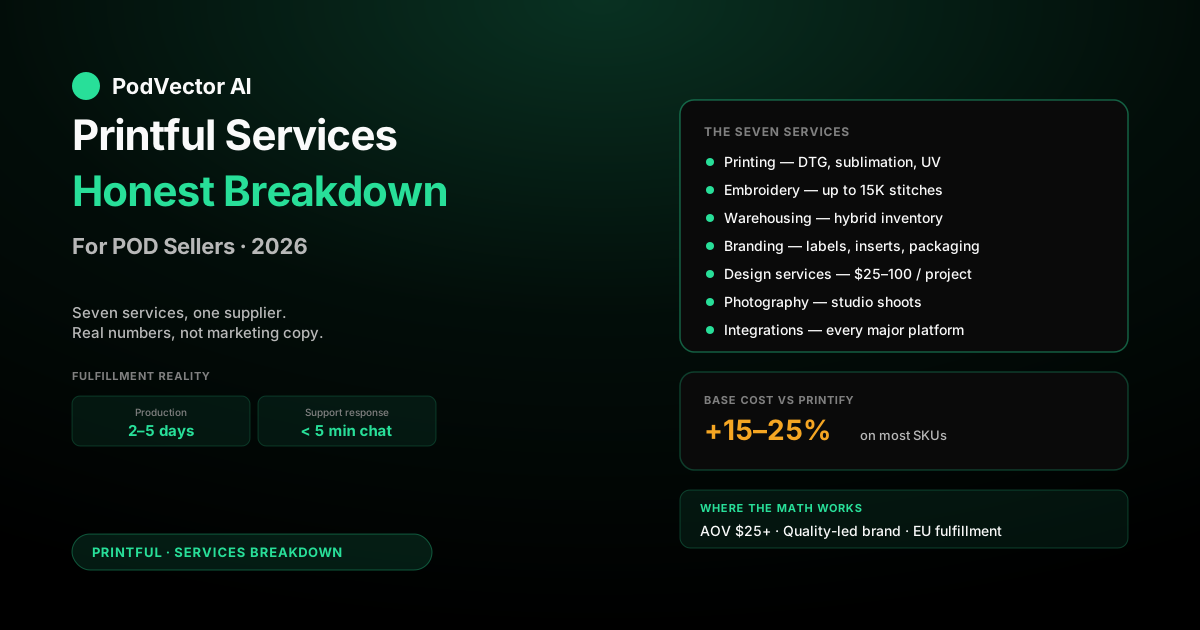
Quick Answer: Printful's print-on-demand services cover printing, embroidery, fulfillment, warehousing, and branding under one roof — which is the strength and the trap.
You get the cleanest catalog and the most reliable in-house production in POD, but base costs run higher than Printify on most SKUs and meaningfully higher than Gelato on EU orders. According to checkthat.ai, the Bella+Canvas 3001 costs $11.69 on Printful versus $9.04 on Printify with Premium — a 22.7% gap on your most-printed shirt.
Worth it if you're already selling on quality and brand. Painful if you're trying to win on price.
What Printful Actually Is (and Isn't)
Printful is a print-on-demand services platform that owns its production. You upload designs, customers buy, Printful prints and ships in your branding — and crucially, they do it inside their own facilities, not through a third-party network.
That's the line that separates Printful from most of the field. Printify, by contrast, is a marketplace of independent print providers. Same business model on the surface, very different operational reality. Because Printful owns and operates its fulfillment centers rather than outsourcing to third-party printers, quality control is noticeably more consistent — as Merch Titans notes in their 2026 review.
What Printful isn't: a cheap option. The vertical integration that makes their quality consistent also makes their base costs higher. You pay for the in-house factories. The math is what it is.
For a deeper version of this comparison, see our Printify vs Printful pros and cons breakdown.
The Services, One by One
Printful markets itself as a "print-on-demand services" company, plural. That's accurate. The platform bundles seven distinct services that you'd otherwise stitch together yourself.
1. On-demand printing
DTG (direct-to-garment) for apparel, sublimation for all-over prints, cut-and-sew for custom-pattern goods, and UV printing for accessories. Multiple techniques under one supplier. According to G2's 2026 data, the free plan gives every user access to hundreds of customizable products and automated fulfillment across 20+ ecommerce platforms and marketplaces.
T-shirts and hoodies dominate, but mugs, hats, posters, phone cases, and home goods all get strong catalog coverage.
2. Embroidery
This is one of Printful's quieter strengths. Embroidery on hats, hoodies, and polos with included stitch counts in the base price. Pricing scales by stitch count beyond that.
Few POD platforms run embroidery in-house at this scale. According to checkthat.ai, Printful's embroidery is consistently high quality — and if embroidered apparel is your category, the alternatives shrink quickly. A hybrid approach some sellers use: route embroidered and premium items through Printful while sending basic apparel through Printify.
3. Warehousing and fulfillment
Printful Warehousing lets you ship non-POD inventory (your own stock) from their facilities alongside printed goods. One shipping origin, one customer experience.
The fee structure is monthly storage plus per-pick. For sellers running hybrid inventory — some printed, some bulk-purchased — this collapses a lot of operational complexity.
4. Branding and custom packaging
Custom packing slips, inside-label printing, branded stickers, and packaging inserts. Most are paid add-ons. According to Printful's published pricing (via PodVector's costs guide), the printed inside neck label runs $0.99 per unit on the free plan, and the printed outside label runs $2.49 per unit — replacing the manufacturer tag with your brand is the single highest-leverage branding spend per dollar.
None of this is free, but it's available — which is more than most POD competitors offer at all.
5. Design services
Their built-in mockup generator and Design Maker tool handle the majority of what most sellers need. For sellers without design skills, Printful also offers paid graphic design services on demand. Note: if you need AI-generated designs or print-ready image creation, that's outside what Printful's design tools do — you'll need a separate creative workflow.
6. Photography services
Custom product photography of your designs on real models, shot in Printful's studio. Useful for premium brands; usually overkill for early-stage stores.
7. Storefront and integrations
Direct integrations with Shopify, Etsy, WooCommerce, Amazon, eBay, Wix, Squarespace, BigCommerce, and more. Plus their own basic storefront builder for sellers who don't want a third-party platform yet.
Pricing Reality: What You Actually Pay
Here's where most reviews get vague. POD sellers need actual numbers.
According to checkthat.ai's verified 2026 pricing data, the Bella+Canvas 3001 unisex t-shirt — the most-printed shirt in POD — costs $11.69 base on Printful versus $9.04 on Printify with Premium subscription, a difference of 22.7% on every unit. Mugs show an even wider gap: $7.56 on Printful versus $3.68 on Printify, per the same source.
Note a February 2026 development: according to ecommerceceo.com, Printful rolled out a targeted price increase affecting Cotton Heritage products (hoodies, heavyweight tees, sweatshirts, sweatpants), with base prices rising by between 0.4% and 2.4% on affected items. The most popular products — Bella+Canvas, Gildan, mugs, and posters — and standard apparel shipping rates were not affected.
Shipping costs
According to bootstrappingecommerce.com's 2026 Printful pricing data, t-shirt shipping starts at $4.69 and hoodie shipping starts at $8.49. International shipping is where it gets expensive, especially to non-US/non-EU destinations. Printful also applies seasonal surcharges: according to checkthat.ai, a $0.40 holiday surcharge applied from October 15, 2025 through January 17, 2026 — factor that into Q4 margin modeling.
Printful Growth subscription
According to G2's 2026 data, the Printful Growth plan is $24.99/month — or free once you hit $12,000 in annual qualifying sales. Per checkthat.ai, it unlocks up to 33% product discounts. According to ecommerceceo.com, the per-item savings of $2–$5 on Growth exceed the monthly fee at roughly 10–15 orders, so the math is straightforward once you're moving consistent volume. Below that, start on the free plan and upgrade when the numbers justify it.
What "subscription-free" actually means
The base Printful account is free. You only pay when an order ships. That's true — but it doesn't make Printful cheap. It just means your costs scale with sales, not flat. The unit economics still need to work, and they don't always.
Margins, honestly
The answer depends on your retail price and ad spend. On a mid-priced t-shirt with Printful base plus shipping, gross margin is real but thin — and branding add-ons compress it further. Sellers running paid ads on thin-margin SKUs feel the squeeze fastest. We dig into the full picture in our Printify vs Printful comparison.
Quality and Fulfillment Times
Print quality is genuinely strong. According to Merch Titans' 2026 review, Printful's DTG prints hold up better after multiple washes and their color accuracy is above average compared to Printify's various print providers. Color accuracy is consistent across batches because everything ships from the same handful of facilities.
Embroidery quality is also above category average — clean satin stitches, accurate color matching.
One caveat worth flagging, per sellvia.com's 2026 review: DTG printing on dark fabrics sometimes looks different from what the mockup shows, so ordering a sample before going live with any product is worth doing — Printful offers sample orders at a discount.
Fulfillment times
According to sellvia.com, production adds 2–7 business days to every order, plus shipping transit. EU orders ship from EU facilities, so transit times stay low for European customers. Printful automatically routes orders to the closest fulfillment center based on customer location — US orders ship from US facilities, EU from EU — which is a real service that most POD platforms pass to you as manual work.
Returns and quality issues
Printful re-prints free for production defects (color off, misprint, damaged shipping). Customer-side returns (wrong size, didn't like it) are not refunded — that policy is consistent across the POD industry.
Bake a realistic defect-rate assumption into your COGS modeling. If you're not tracking actual defect rate in your unit economics, your real margin is lower than you think.
Branding and Custom Packaging Services
This is where Printful pulls ahead for sellers serious about brand. The branding services aren't free, but they exist, and most POD competitors don't offer them at all.
Available branding services (pricing per Printful's published schedule, via PodVector's costs guide):
- Printed inside neck label — $0.99 per unit (free plan); the highest-leverage branding spend per dollar
- Printed outside label — $2.49 per unit
- Custom branded sticker on packaging — priced per order by format
- Custom packaging inserts — priced per unit by format in Printful's branding catalog
- Custom mailers and branded boxes — priced by size and material
Stack a few of these on a mid-priced shirt and branding adds meaningful cost per order. For premium-tier stores with higher average order values, the math usually works. For budget stores competing on low retail prices, branding services eat margin.
Integrations and Workflow Services
Printful's integration list as of 2026 covers every meaningful ecommerce platform: Shopify (most polished), WooCommerce, Etsy, Wix, Squarespace, BigCommerce, Magento, PrestaShop, Ecwid, Webflow, plus Amazon, eBay, Walmart, and Storenvy on the marketplace side.
The API is documented and usable if you're building custom workflows. Most sellers don't need it, but it's there.
Order routing logic
Printful automatically routes orders to the closest fulfillment center based on customer location. That's a real service — manual order routing is a tax most POD platforms pass to you.
Tax and VAT handling
Printful collects and remits VAT for EU and UK orders automatically. For US sellers, sales tax compliance is on you, but Printful provides the documentation needed for your filing.
The Printful–Printify Merger: What Changed
This is now a live topic for any POD seller evaluating Printful. The two largest players in print-on-demand announced a merger, and it changes the competitive landscape in ways that matter for your supplier strategy. For the full picture on what the merger means for fulfillment routing, pricing, and platform positioning, see our dedicated guide: Printful–Printify Merger: The POD Seller's Guide.
The short version: the two platforms remain operationally separate for now. Printful still fulfills in-house; Printify still routes through its provider network. Sellers do not need to immediately change anything, but understanding the direction of the combined entity matters for longer-term supplier decisions.
Customer Support
Support is available via live chat and email. According to Capterra's verified 2026 reviews, the platform is reliable and easy to use, and integrates smoothly with online stores. Note: Style Factory's August 2026 update to their Printful review flagged that phone support availability has changed — verify current support hours directly on Printful's site.
The one weak spot: complex issues (custom embroidery files, large order fulfillment questions) sometimes get bounced between tiers before resolution. Standard issues get answered fast.
Pros and Cons for POD Sellers
Pros
- In-house production means consistent quality batch to batch
- Embroidery available at competitive pricing with consistently high quality
- Strongest branding service stack in POD
- Polished UI and reliable integrations across every major platform
- EU fulfillment centers for fast EU delivery
- Warehousing service for hybrid inventory sellers
- Growth plan becomes free at $12,000 in annual qualifying sales (per G2's 2026 data)
Cons
- Base costs run higher than Printify on most SKUs — 22.7% gap on Bella+Canvas 3001 per checkthat.ai
- EU base costs run higher than Gelato on EU orders
- Production adds 2–7 days to every order (per sellvia.com)
- February 2026 price increases on Cotton Heritage products (per ecommerceceo.com)
- Branding add-ons stack up fast on low-AOV stores
- Growth subscription savings only pencil out once you're moving consistent order volume
Who Printful Is and Isn't For
Good fit
- Premium brands selling at higher average order values with branding as differentiator
- Stores prioritizing consistent quality over lowest unit cost
- Embroidered apparel businesses (hats, hoodies, polos)
- EU-focused stores wanting EU fulfillment
- Hybrid inventory sellers needing warehousing
- Established sellers who can amortize the Growth subscription
Bad fit
- Budget t-shirt stores trying to win on price
- Sellers testing many designs to find a winner where base cost gaps compound at low volume
- Sellers running aggressive paid ads on thin margins
- Stores where production speed advantage matters most (Printify with top providers may be faster)
The real test
The answer depends on your unit economics, not on Printful's feature list. The question that matters: at your AOV, ad spend, and target margin, does Printful's quality premium justify the unit cost premium?
That requires looking at actual numbers — landed COGS, refund-adjusted margin, blended CAC — not list prices. That's harder than reading review articles, but it's the only honest path.
For more context, see our Printify vs Printful pros and cons breakdown, the merger guide, and the full Shopify POD strategy overview. For the third-party perspective, Style Factory's comprehensive Printful review (updated August 2026) is the most detailed independent breakdown available.
If you're also running Printify alongside Printful, see our guide on linking Printify to Etsy and our breakdown of Printify free shipping codes — both affect how your total landed cost compares across suppliers.
FAQs
Is Printful free to use?
Yes, the base account is free. You pay only when an order ships — base product cost plus shipping. According to G2's 2026 pricing data, the optional Growth subscription is $24.99/month but becomes free once you hit $12,000 in annual qualifying sales.
How much can you realistically make with Printful?
Gross margins depend on your retail price, ad spend, and branding add-ons. The unit economics require real modeling — sellers who build profitable stores have real CAC discipline and product-market fit, not accidental traffic. For a margin-focused analysis, see our POD seller's guide to AI for ecommerce marketing.
Is Printful better than Printify?
Printful has higher base costs but more consistent quality (vertical integration). According to checkthat.ai, the Bella+Canvas 3001 costs $11.69 on Printful versus $9.04 on Printify with Premium — a 22.7% difference. For premium brands, Printful usually wins. For price-competitive stores, Printify usually wins. See our full Printify vs Printful breakdown.
How long does Printful take to ship?
According to sellvia.com's 2026 review, production adds 2–7 days to every order, plus shipping transit. EU-to-EU orders stay fast thanks to EU fulfillment centers. International routes vary widely.
Does Printful do embroidery?
Yes, on hats, hoodies, polos, and select apparel. According to checkthat.ai, Printful's embroidery is consistently high quality. It's one of the platform's clearest advantages over competitors who outsource embroidery or don't offer it at all.
What happened with the Printful–Printify merger?
The two platforms announced a merger but remain operationally separate for now. For the full breakdown of what changed and what it means for your supplier strategy, see our Printful–Printify Merger guide.
What's the catch with Printful?
Higher base costs than most competitors. The vertical integration that makes quality consistent also makes unit economics tighter. If your retail price is low and you're running paid ads, the margin math gets uncomfortable fast. The February 2026 price increases on Cotton Heritage products (per ecommerceceo.com) are an additional factor to model.
Stop guessing whether Printful is profitable for your store
Printful's base costs look fine in a spreadsheet. Then refunds, ad spend, and branding add-ons hit your real margin — and most sellers don't see it until quarter-end.
Victor is the AI employee built for intermediate-to-advanced POD sellers on Shopify. He reads your store, ad, and supplier data into one live data warehouse and surfaces the truth: which SKUs actually net positive, where margin leaks, whether the Printful premium is paying for itself. Every move he proposes waits on your approval before anything executes.
No dashboards to wire up. Ask in plain English, get the answer.
Try Victor free