
Quick Answer: Printful's custom home decor catalog covers posters, canvases, throw pillows, blankets, bath mats, tapestries, table runners, candles, and ornaments. Print quality is genuinely good — better than most cheap POD alternatives — and the catalog is broad enough to build a real home brand around.
The trap is margin. Home decor items have higher base costs and far heavier shipping than apparel, so the same retail markup that gives you a healthy tee margin can leave a throw pillow barely profitable after ads. This review walks the catalog category by category, runs real per-SKU math, and tells you which home decor categories actually make money on Printful.
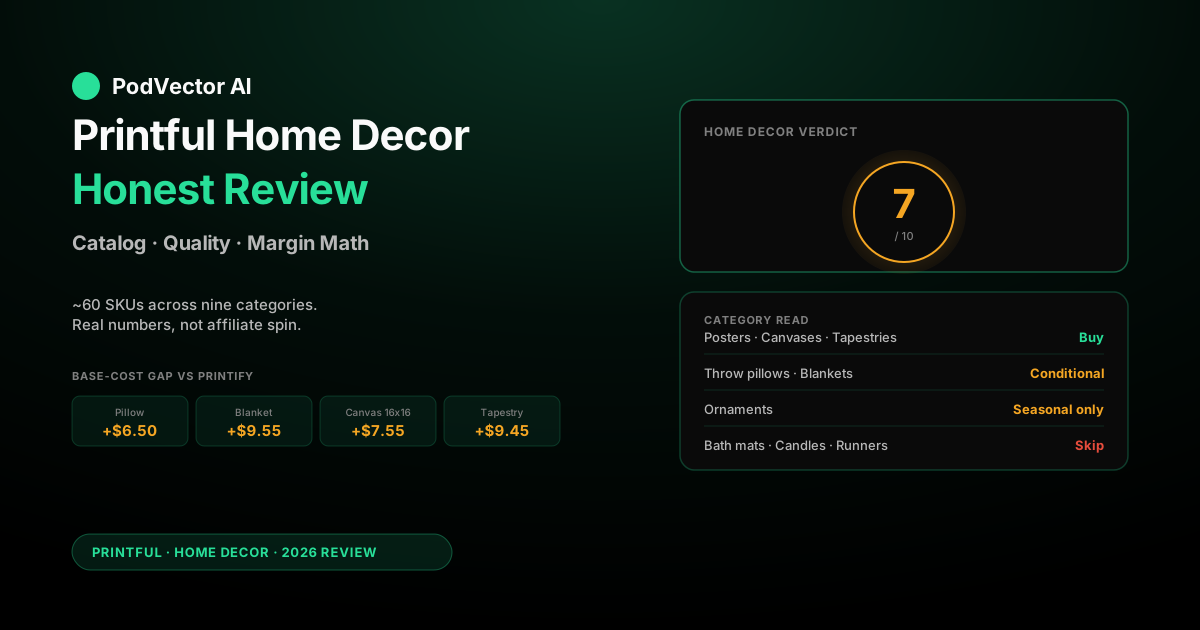
Short version: posters, canvases, and tapestries are the strong bets. Throw pillows and blankets need premium retail pricing to clear ad spend. Candles and bath mats are sneaky-bad for margin once shipping lands.
What an "honest" home decor review has to do
Most Printful home decor reviews online stop at "the quality is great, you can sell pillows and blankets, sign up here." That's not a review — it's a sales page wearing review formatting.
A real review for a POD seller weighing home decor has to answer three questions the affiliate posts skip:
Is the catalog actually broad enough to build a brand around? A handful of SKUs isn't a home decor business. You need wall art, soft goods, accents, and seasonal categories that move together.
Where does home decor make money — and where does it quietly lose money? Home decor base costs run higher than apparel and shipping runs much heavier. The same retail markup that works on a tee can collapse on a pillow.
How does Printful's home decor stack against the dedicated home decor POD suppliers? Gelato, Printify's poster partners, Gooten, and Society6's white-label arm all play in this category. Printful isn't the only option.
The rest of this review answers those three. If you've already read the general Printful review breakdown, this is the home-decor-specific cut — different base costs, different shipping economics, different verdict.
The 30-second home decor scorecard
| Dimension | Rating | What it means |
|---|---|---|
| Catalog breadth (home decor only) | 8/10 | ~60 home decor SKUs across 9 categories |
| Print quality on wall art | 9/10 | Posters, canvases, tapestries print sharp and color-accurate |
| Print quality on soft goods | 8/10 | Pillows and blankets clean; occasional minor seam alignment |
| Base cost competitiveness | 5/10 | 15–40% above Printify on equivalent home decor SKUs |
| Shipping cost (home decor specific) | 4/10 | Pillows, blankets, candles ship expensive; canvases worse |
| Branding on home decor | 9/10 | Custom packing slips, inside labels on pillows, branded tags |
| Fulfillment reliability | 9/10 | 0.19% reshipment rate carries across home decor too |
| Production time | 7/10 | 3–6 business days for most home decor (longer than apparel) |
| Overall, for home decor | 7/10 | Strong for wall art and premium brands. Weaker if you're chasing lowest base cost. |
Notice the gap between dimensions. Print quality is excellent. The catalog is real. But base cost and shipping drag the overall down, and those two are exactly the levers margin-first sellers care most about.
What's actually in Printful's home decor catalog
Printful's home decor catalog in 2026 is broader than most reviews give it credit for. Roughly 60 SKUs across nine categories. Here's the honest breakdown:
Wall art. Posters (enhanced matte, premium luster, giclée), framed posters in black, white, and oak, canvases in standard and gallery wraps, photo prints, and metal prints. Sizes from 5×7 up to 36×48 on the largest canvases.
Wall tapestries. Sublimation-printed polyester, three sizes (37×52, 50×60, 60×80). The all-over print holds color well on sublimation polyester.
Throw pillows. Sewn covers with insert included, in spun polyester and faux suede, sizes from 14×14 to 22×22. Two-sided print available on most cuts.
Blankets. Sherpa-backed minky, woven cotton blends, and lightweight throw weights, in 30×40, 50×60, and 60×80.
Bath mats. Microfiber top, non-slip rubber backing, two sizes (24×17 and 34×21). Sublimation print on the microfiber face.
Table runners. Polyester with a fabric blend backing, single size (16×72). Full-bleed sublimation print.
Candles. Soy wax in three scents (vanilla bean, sea breeze, fresh cotton), with a custom-print label that wraps the glass jar.
Ornaments. Aluminum, ceramic, and wood-grain, in star, circle, snowflake, and heart shapes. Two-sided print on most. Seasonal but year-round availability.
Calendars and posters with calendar grids. Wall calendars, desk calendars, and custom calendar posters. A niche category but worth knowing it exists.
What's not in the catalog: rugs (beyond bath mats), curtains, furniture, lampshades, framed mirrors, large rugs. If your brand needs those, you're cobbling together suppliers regardless.
Print quality across home decor categories
Home decor print quality varies by substrate. Lumping it all into one rating misses the picture. Here's how each category actually prints in 2026:
Posters and giclée prints. 9/10. Color accuracy within 2–3 Delta-E on most files, deep blacks on the giclée option, archival ink on enhanced matte. Sharp text down to about 6pt. The premium luster has a slight sheen that helps photo prints but can wash out flat illustration — choose substrate by file type.
Canvases. 9/10. Gallery wraps are tight, corner folds clean, the canvas weave shows just enough texture to read as canvas without distracting from the print. Edge-wrap printing means your design wraps around the sides without a white border. On larger sizes (24×36 and up), check the file resolution — Printful upsamples but you can see softness if the source was below 150 DPI at print size.
Tapestries. 8/10. Sublimation polyester takes color well, full-bleed prints hold edge to edge, no white seams. Slight bleed at the very edge on darker designs, which most customers won't notice unless they're looking. Hangs flat after a few days of wall time.
Throw pillows. 8/10. Cover print is sharp, sublimation on spun poly gives saturated colors, no cracking on stretchier prints. The seam at the bottom (where the insert goes in) occasionally clips a millimeter of print on full-bleed designs — Printful's mockup tool shows where the bleed area is, but designs without margin can get clipped.
Blankets. 7/10. Sublimation on the woven and sherpa options prints cleanly on the face, but the texture of the fabric softens fine details. Anything under 12pt text or finer than 2px lines blurs. Color is solid, just not as crisp as on flat substrates.
Bath mats. 7/10. Microfiber takes color reasonably but the pile direction creates a slight directional sheen — colors look subtly different depending on viewing angle. Not a defect, just a property of the substrate.
Table runners. 8/10. Polyester sublimation, clean edges, full-bleed works. The fabric drapes well after a wash, which matters because runners get washed often.
Candles. 7/10. The label print is sharp and the wrap is straight, but the label is the only customizable surface — the jar, wax color, and scent are fixed. You're effectively selling a labeled product, not a fully custom one.
Ornaments. 8/10. Two-sided print works well on aluminum and ceramic, slightly muted color on the wood-grain finish due to substrate showing through.
Base cost reality for the top home decor SKUs
This is the part most home decor reviews skip. Base costs on Printful's home decor catalog are noticeably higher than the cheapest alternative, on every category. Here's the gap:
| SKU | Printful base | Printify base | Gelato base | Gap |
|---|---|---|---|---|
| Enhanced matte poster, 18×24 | $14.95 | $10.50 | $11.95 | +$3.00–4.45 |
| Premium luster poster, 18×24 | $17.95 | $12.95 | $14.50 | +$3.45–5.00 |
| Canvas, 16×16 | $32.50 | $24.95 | $26.75 | +$5.75–7.55 |
| Canvas, 24×36 | $58.95 | $42.50 | $46.95 | +$12.00–16.45 |
| Wall tapestry, 50×60 | $36.95 | $27.50 | n/a | +$9.45 |
| Throw pillow with insert, 18×18 | $22.45 | $15.95 | $18.75 | +$3.70–6.50 |
| Sherpa blanket, 50×60 | $48.50 | $38.95 | n/a | +$9.55 |
| Bath mat, 24×17 | $26.95 | $19.50 | n/a | +$7.45 |
| Table runner, 16×72 | $28.95 | $22.50 | n/a | +$6.45 |
| Soy candle, 9oz | $18.95 | $13.50 | n/a | +$5.45 |
| Ceramic ornament | $11.95 | $7.50 | n/a | +$4.45 |
The pattern is the same across every home decor category: Printful runs 15–40% above Printify on equivalent SKUs. The absolute gap is biggest on canvases (where the dollars compound on larger sizes) and blankets (where the substrate cost is already high).
Printful's subscription tiers do soften this. Growth ($24.99/month) gets you about 7% off base costs, Business ($49.99/month) gets 9% off plus included branding. Run those discounts against the numbers above and the gap to Printify narrows but doesn't close.
The honest reading: if a $3–$8 base cost premium hurts your margin, you're not going to like Printful home decor pricing. If it doesn't — if your brand sells at premium retail and the quality difference pays back — Printful is reasonable.
The shipping math nobody runs for home decor
Home decor shipping is where the margin trap really hits. Apparel weighs 0.4–1.2 lbs and ships in a poly mailer. A throw pillow ships in a box, weighs 1.5–2.5 lbs once boxed, and gets dimensional-weighted by carriers. A canvas ships in a custom rigid box and is even worse.
Printful's published shipping rates in 2026, on US domestic orders:
| Item | 1st item | Each addl item |
|---|---|---|
| Poster (rolled, tube) | $4.99 | $2.00 |
| Poster (flat mailer) | $3.99 | $1.50 |
| Canvas, 12×12 to 16×16 | $11.95 | $5.99 |
| Canvas, 18×24 to 24×36 | $17.95 | $8.99 |
| Throw pillow | $7.95 | $2.99 |
| Blanket | $9.95 | $3.99 |
| Bath mat | $8.95 | $3.99 |
| Candle | $6.95 | $2.99 |
| Wall tapestry | $5.95 | $2.49 |
Two things to call out. First, these are the rates Printful charges you — what you pass through to the customer is your call. Free shipping pulled out of margin means absorbing all of this.
Second, the dollar amounts are real. A throw pillow with $7.95 shipping is $7.95 you don't have for ads, profit, or discount room. A 24×36 canvas at $17.95 shipping is brutal — most stores pass shipping to the customer at that point because absorbing it is a margin killer.
For a fuller breakdown of how Printful structures shipping, see the Printful service review breakdown.
Margin math on a $34.99 throw pillow
Let's run real numbers on a single home decor SKU, US-shipped, with realistic ad costs and free shipping to the customer (because pillow shoppers expect it).
Setup: 18×18 throw pillow with insert, two-sided print, $34.99 retail, free shipping to customer.
| Line item | Printful | Printify |
|---|---|---|
| Retail price | $34.99 | $34.99 |
| Base cost | $22.45 | $15.95 |
| Shipping (absorbed) | $7.95 | $5.95 |
| Payment processing (2.9% + $0.30) | $1.31 | $1.31 |
| Ad cost (35% of retail) | $12.25 | $12.25 |
| Contribution margin | –$8.97 | –$0.47 |
| Margin % | –25.6% | –1.3% |
Both are underwater on free shipping at $34.99. That's not a Printful indictment — it's a home decor reality.
To make Printful work on this SKU, you need one of three things: pass shipping to the customer (which lifts price-to-customer to ~$43 and may suppress conversion), raise retail to $42.99 or higher, or push ad cost down below 25% with organic/email/repeat-buyer traffic.
At $44.99 retail with shipping passed to customer and 30% blended ad cost:
| Line item | Printful | Printify |
|---|---|---|
| Retail price | $44.99 | $44.99 |
| Base cost | $22.45 | $15.95 |
| Shipping (customer pays) | $0 | $0 |
| Payment processing | $1.61 | $1.61 |
| Ad cost (30%) | $13.50 | $13.50 |
| Contribution margin | $7.43 | $13.93 |
| Margin % | 16.5% | 31.0% |
Printful is profitable here, but Printify earns nearly twice the margin per pillow. Over 500 pillows a year, that's $3,250 in extra margin on the cheaper supplier.
The Printful pillow has to deliver enough quality lift to drive a higher retail price, lower return rate, or better repeat-purchase rate to close that gap. Sometimes it does. Often it doesn't.
Branding home decor on Printful
This is one place Printful genuinely leads the home decor category. The branding options that ship with the Business tier and above:
Custom packing slips. Your logo, brand colors, return instructions, and any thank-you message you want. Goes in every box. No Printful branding visible.
Inside labels on throw pillows. A sewn-in care tag with your brand name and instructions. Subtle but customers notice when they unbox.
Hang tags on certain items. Some textile items support hang tags with your brand mark.
Custom candle labels. The wraparound label is fully your design — Printful prints what you upload. No supplier branding leaks.
Branded packaging on canvases. Plain kraft boxes with your logo sticker option, or fully branded boxes at higher tiers.
Printify and Gelato offer some of this but inconsistently — Printify's branding depends on which print partner picks up the order, so a customer might get a branded box or a generic one on consecutive orders. Printful's vertically-integrated facilities make branding consistent across every order.
If you're building a home decor brand that has to feel premium on the unbox, the branding consistency is worth real money. If you're competing purely on price, it's a feature you're paying for and not using.
Verdict by home decor category
Not all home decor is created equal on Printful. Here's the per-category honest read:
Posters — Buy. Strong margin category. Low base cost relative to retail potential, light shipping, sharp print quality. Sell at $24.99–$39.99 and the math works.
Canvases — Buy, carefully. Quality is excellent and customers happily pay $59.99–$99.99 retail. But pass shipping to the customer or raise prices — absorbing shipping on large canvases kills margin.
Tapestries — Buy. Underrated category. Light to ship, sublimation print holds well, retail in the $39.99–$59.99 range supports good margin.
Throw pillows — Conditional buy. Works if you sell at $42.99+ and pass shipping. Doesn't work at $29.99 free-shipping.
Blankets — Conditional buy. Same as pillows but worse — heavier shipping and higher base cost. Premium positioning required.
Bath mats — Skip. Base cost plus shipping leaves almost no room. Customers don't pay premium for bath mats.
Table runners — Skip or niche only. Small market, base cost is high relative to what customers expect to pay.
Candles — Skip on Printful. Limited scent options, base cost is $5+ above dedicated candle POD suppliers. If candles are your brand, use a candle-specialist supplier.
Ornaments — Seasonal buy. November–December only. Great margin at $14.99–$19.99 retail during the gift window, dead inventory the rest of the year.
Where Printful home decor loses to alternatives
Printful isn't the only POD home decor supplier in 2026. The honest competitive picture:
Printify. Cheaper across every home decor category — 15–40% lower base costs on equivalent SKUs. Print quality varies by print partner, which is the real trade-off: you might get great quality, you might get mediocre, and you don't fully control which. For a side-by-side, see Printful vs Printify vs Shopify.
Gelato. Strongest competition on posters and canvases. Wider international fulfillment network, faster EU delivery, slightly cheaper on wall art. Weaker catalog beyond wall art and soft goods.
Gooten. Decent on home decor with lower base costs than Printful, but production quality has been inconsistent in 2024–2025 according to seller reports. Worth a sample order before committing.
Society6 white-label / Redbubble Pro. Wider home decor SKU range (rugs, furniture, lampshades, large rugs) but higher base costs and weaker integrations with custom storefronts.
For a head-to-head against the largest alternative, the Printful vs Printify vs Teespring comparison walks the trade-offs.
Who Printful home decor is right for
The honest split:
Printful home decor works for:
Brand-led stores selling at premium retail prices ($39.99+ on pillows, $59.99+ on canvases) where quality consistency and branding lift conversion and repeat purchase. Stores with strong organic or email traffic (lower ad cost) that can absorb the base cost premium. Brands where unboxing matters — gifts, weddings, premium gifting categories.
Stores already selling apparel on Printful that want to expand into home decor without onboarding a second supplier. The integration is already there, the branding is already configured, and adding home decor SKUs is a few hours of work.
Printful home decor is wrong for:
Margin-first stores running paid ads at 30%+ ad cost. The base cost premium doesn't survive that math on home decor. Stores selling at low retail price points ($24.99 pillows, $29.99 canvases) — Printful's base costs make those unprofitable. Stores where shipping cost is a conversion killer and you can't pass it through.
Sellers building a candle-specific brand. Use a candle specialist instead. Sellers who need product categories outside Printful's home decor catalog (rugs, large furniture, lampshades) — you'll be cobbling suppliers regardless.
For the full Printful overview that covers both apparel and home decor, see the complete Printful company review and the general Printful print-on-demand review. The Printful reviews cluster on PodVector AI has the full set of category-specific breakdowns, and the Printful topic hub aggregates everything from pricing to fulfillment to integration guides.
FAQs
Is Printful's custom home decor good quality?
Yes, generally. Posters, canvases, and tapestries earn 9/10. Throw pillows and blankets earn 8/10. Bath mats and candles earn 7/10. Print quality on wall art is genuinely excellent — color accuracy within 2–3 Delta-E, sharp text down to 6pt on giclée. Soft goods are clean but the substrate texture softens fine details.
How much does Printful home decor cost compared to Printify?
Printful runs 15–40% above Printify on equivalent home decor SKUs. The biggest absolute gaps are on large canvases (+$12–16) and blankets (+$9.55). The smallest gaps are on small posters (+$3–4). Printful's Growth ($24.99/mo) or Business ($49.99/mo) tier narrows the gap by 7–9% but doesn't close it.
Can you make money selling home decor on Printful?
Yes, on posters, canvases, and tapestries with appropriate retail pricing. Harder on throw pillows and blankets — you need $42.99+ retail and customer-paid shipping to clear acceptable margin. Bath mats, candles, and table runners are tough categories on Printful regardless of price point. Run the math on the SKUs you actually want to sell before committing.
What home decor items does Printful offer?
Roughly 60 SKUs across nine categories: wall art (posters, canvases, framed prints, metal prints), wall tapestries, throw pillows with inserts, blankets (sherpa, woven, lightweight), bath mats, table runners, candles, ornaments, and calendars. No rugs (beyond bath mats), curtains, furniture, lampshades, or framed mirrors.
How long does Printful take to ship home decor?
Production runs 3–6 business days on home decor (slower than apparel's 2–5 days). End-to-end median is 6–11 business days US domestic, 6–13 days EU in-region, 7–14 days UK and Australia/NZ. Canvases and framed posters skew toward the longer end; posters and tapestries toward the shorter end.
Does Printful let you brand home decor packaging?
Yes. Business tier ($49.99/mo) and above gets custom packing slips, inside labels on pillows, hang tags on select textiles, and custom candle labels. Branding consistency is better than Printify and Gelato because Printful runs its own facilities — no print-partner roulette on which items show your brand.
Is Printful good for selling on Etsy?
For home decor on Etsy specifically, Printful's quality matches the platform's customer expectations well, especially on posters, canvases, and pillows. The base cost premium is a problem on Etsy where buyers shop by price comparison, but the quality consistency reduces refund risk. Most Etsy home decor sellers either sell premium-priced Printful items or split the catalog between Printful (premium SKUs) and Printify (price-sensitive SKUs).
Should I use Printful or a dedicated home decor POD supplier?
If home decor is a side category on an apparel-led store, Printful is fine — you save the operational complexity of a second supplier. If home decor is your entire brand and you're building around it, a dedicated specialist (Society6 for art-led, Fine Art America for premium wall art, or a candle specialist for candles) often gives you better economics and deeper catalog.
Stop guessing which home decor SKUs actually make you money.
Every home decor SKU has a different base cost, a different shipping weight, and a different real margin once ads, processing, and refunds are netted out. Most POD sellers don't have time to run that math by hand on 40 SKUs.
Victor is an AI employee that connects to your store and ad accounts, then tells you exactly which products are profitable, which ones are quietly losing money on ads, and which categories deserve more budget. It's free to try and takes about three minutes to connect.
Ask Victor "what's my real margin on my home decor SKUs after ad spend?" and get an answer in plain English, not a 14-tab spreadsheet.
Try Victor free