
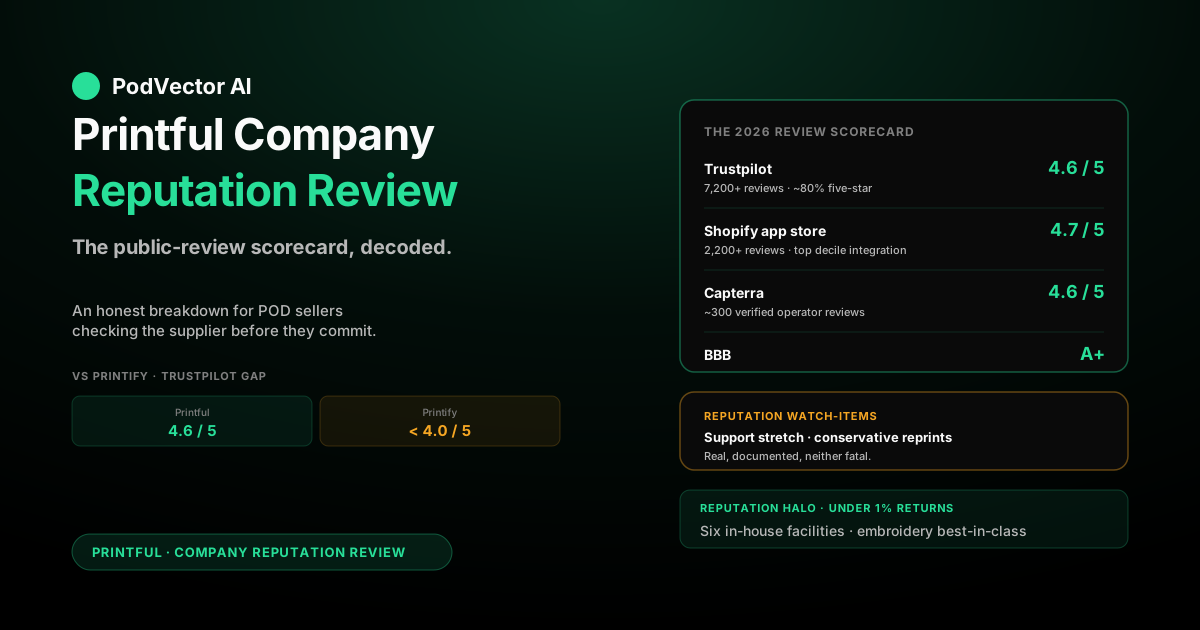
Quick Answer: Printful's reputation is the strongest in print-on-demand, but it is not unanimous. Trustpilot sits at 4.6/5 across 7,000+ reviews. The Shopify app holds 4.7/5 across 2,200+ reviews. Both are best-in-class for the category.
The complaint pattern that hurts reputation in 2026 is not print quality — it is support response time and stretched production windows during Q4. Quality and fulfillment reliability remain the strongest pillars.
For most POD sellers, Printful is the safe brand choice. The risk you are accepting is higher per-unit cost in exchange for a partner customers can Google without finding horror stories.
The 2026 Reputation Scorecard
Printful is the print-on-demand company most sellers hear about first, and that recognition is earned over more than a decade of in-house fulfillment. The reputation question is not whether Printful is legitimate — it clearly is — but where the cracks are.
Here is the public-data snapshot most reviews skip listing in one place. These numbers move slightly week to week, but the order of magnitude has been stable through 2025 and 2026.
Trustpilot: 4.6/5 from roughly 7,200 reviews. Shopify app store: 4.7/5 from over 2,200 reviews. Capterra: 4.6/5 from around 300 reviews. G2: 4.4/5 with hundreds more.
For context, Printify's Trustpilot score sits below 4.0/5 with a meaningfully higher rate of one-star reviews, and most other POD operators do not have enough volume of reviews to make a fair comparison.
The honest read is that Printful has the cleanest public-review track record in the category, and that is the single biggest reason most brand-led POD stores default to it. The complaints that do exist cluster around predictable themes you can plan for.
What 7,000+ Trustpilot Reviews Actually Say
Trustpilot is the most useful single source because it has volume, recency, and verified reviewer flags. The 4.6/5 average headline number hides a more nuanced picture.
Roughly 80% of reviews are 5-star, with another 8–10% at 4-star. That bunching at the top is consistent with a company that mostly ships on time and prints what was ordered.
The negative tail is what matters for reputation risk. About 5–7% of reviews are 1-star, and they cluster into a few specific complaint types rather than scattering across every aspect of the product.
The top complaint themes on Trustpilot in 2025 and 2026, in order of volume: support response time during peak season, print defects on individual orders (color mismatch, small misalignment), customer-side shipping address errors that Printful does not catch, and Q4 production delays of 5–9 business days versus the usual 2–5.
Note what is mostly absent. There is no widespread "the company stole my money" thread. No mass-billing-error pattern. No data-loss complaints. The negative reviews read like operations frustration, not trust collapse.
The Shopify App Store Signal
The Shopify app store rating is the most operator-relevant number on this list. It is rated by people who actually run stores and integrate Printful into a paid workflow, not casual buyers.
4.7/5 across 2,200+ reviews puts Printful in the top decile of all Shopify apps regardless of category. The Printify app sits at roughly 4.3/5 across a similar volume, which is still strong but visibly lower.
The Shopify reviews skew toward integration reliability — does the app sync products, does it pull orders, does it stop syncing during merge updates. Printful's app rarely shows up on Shopify down-detector threads, and the integration team ships compatibility fixes within days when Shopify updates its admin API.
For a seller deciding between two POD partners with comparable products, the Shopify app rating is often the deciding factor. Integration breakage costs more in lost orders than a $2 unit cost difference saves.
BBB, Reddit, and the Seller Forums
Printful has BBB accreditation with an A+ rating, which is mostly a low-bar indicator that the company responds to escalated complaints. Reddit and seller forums are the more honest picture.
On r/printful, r/printondemand, and r/etsysellers, the prevailing sentiment in 2025–2026 is that Printful is reliable but expensive. Threads asking "is Printful trustworthy" almost always get the same answer: yes, but check the margin math first.
The negative posts tend to come from sellers who had a single bad order, escalated to support, and either got a slow response or a refusal to reprint a borderline case. Printful's reprint policy is real but conservative — they reprint clear defects, they negotiate on borderline cases.
The pattern is consistent with a company that is operationally strong but has a support team that is now stretched thin against rapid catalog growth. This is a reputation watch-item, not a reputation crisis.
The Five Complaint Patterns That Keep Showing Up
If you read 200 negative reviews across Trustpilot, Reddit, and the Shopify app store, the same five themes account for the majority of one-star reports. Knowing these in advance lets you decide whether the risk is acceptable for your store.
1. Q4 production stretch. Production averages 2–5 business days for most of the year. In November and December, it stretches to 5–9 business days for the most popular SKUs. Sellers who do not warn customers see refund requests.
2. Support response time. Live chat queues that used to be under 5 minutes are now 20–40 minutes during business hours. Email replies are typically 12–24 hours. Complex issues — duplicated orders, customs holds — can take 3–5 business days.
3. Borderline reprint refusals. Clear defects get reprinted free. Borderline cases — slight color shift, mild misalignment — sometimes get a partial credit instead of a full reprint. Sellers who expected uniform "yes" get frustrated.
4. Customer-side address errors. Printful does not actively validate addresses beyond format checks. If a customer ships to "123 Main Street" instead of "123 Main St" and the carrier returns the package, the seller eats the reship cost. This is industry-standard but still appears in negative reviews.
5. Price increases on legacy SKUs. Base prices have crept up roughly 3–6% across the catalog over the last 18 months. Sellers who priced their store once and never revisited get squeezed margins, and some blame Printful's reputation when it is really their own pricing hygiene.
Three of these are operational realities of POD at scale. Two of them — support stretch and reprint conservatism — are real reputation drag that did not exist three years ago.
Where Printful's Reputation Is Earned
The reputation cuts both ways, and the positive side is more durable than the negative complaints suggest. Five things keep showing up in the 5-star reviews and the long-term seller threads.
Consistent print quality. The single most-mentioned strength is that the t-shirt you sample in March prints the same way in November. In-house equipment and standardized color profiles do most of the work here.
Embroidery is the standout product. Reviewers consistently call out hat and beanie embroidery as the cleanest in the category. The digitization team actively flags files that will not embroider well before production rather than shipping a mess.
Global fulfillment that actually works. The six-facility network — US, Mexico, Canada, Latvia, Spain, Japan — auto-routes to the closest facility with capacity. EU buyers get items in 4–6 days, which most competitors cannot match.
Integration reliability. Shopify, Etsy, Amazon, Walmart, TikTok Shop, WooCommerce, BigCommerce, Wix, and Squarespace integrations are mature. Down-time is rare and recovery is fast.
Returns and reprints under 1%. Printful's public figure for return-and-reprint rate is under 1% of shipped orders. That number is consistent with what seasoned sellers report in private threads.
Reputation vs Printify and the Network Model
The single most useful reputation comparison is Printful versus Printify, because they own most of the POD market between them and operate on opposite models.
Printful owns its print operation. Six facilities, one company, consistent output. Reputation upside: predictability. Reputation downside: when one facility has a problem, you cannot route around it inside the Printful network.
Printify is a network of independent print partners. Hundreds of facilities, dozens of operators, variable output. Reputation upside: lower prices and broader catalog. Reputation downside: quality and turnaround vary by which partner the order routed to.
Both Trustpilot and Shopify ratings reflect this gap. Printful's variance is lower because the work is more consistent. Printify's mean is lower because some partners are weaker than others.
If your brand-led store cannot tolerate a 10% quality variance on a customer's first order, Printful's reputation premium is worth paying for. If you compete on price and your customer accepts a "POD t-shirt" as a category rather than a brand, Printify's reputation is acceptable.
For a detailed cost-side comparison, see our Printify vs Printful pricing breakdown and the pros and cons comparison.
Financial Stability and the Layoff Story
One reputation thread that occasionally surfaces is whether Printful is financially stable. The short answer is yes, with caveats.
Printful merged operationally with Printify in 2024 under a single holding company while keeping the brands and pricing separate. That merger is sometimes misread as a sign of trouble. It is not — the combined entity is larger and more diversified than either brand was alone.
Printful did run a layoff round in 2023 that affected around 7% of staff, mostly on the corporate and product side rather than production. Reviewers who experienced the support stretch in 2024 often trace it to that headcount reduction. The production facilities have continued to expand, not contract.
For a seller deciding whether to build a store on top of Printful, the financial reputation is solid. There is no credible scenario in which Printful disappears in the next 24 months, and your contingency plan should be the standard one — keep your storefront data portable so you could move to another POD partner if you ever needed to.
What Printful's Reputation Means for Your Store
Reputation matters because your customer will Google your supplier. When they search "Printful reviews" they will find the 4.6 Trustpilot score, the largely positive sentiment, and a handful of negative threads that read as operational complaints rather than scam warnings.
That is a good outcome for your brand. The customer comes away with the impression that you partnered with a real company that prints things and ships them, not a drop-ship middleman they cannot pronounce.
Compare that to a customer who Googles a Chinese drop-ship supplier and finds the negative reviews dominating the SERP. Same product category, totally different trust outcome.
That reputation halo is real money. Brand-led stores that source from Printful tend to convert at higher rates and command higher price points because the supplier check passes cleanly. You are buying trust on top of t-shirts.
The flip side is that you pay for that trust in unit cost. Most stores can absorb 15–35% higher base costs if their retail pricing reflects brand positioning. Bargain-priced listings cannot, and that is where the reputation premium starts to look expensive.
The Honest Verdict
Printful's company reputation in 2026 is the strongest in print-on-demand, full stop. The numbers back it up across every public review platform that matters.
The two reputation watch-items are support response time and the conservative reprint policy on borderline cases. Both are real, both are documented, neither is fatal. A seller who knows about them in advance can plan around them by setting customer expectations correctly and building support friction time into their refund policy.
The five-figure question is not whether Printful is reputable. It is whether the reputation premium fits your unit economics. If your retail price absorbs the higher base cost, you get a partner you do not have to defend. If your margins do not survive the premium, you are paying for trust you cannot afford.
For the broader brand-and-margin picture, our main Printful review walks through pricing tiers and the Growth Plan math, and our print quality review covers the DTG and embroidery output in detail. For other dimensions of the supplier check, see our overall quality review and our Quick Stores review.
You can also browse the full Printful reviews cluster and the wider Printful topic hub.
One external reference worth bookmarking is the live Trustpilot page for Printful. Watching whether the 4.6 score holds steady through future Q4 cycles is the most reliable way to track the company's reputation in real time.
FAQs
Is Printful a legitimate company?
Yes. Printful has been operating since 2013, holds BBB accreditation with an A+ rating, and runs six in-house fulfillment facilities globally. The legitimacy question is not seriously contested in any seller community.
What is Printful's Trustpilot score?
4.6/5 across roughly 7,200 reviews as of 2026, with about 80% of reviews at 5 stars and 5–7% at 1 star. The negative reviews cluster around support response time and Q4 production delays.
Is Printful's reputation better than Printify's?
On every public review platform with meaningful volume, yes. Printful's Trustpilot and Shopify app store scores are visibly higher than Printify's. The trade-off is that Printful's base prices are 15–35% higher across most SKUs.
Why are some Printful reviews negative?
The five most common complaints in 2025–2026 are Q4 production delays, longer support response times since the 2023 layoffs, conservative reprint policies on borderline defects, customer-side address errors, and creeping base prices on legacy SKUs. None of these are trust-collapse issues.
Did Printful merge with Printify?
The two companies merged operationally under a single holding company in 2024 but kept their brands, pricing, and platforms separate. From a seller's perspective, they remain two distinct POD providers with two distinct catalogs.
Is Printful financially stable in 2026?
Yes. The 2023 layoff round affected around 7% of staff on the corporate side, but the production facilities have continued expanding. There is no credible scenario in which Printful disappears in the next 24 months.
Does Printful's reputation affect my store's brand?
Yes, in a measurable way. Customers who Google your supplier and find the 4.6 Trustpilot score and largely positive sentiment come away with a stronger trust impression than they would from a no-name drop-ship supplier. That trust premium is part of what you pay for in higher unit cost.
Where can I check Printful's current reputation?
Trustpilot, the Shopify app store reviews, r/printful and r/printondemand on Reddit, and the BBB profile are the four most useful sources. Trustpilot is the highest-volume single source.
Your supplier's reputation is one input. Your store's actual margin is the other.
Printful's 4.6 Trustpilot score buys you brand trust. It does not tell you whether your store is profitable per order, which SKUs are losing money, or where your ad spend is leaking.
Victor is the AI employee that gives you the truth about your own store — per-SKU margin, ROAS, and the leaks that are costing you money — all from one place.
Try Victor free