
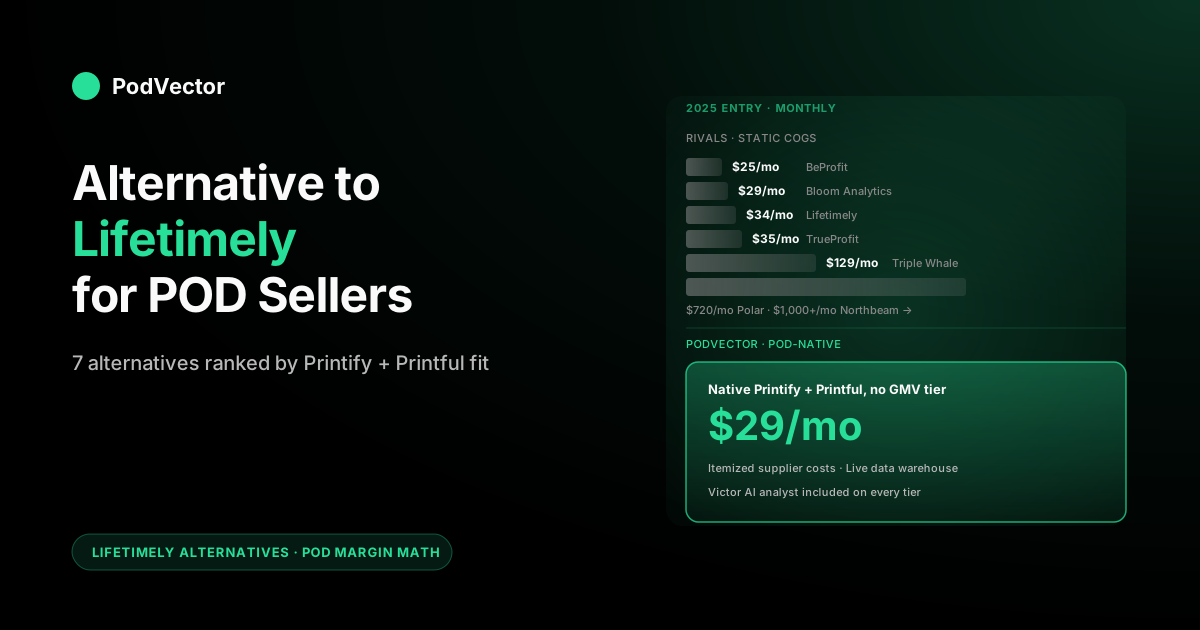
Quick Answer: The best Lifetimely alternative for a Print-on-Demand store is the one that itemizes Printify or Printful supplier costs at the SKU level automatically — something Lifetimely cannot do, because it relies on a static per-product COGS field you maintain by hand.
For most POD operators that means PodVector AI at $29/month flat, with Victor (an AI employee) included on every tier and Printify and Printful invoices joined to Shopify orders automatically. TrueProfit, Bloom Analytics, BeProfit, Polar Analytics, Triple Whale, and Northbeam are also viable alternatives — each suited to a different store profile.
This roundup compares all seven across pricing, POD fit, LTV depth, and what each one actually replaces. The decision matrix at the bottom is the fastest path to a pick.
Why POD sellers look for a Lifetimely alternative
Lifetimely is a solid LTV and profit dashboard for traditional Shopify DTC. According to the Shopify App Store, it tracks net profit, P&L, LTV, and cohort analytics in real-time and is built for Shopify and Shopify+Amazon brands. It's not always the right fit for Print-on-Demand. Three structural mismatches push most POD operators to look elsewhere.
Static COGS modeling. Lifetimely supports standard cost inputs but relies on a generalized structure where merchants must define cost categories themselves — and there are no dedicated inputs for supplier-tier discounts or per-variant POD pricing changes. That works when you own inventory and pay one invoice per shipment. It breaks the moment you sell on Printify or Printful, where the per-item base cost shifts with sample tiers, supplier promotions, and product variant changes. The full mechanics are covered in the Lifetimely Shopify app review for POD sellers.
No native Printify or Printful integration. Lifetimely connects to Shopify, ad platforms, and email tools. Supplier invoices come in as a CSV upload or a manual table — and that table goes stale every time Printify changes base pricing. For a store running 50+ designs, the upkeep is its own job.
LTV-first, profit-second. Lifetimely's strength is customer lifetime value and cohort analysis — its cohort charts let you track repeat purchase rates by acquisition month and compare subscribers to one-time buyers. POD operators usually need contribution margin first, attribution second, LTV third. The order of operations is wrong for the workflow. The Lifetimely review for POD sellers walks through where this matters.
Pricing scales with order volume. Lifetimely's paid plans are order-volume tiered. A fast-growing POD store can move up a price tier before it has the margin health to justify it. The seven alternatives below cover every realistic exit path: more POD-specific, cheaper, more attribution-heavy, or more enterprise-grade.
1. PodVector AI — POD-native, Victor on every tier
PodVector AI is built for one thing: making Print-on-Demand profit visible at the SKU level. It's the alternative most directly aimed at the POD-specific gap Lifetimely leaves open.
Pricing. $29/month flat at the entry tier, no GMV or order-volume ladder. Higher tiers add seats, additional ad accounts, and longer history retention.
POD fit. Native Printify and Printful integrations ingest supplier invoices line by line, join them to Shopify orders at the SKU level, and surface per-design profit automatically. Sample tier discounts, supplier price changes, and shipping inclusions all map correctly without manual CSV maintenance. Note: Printify and Printful COGS enters through completed orders — if your store is brand new with no sales yet, margin answers won't populate until orders flow through.
What Victor reads. Victor reads live data from Shopify, Meta Ads, Google Ads, Printify, and Printful into a single data warehouse. You can ask questions like "what was my Printify hoodie margin last week" or "which Meta ad set is bleeding margin" in plain English, and Victor queries the warehouse and returns an answer. Victor reads ad platforms and proposes moves — he does not pause campaigns or change bids directly, as ad-platform writes are not built.
What Victor can do on Shopify (with your approval). Reprice products in bulk, create a buy-one-get-one discount (see the Shopify Buy X Get Y discount guide for the manual version), set up free-shipping discounts, raise your free-shipping threshold, organize collections, and update shipping settings. Every action requires explicit operator approval — Victor never acts unilaterally. Broader write automation is expanding.
<<<<<<< Updated upstreamWeekly Health Report. Victor sends a proactive Weekly Health Report summarizing your store's week. All other interactions are query-driven — there is no around-the-clock monitoring between check-ins, and each session starts fresh with no cross-session memory.
=======Weekly Health Report. Victor sends a proactive report summarizing your store's week every Monday morning. All other interactions are query-driven — there is no around-the-clock monitoring between reports, and each session starts fresh with no cross-session memory.
>>>>>>> Stashed changesWhere it falls short. No email-marketing data ingested (email channel is blind). No Etsy, Amazon, TikTok, or Klaviyo data. Fewer pre-built cohort dashboards than Lifetimely's mature LTV suite. If LTV cohorts are your daily workflow, Lifetimely still wins on out-of-the-box dashboards.
Best for. Any POD store on Shopify where supplier-cost accuracy is the bottleneck and where having an AI employee that can propose and execute Shopify-side actions matters, regardless of GMV.
2. TrueProfit — Shopify net profit, mobile-first
TrueProfit is the most-cited direct competitor to Lifetimely. It's a Shopify net-profit dashboard with a mobile app, real-time profit tracking, and ad-spend integrations across Meta, Google, TikTok, and Snapchat.
Pricing. Plans start around $35/month and scale by order volume. Roughly tied with Lifetimely at the entry tier, slightly cheaper at most middle tiers.
POD fit. COGS is a flat per-SKU value you set or upload. Same model as Lifetimely. No native Printify or Printful integration. For a store with stable supplier pricing and a small catalog, that's manageable; for a 100-SKU Printify store with monthly base-cost changes, it's manual maintenance.
LTV and profit. Stronger than Lifetimely on real-time net profit and weekly email reports. The mobile app is the most-praised feature — many POD operators check margin on their phone between meetings, and TrueProfit is built for that.
Best for. POD operators who want a faster, mobile-first version of Lifetimely's profit dashboard at a similar price, with COGS handled manually.
3. Bloom Analytics — profit map and AI insights
Bloom: Profit Analytics is one of the newest Lifetimely competitors and ships a "Profit Map" view that visually breaks down which products, channels, and customers drive net profit. AI-powered insight generation is part of the pitch.
Pricing. Plans start around $29/month and scale with order volume. Cheaper than Lifetimely at the entry tier, with predictable pricing.
POD fit. According to Bloom's own comparison, its cost system provides guided COGS setup that shows how many products have missing costs, and it captures COGS for deleted Shopify variants — handling edge cases Lifetimely misses. Still not a native Printify or Printful integration; you'll either upload supplier invoices or model them as static rates. Better structured than Lifetimely's flat-COGS approach, but the file maintenance is still on you.
LTV and profit. CM1/CM2/CM3 reporting, cohort analysis, and AI-generated insights round out the dashboard. The Profit Map is the standout feature — it answers "where is my money actually coming from" in one view. Bloom is "often considered a strong alternative for Shopify brands that want clear profit visibility without stitching together multiple tools or spreadsheets," according to Bloom's own positioning.
Best for. POD operators who want Lifetimely's depth at a lower price, with more flexible cost modeling, and don't mind handling supplier costs as a managed table.
4. BeProfit — entry-level profit calculator
BeProfit is the simplest of the alternatives — a profit calculator that pulls Shopify orders, ad spend, and a manual COGS table into a single dashboard.
Pricing. Free tier exists; paid plans start around $25/month and scale at higher GMV. Entry-level by design. BeProfit pricing for POD sellers covers the tiers in detail.
POD fit. Manual COGS entry is the model. You list SKUs, set their supplier costs, and BeProfit calculates margin. BeProfit offers a user-friendly dashboard and customizable reports, and integrates with Facebook Ads, Google Ads, and TikTok Ads. For a POD store with fewer than 20 active designs and stable supplier pricing, that's enough. For larger or more dynamic catalogs, the upkeep beats the value.
LTV and profit. Profit is the focus; LTV is light by comparison. If you want cohort-style retention reporting, BeProfit isn't the pick.
Best for. Side-hustle POD stores under low GMV running one or two ad channels, where simple is more valuable than sophisticated.
5. Polar Analytics — full BI for $5M+ Shopify DTC
Polar Analytics is a full business-intelligence platform with cross-channel attribution, an AI employee, and a unified data layer. It's positioned for Shopify DTC brands at significant scale.
Pricing. Polar's entry tier is priced for higher-GMV stores — a significant step up from Lifetimely's entry price. The current ladder is broken down in the Polar Analytics pricing breakdown for POD sellers.
POD fit. Polar's data warehouse expects a CSV upload to model supplier costs. Same gap as Lifetimely — no native Printify or Printful integration. For a POD store at sub-$5M GMV, most of Polar's capability sits idle.
LTV and profit. Polar wins on attribution depth, multi-channel reporting, and a natural-language analyst interface. LTV cohorts exist but aren't the headline. For a comparison of how Polar stacks up specifically for POD sellers, see the Polar Analytics vs PodVector comparison.
Best for. POD brands at significant GMV where cross-channel attribution and BI breadth matter more than supplier-cost itemization or LTV cohorts.
6. Triple Whale — DTC attribution and LTV
Triple Whale is the most-cited Polar alternative for Shopify DTC. It's a pixel-driven analytics platform with creative analytics, server-side attribution, and a "Sonar" pixel that recovers post-iOS signal. According to Triple Whale's own documentation, it consolidates data from Shopify, Facebook Ads, Google Ads, Klaviyo, and more.
Pricing. According to the Lifetimely alternatives page on useamp.com, Triple Whale's cheapest plan is $129/month, and stores doing more than $1M in sales pay at least $400/month — more expensive than Lifetimely at most tiers.
POD fit. Strong on Shopify and ad platform integrations, weak on Printify or Printful supplier costs. You'll model COGS as a flat per-SKU rate or upload a CSV. That works for traditional DTC where COGS is stable; it doesn't work as well for POD where supplier prices shift. For a head-to-head on how ad analytics tools compare for POD, see the Google Ads vs Facebook Ads guide for POD sellers.
LTV and profit. LTV reporting is bundled in. Strongest on creative-level attribution and ad-channel reporting — the Creative Cockpit is what Triple Whale users praise most.
Best for. POD stores spending heavily on paid social where creative analytics is a real workflow, and where COGS variability is low enough that flat-rate cost modeling doesn't distort margin.
7. Northbeam — first-party ML attribution
Northbeam is positioned as the analytics platform for serious DTC operators. It uses machine learning on first-party data to deliver attribution that doesn't depend on platform-reported numbers.
Pricing. Custom — enterprise-tier from the start; not aimed at sub-$2M stores.
POD fit. Like Polar and Lifetimely, Northbeam doesn't natively integrate Printify or Printful supplier costs. You'll layer those in manually or accept that profit numbers are revenue-minus-ads, not true contribution margin.
LTV and profit. Northbeam's strength is attribution accuracy, not LTV cohorts. The ML attribution engine corrects for platform self-reporting bias and is widely considered more accurate than what Polar or Triple Whale ship by default.
Best for. POD brands at significant GMV where attribution accuracy is the highest-value decision, and supplier-cost modeling is already solved by an external accounting workflow.
Side-by-side comparison
The table below is the fastest read. Entry prices are current as of July 2026 — most platforms have GMV or order-volume ladders above this floor.
| Tool | Entry price | POD COGS | LTV depth | AI employee | Best for |
|---|---|---|---|---|---|
| PodVector AI | $29/mo flat | Native Printify + Printful | Cohort + per-SKU | Victor (every tier) | POD operators |
| Lifetimely by AMP | Free plan; paid tiers volume-based | Static per-SKU COGS | Strong (LTV-first) | Profit Agent (paid) | LTV/CAC analysis |
| TrueProfit | ~$35/mo | Static per-SKU COGS | Profit-first, light LTV | No | Mobile-first profit tracking |
| Bloom Analytics | ~$29/mo | Flexible custom costs | CM1/CM2/CM3 + AI insights | Limited (insight gen) | Profit Map and AI summaries |
| BeProfit | Free tier; paid ~$25/mo | Manual COGS table | Light | No | Side-hustle POD stores |
| Polar Analytics | High-GMV tiered pricing | CSV upload only | Light (attribution-first) | Ask Polar (paid tiers) | $5M+ Shopify DTC |
| Triple Whale | ~$129/mo (per useamp.com) | Static per-SKU COGS | Bundled with attribution | Moby (paid) | Creative-heavy DTC |
| Northbeam | Custom / enterprise | Manual COGS | Light (attribution-first) | No | $5M+ DTC, attribution-first |
Two things stand out. First, only PodVector AI ships native Printify and Printful supplier integration — every other alternative expects you to maintain COGS yourself. Second, Lifetimely has added a "Profit Agent" AI feature on paid tiers, narrowing the AI gap with some alternatives — but it still lacks POD-native supplier cost ingestion.
Which alternative fits your POD store
Three questions narrow it to one.
| Your situation | Best alternative | Why |
|---|---|---|
| POD store, supplier-cost accuracy is the gap | PodVector AI | Only platform with native Printify + Printful invoice integration at SKU level |
| POD store, mobile-first profit checking | TrueProfit | Best-in-class mobile app for daily profit reads, weekly email digests |
| POD store wanting a Profit Map view | Bloom Analytics | Visual profit attribution by product/channel/customer at a similar price |
| Side-hustle POD store at low GMV | BeProfit (or PodVector AI) | Simple profit calculator at low price; PodVector AI if Printify catalog is large |
| POD brand at $5M+ GMV, attribution is the priority | Polar Analytics or Northbeam | Full BI breadth or ML attribution, both at enterprise price points |
| POD store spending heavily on paid social | Triple Whale | Creative Cockpit pairs ad-level reporting with Shopify revenue |
The shortest decision: if your bottleneck is "I can't trust my Printify or Printful margin numbers," PodVector AI is the alternative aimed straight at that. If your bottleneck is "I want Lifetimely's LTV cohorts but don't want to maintain a manual COGS table," PodVector AI or Bloom Analytics fits. If your bottleneck is "I'm scaling ad spend across channels and I want attribution depth," Polar Analytics or Triple Whale is the right move. The Polar Analytics alternatives roundup covers the attribution-first path in more detail.
For more context on how POD profit math actually works once you have visibility, the Shopify + Printify setup guide walks through the integration and unit economics. The Printful embroidery review covers supplier-side cost realities for a specific product category. For a deep comparison of two of the biggest fulfillment partners, see the Printify vs Printful pricing, quality, and features comparison.
For operational workflows that become relevant once you have margin visibility, the Shopify + QuickBooks refund workflow is a common next step. The PodVector AI comparison hub indexes every Lifetimely, Polar, and BeProfit head-to-head. The PodVector AI topic hub covers the broader product context.
FAQs
What's the cheapest alternative to Lifetimely?
BeProfit's free tier is the cheapest entry point at $0. For an actual paid alternative, BeProfit at around $25/month, Bloom Analytics at around $29/month, and PodVector AI at $29/month flat are all competitive on price. PodVector AI is the only one with native Printify and Printful integration, so for POD operators the value gap is wider than the price difference suggests.
Which Lifetimely alternative is best for Shopify Print-on-Demand specifically?
PodVector AI. It's the only platform on this list with native Printify and Printful supplier-invoice integration that joins to Shopify orders at the SKU level. Every other alternative — including Lifetimely itself — expects you to maintain COGS as a static per-SKU table, which breaks under POD's variable supplier pricing.
Has Lifetimely added AI features recently?
Yes. Lifetimely now includes a "Profit Agent" that delivers AI insights, alerts, and forecasts — including a Slack integration — on paid tiers. It also offers month-to-month LTV projections and an LTV Drivers report that surfaces which products and discount codes are most effective at increasing average LTV. These additions narrow the AI gap with some alternatives, but the core COGS limitation for POD (no native Printify or Printful integration) is unchanged.
Can I use Lifetimely and a Lifetimely alternative together?
Yes, though it's rare. The most common stack is one profit dashboard plus an attribution tool. Some POD operators run Lifetimely for LTV cohorts and PodVector AI for itemized supplier costs side by side, but most consolidate to one once they see how much overlap exists. The choice is usually about which tool's COGS number you trust most.
Does TrueProfit work for Print-on-Demand?
TrueProfit works for any Shopify store, but it doesn't have native Printify or Printful integration. You'd model supplier costs as a static per-SKU value and update the table when suppliers raise prices. For a POD store with few active designs that's manageable; for a large catalog with frequent supplier changes, it's a maintenance burden similar to Lifetimely's.
Is there a free alternative to Lifetimely?
Native Shopify Analytics (included free with any Shopify plan) covers acquisition, conversion, and per-SKU sales reporting. BeProfit also offers a free tier for stores under low order volumes. Neither models supplier costs at the level POD requires, but for a new POD store on one or two ad channels, free Shopify Analytics paired with manual margin tracking is often enough to start.
How does PodVector AI compare to Lifetimely across all features?
PodVector AI wins on POD-specific cost integration, flat pricing, and the included AI employee (Victor) that can both answer questions and execute approved Shopify-side actions. Lifetimely wins on out-of-the-box LTV cohort dashboards, its Benchmarks tool that scores your store against competitors, and email-marketing context via Klaviyo. The full feature-by-feature comparison is in PodVector AI vs competitors: the complete POD profit tracker comparison.
What about Printify vs Printful — does the analytics tool choice depend on which supplier I use?
Only PodVector AI ingests both natively, so the supplier choice doesn't change your analytics tool decision if you're on PodVector AI. If you're evaluating which supplier to use, the Printify vs Printful pricing comparison is the right starting point — supplier cost differences directly affect which margin numbers any analytics tool surfaces.
Why isn't Glew or Metrilo on this list?
Glew and Metrilo are general-purpose ecommerce analytics suites — closer to Polar Analytics than to Lifetimely in surface area. They appear in broader "Lifetimely alternatives" lists, but for POD specifically they share Polar's gap: no native Printify or Printful supplier integration. If you're at significant GMV and want a full BI suite, see the Polar Analytics alternatives roundup for that path.
The POD-native Lifetimely alternative
Lifetimely is built for traditional Shopify DTC. The other alternatives expect you to maintain a static COGS table that goes stale every time Printify or Printful changes pricing.
PodVector AI is built for Print-on-Demand. Native Printify and Printful supplier integration. Live data warehouse. Victor — the AI employee — included on every plan, with Shopify-side write actions under your approval. $29/month flat, no GMV ladder.
Try Victor free