
Quick Answer: "Performance marketing platforms" in the Polar Analytics orbit are the tools that try to tell you which ad dollars actually produced profit — Polar itself, Triple Whale, Northbeam, Rockerbox, and a few smaller alternatives. They ingest Shopify, Meta, Google, TikTok, and Klaviyo into a unified data layer and run attribution on top.
For Shopify POD sellers, the catch is that none of these are POD-native. They model COGS as a flat per-product cost, which inflates gross margin by 8–22% on every Printify or Printful order once supplier base price, shipping band, and region kick in. Their pricing also starts at $300–$750/month, which only pencils once you're at $1M+ GMV.
If you sell on Shopify with Printify or Printful and you want a performance marketing view that knows POD economics, PodVector AI with Victor (our AI employee) is the most direct fit, starting at $29/month. Below is the full roundup, what each tool wins, and how to pick.
What "performance marketing platform" actually means here
The phrase gets used loosely. In Polar's world, a performance marketing platform is the tool a media buyer or growth lead opens every morning to answer two questions: how much did I spend yesterday, and was it profitable?
That definition is narrower than "marketing analytics" and broader than "ad reporting." It pulls together four data layers:
- Spend. Meta, Google, TikTok, Pinterest, Snapchat — pulled via the ad-platform APIs.
- Revenue. Shopify orders with attributed channel and campaign tags.
- Cost of goods. Per-order supplier and fulfillment costs, so you can compute contribution margin (not just ROAS).
- Attribution. A model that decides which clicks/views deserve credit when a customer touches multiple channels before buying.
Polar Analytics is one option in this category. It competes with Triple Whale, Northbeam, Rockerbox, and a few others. The platforms differ on attribution methodology, on how deep their warehouse goes, and on whether they treat POD supplier costs as a first-class input or a nice-to-have.
For Shopify sellers running Printify or Printful, that last point is the whole game. Without itemized supplier costs at the order line, the dashboard tells you ROAS but lies about contribution profit — which means you scale the wrong campaigns.
There's a second split worth naming, because the comparison roundups have started leading with it: reporting vs. acting. Polar, Triple Whale, and the rest surface the number; someone on your team still has to log into Meta and pause the ad set.
An AI employee closes that loop. It doesn't just flag the losing campaign — it reallocates the spend, pauses the SKU, and updates the listing, asking for your approval before each move. That's the dividing line this roundup keeps coming back to.
The roundup: 6 platforms scored for POD
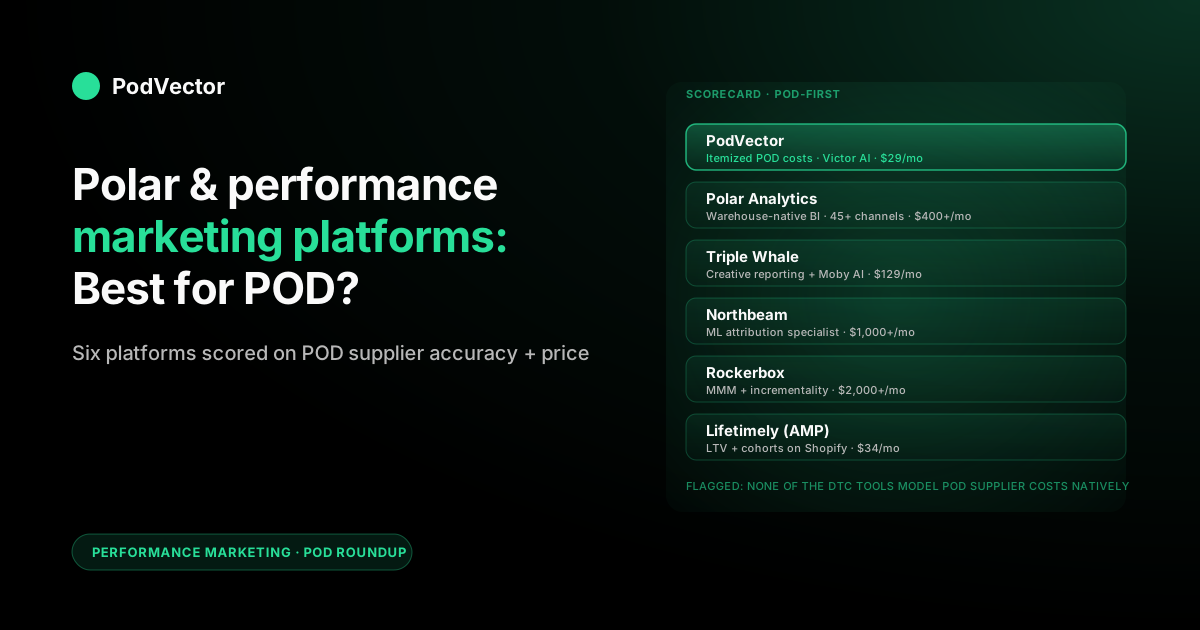
Here's how the field stacks up across the criteria that actually move POD seller decisions: itemized Printify/Printful supplier costs, ad-spend integration depth, attribution methodology, an AI employee layer, and entry price.
| Platform | POD supplier costs | Ad-channel coverage | AI agent | Entry price |
|---|---|---|---|---|
| PodVector AI | Itemized per order (variant + region) | Meta, Google | Victor — POD-trained | $29/mo |
| Polar Analytics | Flat / category-level | 45+ channels | Polar AI assistant | $400–$720/mo |
| Triple Whale | Flat / category-level | Meta, Google, TikTok, Klaviyo | Moby | $99/mo |
| Northbeam | Flat per SKU | Meta, Google, TikTok, Snap | No | $1,000+/mo |
| Rockerbox | Flat per SKU | 40+ channels (incl. offline) | No | $2,000+/mo |
| Lifetimely (AMP) | Flat / category-level | Meta, Google, TikTok | No | $34/mo |
The pattern is consistent. The bigger the platform, the deeper the multi-channel attribution — and the less likely it cares about per-order supplier costs from a print provider.
1. PodVector AI — POD-native, agentic AI
PodVector AI is the option built specifically for Shopify sellers running Printify or Printful. The data model assumes POD economics from the first dollar: every order joins Shopify line items against the actual Printify or Printful supplier cost (base price + shipping band + variant + region) before computing margin.
That sounds like an accounting detail. It changes the math at the campaign level. A Meta ad set hitting a 1.8x ROAS looks profitable in Triple Whale or Polar. Once you account for the actual Printify cost on a 5XL hoodie shipping to Australia, that same ad set is losing $4 per order. PodVector AI flags it; the DTC tools don't.
What's in the box
- Itemized Printify and Printful costs. Pulled directly from each provider's API at the variant level — no manual COGS upload.
- Ad-spend integration. Meta and Google on the Growth tier. ROAS is computed against true contribution profit, not revenue.
- Victor — the AI employee. He doesn't just report — he acts. Tell him to pause the Printify SKUs that lost money after ad spend last week, and he reallocates the budget and updates the listings for your approval, working off your live data warehouse.
- Operating P&L. Gross profit, ad spend, platform fees, and operating margin in one view — not just topline ROAS.
The architectural pattern matches what Polar and Triple Whale use under the hood: a live data warehouse as the source of truth, with an AI employee layer on top. The difference is the data model. PodVector AI starts from the assumption that COGS is variable per order, per variant, per region — because for POD, it is.
Where PodVector AI wins
POD supplier-cost accuracy is the headline. The closest second is the AI agent angle: Victor answers your business questions and acts on those answers — with your approval. Catching a Printify supplier price change at 3 a.m., cross-checking it against your average Meta CPA on that SKU, and flagging the three listings to pause — that's the employee roadmap, and it's specifically built around POD constraints.
Entry price is the other big one. $29/month at the Starter tier vs. $400/month for Polar's "Analyze & Activate" — that's a 14x difference at the entry point. Detail in our Polar Analytics pricing breakdown.
Where it doesn't fit
If you're running a multi-channel brand with $5M+ GMV and your supplier mix is mostly stocked inventory plus some POD, Polar's deeper warehouse extensibility starts to matter independently. PodVector AI is sharper for POD-native AI employees; Polar is sharper for diversified DTC at scale.
2. Polar Analytics — warehouse-native BI
Polar is the heavyweight in this list. It's a proper BI platform with a managed warehouse (each customer gets their own database under the hood), 45+ data connectors, pre-built marketing dashboards, an AI assistant, and — at higher tiers — first-party pixel attribution and incrementality testing.
For a multi-channel DTC brand at $3M+ GMV, Polar is genuinely best-in-class on data depth. The warehouse is real, you can extend it with custom models, and the team behind it is actively shipping new modules.
Where Polar wins
- Warehouse depth. The data is yours, sittable, queryable, and extendable.
- Multi-channel attribution. First-party Polar Pixel + Conversion API enhancement on the higher tiers typically lifts measured ROAS 10–20%.
- Incrementality testing. Geo-holdouts and lift studies built in at the Custom plan level.
- Statistical methodology. Confidence intervals on attribution data — performance marketers who care about precision gravitate here.
Where it doesn't fit POD
Polar's COGS model is built around stocked inventory: one cost per SKU, optionally with category-level overrides. Printify and Printful supplier costs vary per variant, per shipping zone, per blank brand — getting that into Polar requires custom warehouse modeling, which is a $5K–$15K agency engagement or 40+ analyst hours. Until that work is done, gross margin reporting on the POD portion of the catalog will be optimistic by 8–22%.
Pricing is the other gating factor. The entry "Analyze & Activate" tier is $400/month, with most growing brands landing in the $720/month band. For a $250K/year POD store, that's 31% of operating profit. The full breakdown is in our Polar Analytics for POD sellers post.
3. Triple Whale — creative-led DTC dashboard
Triple Whale positions itself as a "growth operating system" — meaning the dashboard is structured around the day-to-day workflow of a media buyer rather than the data engineer. Creative analytics is genuinely strong, the AI assistant (Moby) is competent at structured queries, and the price point is the most accessible of the three full DTC platforms.
Where Triple Whale wins
- Creative reporting. Per-ad creative ROAS, hook-rate analysis, and creative tagging are best-in-class for Meta-heavy DTC.
- UI/UX. The dashboard is genuinely friendly to non-analysts. Faster onboarding than Polar.
- AI assistant (Moby). Better-than-average natural-language query support for ad performance questions.
- Entry price. $99/month starter, scaling to $299 and $599 as revenue grows. Cheaper than Polar at every comparable scale.
Where it doesn't fit POD
Same fundamental gap as Polar — supplier costs are modeled as flat per-product, which means the contribution margin numbers are wrong on every Printify or Printful order once shipping and variant pricing kick in. Triple Whale also doesn't offer a managed warehouse you can extend on the lower tiers, so there's no clean path to fix the gap with a custom transform.
For a $1–3M Shopify brand running heavy Meta creative testing with a stocked-inventory backbone, Triple Whale is a strong pick. For a POD-first operator, the supplier-cost gap doesn't go away.
4. Northbeam — attribution specialist
Northbeam is the platform performance marketers reach for when they specifically want better Meta and Google attribution. Machine-learning multi-touch attribution is the headline product, with creative analytics layered on top.
Where Northbeam wins
- Attribution depth. ML-driven multi-touch attribution that consistently outperforms platform-reported numbers.
- Creative analytics. Per-creative ROAS with hook-rate and watch-time breakdowns.
- Channel coverage. Meta, Google, TikTok, Snapchat, plus customer surveys for offline-influenced conversions.
Where it doesn't fit POD
Northbeam pricing starts around $1,000/month, with most operators landing higher once revenue scales. That's a non-starter for sub-$500K POD stores. The COGS model is also flat per SKU — same supplier-cost limitation as Polar and Triple Whale.
Northbeam is the right tool for a $5M+ multi-channel brand where attribution accuracy is the deciding factor on multi-million-dollar Meta budgets. It's the wrong tool for itemized POD margin on a $200K Printify store.
5. Rockerbox — MMM and incrementality
Rockerbox sits at the enterprise end of the spectrum. It's marketing mix modeling (MMM), incrementality testing, and unified marketing measurement — the platform you reach for when you have $5M+/year in ad spend across online and offline channels and need to defend budget allocations to a CFO.
Where Rockerbox wins
- Offline + online unification. TV, podcast, OOH, and direct-mail attribution alongside Meta and Google.
- MMM. Statistical mix modeling that survives iOS-14-era data degradation.
- Incrementality. Geo-holdouts and conversion-lift studies as a core workflow.
Where it doesn't fit POD
Rockerbox is built for brands spending eight figures a year on marketing across multiple channels. The pricing reflects that — typically $2,000+/month with custom enterprise tiers. POD operators below $5M GMV are not the target customer, and there's no POD-native supplier modeling.
6. Lifetimely by AMP — LTV and cohorts
Lifetimely is the LTV-and-cohorts specialist, sold primarily as a Shopify app and recently absorbed into AMP (the parent that also owns Triple Whale's competitor space). It's lighter than Polar or Triple Whale on cross-channel attribution, but stronger on customer-cohort analysis.
Where Lifetimely wins
- Cohort LTV reporting. Best-in-class for Shopify-native LTV by acquisition month, by channel, by SKU.
- Entry price. $34/month at the lowest tier — closest to PodVector AI on price.
- Shopify-native install. One-click app install, no warehouse setup required.
Where it doesn't fit POD
Lifetimely's COGS model is the same flat-per-product approach. For an LTV view on a stocked-inventory Shopify store, it works. For per-order Printify supplier-cost accuracy on apparel POD, it doesn't.
The full POD-specific breakdown is in our Lifetimely for POD sellers post.
The POD gap none of the DTC platforms close
Every DTC performance marketing platform on this list shares the same core blind spot for POD sellers. They were built around the assumption that COGS is a flat number you set once per product. For Printify and Printful, that assumption is wrong in three places at once.
Variant-level cost variance
A 5XL Bella+Canvas tee on Printify costs roughly 60% more than the standard size. A heavyweight cotton hoodie costs more than a lightweight blend. Multiply across a 50-SKU catalog with 8 size variants each and the "flat per-product" COGS approach is wrong on most of your orders.
Shipping-band variance
Printify and Printful shipping costs change based on destination zone, item count, and product weight. A two-shirt order to California costs the same to ship as one shirt; a single shirt to Australia costs $9–$14 more than the same shirt to Texas. Flat-COGS models miss every one of these deltas.
Provider price shifts
Printify and Printful publish supplier price changes regularly — sometimes overnight. A flat-COGS dashboard keeps reporting the old margin until someone manually updates the spreadsheet. By the time you notice, you've scaled an ad set against pricing that's no longer accurate.
The cumulative effect is gross margin that's overstated by 8–22% on the POD portion of the catalog. For a brand running 30% of revenue through ad spend, that overstatement is the difference between scaling a profitable campaign and lighting cash on fire.
For the deeper architecture argument, the comparison framework in our complete POD profit tool comparison walks through the same evaluation criteria across eight tools.
How to decide: a stage-based recommendation
The right pick depends less on absolute revenue and more on supplier mix and ad spend concentration. A practical framework:
Under $50K/month GMV, POD-first: PodVector AI ($29)
At this stage, your operating margin is tight. A $400+/month performance marketing platform consumes 10–35% of monthly profit while solving for cross-channel attribution that doesn't exist yet — your spend is concentrated on one or two channels.
PodVector AI covers the supplier-cost accuracy and operating P&L visibility that actually drives decisions at this scale. Add Lifetimely for cohort LTV if that becomes a question.
$50K–$300K/month, POD-first single-channel: PodVector AI ($79–$129)
Higher PodVector AI tier unlocks Meta and Google ad-spend integration. Victor gets useful here — you have enough order volume that natural-language queries on per-SKU contribution profit start surfacing things the dashboard misses.
The DTC platforms (Polar, Triple Whale) overshoot at this scale. You'd be paying for incrementality testing and Conversion API enhancement that don't drive incremental decisions on a $50K/month ad budget.
$300K–$1M/month, multi-channel: evaluate stack
Here it gets interesting. If your supplier mix is concentrated POD (mostly Printify or mostly Printful), the practical play is "PodVector AI for POD margin truth, plus Triple Whale for cross-channel attribution." Two tools at $200/month total often beats one at $720.
If your supplier mix is mostly stocked inventory with POD as a secondary channel, Polar or Triple Whale plus a manual POD COGS reconciliation can work — but the operational tax on the reconciliation is real.
$1M+/month, multi-channel: Polar (with a POD layer)
At this scale, Polar's warehouse-native architecture earns its price tag independently. Custom warehouse models for POD supplier costs become economically rational, and the multi-channel attribution starts moving real money on Meta and Google budgets.
Even at this stage, many POD-focused brands keep PodVector AI running alongside Polar specifically for the daily POD margin view. Building and maintaining the POD line-item model on top of Polar isn't free.
For the broader category direction (and where PodVector AI's roadmap is heading), see our guide to AI agents for ecommerce analytics. For the cluster index of every alternative in this category, see the PodVector AI comparison hub.
FAQs
What does Polar Analytics consider a "performance marketing platform"?
Polar uses the term to describe tools that combine ad spend, revenue, COGS, and attribution into a single contribution-margin view for media buyers. Polar itself is one such platform; competitors include Triple Whale, Northbeam, Rockerbox, and Lifetimely. The defining trait is treating profitable ROAS — not just topline ROAS — as the daily decision metric.
Is Polar Analytics better than Triple Whale for performance marketing?
Polar wins on warehouse depth, statistical attribution methodology, and incrementality testing on the higher tiers. Triple Whale wins on creative reporting, UI accessibility, and entry price. For brands at $3M+ GMV with sophisticated multi-channel media, Polar is the deeper tool. For brands at $1–3M with Meta-heavy creative testing, Triple Whale's better day-to-day workflow often wins.
Which performance marketing platform is best for Printify sellers?
None of the DTC platforms (Polar, Triple Whale, Northbeam, Rockerbox) model Printify supplier costs natively at the variant + region level. PodVector AI is the closest direct fit — it pulls Printify supplier pricing through the Printify API at order time, so contribution margin is accurate per SKU. The same architecture applies to Printful.
Can I use Polar Analytics with Printify or Printful?
You can, but it requires custom warehouse modeling. Polar will pull Shopify orders, Meta and Google ad spend, and Klaviyo data cleanly out of the box. To get accurate Printify or Printful supplier costs into the dashboard, you need to load supplier price tables into Polar's COGS model and maintain them through any provider price changes — typically a $5K–$15K agency engagement or 40+ hours of in-house analyst time, plus ongoing maintenance.
What's the cheapest performance marketing platform for POD sellers?
PodVector AI at $29/month is the lowest entry price for a tool that combines ad-spend integration with POD-native supplier costs. Lifetimely's $34/month is close on price but doesn't model Printify or Printful supplier costs at the variant level. The DTC platforms (Polar, Triple Whale) start at $99–$400/month and don't close the POD gap at any tier.
Do performance marketing platforms work for POD sellers under $100K/year?
The DTC-class platforms (Polar, Northbeam, Rockerbox) don't pencil at this revenue level — the monthly cost consumes too much of operating profit. PodVector AI at $29/month and Lifetimely at $34/month are the realistic options. The supplier-cost accuracy difference between them is meaningful for POD-first stores.
Does PodVector AI replace Polar Analytics for performance marketing?
For POD-first Shopify sellers under $1M GMV, yes — PodVector AI covers the supplier-cost accuracy, operating P&L, ad-spend integration, and AI employee layer that Polar would otherwise provide, at a fraction of the price. For multi-channel DTC brands at $3M+ GMV with diversified media, Polar's warehouse depth and incrementality modules add capabilities PodVector AI doesn't, and a stack that includes both can make sense.
What's the difference between attribution and contribution margin in this context?
Attribution decides which channel/campaign gets credit for a sale. Contribution margin decides whether that sale was profitable after the cost of goods. Performance marketing platforms try to combine both — but the contribution margin number is only as good as the COGS model underneath. For POD sellers, that's where the DTC platforms fall short.
POD-native performance marketing — without the DTC platform tax
Polar, Triple Whale, and Northbeam built their performance marketing platforms for stocked-inventory DTC. Printify and Printful sellers get a different reality: variable supplier costs per variant, per region, per shipping band. PodVector AI models that natively, integrates Meta and Google ad spend, and ships Victor — the AI employee trained on POD economics. Start at $29/month.
Try Victor free