
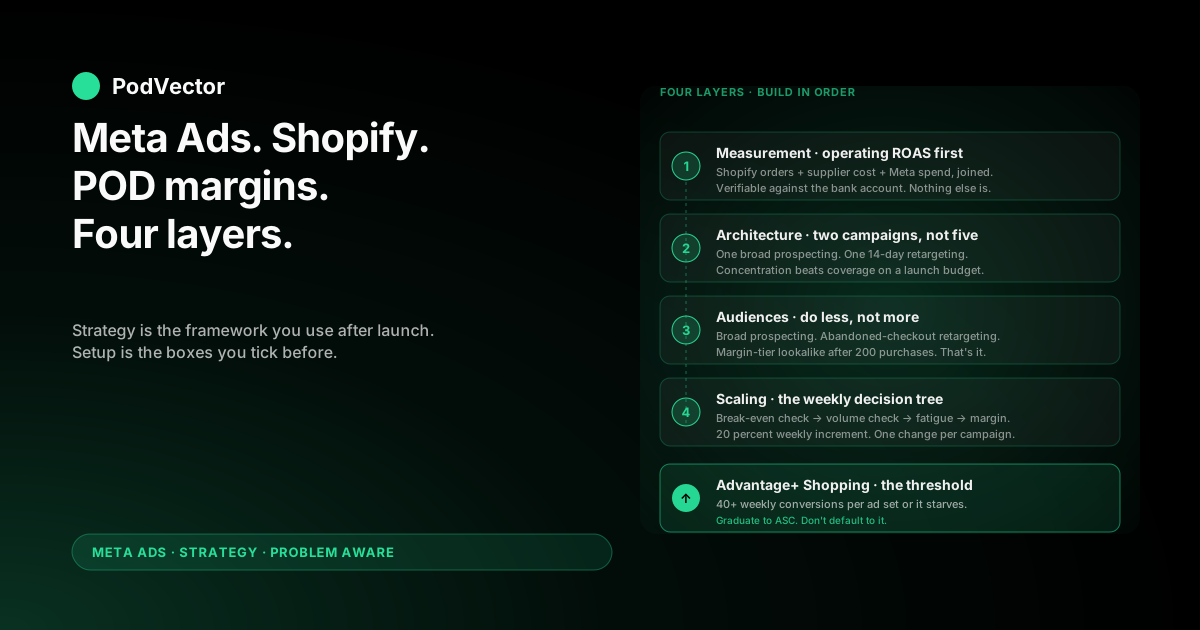
Quick Answer: A Meta Ads Shopify strategy for print-on-demand is not a campaign template you copy from a 50%-margin DTC brand. POD margins of 28–35% after Printify or Printful supplier cost change every strategic decision: budget floor, audience structure, creative cadence, and the metric you actually optimize against.
The strategy has four layers — measurement, campaign architecture, audience structure, and a scaling decision tree — and it only works if you build them in that order. Skip the measurement layer and the next three optimize toward the wrong number.
This playbook walks each layer with the numbers that matter for POD specifically, plus the three strategic mistakes that quietly burn the most budget at this margin profile.
Strategy vs. setup: what most POD operators get wrong
Open any "Meta Ads Shopify" guide on the first page of Google — Shopify's own Meta Ads Manager walkthrough, OptiMonk's beginner's guide, Tenten's 2026 playbook — and you'll get a setup walkthrough wearing a strategy label.
That's a problem. Setup is the boxes you tick before launch. Strategy is the framework you use to make every decision after launch: which campaign to scale, which to kill, where to put the next $1,000, and which numbers to trust when those numbers disagree.
For POD on Shopify, that distinction is expensive. A 50%-gross-margin DTC store can survive sloppy strategy because most campaigns clear the bar. A POD store at 28–35% contribution margin after Printify or Printful supplier cost cannot.
The strategy below is built specifically for that margin profile. It assumes the mechanical setup is done — pixel installed, Conversions API on, catalog connected — and starts at the decisions that actually move the bank account.
If the setup side isn't done yet, start with Shopify with Facebook Ads strategy for POD, which walks the five integration contracts. Come back here for the strategic layer on top.
Layer 1: measurement comes first, not last
This is the layer most POD operators skip and the one that decides whether the next three layers compound or cancel out.
The default reality on a fresh Shopify + Meta install: Meta Ads Manager reports one ROAS number, Shopify analytics reports a different one, and the Facebook & Instagram channel app reports a third. None of them is your operating ROAS.
What "operating ROAS" actually means for POD
Your operating ROAS is the only number with a clear definition: profit you can verify against the bank statement, divided by spend Meta charged your card.
For a POD order that's: order subtotal, minus refunds, minus Printify or Printful supplier cost, minus payment processing fees, minus shipping subsidy if any, divided by Meta spend over the same window.
That number does not live inside Meta. It does not live inside Shopify. It lives in a place where you join Shopify orders to supplier-cost data to Meta spend — typically a live data warehouse or a workbook that does the same job.
Why this is a strategic decision, not a reporting one
Every decision the next three layers ask you to make — scale this campaign, kill that ad set, raise this budget, change this audience — is a comparison between two numbers. If those numbers come from Meta's dashboard, you're optimizing toward Meta's view of conversions. If they come from Shopify's last-click report, you're optimizing toward last-click attribution.
Neither view tells you whether the campaign made money. Only the joined warehouse view does.
The pillar piece, the complete Meta Ads playbook for POD sellers, covers the measurement architecture in depth. The cross-cluster complete guide to Meta Ads ROAS and attribution for POD walks the math behind how a 10% reporting error reshapes 30-day spend allocation. Both are required reading before the rest of this strategy will produce predictable outcomes.
Layer 2: campaign architecture for POD margins
Once you have a trustworthy operating-ROAS number, the next strategic decision is how many campaigns to run, how to split them, and what each one is responsible for.
Most published guides recommend a "full-funnel" structure with prospecting, retargeting, and brand campaigns — borrowed wholesale from the DTC playbook. For POD on a launch budget, that structure is over-engineered.
The two-campaign starting point
For the first 30 days on a budget under $150/day, run two campaigns:
- Prospecting (broad). Single ad set, broad targeting, age 25–55, country only. Budget: $40–80/day. Goal: feed the pixel and CAPI 50+ purchase events so the algorithm exits learning.
- Retargeting (abandoned checkout + viewed product). Single ad set, 14-day window. Budget: $15–30/day. Goal: convert the highest-intent pool Shopify already produced.
That's it. No lookalikes yet. No interest stacks. No third "brand awareness" campaign with a $5/day budget that does nothing measurable. Two campaigns, two purposes, one decision per week per campaign.
Why the temptation to over-structure hurts POD specifically
Meta's algorithm needs roughly 50 conversions per ad set per week to exit the learning phase and deliver predictable cost-per-purchase. At a $30 average order value and a 2% conversion rate, that requires roughly $75/day per ad set in spend — minimum.
Split a $100 daily budget across five ad sets and none of them ever exit learning. The campaign produces noisy reporting, the algorithm never stabilizes, and you end the month convinced "Meta doesn't work for POD." Meta worked fine. The structure starved every ad set of signal.
Concentration of spend is the strategic move at POD launch budgets. Diversification comes after the first campaign is producing trustworthy numbers.
For step-by-step launch mechanics inside this two-campaign structure, see how to run Facebook Ads for Shopify, step by step.
Advantage+ Shopping vs. manual: the strategic call
Advantage+ Shopping Campaigns (ASC — Meta's all-in-one auto-targeted shopping campaign type) is the strategic question every POD operator asks in 2026, and most of the published advice gets it half-right.
The marketing line vs. the math
Meta reports that ASC delivers 17% higher ROAS than manual campaigns on average. That's true for the average advertiser. It is not true for the POD store on a $50–80/day launch budget.
ASC's algorithm needs roughly 50 conversions per week per campaign to escape learning. A POD store at $50/day spend and a $25 average order value produces around 30–40 weekly conversions in month one. ASC at that scale runs hot, never stabilizes, and the "17% higher ROAS" benchmark doesn't apply.
The strategic call by stage
The decision is straightforward when framed by conversion volume, not by tenure:
- Under 40 weekly purchase conversions: manual prospecting + manual retargeting. ASC will starve. Don't run it.
- 40–80 weekly conversions: manual prospecting + manual retargeting + ASC at 20% of total budget as a third campaign. Compare ASC's true ROAS to manual prospecting weekly. If ASC underperforms for three weeks, pause it.
- 80+ weekly conversions: shift toward ASC as the primary prospecting campaign at 50–60% of budget. Keep manual retargeting separate (ASC's retargeting blend is opaque and harder to optimize for POD margin).
The threshold is conversions per week, not dollars per day. A high-AOV POD store with bundled apparel can hit ASC's volume floor at lower spend; a low-AOV mug store needs more spend to get there.
Layer 3: audience structure at POD margins
Most "Meta Ads Shopify strategy" articles dedicate half their word count to interest stacking, lookalike layering, and demographic targeting. That advice mostly does not apply to POD in 2026.
What changed
Meta's algorithm in 2026 outperforms hand-tuned interest stacks on broad targeting once it has 40+ training conversions. Narrow targeting on a small budget produces three failure modes simultaneously: fewer impressions, higher CPMs, and slower learning-phase exit. All three compound against POD margins.
The strategic move at POD scale is to do less audience work, not more. Broad on prospecting, behavior-based on retargeting, and one carefully-built lookalike once you have enough purchase data to seed it.
The three audiences worth building
- Broad prospecting. Country + age 25–55. Let the algorithm find buyers. No interest stacks. No "Shopify enthusiasts" or "fans of [competitor]." Those layers slow learning without meaningful targeting upside.
- Abandoned checkout, 14-day window. Shopify's customer database produces this audience at 4–6× the size of the purchaser audience after three months of paid traffic. It's the highest-intent, lowest-cost retargeting pool a POD store has, and most operators underuse it.
- Top-quartile-margin lookalike (after 200+ purchases). Most operators build lookalikes from "all purchasers." A lookalike seeded from your top-quartile-margin purchasers — the buyers of multiple high-margin SKUs — produces a meaningfully different and better prospecting audience. This is a POD-specific edge most DTC playbooks miss because owned-inventory stores don't have the same margin variance per SKU.
For sibling specifics on scaling these audiences once they're producing signal, see scaling Facebook Ads + Shopify strategy for POD and the broader Shopify Facebook Ads strategy for POD.
Layer 4: the scaling decision tree
This is the layer where good measurement plus disciplined campaign structure pays off. Without the prior three layers, scaling decisions are vibes. With them, scaling becomes a tree with clear branches.
The weekly cadence
Same time, same day, every week. Pull last 7 days of operating ROAS per campaign from your warehouse. Then walk the tree.
- Is operating ROAS above your break-even number? (For most POD: 1.8–2.4× depending on AOV and supplier cost.)
- Yes: continue to step 2.
- No: continue to step 3.
- Has the campaign produced 40+ purchase conversions in the last 7 days?
- Yes: raise the budget by 20%. Wait 7 days before reassessing. Do not raise again before the next weekly review.
- No: hold budget. The signal is too thin to act on.
- Is creative fatigue the cause? (CTR dropped 15%+ vs. trailing 4-week baseline; frequency above 3.5.)
- Yes: rotate in two new creatives, pause two oldest. Hold budget for one week.
- No: continue to step 4.
- Is margin compression the cause? (SKU mix shifted toward lower-margin items.)
- Yes: filter the catalog feed harder. Drop bottom 30% of SKUs by margin. Hold budget for one week.
- No: pause the campaign. Reallocate budget to the next-best campaign in the account.
Why the 20% increment, not 50%
Meta's learning phase resets when you change campaign budget by more than 20%. A 50% jump triggers a fresh learning period, during which cost-per-purchase rises and reported ROAS drops. The campaign looks like it broke when in fact you triggered the reset. Stay under 20% per week and the algorithm holds its existing model.
The discipline matters more than the optimization. An account with one well-chosen 20% increment per week outperforms an account with three impulsive changes by month three.
Creative strategy: cadence over cleverness
Creative strategy gets more digital ink than any other strategy topic, and most of it is the wrong shape for POD.
The math that matters
POD audiences saturate quickly. A single ad creative reaching the same Meta-defined cohort for three weeks loses 30–50% of its CTR by week four. That's not creative quality — it's just impression fatigue.
The strategic implication: cadence beats genius. Two new creatives every week, average production quality, beats one perfect creative running for two months. Most POD operators try to do the inverse and watch their CPM rise quietly while the "great ad" stops performing.
The four-creative weekly rotation
Each prospecting ad set holds four active creatives at any time. Each week:
- Pause the two with the lowest 7-day CTR.
- Add two new ones — typically variants of the trailing two best performers, with one element changed (hook, format, or CTA).
That's four iterations per week per ad set, twelve creative changes in a 30-day window, and roughly 50–70% of the cost of producing genuinely original creatives every time. Variants of winners outperform fresh-from-scratch creative on POD audiences in roughly 60% of weeks once the account has a winner to vary from.
Budget allocation framework by stage
Most published budget guidance is the wrong scale for POD launch budgets. Here's the framework that actually works at 28–35% margin.
Days 1–30: install and prove the strategy
$60–100/day total. 70% prospecting, 30% retargeting. Two campaigns. The deliverable at day 30 is not revenue — it's a working operating-ROAS number you trust against the bank account. If you don't have that, there's nothing to scale and the next 60 days won't go anywhere good.
Days 31–60: pressure-test SKU and creative selection
$100–180/day total. 60% prospecting, 30% retargeting, 10% in reserve for ASC if conversion volume crosses the threshold. Start the four-creative rotation. Begin margin-tier filtering on the catalog feed.
By day 60 you should have 2–3 campaigns with stable, trustworthy operating-ROAS numbers and one clear winner.
Days 61–90: scale the winners
$180–400/day total. Apply the 20% weekly increment to winners. Pause anything below break-even after a 14-day signal window. By day 90, an account running this strategy is producing decisions, not just spend. That's the bar.
Beyond day 90: reinvest in the measurement layer
Once spend crosses ~$15K/month, the bottleneck stops being campaign optimization and becomes decision velocity — how fast you can answer questions like "is this new SKU profitable on Meta?" or "did last week's creative test pay back?" The accounts that scale past $50K/month spend almost always built a live-data answer machine over their warehouse so those questions get answered in seconds, not weeks.
That's the layer Victor was built for, but the principle stands either way: at scale, the strategy stops being campaign-side and becomes data-side.
Three strategic mistakes that cost the most
1. Optimizing on Meta's reported ROAS
Meta's reported ROAS uses Meta-attributed conversions valued at order subtotal. For POD that's the wrong signal in two ways: it inflates reported revenue (Meta over-claims attribution) and over-weights low-margin orders (subtotal does not equal profit). Operators who scale against Meta's number end up with healthier dashboards and weaker bank accounts.
2. Splitting budget across too many campaigns at launch
Five campaigns at $20/day each looks comprehensive and produces zero useful signal. Two campaigns at $50/day each produce trustworthy numbers within three weeks. The discipline is concentration, not coverage.
3. Treating Advantage+ Shopping as an automatic upgrade
ASC works at scale. Below 40 weekly conversions per ad set it starves and the marketing-quoted "17% higher ROAS" doesn't apply. The strategic move is to graduate to ASC when conversion volume justifies it — not to treat it as a default because the trade press says it's the future.
FAQs
What's the minimum monthly Shopify revenue to justify a Meta Ads strategy for POD?
Roughly $30K–50K/month organic revenue before paid ads make sense as a primary growth channel. Below that, the fixed cost of measurement infrastructure, creative production, and account management eats too much of the margin. Stores below the threshold are usually better off compounding organic content and email until volume justifies paid acquisition overhead.
How long before I trust the operating-ROAS number?
14 days minimum, 21 ideal. The combination of Meta's 7-day click attribution window and Printify or Printful's 5–9 day fulfillment lag means anything earlier is noise. Set the rule in writing before launch — the temptation to act on day-3 data is the most expensive impulse in the playbook.
Should I run a separate campaign for each Shopify collection?
No. One prospecting campaign with a filtered catalog feed (top 8–15 SKUs by organic order volume) outperforms a per-collection structure on launch budgets. The catalog feed is where you control SKU selection — not the campaign structure. See Facebook Ads + Shopify strategy for POD for the SKU filter mechanics.
How does this strategy change if I'm using Printful instead of Printify?
The strategy is the same. The numbers shift slightly because Printful's average supplier cost runs $1.50–3.00 higher per unit on apparel, which compresses margin further and tightens the break-even ROAS by roughly 0.2×. The two-campaign architecture, four-creative rotation, and 20%-weekly-increment rule all hold. What changes is the break-even number you compare campaigns against.
What about TikTok and Google Ads — should I run them in parallel?
Not in the first 90 days. Concentration of budget and attention beats diversification at POD launch margins. Once Meta is producing consistent operating ROAS above break-even and you're ready to scale past $400/day on Meta alone, layer in a second channel. Until then, channel diversification dilutes signal and slows the learning loop on the channel you've already paid to learn.
Do I need an agency to run this strategy?
For accounts under $20K/month spend, no. The strategy above is designed to be run by the operator with two to three hours per week of engaged attention, mostly in the weekly review. Above $20K/month spend, a specialist agency or in-house buyer pays back through faster creative production and tighter campaign hygiene — but they should be running this strategy, not a generic DTC template that ignores POD margins.
How do I know if creative fatigue or margin compression is the real cause of a ROAS drop?
Two signals. Creative fatigue: CTR drops 15%+ vs. the trailing 4-week baseline and frequency rises above 3.5. Margin compression: SKU mix shifts toward lower-margin items in the same window — visible in your warehouse but invisible to Meta. The two need different fixes (rotate creative vs. filter the catalog), so getting the diagnosis right matters more than reacting fast.
The number Meta's dashboard won't show you
Meta's Ads Manager reports ROAS against subtotal. Shopify reports last-click revenue. Neither shows contribution margin per campaign after Printify or Printful supplier cost — the number that actually decides whether to scale.
Victor is the AI employee POD operators ask "is this campaign profitable on margin, not just spend?" and get a live, warehouse-grounded answer. Your Shopify orders, your supplier costs, your Meta spend, joined and reasoned over in plain English.
No dashboards to learn. No SQL to write. Ask the question, get the number.
Try Victor free