
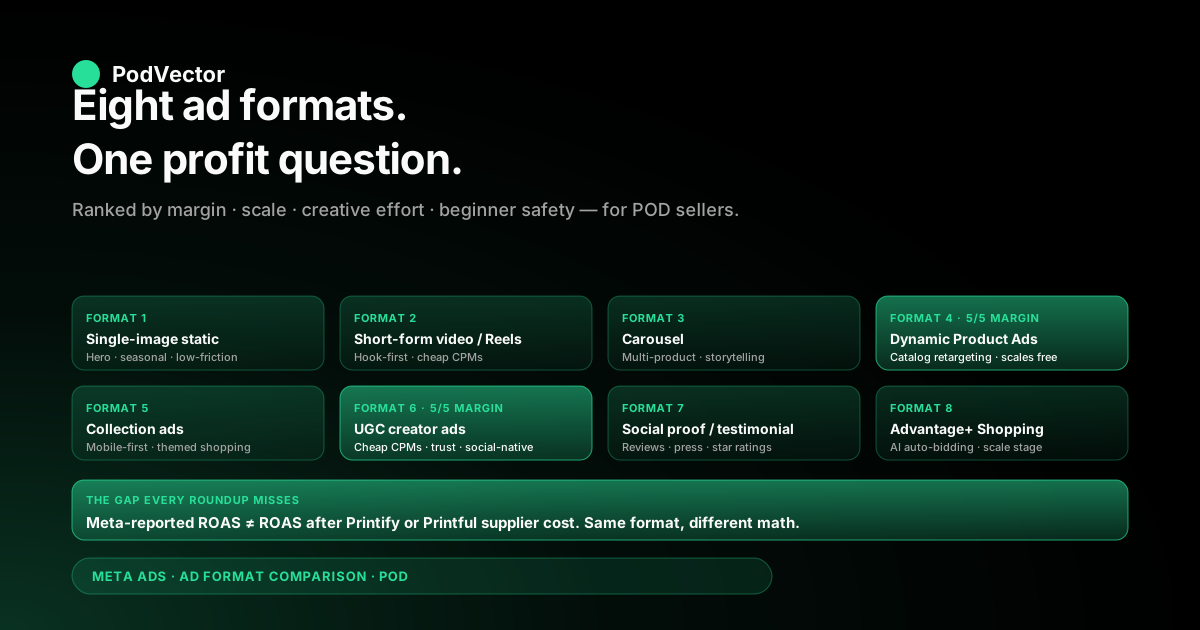
Quick Answer: The eight Facebook ad formats that consistently win for ecommerce in 2026 are single-image static, short-form video and Reels, carousel, Dynamic Product Ads, Collection, UGC creator ads, social proof testimonials, and Advantage+ Shopping Campaigns. They are not interchangeable — each one fits a different stage of the funnel, a different creative budget, and a different stock catalog size.
For print-on-demand sellers, the ranking shifts. Dynamic Product Ads and short-form video sit at the top because they scale across hundreds of designs without per-product creative work. Collection ads and Advantage+ work once your catalog and pixel data are clean. Static single-image ads still earn their slot for hero designs and seasonal pushes.
The comparison table below ranks each format on POD-specific axes — profit margin friendliness, scale potential, creative effort, and beginner safety — and flags the trap none of the standard roundups mention: ROAS reported by Meta is not ROAS after Printify or Printful supplier cost.
How we rank "best" for POD
Most "best Facebook ads" roundups score formats on average click-through rate or which big brand uses them. Sephora, Warby Parker, and Allbirds get cited a lot. Their ad budgets and unit economics share almost nothing with a print-on-demand store running on Printify or Printful margins.
A POD seller has different constraints. Per-unit margin is thin once supplier cost lands. Creative volume is high because new designs ship weekly. The catalog can be hundreds of SKUs deep but each SKU sells in low volume. A format that wins for a $200-AOV apparel brand can quietly lose money for a $25-AOV t-shirt store.
So the four axes below are the ones that actually matter when you read the ranking.
- Margin friendliness. Does the format protect contribution margin, or does it inflate ROAS by reporting on revenue that loses money once supplier cost lands?
- Scale potential. Can it run across a 200-design catalog without manually building 200 ads?
- Creative effort. How much production time does each fresh ad eat — product photography, video editing, copy?
- Beginner safety. Will a first-time media buyer running this format set fire to budget before learning anything useful?
The eight formats below are ranked on these axes, not on engagement vanity metrics. The companion complete Meta Ads playbook for POD sellers covers the underlying account architecture these formats run inside.
1. Single-image static ads
The original Facebook ad format. One image, one headline, one primary text block, one button. Still in the lineup because it is the lowest-friction ad to ship.
For POD, single-image works hardest in two scenarios. The first is a hero design — the one shirt or mug that already converts at retail and deserves a polished promo. The second is a seasonal push where the calendar matters more than testing matrix complexity.
The Inflow research team analyzed top retailer ads and found single-image static still appears across Walmart, Target, and Amazon's organic Facebook activity. The reason is unglamorous: single image scales across the catalog with no editing pipeline, and Meta's algorithm gives it cheap impressions when video is saturating the auction.
The downside is creative fatigue. A static image at the same angle starts losing CTR after roughly two weeks of continuous spend. POD operators with one or two designs a week of new artwork can cycle through fast enough; brands with one hero design need to refresh the angle, background, or model every few weeks.
Best for: hero products, seasonal pushes, beginner accounts under $100/day spend.
Watch out for: running the same image to a saturated retargeting audience for more than 14 days.
2. Short-form video and Reels
Short-form video — under 15 seconds, vertical 9:16, designed for Reels placement — is the format the Meta algorithm rewards most aggressively in 2026. Lower CPMs and stronger reach in cold audiences.
What makes it work for ecommerce is the hook. The first 2 seconds need to stop the scroll, usually with a problem statement or visual surprise. Dollar Shave Club's category-challenging openings and Purple's "disrupted sleep" problem-first hooks are both cited in current creative breakdowns as the gold standard.
For POD, the production cost question is real. A 12-second product video — model wearing the shirt, three angles, one zoom on the print — runs $50–$200 to shoot if outsourced, or roughly two hours of phone-shot footage if you do it yourself. The math works because one good Reel can power a creative for a month before fatigue sets in.
The trap is treating Reels like a TV ad. Long brand intros lose. The product needs to enter frame within the first 3 seconds or the algorithm gives up serving it.
For step-by-step Reels production frameworks, the step-by-step ecommerce Facebook ads guide walks through the creative brief.
Best for: cold prospecting, top-of-funnel awareness, product launches.
Watch out for: auto-generated captions that misread your product name — Meta is generating them by default and they show on muted Reels.
3. Carousel ads
Carousel ads stack 2 to 10 cards in a swipeable unit. Each card has its own image, headline, and link. The format is valuable for two distinct ecommerce jobs.
The first job is multi-product discovery. A POD store with five tropical-themed designs in a collection can show all five in one carousel and let Meta auto-rank the best-performing card to the front. This is genuinely scale-friendly — you build one ad and the algorithm sorts it.
The second job is storytelling. Each card advances a narrative — "Card 1: the problem. Card 2: the design. Card 3: the print quality. Card 4: the customer review. Card 5: the offer." This works well for higher-AOV POD products like premium hoodies or wall art where the buyer needs more reassurance before clicking.
Carousel CTRs run roughly 30–70% higher than single-image for product discovery use cases, which is the consistent finding across both AdStellar's 2026 carousel breakdown and Inflow's research data.
The downside for POD is feed maintenance. If a SKU goes out of stock at one print provider mid-campaign, the carousel card linking to it sends traffic to a dead PDP. The fix is either dynamic carousels (covered in DPA below) or weekly catalog audits.
Best for: design collections, multi-variant SKUs, mid-funnel consideration.
Watch out for: carousels with one weak card — Meta's auto-ranking can't save a card with bad creative, it just buries it.
4. Dynamic Product Ads
Dynamic Product Ads (DPA — Meta's automated retargeting format that pulls products from your catalog feed) are the highest-leverage ad type a POD store can run. One campaign retargets every site visitor with the specific products they viewed.
The math is brutal in DPA's favor. A site visitor who looked at three designs and left will see those exact three designs in their feed within 24 hours. The intent signal is already there, the creative is auto-built from the product feed, and the targeting is automatic.
For a POD catalog with 200+ designs, DPA replaces what would otherwise be 200 manually-built retargeting ads. There is no other format on this list that scales linearly with catalog size at zero incremental creative cost.
The setup prerequisite is a clean product feed. The dynamic Facebook ads product feed strategy guide walks through Shopify-to-Meta feed config; the Facebook DPA Shopify strategy covers the campaign-level structure.
The trap is running DPA cold. The format only works when the audience has site-visit signal. A new POD store with no traffic yet should run prospecting (video, single image, Reels) for 30 days before turning on DPA — otherwise the algorithm has no one to retarget.
Best for: retargeting site visitors, mid-funnel, catalogs with 50+ SKUs.
Watch out for: running DPA before you have at least 1,000 monthly site visitors — the audience is too thin to optimize.
5. Collection ads
Collection ads are the mobile-first format Meta built specifically for catalog-driven shopping. A hero image or video sits on top, and four product tiles auto-populate from your catalog underneath. Tap any tile and the user lands in a full-screen Instant Experience that loads inside Facebook before sending them to your PDP.
For POD, Collection works best when you have a unifying theme — a "Christmas designs" collection, a "national parks t-shirt series," a "minimalist line art" range. The hero asset frames the theme; the tiles let the user pick the specific design.
The conversion advantage is fewer clicks. Mobile shoppers don't bounce between Facebook and your store — the Instant Experience loads inline. Conversion rates from Collection ads typically run 1.5–3× single-image equivalents for catalog-style merchants.
The cost of admission is product feed setup. Without a synced Meta Commerce Manager catalog, Collection won't auto-populate the tiles and you'll be stuck building each one manually. The Meta Ads + Shopify integration guide covers the catalog wiring.
Best for: themed collections, mobile-heavy audiences, mid-to-bottom funnel.
Watch out for: hero video that doesn't match the tile products — Meta penalizes mismatched creative with lower delivery.
6. UGC creator ads
UGC (user-generated content) ads use real customers, micro-influencers, or paid creators filming the product in unscripted, phone-quality settings. The format reads as native to social feeds rather than as paid promo.
Gymshark built one of the fastest-growing apparel brands almost entirely on UGC creative. The pattern works because the algorithm reads UGC as "organic-style" content and rewards it with cheaper impressions, while users trust peer recommendations more than brand-produced ads.
For POD, UGC unlocks a margin advantage other formats can't touch. A creator filming themselves wearing your shirt costs $50–$300 per piece of usable footage versus $500+ for a polished studio shoot. The lower CPM that UGC earns then compounds the margin gain.
The catch is sourcing and rights. You need either a creator marketplace (Whop, Insense, Twirl) or a customer-referral program that asks buyers to share footage in exchange for a discount or commission. The footage needs explicit usage rights — Meta does spot-check.
UGC also fatigues fast. A single creator shown to the same audience for 4+ weeks loses CTR. Plan to cycle three or four creators per active offer.
Best for: apparel, accessories, lifestyle products, cold prospecting.
Watch out for: UGC that mentions specific health, financial, or legal claims — Meta's policy team rejects these even when the claim is technically true.
7. Social proof and testimonial ads
Social proof ads layer customer quotes, star ratings, press mentions, or sales counters directly into the creative. Ridge Wallet built a stacked-testimonial template that other DTC brands now copy: three short quotes, three press logos, one product photo, one CTA.
The job this format does is overcoming skepticism in the bottom funnel. A site visitor who has seen the product but didn't buy needs the social proof confirmation more than they need to see the product again. That's why testimonial ads typically outperform standard product ads in retargeting audiences.
For POD, the input is straightforward: pull your top five Shopify reviews, drop them on the design backdrop, ship the ad. The creative effort is hours rather than days.
The constraint is review volume. A new POD store with under 50 reviews can't credibly run social proof ads — the same five quotes get fatigued quickly across audiences. Stores with 200+ reviews can rotate quotes weekly and keep the format fresh for months.
Press logos are powerful when available. "As seen in Etsy Trends 2026" or a craft fair feature counts. Don't fabricate logos — Meta's policy team and customers both spot it.
Best for: retargeting, bottom funnel, stores with 100+ verified reviews.
Watch out for: review screenshots that include personally identifiable info — blur or omit last names.
8. Advantage+ Shopping Campaigns
Advantage+ Shopping Campaigns (ASC — Meta's AI-driven automated campaign type that consolidates audience selection, creative testing, and budget allocation) launched as Meta's answer to Google's Performance Max. By 2026 it accounts for an increasing share of ecommerce spend on the platform.
What you give up is control. ASC decides which audience to serve, which creative variant to run, and where to place it. What you get back is iteration speed — Meta's algorithm tests faster than a human media buyer could and reallocates budget across creatives in near real-time.
For POD, ASC is a stage-3 tool. A store running its first $10/day campaign has nothing to feed the AI — no historical conversion data, no proven creative. ASC needs at least 50 conversions a week to optimize meaningfully, which usually means $50/day spend minimum.
Once your account has that data depth, ASC tends to outperform manually-built lookalike-and-interest campaigns by 15–30% on raw ROAS. The catch is the same as with any Meta-reported ROAS: it's pre-supplier-cost. A 3.5x ASC ROAS on a Printify product can mean you're losing money once base cost lands.
For the deep dive on whether ASC fits your stack, the Meta Ads vs alternatives comparison covers the trade-offs against Google Performance Max and TikTok Smart Performance Campaigns.
Best for: stores with 50+ weekly conversions, accounts running $50+/day, scale-stage operators.
Watch out for: ASC's tendency to over-spend on retargeting at the expense of new-customer acquisition. Set a "new customer ratio" floor.
Side-by-side comparison table
The eight formats above, scored on the four POD-specific axes. Higher scores are better in every column except creative effort, where lower is better.
| Format | Margin friendliness | Scale potential | Creative effort | Beginner safe |
|---|---|---|---|---|
| Single-image static | 3/5 | 2/5 | Low | Yes |
| Short-form video / Reels | 4/5 | 3/5 | Medium | With template |
| Carousel | 3/5 | 4/5 | Medium | Yes |
| Dynamic Product Ads | 5/5 | 5/5 | Low (one-time setup) | No — needs traffic |
| Collection | 4/5 | 4/5 | Medium | No — needs catalog |
| UGC creator ads | 5/5 | 3/5 | Medium-low | Yes |
| Social proof / testimonial | 4/5 | 3/5 | Low | No — needs reviews |
| Advantage+ Shopping | 3/5 | 5/5 | Low | No — needs spend depth |
The two formats scoring 5/5 on margin friendliness — DPA and UGC — are the ones print-on-demand sellers underuse most. DPA scales catalog retargeting at zero incremental creative cost, and UGC pays for itself through cheaper impressions and higher trust.
The format scoring 5/5 on scale potential without prerequisites is none of them. Every high-scale format needs either site traffic, a clean catalog, or spend depth before it works. That's why beginner POD accounts should start with single-image static and short-form video, then layer DPA and Collection once the data foundation is in place.
The POD profit reality nobody else mentions
Every "best Facebook ads for ecommerce" article you've read measures success in ROAS as Meta reports it. That number is revenue divided by ad spend. It doesn't subtract the supplier cost that Printify or Printful charges you when the order ships.
A 3.0x reported ROAS on a $25 t-shirt sounds healthy. The math: $100 ad spend produces $300 in revenue, 12 orders. Net of Printify base cost ($10/shirt = $120), Shopify fees ($9), and the $100 ad spend, you're at $71. Real margin is roughly 24%, not the 67% that "3.0x ROAS" implies.
Now imagine the same campaign reports 3.0x but the average order is a custom mug at $18 with $7 supplier cost. Net of fees, real margin drops below 10%. Same ROAS. Different products. Different real-money outcomes.
This gap is what the standard ad-format roundups skip. The eight formats above are all capable of producing the same misleading ROAS number. The format question and the profit question are separate questions, and the profit question is the one that decides whether you scale or pull spend.
For the deeper breakdown on closing this gap, the complete guide to Meta Ads ROAS and attribution for POD walks through the calculations.
Recommended ad-format stack by funnel stage
Use this as the deployment order if you're rebuilding your account from scratch.
| Funnel stage | Primary format | Secondary format | Why this combo |
|---|---|---|---|
| Cold prospecting (top of funnel) | Short-form video / Reels | UGC creator ads | Cheapest CPMs, broadest reach, social-native creative |
| Mid-funnel consideration | Carousel | Collection | Multi-product discovery, themed buying, mobile-first |
| Bottom-funnel retargeting | Dynamic Product Ads | Social proof / testimonial | Reminds visitors of exact products viewed, overcomes hesitation |
| Scale stage ($50+/day, 50+ weekly conversions) | Advantage+ Shopping | DPA + UGC | Algorithmic optimization on top of clean creative library |
Two principles drop out of this stack. The first is that no single format is the answer at every stage. The second is that the prerequisites compound — Collection ads assume a clean catalog, DPA assumes site traffic, ASC assumes conversion depth. Building these in order avoids the trap of buying advanced tooling before the data layer it depends on exists.
For the broader format taxonomy and how each format maps to Meta's ad objectives, see the complete guide to Meta ad types for POD sellers.
FAQs
Which Facebook ad format converts highest for ecommerce?
Dynamic Product Ads convert highest in retargeting audiences because they show site visitors the exact products they viewed. For cold audiences, short-form video / Reels typically wins on cost-per-acquisition.
How many ad formats should I run at once?
For a starter account under $50/day spend, run two formats — one for prospecting (video or single-image) and one for retargeting (DPA once you have traffic). Adding more formats fragments budget and slows learning.
Are video ads always better than image ads?
No. Video earns cheaper impressions when the creative is strong and the hook lands. Static single-image often outperforms weak video, and it's faster to ship hero-product or seasonal pushes.
Do Facebook ads still work for POD in 2026?
Yes, but the margin window is narrower than three years ago. CPMs have risen and iOS-related signal loss requires Conversions API to recover. Profitable POD ads in 2026 require either niche targeting, UGC creative, or strong organic flywheel — not just turning on broad Advantage+.
What ROAS do I need to be profitable on Printify or Printful?
The break-even ROAS depends on supplier cost ratio. A typical Printify t-shirt at $25 retail with $10 supplier cost needs roughly a 2.5x reported ROAS to clear processing fees and ad spend. Premium products with lower supplier-cost ratios can profit at 2.0x.
Should I use Advantage+ Shopping Campaigns or build campaigns manually?
Advantage+ wins once your account has 50+ weekly conversions to feed the algorithm. Below that threshold, manually-built campaigns with explicit audience targeting give you faster diagnostic signal on what's working.
Why is my Meta-reported ROAS different from my actual profit?
Meta reports revenue, not profit. The difference is supplier cost (Printify or Printful base cost), Shopify processing fees, and your ad spend. A 3.0x reported ROAS on a $25 t-shirt with $10 supplier cost typically nets to roughly 25% real margin.
Stop guessing which ad format is profitable
Meta tells you ROAS. It doesn't tell you margin. The ad format that "wins" in your dashboard can be the one quietly burning money once Printify supplier cost lands two days later.
Victor is the AI employee that pulls your Meta spend, Shopify revenue, and Printify or Printful supplier cost into a single source of truth — and answers the question every POD operator needs answered daily: which campaign is actually profitable today? Ask in plain English, get the number that matches your bank balance.
Try Victor free