
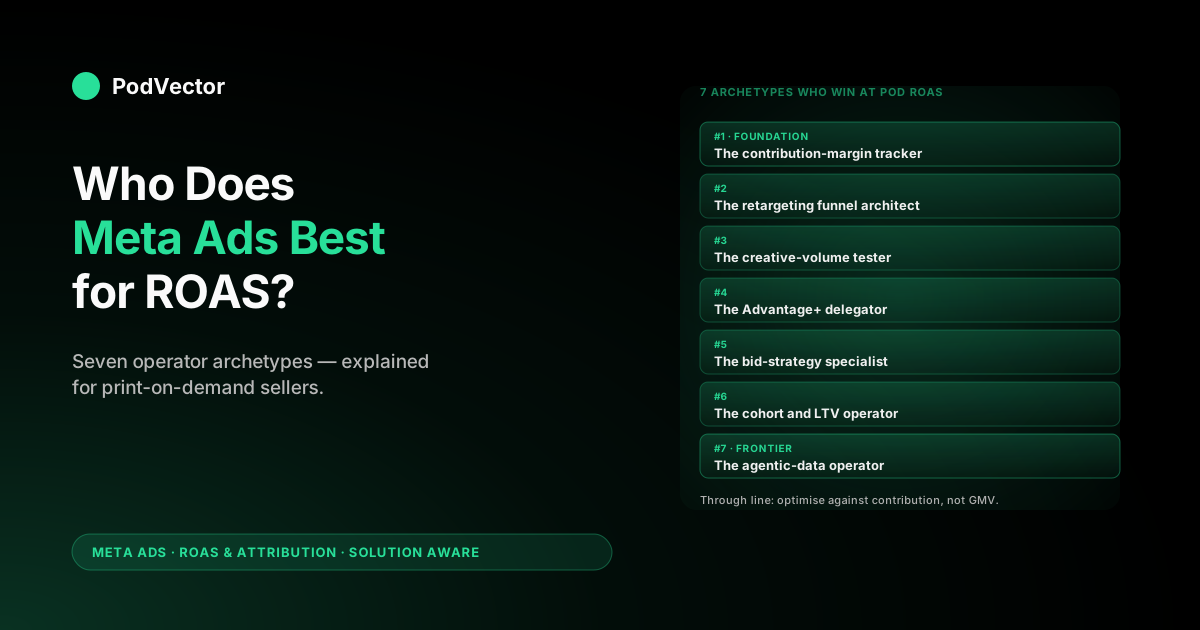
Quick Answer: The operators who do Meta Ads best for ROAS aren't agencies with secret targeting tricks. They're the seven archetypes below — the contribution-margin tracker, the retargeting funnel architect, the creative-volume tester, the Advantage+ delegator, the bid-strategy specialist, the cohort operator, and the agentic-data operator.
What separates them isn't budget or experience. It's that all seven optimise against true contribution margin instead of Meta's reported ROAS. Reported ROAS uses order subtotal as the conversion value. For a Printify or Printful store, that ignores supplier cost, payment fees, and refunds — a 4.0x reported ROAS routinely lands at 2.0–2.4x on actual contribution.
Pick the archetype closest to your current weakness and copy its signature move. The compound effect of two or three is more than the sum.
The 7 archetypes who do Meta Ads best
Most "who does it best" articles for Meta Ads are agency listicles. They rank shops by case-study claims and disclosed retainers. That's the wrong question.
The real determinant of ROAS isn't who runs the account — it's how the operator measures success. The seven archetypes below appear across in-house teams, freelancers, and agencies. What unifies them is method, not headcount.
| Archetype | Signature move | Where they win | POD-specific? |
|---|---|---|---|
| 1. Margin tracker | Sends contribution as Purchase value | Foundational ROAS accuracy | Yes — biggest gap |
| 2. Funnel architect | Layered retargeting against warm audiences | 3–4x prospecting ROAS | Universal |
| 3. Creative tester | 10+ creatives per ad set per month | CTR and fatigue control | Universal |
| 4. Advantage+ delegator | Broad targeting, AI allocation | 20–40% reported ROAS lift | Universal |
| 5. Bid specialist | Highest Value or ROAS goal | 15–30% lift on profit signal | Compounds with #1 |
| 6. Cohort operator | LTV and repeat-purchase modeling | Buying break-even on AOV alone is wrong | Yes — sticker volume |
| 7. Agentic-data operator | Live warehouse + AI employee | Daily true-ROAS decisions, not weekly | Yes — supplier-cost variance |
The order matters. Archetype 1 is the foundation — the rest compound on top of accurate value signal. An Advantage+ campaign optimising against subtotal-as-value will systematically over-invest in low-margin SKUs. Fix the value first, then the rest pays out.
If you only adopt one archetype, make it #1. If you have a quarter to compound, work down the list.
1. The contribution-margin tracker
This operator's signature move is the one Meta's own documentation never mentions. They send contribution margin — not order subtotal — as the Purchase event's value parameter.
The default Shopify–Meta integration fires a Purchase event whose value equals the order subtotal. Meta has no way to know what Printify or Printful charged you to fulfil that order. Reported ROAS is therefore GMV-ROAS — gross merchandise value divided by ad spend — not anything close to profit-ROAS.
For a $26.99 hoodie with a Printify supplier cost of $14.20, that's a 47% gap baked into every reported number. A 4.0x dashboard ROAS sits closer to 2.1x on actual contribution.
The margin tracker fixes this with a server-side webhook or a custom data layer. The Purchase event's value field gets replaced with (order_total − supplier_cost − payment_fees − expected_refunds). Meta's algorithm now optimises toward genuinely profitable conversions instead of high-revenue, low-margin orders.
Lift on POD accounts ranges 30–80% on reported ROAS once the algorithm has 7–14 days to recalibrate. The reported number drops short-term — fewer events flagged as high-value — and then climbs as the bidder finds new pockets of profit.
This archetype's hardest part isn't engineering. It's the patience to ride out the dip while Meta relearns. Most teams quit on day 3.
2. The retargeting funnel architect
Public benchmark data puts retargeting at a median 3.61x ROAS versus 2.11x for prospecting. The funnel architect doesn't just turn on a generic retargeting audience and call it done. They build layers.
The standard architecture has three or four tiers. Tier 1 is product viewers in the past 14 days. Tier 2 is add-to-cart non-purchasers in the past 30 days. Tier 3 is past 180-day purchasers excluded from Tier 1 and 2 — these get a cross-sell or repeat-purchase ad. Tier 4 (optional) is engaged-but-not-clicked social audiences.
Each tier gets its own creative angle. Tier 1 sees product-focused ads with a price anchor. Tier 2 sees urgency and review-led ads. Tier 3 sees a new collection or bundle. The architect treats each tier as a distinct campaign with distinct creative, not one ad set with stacked audiences.
For POD, retargeting against past purchasers is especially high-leverage. A 30-day cohort that bought a t-shirt is 4–6x more likely to buy a second item from the same store than a cold prospect. Most POD operators don't run this campaign — the architect always does.
For deeper coverage of how retargeting integrates with Shopify's data layer, see Facebook retargeting ads for Shopify.
3. The creative-volume tester
The creative tester's premise is simple. Meta's bid auction rewards engagement signals — CTR, video view-through, post engagement — and creative quality dominates those. No targeting trick beats a 4x-CTR creative.
The signature behaviour is volume. The tester ships 10–20 new creative variants per ad set per month, mostly UGC, mostly under 30 seconds. They're not trying to find one perfect ad. They're trying to maintain a portfolio so the inevitable fatigue (30–50% performance decay after a creative hits 2–3x audience reach) gets absorbed by fresh inventory.
UGC outperforms polished brand video on POD apparel by a wide margin. Public benchmarks show 2–4x CTR uplift. The reason is medium-fit — Reels and Stories are personal-feed surfaces, and creative that feels native to the surface beats creative that looks like a TV spot.
The tester's stack is usually: a UGC sourcing pipeline (Insense, Trend, or in-house), a basic editing tool (CapCut), and a tagging convention so creative-level performance can be analysed in aggregate.
Where this archetype loses is when production cost outpaces ROAS lift. The discipline is to keep creative production sub-3% of media spend.
4. The Advantage+ delegator
Meta's Advantage+ Shopping suite is the platform's bet on AI-led campaign management. Public data shows 32% ROAS lift on average versus manual campaigns, and 70% YoY revenue lift in Q4 across Advantage+ adopters.
The delegator embraces this. Their account structure is two or three Advantage+ Shopping campaigns at most — one prospecting-heavy, one retargeting-heavy — with broad audiences and AI budget allocation. They resist the urge to micromanage.
The hard part is what the delegator doesn't do. They don't build 14 ad sets per campaign. They don't carve audiences by interest stack. They don't dayparting. The point of Advantage+ is to feed the algorithm scale and signal — fragmenting the account starves it.
For POD, Advantage+ tends to over-index on broad audiences, which sometimes hurts niche apparel stores (a Christian-themed store, say, gets allocated impressions outside its actual buyer pool). The delegator handles this with audience exclusions rather than narrow targeting.
Pairing Advantage+ with archetype 1's contribution-value signal is the highest-leverage combination available. Without contribution value, Advantage+ allocates toward whichever SKU produces the most subtotal — often the highest-COGS hoodies that lose money. With contribution value, it allocates toward the SKUs that actually pay rent.
5. The bid-strategy specialist
Bid strategy is the lever most POD operators leave on Lowest Cost (the default) and never revisit. The specialist treats it as a primary control surface.
The three options that matter for ROAS are Highest Value, ROAS goal, and Cost Cap. Lowest Cost optimises for conversion volume regardless of value — it produces lots of cheap, low-margin orders. Highest Value optimises for the value parameter you send. ROAS goal lets you set a minimum ROAS floor and Meta's bidder respects it.
The specialist's playbook: switch top-of-funnel campaigns to Highest Value once the ad set has 50+ purchase events in the past 7 days, and switch retargeting campaigns to ROAS goal once they have 100+ events. Below those thresholds, value optimisation is statistically unreliable — the bidder doesn't have enough signal to find genuinely high-value users.
Most POD stores under $30K/month sit below the 50-event threshold per ad set. The specialist's workaround is consolidation: fewer ad sets, broader audiences, more creatives per ad set, so events pool. Two ad sets with 80 events each beat eight ad sets with 20 events each.
This compounds with archetype 1. Highest Value bidding optimised against subtotal-as-value pushes Meta to find expensive orders, not profitable ones. Highest Value optimised against contribution-as-value pushes it to find profitable ones. Same setting, opposite outcome.
6. The cohort and LTV operator
The cohort operator measures Meta Ads ROAS on a 60-, 90-, or 180-day window, not a 7-day attribution window. Their thesis: a customer's value isn't the first order. It's first order plus the predicted repeat-purchase tail.
For POD, the repeat-purchase tail varies wildly by niche. Generic apparel stores see 8–15% repeat in 180 days. Niche stores (dog breeds, hobby groups, fandoms) see 30–55%. The operator who measures only first-order ROAS systematically under-spends on niche stores and over-spends on generic ones.
The signature move is a customer-lifetime-value model layered onto first-order data. Even a simple multiplier (last quarter's first-order revenue × observed repeat rate × average repeat order value) shifts the break-even ROAS calculation by 20–40%. A campaign that looks unprofitable on day-one ROAS often pencils out at LTV-ROAS.
The trap: most off-the-shelf reporting tools don't model LTV correctly for POD. They use the 12-month repeat rate, which is optimistic for niche apparel (where buying patterns are seasonal or event-driven) and pessimistic for generic apparel (where buyers fade after 30 days of non-engagement).
The cohort operator usually maintains the LTV model in their own warehouse and pipes it into the bidder via custom audience values, rather than trusting platform defaults.
7. The agentic-data operator
This archetype is the newest and the rarest. Their setup: every Shopify order, Meta spend row, Printify or Printful supplier-cost line, and payment-fee breakdown lands in a unified data warehouse within minutes. An AI employee sits on top of that warehouse and answers questions in plain English.
"Which Meta campaigns were unprofitable last week after supplier cost?" returns a list with names and contribution-margin numbers. "Which ad set's break-even ROAS just shifted because of last week's Printify price increase?" returns the affected ad sets and the new floor.
The operator stops opening five tabs (Meta Ads Manager, Shopify, Printify, payment processor, spreadsheet) to compose ROAS-after-COGS by hand. The agent composes it on demand, against the freshest data, in seconds.
Why this matters for ROAS: speed of decision. The classic POD failure mode is a campaign that looks healthy in Meta's dashboard for two weeks while quietly losing money on contribution. By the time the operator pieces together the supplier-cost view in their spreadsheet, the campaign has burned $4,000–$10,000 in cumulative loss. The agentic operator catches it on day 2.
The architecture is generic across the analytics industry. The customer's warehouse can be Snowflake, Redshift, Databricks, or equivalent. What's specific is the agent's ability to write SQL on demand, join the right tables (orders, ad spend, supplier costs, fees), and explain the result without the operator having to author the query themselves.
Victor answers and acts — with your approval — flagging unprofitable ad sets for pause, drafting budget reallocations against tonight's true-ROAS picture, even firing the contribution-margin Purchase event to Meta's CAPI without engineering tickets. That's the trajectory.
What ties all seven together
The seven archetypes look like seven different jobs. They aren't. They're seven facets of one decision: what number are we optimising against?
The margin tracker decides Meta's bidder optimises against contribution. The funnel architect decides each cohort gets the cohort-appropriate creative. The creative tester decides production volume gets weighted by performance. The Advantage+ delegator decides Meta's AI gets clean signal at scale. The bid specialist decides the bidder uses the right strategy for the event volume available. The cohort operator decides break-even is set on LTV not first-order. The agentic operator decides decisions get made on live data, not last week's pivot table.
Every one of these decisions answers the same upstream question: what number?
Operators who do Meta Ads best for ROAS have a consistent answer: contribution margin, measured live, modeled on cohort behaviour, fed back into Meta's bidder.
For a step-by-step breakdown of the tactics each archetype runs, see the sibling article best ways to use Meta Ads for higher ROAS, compared. For the foundational vocabulary, the Meta Ads ROAS definition help center walks through the metric mechanics.
The POD-specific overlay
Three things make POD different from a generic Shopify store, and all three change which archetype matters most.
First, supplier cost is variable per SKU and per supplier. Printify and Printful price t-shirts, hoodies, mugs, and posters differently, and within each category they offer multiple supplier options at different price points. A store running 80 SKUs across three suppliers has 80 different break-even points. Generic ROAS reporting that uses a flat COGS percentage is wrong by 5–25 percentage points on most SKUs.
Second, refund rates run higher for printed apparel than generic ecom. Returns on size and print quality are common. A 6–10% refund rate on apparel versus 2–3% on standard DTC means contribution margin is overstated wherever refunds aren't backed out of Purchase event values.
Third, repeat-purchase patterns vary enormously by niche. The cohort operator archetype matters more for POD than for category-anchored DTC because the LTV model determines whether a niche apparel store should be paying $25 or $45 to acquire a customer.
The practical implication: archetypes 1, 6, and 7 are POD-specific in their leverage. Archetypes 2, 3, 4, and 5 are universal but compound differently once 1, 6, and 7 are in place.
For broader strategy across the funnel, the complete Meta Ads playbook for print-on-demand sellers covers campaign structure end-to-end. For format-level differentiation, the complete guide to Meta ad types walks each ad format that POD sellers actually use.
Worked example: a POD apparel store on $1,200/day
Concrete numbers help. Take a hypothetical Printify-supplied apparel store running $1,200/day on Meta. Average order value $39. Printify supplier cost averages $16. Payment fees 2.9% + $0.30. Refund rate 7%.
The starting state, before any archetype is in place:
- Daily orders: 60
- Daily revenue: $2,340
- Reported ROAS: $2,340 / $1,200 = 1.95x
- Supplier cost: 60 × $16 = $960
- Payment fees: $2,340 × 0.029 + 60 × $0.30 = $85.86
- Refund cost (7% × revenue + restocking): ~$180
- True contribution: $2,340 − $960 − $85.86 − $180 = $1,114.14
- True contribution ROAS: $1,114.14 / $1,200 = 0.93x
The dashboard shows healthy 1.95x. The bank account is losing $86 per day. This is the state most POD operators discover six weeks in, after a Printify price increase or a refund spike.
Apply the archetypes in order. Archetype 1 (contribution-margin value parameter) plus archetype 5 (Highest Value bidding) typically lift reported ROAS 30–50% combined as Meta's algorithm starts steering toward higher-margin SKUs. Reported climbs to ~2.7x.
Archetype 4 (Advantage+ delegation against the new value signal) and archetype 2 (retargeting funnel) typically add another 20–30% on top. Reported climbs to 3.3x.
Archetype 3 (creative volume) keeps fatigue at bay so the gains don't decay. Archetype 6 (LTV cohort modeling) reveals that the store's 90-day LTV is $54, not $39, which raises the break-even ROAS floor and unlocks more aggressive bidding on prospecting.
Archetype 7 (the agentic-data operator) catches a Printify price increase the day it lands rather than three weeks later, preventing a 12% margin erosion that would otherwise persist undetected.
Combined trajectory: reported ROAS 1.95x → 3.3x, true contribution ROAS 0.93x → ~1.8x. The store moves from $86/day loss to ~$960/day contribution, on the same $1,200 spend.
None of these numbers are guaranteed — every account's gap factor and tactic responsiveness are different. The pattern, though, is consistent across operators who put the archetypes in place.
FAQs
Is "who does Meta Ads best" really about agencies or about operators?
Both, but the operator framing is more predictive. The same agency runs profitable accounts and unprofitable ones because the limiter is usually the data layer, not the media buyer. Hire whichever agency or in-house operator can answer "what value are we sending to Meta?" with "contribution margin" rather than "order subtotal." That single question filters out 80% of the field.
Which archetype matters most for a POD store under $50K/month?
Archetype 1 (contribution-margin tracker) and archetype 4 (Advantage+ delegator) together. At small scale you don't have the event volume for archetype 5's value bidding to converge, and you don't have the creative budget for archetype 3's full volume program. But archetype 1's value-signal fix and archetype 4's broad Advantage+ campaign work at any scale and compound over time. Add archetype 6 (cohort modeling) once you have 90 days of order data.
Can one operator run all seven archetypes simultaneously?
Yes — these are facets of one job, not separate roles. The operator who does Meta Ads best for ROAS is making all seven decisions at once. The reason most accounts only execute on two or three is engineering and data-warehouse cost, not skill or insight. Archetypes 1, 6, and 7 require infrastructure most POD stores don't have in place.
How long does the contribution-margin value-parameter switch take to pay off?
7–14 days for Meta's algorithm to recalibrate. Reported ROAS often dips for the first 3–5 days as fewer events flag as high-value and bid intensity drops. By day 10–14, the bidder has found new pockets of profit and reported ROAS climbs above the starting baseline. Most teams quit on day 3–5 and miss the recovery.
Is hiring a Meta Ads agency worth it for POD?
Only if the agency demonstrably runs archetypes 1, 6, and 7 — the POD-specific ones. Most agencies are excellent at archetypes 2, 3, 4, and 5 (the platform-tactical ones) but treat the data layer as the client's problem. Without contribution-margin signal, the agency optimises toward GMV at best, regardless of how skilled the media buyer is. For more on agency selection criteria, see the Meta Ads agencies and courses for POD guide.
Does Advantage+ Shopping work for niche POD stores?
Usually yes, but with audience exclusions. Advantage+ defaults to broad targeting which hurts hyper-niche stores (think breed-specific dog apparel). The fix is exclusion lists — past purchasers from off-niche segments, broad demographic exclusions, geo restrictions — rather than narrow inclusions. Test 14 days against a manual broad campaign to confirm Advantage+ wins on contribution ROAS, not just reported ROAS.
How is Highest Value bidding different from ROAS goal bidding?
Highest Value tells Meta to maximise total value (the sum of value parameters across conversions) within the budget. ROAS goal sets a minimum ROAS floor — Meta will spend slower or not at all if it can't hit the floor. Use Highest Value when you want to spend the full budget and let Meta optimise the mix. Use ROAS goal when you have a hard profitability constraint and prefer under-spending to overspending. Both require sufficient event volume — typically 50+ purchases per 7 days at the ad set level.
What's the cheapest way to get to "agentic-data operator" without building a warehouse?
Use a managed AI employee that joins Shopify, Meta, Printify or Printful, and your payment processor in a unified data layer for you. The build-it-yourself path costs $40–$120K in engineering and 4–6 months. The managed path is faster and cheaper, and the resulting query layer is the same. External vendors like Triple Whale have published their own approach to the problem; PodVector AI's Victor is purpose-built for POD's supplier-cost variance.
Want to operate like archetype 7 without building a warehouse?
The seven archetypes compound. But six of them sit on top of archetype 7 — the live data layer that joins Shopify, Meta, Printify or Printful, and payment fees in one place. Without it, contribution-margin signal is theoretical, LTV cohorts are spreadsheet-bound, and supplier-price changes go undetected for weeks. Victor builds that layer for you and answers questions in plain English from live data: "which Meta campaigns were unprofitable last week after supplier cost?" returns the list, the numbers, and the cause.
Try Victor freeRelated reading: all ROAS & Attribution articles · Meta Ads topic hub · the complete guide to Meta Ads ROAS and attribution for POD.