
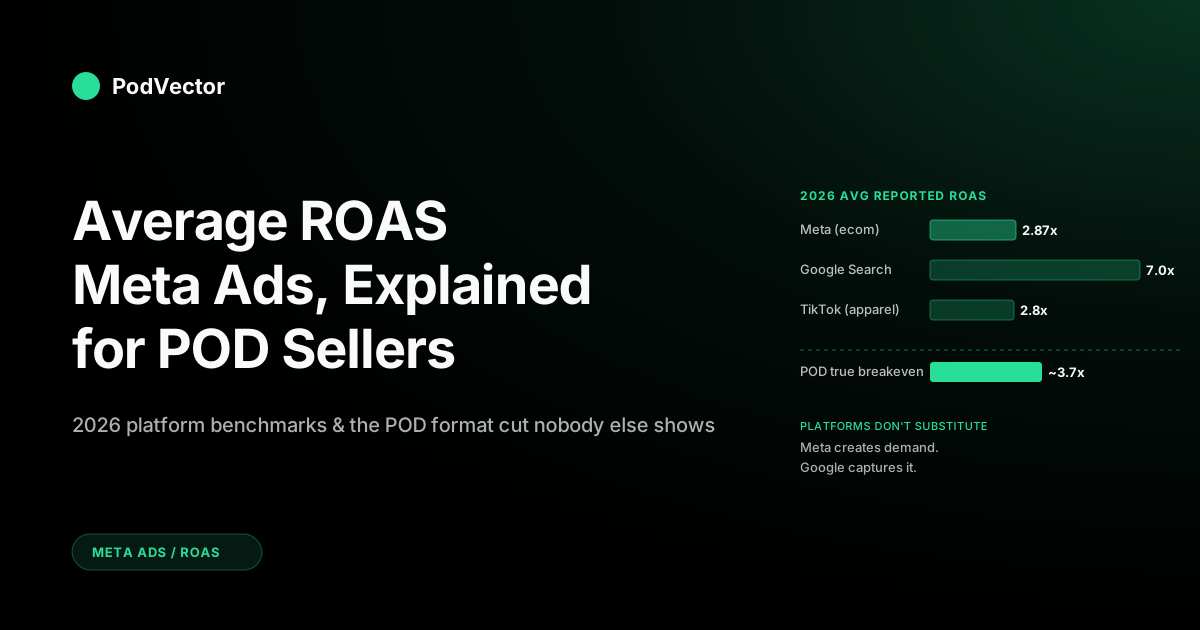
Quick Answer: The average ROAS for Meta Ads in 2026 is 2.5x–4.0x across e-commerce, with reported figures clustering around 2.8x (e-commerce median ~2.79x, ranging as high as 3.61x by industry). Apparel and fashion — the bulk of POD — sits at roughly 2.5x–3.65x reported.
For print-on-demand specifically, those reported averages are misleading. POD margins are 20–40% thinner than the apparel brands setting the benchmark, so a 3.0x reported ROAS that breaks even for a screen-printed brand is a loss for a Printify or Printful store.
The number to track isn't the platform average. It's your store's POAS (profit on ad spend) after Printify/Printful unit cost, shipping, and Meta fees — usually 1.0–1.5x lower than what Ads Manager shows.
The 2026 headline numbers
The number cited most often: average Meta Ads ROAS for e-commerce in 2026 is ~2.8x, with reported figures spanning 2.79x to 3.61x depending on industry. The e-commerce median lands around 2.79x.
You'll also see the old 3:1 "rule of thumb" quoted everywhere as the line for a "good" ROAS. For a brand that produces in-house, 3:1 is healthy. For POD, 3:1 reported is closer to breakeven than to good — which is the whole reason the platform average misleads here.
Both are reported ROAS — meaning revenue divided by ad spend, before product cost, shipping, and platform fees come out. That distinction matters more for POD than almost any other category.
Here's what the 2026 benchmark looks like in one view:
| Cut | Reported ROAS (Meta, 2026) | Source pattern |
|---|---|---|
| All e-commerce average | 2.8x | Multi-vendor reports |
| E-commerce median | 2.79x | Independent benchmarks |
| Apparel & fashion | 2.5x – 3.65x | Mid-range |
| Beauty & personal care | 1.57x – 3.6x | Often lowest in 2026 |
| Home & garden | 3.86x | Higher AOV |
| Auto parts (highest) | 6.76x | Solution-aware traffic |
| Telehealth (lowest) | 0.15x | Long sales cycle |
POD apparel sits in the middle of that spread — but the spread itself hides the real story. Reported ROAS does not equal money-in-pocket, and the gap is wider for POD.
Average ROAS by industry — finding apparel
Industry benchmark reports break Meta ROAS down by category. The categories closest to POD are apparel & fashion and (for niche stores) beauty & cosmetics or home decor.
Across published 2026 reports, apparel hovers in the 2.5x–3.65x range. That feels healthy on paper. The catch: apparel benchmarks are dominated by brands that own production, screen-print at scale, or hold inventory — not POD.
| POD-relevant category | Reported avg ROAS | Typical merchandise margin |
|---|---|---|
| Apparel & fashion (in-house) | 3.0x – 3.65x | 50–65% |
| Apparel (POD) | 2.5x – 3.0x reported | 20–35% |
| Beauty & cosmetics | 1.57x – 3.6x | 40–60% |
| Home & garden | 3.86x | 35–50% |
| Toys & games | ~6.0x | 40–60% |
Two things stand out for POD sellers reading these numbers:
First, a 3.0x ROAS in screen-printed apparel is healthy. The same 3.0x ROAS in POD apparel is roughly breakeven. The reported number looks the same. The take-home number is not.
Second, "POD apparel" is not one thing. T-shirts, hoodies, all-over-print, and mugs each carry different unit costs, shipping rates, and AOV — which means each carries a different breakeven ROAS.
For a deeper look at how the apparel average specifically misleads POD sellers, see our companion piece on average ROAS for Meta Ads.
POD format cut: T-shirts, hoodies, all-over print, mugs
Most benchmark reports stop at "apparel." That's the wrong granularity for POD. The product format inside your store changes the math more than any creative or audience choice.
| POD format | Typical AOV | Printify/Printful unit cost | Margin % | Breakeven ROAS |
|---|---|---|---|---|
| Standard t-shirt | $24 | $10–$13 | ~46% | ~2.2x |
| Premium hoodie | $45 | $22–$28 | ~42% | ~2.4x |
| All-over-print apparel | $38 | $22–$26 | ~37% | ~2.7x |
| Ceramic mug (11oz) | $18 | $8–$10 | ~50% | ~2.0x |
| Poster / canvas print | $32 | $12–$16 | ~56% | ~1.8x |
Two formats stand out at the extremes. Posters and mugs have the best margin profile and the lowest breakeven ROAS. All-over-print has the worst, which is why AOP stores struggle to scale on Meta even when their reported ROAS looks fine.
If your store is heavily AOP-weighted, the platform "average" of 2.8x is roughly your floor — not your benchmark. If your store is mug-heavy, you have headroom most apparel brands don't.
The point: the average ROAS for Meta Ads gets quoted as a single number. For POD, the right benchmark is your format-weighted breakeven, calculated from the actual mix in your store.
Meta vs Google vs TikTok averages
Meta isn't the only paid channel POD sellers use. Most stores split spend across Meta, Google, and increasingly TikTok. Each platform has a different reported-average baseline.
| Platform | 2026 reported avg ROAS | What drives the number |
|---|---|---|
| Meta (Facebook + Instagram) | 2.5x – 4.0x | Mix of cold prospecting + retargeting |
| Google Search | 6.0x – 8.0x | High-intent queries |
| Google Shopping | 5.0x – 6.5x | Visual product comparison |
| Google Display | 2.5x – 4.0x | Retargeting-heavy |
| YouTube | 2.0x – 3.5x | Discovery + brand |
| TikTok (overall) | 1.7x – 2.5x | Cold-traffic-heavy |
| TikTok (apparel) | ~2.8x | Format-creative fit |
| 2.7x | Visual product discovery |
The platform comparison flatters Google. Search ROAS at 6x–8x looks like a no-brainer compared to Meta's 2.8x. The reason it isn't: Google Search captures demand that already exists. Meta creates demand that didn't.
For most POD niches — design-led apparel, niche hobbies, gift categories — Search volume is too low for Google to scale spend. Meta's lower average ROAS comes with much higher addressable spend, which is what most POD stores actually need.
The right reading: Meta's 2.8x is the benchmark for the channel that does the heaviest demand-creation work. Google's 6x is the benchmark for the channel that mostly captures intent. They aren't substitutes, and the headline numbers shouldn't be compared directly.
For platform-level decisions, read the full Meta vs alternatives comparison for POD.
Facebook vs Instagram inside Meta
"Meta Ads" bundles Facebook and Instagram. The average ROAS published as a single number hides a real difference between the two placements.
| Placement | Reported avg ROAS | Best for |
|---|---|---|
| Facebook Feed | ~2.19x | Older demos, broader reach |
| Instagram Feed | ~2.6x | Visual product creative |
| Instagram Stories | ~3.0x | Retargeting + UGC |
| Instagram Reels | ~2.8x | Short-video product demos |
| Audience Network | 1.5x – 2.0x | Often delivers worst ROAS |
| Marketplace | 2.0x – 2.5x | Bargain-hunter intent |
For POD apparel and design-led products, Instagram tends to outperform Facebook Feed by 0.3x–0.6x ROAS. Reels in particular reward POD because static product mockups don't carry as much information as a 15-second design walk-through.
One placement to watch: Audience Network. It's frequently the placement dragging "Meta average ROAS" down inside an Advantage+ campaign. Excluding it, or auditing its spend share, lifts campaign-level ROAS without changing creative or audience.
Cold, warm, retargeting averages
The single Meta average smooths over a 3x range between campaign stages. POD store-level averages are almost always a weighted mix of these.
| Stage | Reported avg ROAS | Share of POD spend (typical) |
|---|---|---|
| Cold prospecting | 1.5x – 2.0x | 50–70% |
| Warm audiences (engagement, video views) | 2.5x – 3.5x | 15–25% |
| Retargeting (web visitors, cart abandoners) | 4.0x – 5.5x | 10–25% |
| Dynamic product ads (DPA) | 3.5x – 4.5x | 5–15% |
Two implications for POD sellers reading their own dashboard:
If your blended ROAS is at the platform average of 2.8x, you're probably running a ~60/25/15 cold-warm-retarget split. That's normal and healthy.
If your blended ROAS is above 4x and your spend is under $5K/month, you're almost certainly retargeting-heavy. You haven't hit the prospecting wall yet. The number won't hold as you scale spend.
The full mechanics of which stages POD stores should weight more heavily live in our step-by-step guide to increasing ROAS on Meta.
How the average has shifted 2022 → 2026
Average Meta ROAS in 2022 was higher. The drop into 2026 is real, and POD has been hit harder than the average store.
| Year | Meta avg ROAS (ecom) | Direction | Driver |
|---|---|---|---|
| 2022 | ~3.7x | Pre-iOS-recovery peak | Pixel signal still rich |
| 2023 | ~3.2x | Down | iOS 14.5 attribution loss baked in |
| 2024 | ~3.0x | Down | CPMs up, AOV flat |
| 2025 | ~2.95x | Flat | CAPI adoption stabilizing reporting |
| 2026 | ~2.8x | Slight down | AI-driven competition raising CPMs |
POD has tracked below this curve. The reason: Printify and Printful unit costs rose 8–14% in the same window, while POD AOV stayed roughly flat. Margin compressed, breakeven ROAS rose, and the cushion above the platform average eroded.
The practical implication: a POD store that hit a comfortable 2.8x ROAS in 2023 is breakeven at the same number in 2026. Same dashboard, different reality.
Benchmarking your POD store against the average
Looking at the platform's 2.8x average and comparing it to your Ads Manager number is the wrong test. Three checks matter more.
Check 1: Compare your true ROAS, not your reported one. Pull Ads Manager spend, deduct Printify/Printful unit cost on the orders that ad spend produced, deduct shipping, deduct Meta and payment processor fees. The result is what you actually keep.
Most POD stores find their true ROAS is 0.8x–1.4x lower than reported. A 3.0x reported is often a 1.8x true.
Check 2: Calculate your format-weighted breakeven. Multiply each format's breakeven ROAS by its share of revenue. A store that's 40% t-shirts, 30% hoodies, 20% mugs, 10% AOP has a different breakeven than the published apparel average.
Check 3: Compare your spend mix to the cold/warm/retarget split above. If your blended average looks fine but is propped up by 30%+ retargeting, your prospecting layer is the problem and scaling spend will surface it.
Doing these three checks weekly — or hourly, with the right tooling — is the work most POD stores skip. The platform average becomes the comfort number. The store-specific numbers are where the actual decisions live.
FAQs
What is the average ROAS for Meta Ads in 2026?
Across e-commerce, the reported average is ~2.8x, with an e-commerce median around 2.79x and an industry spread of 2.79x–3.61x. Apparel and fashion average 2.5x–3.65x. POD apparel reported numbers tend to land inside that range, but true ROAS after unit cost runs 0.8x–1.4x lower.
Is a 3x ROAS on Meta Ads good for a print-on-demand store?
For a screen-printed brand, yes. For a POD store, 3.0x reported usually means roughly breakeven — sometimes slightly negative — once Printify or Printful unit cost, shipping, and Meta fees are deducted. Most healthy POD stores need 3.5x–4.0x reported to clear meaningful profit.
Why is POD ROAS lower than the apparel benchmark?
Apparel benchmarks are dominated by brands that produce in-house at 50–65% margins. POD margins on Printify and Printful run 20–35%. Same reported revenue, lower take-home, lower true ROAS.
How do Meta averages compare to TikTok and Google?
Meta averages 2.5x–4.0x. Google Search averages 6x–8x but on much smaller addressable spend. TikTok averages 1.7x–2.5x for cold traffic and ~2.8x for apparel. The platforms don't substitute cleanly — Meta does demand-creation, Google captures existing demand, TikTok rewards format-native creative.
Does Meta's 2.8x average include retargeting?
Yes. It's a blended average across cold, warm, and retargeting. Cold-only averages are closer to 1.5x–2.0x, and retargeting averages are closer to 4.0x–5.5x. A POD store running mostly prospecting will sit below the published average; a store running mostly retargeting will sit above it.
How can I see my true ROAS instead of the reported one?
Pull each order's Printify or Printful unit cost, shipping, and platform fees, attribute the matching ad spend, then divide net revenue by ad spend. That's your true ROAS. Doing this manually is hours of weekly work — modern AI employees can answer the question against a live data warehouse in seconds. See our complete guide to Meta Ads ROAS and attribution for POD.
Related reading
- Meta Ads for POD — topic hub
- ROAS & Attribution — cluster hub
- The Complete Guide to Meta Ads ROAS and Attribution for POD
- What is a Good ROAS on Meta Ads?
- How to Increase ROAS on Meta Ads (Step-by-Step)
- The Complete Meta Ads Playbook for Print-on-Demand Sellers
- External: TrueProfit — What's a Good ROAS in 2026?
Stop benchmarking against a number that ignores your unit cost
The platform average is 2.8x. Your true ROAS is some other number, and you can't run a POD store off the wrong one.
Victor is the AI employee built for POD. Connect Shopify, Printify or Printful, and Meta — Victor pulls every order's unit cost, shipping, fees, and ad spend into a single live data warehouse, and answers which Meta campaigns are unprofitable after COGS in seconds.
No spreadsheets. No manual reconciliation. Just the true ROAS the platform average won't show you.
Try Victor free