
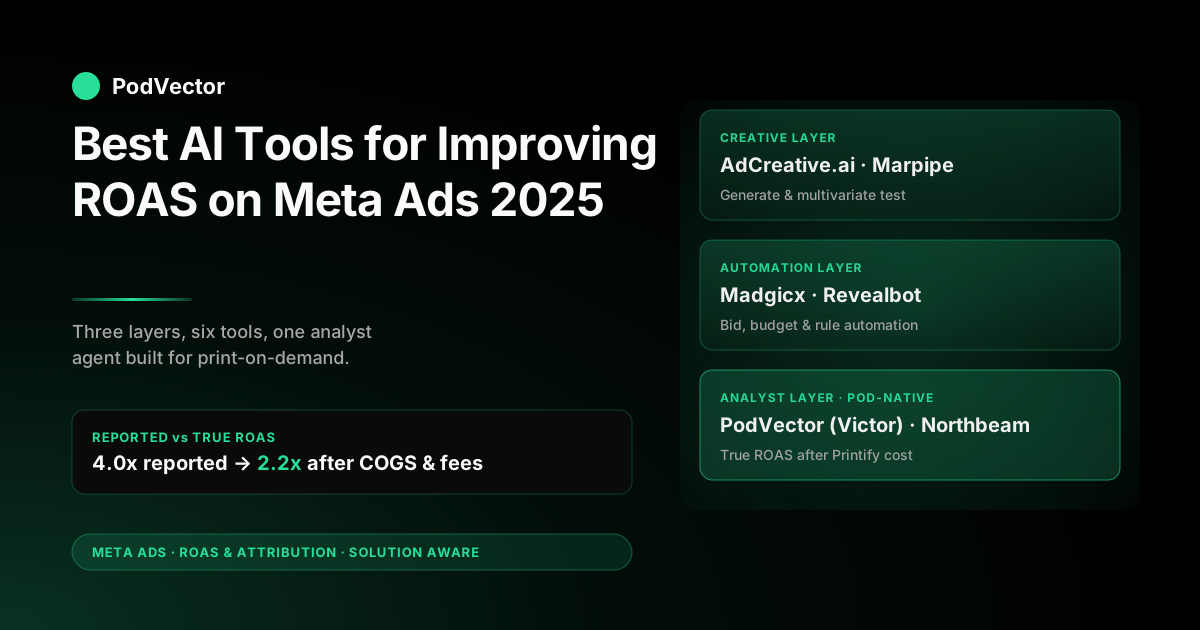
Quick Answer: The strongest AI tools for lifting Meta Ads ROAS in 2025 fall into three buckets — creative generators (AdCreative.ai, Marpipe), bid and budget automators (Madgicx, Revealbot), and AI employees that act on your own store data, not just Meta's (PodVector AI). Attribution tools like Northbeam sit alongside as the multi-channel referee. Each fixes a different failure mode.
For most stores, creative tools move click-through rate, automation tools move cost-per-result, and an AI employee moves the only number that matters: profit after print costs and fees — by pausing the losing ad sets and scaling the winners for you.
For print-on-demand sellers specifically, the gap nobody else fills is true ROAS. Meta's reported ROAS treats a $24.99 shirt as $24.99 of value, ignoring the $11.50 you paid Printify. The right AI stack closes that gap before optimising anything else.
Quick comparison table
Most roundups list ten tools and let you sort it out. The reality is that AI tools for Meta Ads cluster into a few jobs. The table below groups them by job, since stacking one tool from each row usually beats buying three tools from the same row.
| Tool | Job it does | Starting price | Best for | POD-aware? |
|---|---|---|---|---|
| AdCreative.ai | Generate ad creative at volume | $39/mo | Stores shipping 20+ creatives/week | No |
| Marpipe | Multivariate creative testing | $199/mo | Brands with a creative team | No |
| Madgicx | Bid, budget, and audience automation | $55/mo | Solo operators on Meta-only | No |
| Revealbot | Custom if/then rules across platforms | $99/mo | Ops teams that want control | No |
| Northbeam | Multi-touch attribution | ~$1k/mo | Stores past $100k/mo with multi-channel spend | Partial |
| PodVector AI (Victor) | AI employee agent over your warehouse | Free tier | POD sellers on Shopify + Printify/Printful | Yes — built for POD |
The ranking nobody on the SERP makes explicit: pick at most one tool per row. Two creative generators feed Meta the same kind of inputs and double your bill without doubling your output. One creative tool, one automation tool, and one AI employee layer is the realistic stack for a POD store doing $20k–$200k a month.
What separates a good Meta Ads AI tool from a bad one
The AI label is doing a lot of work in 2025. Half the tools marketed as "AI for Meta Ads" are template engines with a chatbot wrapper. The other half are genuinely useful — but for different jobs.
Three filters cut through the marketing.
1. Does it touch the right layer? Meta already runs deep neural networks for bidding (Andromeda) and creative ranking (Lattice). A bid-automation tool that competes with Meta's own model often loses. Tools that work around Meta — feeding it better creative, better signal, or better budget rules — tend to win.
2. Does it use your data, or just Meta's? Meta sees clicks and on-platform conversions. It cannot see your Printify cost, your refund rate, or your repeat-purchase value. Tools that pull from your store and supplier directly have a structural advantage on profit-based decisions.
3. Does the price match the lift? A $1,000/month attribution tool that produces 5% lift on a $20k/month account is a $50/month uplift wrapped in a $1,000/month bill. Tool selection is a margin decision, not a feature decision.
1. AdCreative.ai — creative generation at volume
AdCreative.ai generates static ads, video scripts, and copy variants from a product URL or brief. It scores each creative with a "conversion score" model trained on its own historical ad data. Plans start at $39/month for 10 credits and scale up steeply.
Where it fits a POD workflow: you launch a new shirt design, drop the Shopify URL into AdCreative, and pull 20 first-draft creatives in an hour. None will win as-is, but you skip the blank-page problem.
Where it falls short: the conversion score is trained on cross-vertical ad data, not your store. It cannot know that "funny dog tees" outperform "minimalist line art" for your specific list. Treat the score as a tiebreaker, not a verdict.
2. Marpipe — multivariate creative testing
Marpipe is the serious creative-testing tool in the category. You upload modular elements — backgrounds, headlines, product shots, CTAs — and Marpipe generates every combination, ships them to Meta as a structured test, and reports element-level lift.
The Hims & Hers case study Marpipe markets shows a 37% ROAS lift and 19% lower CPM versus a control. That number is the upper end. Real-world POD lifts cluster around 15–25% on creative-bound accounts.
Marpipe is overkill for stores under $10k/month in spend. Below that, you do not have enough conversion volume to give a multivariate test statistical power within a reasonable window. Above $30k/month, it earns its $199/month base.
For deeper context on the tactics that pair with creative testing, see our guide to the eight best ways to use Meta Ads for higher ROAS.
3. Madgicx — Meta-native bid and budget automation
Madgicx is built specifically for Meta. Its automation library includes templates like Stop Loss (auto-pause ads losing money), budget-scaling rules tied to ROAS thresholds, and audience-launching workflows that build lookalikes off your top customers.
The tool's strength is breadth. Most stores end up using two or three of its modules — usually Stop Loss, the auto-budget scaler, and the creative library — and ignoring the rest.
The trap is the default rules. Madgicx's templates use Meta-reported ROAS thresholds. For a POD seller, a "pause if ROAS < 2.0" rule is cutting campaigns that may be 1.0x on actual contribution margin. The rules need to be re-thresholded against true ROAS, which Madgicx itself does not compute.
If you are running Madgicx, raise the ROAS-pause threshold by your typical COGS-to-revenue ratio. For a Printify apparel store at 46% supplier-cost share, a "pause < 2.0" rule should become "pause < 3.7" to mean the same thing in profit terms.
4. Revealbot — rule-based automation for ops teams
Revealbot is what experienced media buyers reach for when Madgicx feels too templated. You build custom if/then rules: if a campaign's 7-day ROAS is below 1.8 and CTR is below 0.6%, then pause and tag for review. Triggers can run hourly, daily, or on Slack-driven manual approval.
It is not an AI tool in the predictive sense — it is rule automation that scales. For a POD operator with a clear sense of what "unprofitable" looks like, Revealbot encodes that judgement so it runs at 3 a.m. without you.
The pairing trick: build the rules around true ROAS pulled from your warehouse, not Meta's reported number. That requires either (a) writing your contribution-margin metric back to Meta as a custom event, or (b) firing Revealbot off a webhook from your data layer instead of from the Meta API.
The second pattern is what differentiates a profitable POD account from a "1.0x reported looks great" account. We cover the underlying calculation in our ROAS & attribution hub.
5. Northbeam — multi-touch attribution
Northbeam is the heavyweight in the multi-touch attribution category. It deduplicates conversions across Meta, Google, TikTok, and email, runs its own modeled attribution, and surfaces "true" channel ROAS that bakes in cross-channel assist.
For a POD store running Meta plus Google plus TikTok plus Klaviyo, Northbeam (or Triple Whale, or Rockerbox) does answer a real question: when Meta and Google both claim the same sale, who actually drove it?
The catch for POD operators is that Northbeam's "ROAS" is still revenue-based, not contribution-margin-based. It tells you which channel deserves the credit. It does not tell you whether the sale was profitable after Printify costs.
Practical rule: Northbeam earns its keep above $100k/month in ad spend, where 5% attribution accuracy compounds into real money. Below that, the same dollars buy more lift in creative or warehouse instrumentation.
6. PodVector AI (Victor) — the POD-specific AI employee agent
The five tools above were built for general DTC. None of them know what Printify is, that supplier costs differ by garment color, or that a "Sample" line item should be excluded from ROAS math. PodVector AI is the one tool in this roundup built specifically for print-on-demand.
Victor is the AI employee agent at the centre of PodVector AI. It connects Shopify and Meta Ads to a unified data warehouse — the same kind of warehouse stack you might know as Snowflake, Redshift, or Databricks — and lets you ask plain-English questions like:
"Which Meta campaigns are unprofitable after Printify cost over the last 14 days?"
"What's my true ROAS by ad set, after refunds, supplier cost, and shipping?"
"Which creatives are scaling but trending toward break-even on contribution margin?"
The output is a number you can act on, not a dashboard you have to interpret. Victor answers and acts — with your approval — auto-pausing the unprofitable ad sets it surfaces, raising budget on the ones still in the green.
Where it fits the stack: alongside a creative tool (AdCreative or Marpipe) and optionally an automation tool (Madgicx or Revealbot). Victor is the AI employee layer; the others are the production layer. Try Victor free if you want him to close the contribution-margin gap on your own account.
A note on Meta's own AI: Advantage+, Andromeda, GEM
Meta itself shipped two large AI updates that affect 2025 ROAS: the Andromeda retrieval system and GEM (the Generative Ads Recommendation Model), which rolled out from mid-2025 and reached broad impact by Q4. Meta's published numbers — 22% ROAS lift on Advantage+ creative, up to 5% conversion lift on Instagram from GEM — are real but qualified.
The qualifier nobody mentions: those lifts are measured on Meta-reported ROAS. If your reported ROAS is 4.0x and your true ROAS is 2.2x, a 22% lift on the reported number is a 22% lift on a number that was already inflated.
None of this means you should turn Advantage+ off. It means you should not rely on Meta's own AI as your ROAS strategy. Pair it with measurement that runs outside Meta's walls.
How to combine them: a stack for a $20k/month POD store
The default trap is buying every tool in the table and watching the subscriptions outrun the lift. A realistic stack for a $20k/month Printify or Printful store looks like this:
Creative layer: AdCreative.ai at $39/month for first-draft generation. Skip Marpipe until spend crosses $30k/month — there is not enough volume to power its tests below that.
Automation layer: Madgicx Stop Loss + budget rules on the lowest plan (~$55/month), with thresholds rewritten to reflect true ROAS, not Meta-reported ROAS. Revealbot is the upgrade once you have written the threshold logic and want full control.
Operator layer: Victor on the free tier. He reads true ROAS off your store and acts on it — pausing the unprofitable ad sets and scaling the green ones with your approval, then you upgrade as warranted. This is the layer that makes the other two honest. Without it, the creative tool optimises to clicks and the automation tool scales a fake ROAS number.
Total monthly tooling at this stage: under $100, plus the free AI employee layer. Skip the $1k/month attribution tool until you cross $100k/month and have multi-channel spend that justifies it.
For the strategic context behind why this stack works for POD specifically, our complete guide to Meta Ads ROAS & attribution for POD walks through the underlying measurement model.
FAQs
Do I need an AI tool to run profitable Meta Ads?
No. Plenty of POD operators run profitable accounts with no AI tooling beyond Meta's own Advantage+. The case for AI tools is that they compress the time between launching a creative, learning whether it works, and reallocating budget. If your team has fewer than three people, that compression is the whole point.
What's the single highest-ROI AI tool for a POD store under $20k/month?
An AI employee that acts on true ROAS by campaign — pausing the losers and scaling the winners, not just charting them. The reason is leverage: every other tool in the stack — creative generators, bid automators — works better when it is optimising against a number that reflects actual profit. Without that, the creative tool ships winners that lose money and the automation tool scales budget on ad sets bleeding margin.
Will Meta's own AI replace these tools?
Partly. Andromeda and Advantage+ have already absorbed the simpler bidding and audience tools. What they have not absorbed — and likely will not — is anything that requires data Meta does not have. Your supplier costs, your refund rate, and your customer LTV live in your warehouse, not Meta's. Tools that work over your data are structurally protected.
How do I evaluate a new AI ad tool without burning budget?
Run it for 14 days against a single ad set, with a clear hypothesis (e.g., "Marpipe will lift CTR 20% on cold prospecting"). Measure on contribution margin, not Meta-reported ROAS. If the lift on profit ROAS is below the tool's monthly cost as a share of ad spend, drop the tool.
Is GEM, Meta's new AI model, worth waiting for?
It is already live in your account if you use Advantage+. There is nothing to wait for. The 22% ROAS lift Meta cited applies to Advantage+ creative specifically — not to manual campaigns or rule-based automation. Turn Advantage+ on for at least one prospecting campaign and let the model work; pair it with measurement that runs outside Meta.
Why do most AI Meta Ads roundups skip POD-specific tools?
Because the SaaS category sells to general DTC. Print-on-demand is a margin niche where supplier cost runs 40–55% of revenue, far higher than the 25–35% the average DTC vendor is built for. A general tool optimising on Meta-reported ROAS will scale POD ad sets that are unprofitable, since it has no view into Printify or Printful cost. The few tools built for POD — including PodVector AI — solve that gap directly.
Let Victor run your Meta Ads on true ROAS
Most AI tools optimise the number Meta reports. Victor optimises the number that pays for the next print run.
Connect Shopify, Meta, and Printify or Printful. Victor finds the campaigns bleeding margin after COGS and fees, pauses them, and reallocates the budget to your winners — with your approval, over your live data.
Try Victor free