
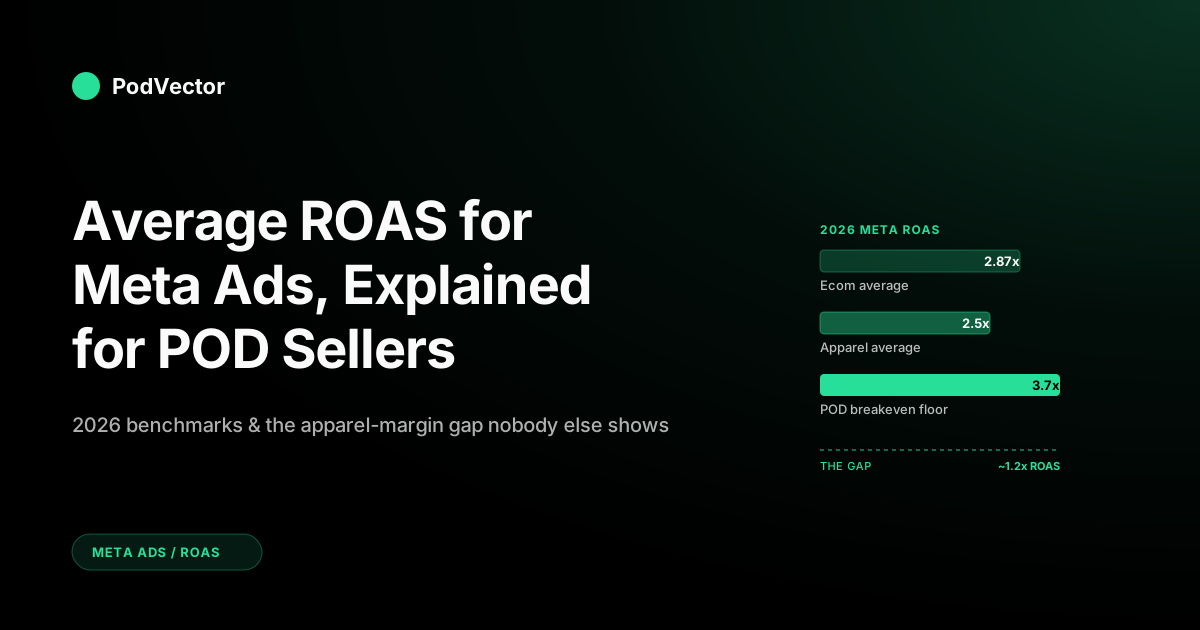
Quick Answer: The average reported ROAS on Meta Ads in 2026 sits between 2.79x and 3.61x across e-commerce, with apparel — where most print-on-demand lives — closer to 2.5x–3.0x.
For POD specifically, those averages are misleading. Public benchmarks assume a 50%–60% gross margin. POD's post-fulfillment margin is closer to 25%–35%, which means the average reported ROAS for an ecom brand is roughly breakeven for a POD store.
The honest read: the average is a starting point, not a target. Your real benchmark is breakeven (1 ÷ post-fulfillment margin), and the average tells you whether you're swimming with or against the tide on creative and audience cost.
What "average ROAS" actually measures
Average ROAS is the mean Return on Ad Spend across a sample of advertisers — usually pulled from one ad platform, one tool's customer base, or one industry survey. It's an arithmetic average of reported numbers.
Reported is the load-bearing word. The figure comes from each advertiser's Ads Manager, which uses Meta's attribution model and conversion windows. It is not bank-account revenue, and it does not subtract supplier cost, fees, or refunds.
So when you read "the average Meta ROAS in 2026 is 2.87x," translate that as: "across this sample, Meta's own attribution credited $2.87 of revenue to every $1 spent." That number is the floor of an iceberg. The next sections cut into it.
2026 average Meta Ads ROAS numbers
The major 2026 benchmark studies converge on a tight range. Across them, the average reported ROAS for Meta Ads sits between 2.79x and 3.61x for general e-commerce, and most guides now quote a working band of 2.5x–4.0x. The most-cited e-commerce-only number is 2.87x.
One distinction the headline number hides: mean vs median. The mean ROAS gets pulled up by a handful of high-LTV, high-AOV brands, so the median — the middle advertiser — runs lower. Cross-industry median ROAS is widely cited at around 2.19x. If a benchmark doesn't say which one it's quoting, assume it's the flattering mean, and shade your own expectation down toward the median.
For context on the spread:
- Bottom quartile: below 1.8x reported. Brands here are typically over-spending on cold prospecting or have weak post-click conversion.
- Average / median: 2.5x–3.0x reported. The bulk of advertisers.
- Good: 3.5x–4.5x reported. Solid creative-audience fit and decent retargeting hygiene.
- Top quartile: above 4.5x–5.0x reported. Often blends Advantage+ Shopping with high-LTV repeat buyers.
Two structural notes shift these numbers. First, Meta's Advantage+ Shopping campaigns post about a 22% higher average ROAS than manual campaigns in 2026 data — roughly 4.52x vs 3.70x. Second, retargeting-only campaigns often clear 6x–8x because they capture warm demand that would have converted anyway.
Both points matter for how you read your own number. A blended account average that mixes prospecting and retargeting tells you nothing about either layer in isolation.
Average ROAS by sub-niche (apparel-heavy view)
Niche matters more than the headline. The same 3.0x ROAS is exceptional in supplements and weak in toys. For POD operators, the relevant rows are apparel, accessories, and home decor — the categories most Printify and Printful catalogs sit in.
| Sub-niche | Below average | Average | Good | Top quartile |
|---|---|---|---|---|
| E-commerce blended | < 1.8x | 2.5x–3.0x | 3.5x–4.5x | > 5.0x |
| Apparel / fashion | < 1.8x | 2.3x–2.8x | 3.0x–4.0x | > 4.5x |
| Accessories (mugs, bags, prints) | < 2.0x | 2.5x–3.2x | 3.5x–4.5x | > 5.0x |
| Home & decor | < 1.8x | 2.0x–2.8x | 3.0x–4.0x | > 4.5x |
| Pet / niche fan apparel | < 2.2x | 2.8x–3.6x | 4.0x–5.0x | > 5.5x |
| Beauty / supplements | < 1.3x | 1.5x–2.0x | 2.0x–3.0x | > 3.5x |
Apparel — the dominant POD category — sits below the headline ecom average. That's not because POD ads are worse. It's because the niche is saturated, the cold-traffic CPMs are high, and the AOV is low.
Pet and fan apparel are the noteworthy outliers. Niche communities have lower competition on creative angles and higher emotional pull, so reported ROAS tends to run a half-point above general apparel.
Why averages mislead POD sellers
The benchmark articles you find on Google are almost all written for general DTC. They assume an advertiser's gross margin sits at 50%–70% — typical for branded skincare, supplements, or own-manufactured apparel.
POD economics are stacked differently. A $24.99 t-shirt with a $13 supplier cost (Printify or Printful blank, print, and shipping) leaves $11.99 of gross — about 48%. Subtract Shopify or Etsy fees (1.5%–6.5%), payment processing (2.9% + $0.30), and a typical 3% refund rate, and the post-fulfillment margin lands closer to 30%–38%.
On heavier products — hoodies, all-over-print, sublimation — supplier cost is a higher share of the price, and margin can dip into the 20%–28% range.
Now apply that to the benchmark. A general DTC brand at 60% margin breaks even at 1.67x ROAS, so the 2.87x average looks healthy. A POD store at 30% margin breaks even at 3.33x ROAS — meaning the same 2.87x average is already losing money before app fees, design costs, or your time.
That's the gap nobody else covers. The average is the same number; the meaning behind it is completely different.
Translating average to breakeven for POD
Before you compare yourself to the average, compute the only ROAS that's actually about your store: breakeven.
Breakeven ROAS = 1 ÷ post-fulfillment gross margin %
For a typical POD store with a 30% post-fulfillment margin, breakeven is 1 ÷ 0.30 = 3.33x on ad spend alone. That's the floor where revenue just covers product cost plus ad spend. It does not include rent, your time, design fees, or app subscriptions.
Add a buffer for everything ad spend doesn't directly carry. A 0.4x–0.8x cushion is reasonable for a store under $20k/month, more if you're paying contractors or apps. So the realistic profitable floor for that 30%-margin POD store is closer to 3.7x–4.1x reported ROAS.
Compare that to the 2.87x ecom average. The gap is roughly a full point. Most POD operators benchmarking themselves against the headline number conclude they're "above average" while quietly losing margin every month.
For the line-by-line walkthrough, see our complete guide to Meta Ads ROAS and attribution for POD. The breakeven framing is also covered from a different angle in what is a good ROAS for Meta Ads.
Reported average vs true average
The benchmark studies report Meta-attributed revenue divided by spend. They call that "ROAS." Inside a POD P&L it's a vanity number — a top-line ratio that says nothing about whether you kept the dollar.
True ROAS uses contribution margin, not revenue. The math:
- Order revenue: $50
- Supplier cost (Printify or Printful all-in): $26
- Payment + platform fees: $2
- Ad spend: $20
- Reported ROAS: $50 ÷ $20 = 2.5x
- Contribution margin: $50 − $26 − $2 = $22
- True ROAS: $22 ÷ $20 = 1.1x
The 2.5x reported number sits right at the ecom average. The 1.1x true number says you barely covered ad and product cost — there's no money for refunds, apps, design, or you.
If you want Meta's algorithm to actually optimize for profit, you have to feed it margin, not revenue. That means sending contribution margin (or a margin-weighted purchase value) through the Conversions API instead of the cart total. Done correctly, the auction starts scaling toward your high-margin SKUs instead of your highest-revenue ones. We unpack that pipeline in the best practices for Meta Ads higher ROAS writeup.
Blended ROAS and MER: the account-level check
Meta's in-platform ROAS over-credits itself — its attribution claims sales that email, organic, and direct would have closed anyway. The fix every 2026 benchmark guide now leans on is to zoom out from the platform number to two account-level ratios.
- Blended ROAS = total store revenue ÷ total Meta spend. It ignores attribution entirely and asks the only question that matters: when you spent more on Meta, did total revenue actually move?
- MER (Marketing Efficiency Ratio) = total store revenue ÷ all paid spend across every channel. The widely-cited healthy floor is 3.0x or higher, but that floor assumes a 50%–60% margin business — so for POD it has to be read against your own breakeven, just like the platform average.
The pattern that catches POD operators: Ads Manager shows a 3.5x account average while blended ROAS sits at 2.2x. That gap is Meta taking credit for repeat buyers and email-driven orders. If your reported average looks healthy but the bank balance isn't growing, blended ROAS is where the leak shows up. Track the platform number daily for creative decisions, but judge whether Meta is truly adding revenue on the blended and MER lines weekly.
ROAS is also a single-order snapshot, which is why the better benchmark guides pair it with two lifetime metrics. CAC (customer acquisition cost = ad spend ÷ new customers) tells you what a buyer costs to win; LTV (lifetime value) tells you what they're worth across repeat orders. A POD store with weak first-order ROAS can still be healthy if returning customers lift LTV well above CAC — and a store with strong reported ROAS but no repeat business is more fragile than the number suggests. For POD specifically, repeat rates are usually thin, so don't lean on LTV to rescue a first-order ROAS that sits below breakeven.
Average ROAS by campaign stage
A blended account ROAS hides almost everything useful. The same 3.2x can come from a healthy 2.0x prospecting layer plus a 7x retargeting layer — or from a sick 1.4x prospecting layer that retargeting is silently subsidizing.
The 2026 averages by stage, on Meta-reported numbers:
| Stage | Average ROAS | POD-good ROAS | What it tells you |
|---|---|---|---|
| Cold prospecting | 1.8x–2.5x | 2.5x–3.5x | Creative-audience fit. Below 1.8x means the hook isn't landing. |
| Warm / engaged audiences | 3.0x–4.5x | 4.0x–6.0x | Mid-funnel proof. Below 3x means the offer isn't closing. |
| Retargeting (site / cart) | 5.0x–8.0x | 6.0x–10.0x | Demand-capture efficiency. Below 5x means tracking is broken. |
| Advantage+ Shopping (blended) | 3.5x–4.5x | 4.5x–5.5x | Algorithmic blend. Watch the prospecting/retargeting split inside it. |
The retargeting line is the one that fools the most people. A 7x retargeting ROAS feels like a win, but if it's just capturing buyers who would have converted from email anyway, the incremental ROAS is much closer to 1.5x. That's a separate problem the attribution pillar covers in depth.
What pulls a POD store above or below the average
Same niche, same season, same offer — and two POD stores will land a full ROAS point apart. The drivers, in roughly the order they matter:
- Average order value (AOV). A $45 AOV at 30% margin yields $13.50 contribution; a $25 AOV yields $7.50. The high-AOV store can absorb a lower reported ROAS and still print profit. Bundles and upsells are the cheapest move here.
- Supplier cost as a share of price. Single-side prints on cheaper blanks (Printify Generic Brand vs. Bella+Canvas, or Printful Gildan vs. premium) shift margin by 5–10 points. The reported ROAS doesn't change, but breakeven does.
- Refund rate. Apparel sits at 2%–5% in print-on-demand. Sizing-charts and clearer mockups pull it toward 2%. Without those, your true ROAS quietly bleeds.
- Creative refresh cadence. POD ad fatigue hits inside 7–14 days for high-spend ad sets. Stores rotating 3–5 new creatives weekly hold ROAS above niche average; stores running the same hero ad for a month decay below it.
- Pixel + CAPI quality. A noisy or duplicated pixel undercounts conversions, deflating reported ROAS even when bank-account ROAS is fine. Server-side conversion tracking that deduplicates against the browser pixel is the fix.
- Audience seasonality. Q4 lifts most POD niches by 30%–60% in reported ROAS. A store benchmarking itself against November numbers in February will misread its own performance.
The factor most operators underweight is supplier cost mix. Two SKUs at the same price can have a 10-point margin gap. If your top-spending creative happens to feature the lower-margin SKU, your true ROAS is a full point below your reported.
Diagnosing where you sit vs the average
The diagnostic that actually matters isn't "am I above 2.87x?" It's "am I above breakeven, and which campaigns are pulling me below?"
The work is mechanical, not clever:
- Compute your post-fulfillment margin per SKU using actual Printify/Printful invoices, not catalog prices. Include shipping. Most POD stores find their realised margin is 3–6 points lower than their cart-level estimate.
- Set breakeven ROAS = 1 ÷ blended margin. That's your floor. Add a 0.4x–0.8x buffer for fixed costs.
- Pull each campaign's reported ROAS, then weight it by the SKU mix it drove. A campaign at 3.2x reported on a 22%-margin hoodie is worse than a campaign at 2.8x reported on a 38%-margin t-shirt.
- Cut what's below breakeven on margin. Scale what's above.
That last step is where most POD operators get stuck. The data lives in five places — Ads Manager, Shopify, Printify, Stripe, and a spreadsheet — and stitching it together by hand each week is the work that quietly never gets done.
Stop benchmarking against the wrong average
The reported number is the easy half. The hard half is knowing which campaigns are actually profitable after Printify, shipping, fees, and refunds — every day, not once a quarter.
Victor is the AI employee built for POD. It connects your Meta Ads, Shopify, and Printify or Printful data into a single source of truth, then answers questions like "which Meta campaigns are unprofitable after COGS this week?" in seconds. No SQL, no spreadsheet rebuild — just the true ROAS your Ads Manager doesn't show you.
Try Victor freeFAQs
What is the average ROAS for Meta Ads in 2026?
Across the major 2026 benchmark studies, average reported ROAS sits between 2.79x and 3.61x for general e-commerce. The most-cited e-commerce-only figure is 2.87x. Sub-niche matters more than the headline — apparel runs 2.3x–2.8x, while pet and niche fan apparel run 2.8x–3.6x.
Is a 3x ROAS good for a POD store?
Not by default. A 3x reported ROAS at a 30% post-fulfillment margin is roughly breakeven on ad spend alone — before app fees, design costs, refunds, and your time. POD stores typically need 3.7x–4.1x reported to be cleanly profitable. See our what is a good ROAS for Meta Ads deep-dive for the full breakeven math.
Why is my reported ROAS higher than my actual profit?
Because reported ROAS uses revenue, not contribution margin. A $50 order with $26 supplier cost and $20 ad spend reports a 2.5x ROAS but a 1.1x true ROAS on margin. The fix is to send margin (revenue minus supplier cost) through the Conversions API as your purchase value, so Meta optimizes toward profitable orders.
Do Advantage+ Shopping campaigns post a higher average ROAS?
Yes, in 2026 data Advantage+ Shopping campaigns post roughly 4.52x average ROAS versus 3.70x for manual campaigns — about a 22% lift. The caveat: Advantage+ blends prospecting and retargeting inside one campaign, so the headline number can mask weak cold-traffic performance. Look at the placement and audience breakdown before scaling spend.
Is the average Meta ROAS the same as the median?
No, and the gap matters. The mean (2.79x–3.61x for ecom) is dragged upward by a few high-AOV, high-LTV brands. The median — the middle advertiser — is widely cited near 2.19x. Most POD stores live closer to the median than the mean, so benchmarking against the flattering headline mean overstates how well you're doing. When a study doesn't specify, assume it's quoting the mean.
How do POD averages compare to Shopify-wide averages?
Shopify-wide ecom averages are pulled across all margins and all categories. POD's apparel-heavy mix and lower margin profile mean POD stores run 0.3–0.6 reported-ROAS points lower than the headline Shopify average for the same category. The number to trust isn't the average — it's your breakeven.
How often should I recalculate my average?
Roll a 7-day and 28-day average per campaign, refreshed daily. Account-wide averages over a quarter or longer hide creative fatigue and seasonal swings. The right cadence is daily ROAS by campaign weighted by margin, with weekly aggregation for trend.
What benchmarks should I look at outside this article?
The most-cited 2026 benchmark sources are AdAmigo's 2026 industry breakdown, TrueProfit's good-ROAS guide, and Triple Whale's quarterly Facebook benchmarks. Read them as inputs, not targets — they're written for general DTC margins, so translate every number into your own breakeven before acting on it.
Related reading
- The complete guide to Meta Ads ROAS and attribution for POD
- What is a good ROAS for Meta Ads?
- How to boost ROAS on Meta Ads 2026 best practices
- Best practices for Meta Ads higher ROAS
- Best Meta Ads for maximizing ROAS 2025
- Meta Ads — ROAS & Attribution cluster
- The complete Meta Ads playbook for print-on-demand sellers
- Meta Ads topic hub