
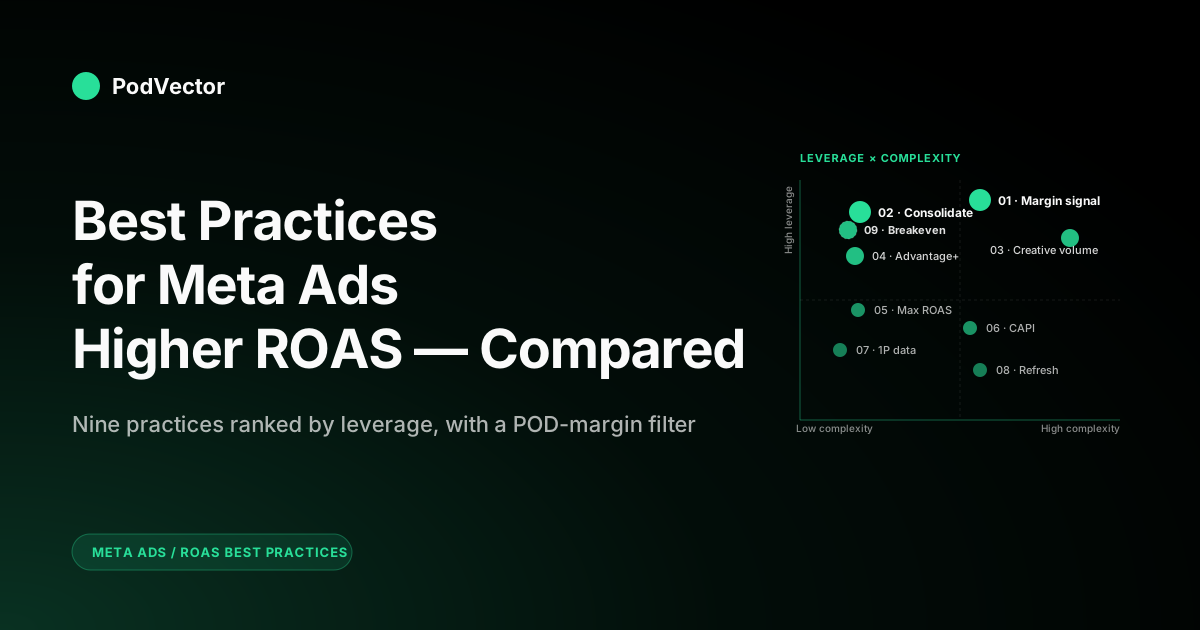
Quick Answer: Nine best practices reliably move Meta Ads ROAS in 2026 — sending margin (not revenue) to Meta, consolidating ad sets to exit the learning phase, shipping high-volume creative, leaning on Advantage+ Shopping for prospecting, switching to Maximize ROAS bidding, defending tracking with the Conversions API, building 1P-data audiences, refreshing creatives before fatigue, and reviewing against breakeven instead of reported ROAS.
Compared head-to-head, they aren't equal. Two practices (margin-aware value tracking and ad-set consolidation) account for most of the realised lift on POD accounts. The other seven amplify those two — but only if the first two are right.
The comparison below ranks each practice by leverage, complexity, and POD-specific impact, plus the failure mode each one creates when you skip it.
The 2026 best-practice ranking, compared
Most "best practices" lists rank items by alphabetical order or by what reads well. The table below ranks the nine that actually move ROAS for a print-on-demand store, sorted by leverage. Leverage = realised lift on a typical POD account divided by the implementation cost (engineering, time, or budget required).
| Best practice | Leverage | Complexity | Typical lift on true ROAS | What it prevents |
|---|---|---|---|---|
| 1. Send margin as conversion value | Very high | Medium (engineering) | +0.5x to +1.0x | Scaling toward worst-margin SKUs |
| 2. Consolidate ad sets | Very high | Low (configuration) | +0.3x to +0.7x | Permanent learning-phase tax |
| 3. Ship 8–12 fresh creatives/month | High | High (production cost) | +0.4x to +0.8x | Frequency-driven decay |
| 4. Advantage+ Shopping for prospecting | High | Low (configuration) | +0.2x to +0.5x | Slow-exiting learning phase |
| 5. Maximize ROAS bidding | Medium | Low (configuration) | +0.15x to +0.35x | Optimising for volume over value |
| 6. Conversions API (CAPI) | Medium | Medium (engineering) | +0.1x to +0.4x | Signal loss from iOS / browser blocks |
| 7. 1P-data audiences | Medium | Low (configuration) | +0.1x to +0.3x | Wasted spend on guessed interests |
| 8. Pre-fatigue creative refresh | Medium | Medium (process) | +0.1x to +0.3x | Cliff drops on frequency > 4 |
| 9. Breakeven ROAS reviews | High (corrective) | Low (math) | Indirect — surfaces lift others miss | Scaling unprofitable campaigns |
Two flags before reading on. First, the lift ranges are realised on POD accounts already sending margin and tracking through CAPI. On accounts that aren't, the absolute numbers vary wildly. Second, "leverage" is not the same as "do this first." Some high-leverage moves require pre-work — that ordering question is at the bottom of this page.
Why "best practices" need a POD filter
The 2026 SERP for this query is full of articles written for stores with higher gross margins. A reported ROAS that looks healthy in those verticals can be quietly unprofitable for a POD store.
POD is different. A typical t-shirt with a Printify or Printful blank, print, and shipping cost leaves a gross margin well under what most ecommerce benchmark articles assume. After Shopify fees, payment processing, and a typical return rate, the post-fulfillment margin for most POD apparel stores is materially lower than the industry average — run the math for your own catalog rather than relying on generic benchmarks.
That means breakeven on ad spend can sit considerably higher than the "2x–4x is fine for most businesses" range cited by ppcbatman.com for general ecommerce. The "best practices" articles that anchor success at general industry benchmarks are quietly recommending you scale into a loss.
So the practical question for a POD operator isn't "does this best practice raise reported ROAS?" It's "does this raise true ROAS after COGS above the floor my margins demand?" Each section below answers that question. For the deeper math, see our gross profit guide for POD and the comparison of how Printify and Printful costs differ in our Printful vs Printify vs Gelato comparison.
1. Send margin, not revenue, as the conversion value
This is the highest-leverage move on the list. Most POD stores send order.total as the conversion value to Meta. That tells the algorithm to scale toward the highest-revenue orders — which on a multi-SKU catalog is rarely the same as the highest-margin orders.
A 3-pack hoodie order on a Printify Premium blank can carry very little margin after fulfillment. A single lower-cost tee with a Choice blank can carry proportionally more. Sending revenue tells Meta the hoodie order is "worth" more — it isn't, in profit terms.
The fix is to switch the value parameter to (revenue − supplier cost) per line item, then sum at the order level. The Conversions API accepts a value field per event — pass margin instead of total.
As Flighted.co notes, "Meta advertising in 2026 is less about hacky, overly-manual media buying tactics… and more about feeding the ad platform the right signals." Margin-accurate value is the most important signal upgrade a POD store can make. Compared to the next eight practices, this one tends to deliver the largest single lift on true ROAS for accounts that have already exited the learning phase. The downside: it requires server-side work to join orders to fulfillment cost data before the event fires.
One important caveat specific to POD: as noted in PodVector's honest-limits documentation, the Shopify seller-entered cost field (which Victor reads) is often empty and does not equal the POD supplier cost, which enters the data warehouse only through completed orders. Validate your cost join carefully before relying on it for margin-aware bidding.
2. Consolidate ad sets to exit the learning phase
Meta's learning phase requires roughly 50 optimisation events per ad set per week. An ad set stuck in learning is one Meta is still guessing on — costs run higher, ROAS sits lower than steady state.
POD operators routinely fragment budget across many ad sets in pursuit of "audience testing." None of those clear 50 events. The fix is to cut to 2–4 ad sets, pool the budget, and let the algorithm find pockets inside one larger audience instead of forcing it across many small ones.
Practical math: if your cost per acquisition requires a minimum weekly spend per ad set to generate 50 conversion events, doubling the ad sets roughly doubles the weekly spend required just to stay out of learning. Most small POD stores can't afford that structure.
The reason this practice ranks so high on leverage is that the implementation cost is near zero — you're configuring, not building. The reason POD operators resist it is that consolidation feels like "less testing." It isn't. According to Flighted.co, the 2026 approach is to test with creatives rather than audiences — do your testing inside one ad set, not across many. For the longer comparison of consolidation styles, see our Meta Ads vs Google Ads vs Bing Ads comparison for POD sellers.
3. Ship 8–12 fresh creatives per month
The 2026 reality: Meta's creative-ranking system rewards variant volume. A single static ad rotated in a single ad set hits high frequency quickly for an active POD audience, and ROAS slides hard from there.
According to AdsGo's analysis of campaigns, "creative quality accounted for 47% of ROAS variance between high and low performing ad accounts with similar audiences and budgets." Prix Studio reinforces this, noting that "videos that capture attention (hook), tell stories, and stimulate action in the first 3 seconds bring a much higher ROAS than static images."
Compared to the lower-leverage practices, this one sits in an awkward spot — the lift is real but the production cost is the highest of any item on the list. Many operators don't have a dedicated creative budget line item.
A workable rotation:
- 4–6 video hooks per month. First 0.5 seconds determines scroll-stop; the next 3 seconds determines watch-through. Shoot or AI-generate the first 3 seconds with intent.
- 3–4 static image variants. Lifestyle, product-on-white, and design-zoom. POD wins on design specificity — show the design.
- 1–2 UGC-style variants. Even AI-generated UGC tends to outperform studio creative on apparel acquisition campaigns.
Run them in one ad set, let Dynamic Creative pick winners, kill the bottom third weekly. Then ship the next batch.
4. Default Advantage+ Shopping for prospecting
Advantage+ Shopping Campaigns (ASC — Meta's automated campaign type that pools prospecting and retargeting under algorithmic control) outperformed manual broad prospecting in most 2025–2026 ecommerce reads. POD is not an exception.
According to LeadsBridge, Advantage+ sales campaigns "automatically target the right audience, pick the best placements, and set the budget to boost online sales more effectively." According to ppcbatman.com, ASC campaigns are "often 15–22 percent" more efficient than manually structured prospecting on comparable accounts.
Where ASC wins for POD: it folds your customer list as an "existing customer" segment, lets the algorithm decide who to retarget vs. acquire, and exits the learning phase faster because budget concentrates in one campaign.
Where it loses: if your value tracking is sending revenue instead of margin (Practice 1), ASC scales toward your worst-margin SKUs aggressively. Get Practice 1 right before turning ASC up, or you'll bake bad signal into bigger spend.
This interaction effect is why "best practices" lists that present items as independent are misleading. Practice 4 doesn't deliver its full lift unless Practice 1 is in place first. We come back to this in the interactions section.
5. Switch to Maximize ROAS bidding when volume allows
Maximize ROAS is Meta's value-aware bidding goal. It bids more on users predicted to convert at higher value-to-spend ratios — which for a margin-aware account is exactly the optimisation you want.
The catch: it needs roughly 50 conversions per week at the campaign level to bid reliably, and it needs accurate value signal (Practice 1 again). On lower-volume accounts, Highest Volume bidding will outperform until conversion velocity clears the threshold. As solidhq.com notes, "ROAS in 2026 is won and lost on five things: signal quality, creative pipeline, campaign structure, retention loops, and how honestly you measure incrementality" — bidding strategy is only one component of that stack.
Compared to setting a Minimum ROAS floor (which is better suited to higher-volume POD stores), Maximize ROAS is the more forgiving bid strategy. It optimises for the best ratio it can find, rather than refusing impressions until predicted ROAS clears a hard floor — which on a smaller account can simply turn off your spend.
The practical rule: don't switch to Maximize ROAS until your campaign is generating enough weekly conversions for Meta to build a reliable value model. On accounts that have the volume and the value signal, the lift over Highest Volume is meaningful; on accounts that have neither, the lift can be negative. Match the practice to the stage.
6. Defend tracking with the Conversions API
The Conversions API (CAPI — Meta's server-side event channel that complements the browser pixel) is now table stakes. According to solidhq.com, "pixel-only setups undercount conversions by 30% to 60% in iOS-heavy verticals." CAPI fills that gap.
According to ppcbatman.com, "CAPI can boost ROAS by 20–40% and provides stronger signals to Meta." Aim for an Event Match Quality score of 7.0 or higher per solidhq.com's recommended threshold; below that, Meta's audience matching gets worse and downstream optimisation degrades.
Setup options for a typical Shopify POD store, in order of completeness:
- Shopify's native Meta Conversions API integration (turn on, low effort, partial coverage)
- Stape, Elevar, or another server-side GTM proxy (medium effort, high coverage)
- Custom CAPI integration on top of your data warehouse (high effort, full margin-aware coverage — needed if you're doing Practice 1 properly)
If you're a smaller store, option 1 captures most of the value. If you're doing margin-aware optimisation, you'll end up at option 3.
7. Build audiences from first-party data, not interests
Detailed targeting (interest-based audiences) is deprecated for new accounts and quietly de-prioritised in the auction for old ones. As LeadsBridge notes, "Meta's algorithm finds your audience when you give it clean conversion data, and manual interest targeting actually constrains the algorithm instead of helping it." The replacement is first-party-data audiences: customer lists, website visitors, video watchers, post engagers.
For POD, the four custom audiences worth keeping live at all times:
- Purchasers (180 days) — exclude from prospecting, include in retargeting expansion lookalikes
- Site visitors (90 days, no purchase) — primary retargeting pool
- Video viewers (75% completion, 30 days) — warm prospecting layer
- Engagers on Instagram or Facebook (90 days) — soft warm pool, useful for lookalike seeds
Compared to interest targeting, 1P audiences carry signal Meta can actually use. The lift isn't dramatic in isolation, but the alternative — stitching together interest stacks — is now openly worse.
8. Refresh creative before fatigue, not after
Most operators replace creatives after CTR drops or CPM spikes. By that point the damage is done — frequency is past the threshold where audience saturation sets in and the next creative carries the cost of the previous one's decay.
The better cadence is to introduce a new creative every 7–14 days inside the same ad set, regardless of whether the current creative is still performing. Dynamic Creative will rotate naturally. The new variant gets initial test impressions; if it outperforms, it gradually replaces the older one without you having to make the kill decision under pressure.
This practice ranks medium-leverage because the lift is real but slow. It compounds with Practice 3 — refreshing volume only matters if you're shipping volume in the first place. As prix-studio.com observes, "with technical adjustments in meta ads being replaced by automation, the biggest leverage advertisers have had has been their creative strategy."
9. Review against breakeven ROAS, not reported ROAS
This isn't a "do this in Ads Manager" practice — it's a reporting and decision discipline. But it's the practice that surfaces whether the other eight are working.
The math:
Breakeven ROAS = 1 ÷ Post-fulfillment gross margin %
Post-fulfillment margin = retail price minus supplier cost minus payment fees minus expected refund cost, divided by retail price. For POD apparel stores, this varies meaningfully by supplier (Printify vs Printful) and product type — run the calculation for your own catalog. Add a buffer for fixed costs Meta doesn't see (apps, design fees, your time). A store with thinner margins should treat a reported ROAS that looks "average" in industry terms as a campaign that needs work. As AdsGo puts it, "compare against your break-even ROAS, not these benchmarks."
For context, ppcbatman.com notes that "median 2026 Meta ROAS is around 2.87× across all industries and 3.7× for ecommerce." For most POD apparel stores, even the ecommerce median is likely below breakeven once supplier costs are factored in — which is exactly why this review practice matters. For the complete supplier cost comparison, see Printful vs Printify for Etsy sellers.
How the practices interact (and which break each other)
The biggest miss in the SERP's "best practices" articles is treating each item as independent. They aren't. Three interactions matter for POD.
Practice 1 unlocks Practices 4 and 5. Advantage+ Shopping and Maximize ROAS both optimise to the value signal you send. Send revenue, and they scale toward big-revenue / low-margin orders. Send margin, and they scale toward high-margin orders. The bidding strategy is downstream of your value-tracking choice.
Practice 2 unlocks Practice 3. Shipping 8–12 creatives a month into a fragmented account where no ad set clears the learning phase wastes the creative budget. The variants don't get enough impressions to reach statistical signal. Consolidate first, then ship.
Practice 6 unlocks Practice 1's full upside. Margin-aware optimisation requires the algorithm to actually receive your margin signal. If a material share of conversions are missing because pixel-only tracking dropped them, the algorithm has proportionally less data to optimise on — including less margin signal.
The practical sequencing for an account starting from scratch:
- Practice 6 (CAPI baseline) — get tracking solid first
- Practice 9 (compute breakeven) — know what number you're targeting
- Practice 2 (consolidate ad sets) — exit the learning phase
- Practice 1 (send margin) — feed the algorithm the right signal
- Practices 4, 5, 7 (ASC, bidding, audiences) — let the algorithm work on good signal
- Practices 3, 8 (creative volume + refresh cadence) — sustain performance once the foundation is solid
Which best practices to apply by store size
Stage matters. A small POD store and a large one should not be running the same Meta playbook. According to solidhq.com, the five-lever playbook described in their 2026 guide "is built for accounts spending $5,000 to $200,000+ per month" — lower-volume stores need a simplified foundation first.
| Monthly Meta spend | Practices to prioritise | Practices to skip for now |
|---|---|---|
| Under $3K | 2, 6, 9 (consolidate, CAPI baseline, breakeven math) | 1 (margin tracking is high-effort), 5 (insufficient conversion volume), 8 (you're not at fatigue yet) |
| $3K–$10K | 1, 2, 3, 4, 6, 7, 9 | 5 (still volume-thin for value bidding), 8 (depends on creative pace) |
| $10K–$30K | All nine | None |
| $30K+ | All nine, plus Minimum ROAS bidding floors per ad set, plus dedicated creative production pipeline | None |
The pattern: smaller stores should pick the foundational practices and ignore the bidding tactics. Larger stores should layer everything. The expensive mistake is a store with a thin spend trying to run Maximize ROAS before it has enough weekly conversions — there isn't enough data for the algorithm to work with, and the bid strategy will restrict impressions rather than improve them.
Best practices people get wrong
Three common implementation failures, each of which turns a "best practice" into a ROAS drag.
Consolidating before tracking is solid. Cutting from many ad sets to a few with broken pixel tracking just concentrates your bad signal. Practice 6 comes before Practice 2.
Sending margin without auditing the join. Some stores ship a margin-aware CAPI integration where the supplier-cost lookup misses a share of SKUs and silently sends zero value for those orders. The algorithm learns to avoid those products entirely. Always validate that all orders have a non-zero margin value firing. This is especially important for POD stores using Printify or Printful, where production costs arrive through order invoices — not from a live catalog sync.
Refreshing creative without killing losers. Shipping new creatives a month into an ad set that already has many active variants doesn't refresh — it dilutes. Kill the bottom third weekly so the new variants get enough impressions to test.
For broader POD ad strategy, see our PodVector strategy overview and our guide to starting a POD t-shirt business.
FAQs
What's the single best practice for boosting Meta Ads ROAS in 2026?
For POD, sending margin (not revenue) as the conversion value is the highest-leverage single move. It tells Meta's algorithm to scale toward profitable orders rather than high-revenue ones, and on a multi-SKU catalog those are rarely the same.
How long do these best practices take to show ROAS lift?
Configuration changes (consolidating ad sets, switching to ASC, changing bid strategy) typically take 7–14 days for the algorithm to re-stabilise. Margin-aware value tracking shows lift in 14–21 days once enough conversions have fed the new signal. Creative-volume changes are slower — expect 30–45 days to see a steady-state lift.
Should I implement all nine best practices at once?
No. Sequence matters. Get tracking solid (CAPI), compute breakeven, consolidate ad sets, then send margin. Once those four are stable, add Advantage+ Shopping, switch to Maximize ROAS bidding when conversion volume supports it, and layer first-party audiences. Creative volume and refresh cadence are sustaining practices once the foundation is solid.
What ROAS counts as "high" for POD specifically?
It depends on your post-fulfillment margin. As a reference point, ppcbatman.com reports the median 2026 ecommerce ROAS at 3.7× — but for POD, that may still be below breakeven once supplier costs are factored in. Run the breakeven formula for your own catalog rather than anchoring to industry averages.
Do these best practices apply to Printify and Printful equally?
Yes — the practices are platform-agnostic. The breakeven math differs because Printify Choice blanks tend to run lower supplier cost than Printful, which shifts the breakeven floor by a meaningful margin. Run the math for your specific catalog; don't assume. See our complete Printify guide and the Printful vs Printify vs Gelato comparison for supplier cost context.
Which best practice should a small POD store skip?
Maximize ROAS bidding and Minimum ROAS floors should both wait until your campaign has enough weekly conversions for value-aware bidding to work reliably. Below that threshold, you'll bid yourself out of impressions. Stick with Highest Volume until you have the data. The exact spend threshold depends on your CPA, but solidhq.com's 2026 playbook targets accounts at $5,000+ monthly spend as the minimum for these advanced tactics.
How does AI factor into Meta Ads best practices in 2026?
AI is now embedded in the platform itself — Advantage+ campaigns, creative ranking, and value-based bidding are all AI-driven. As prix-studio.com notes, "the Meta advertising ecosystem of 2026 has a much more complex structure compared to past years, with data privacy restrictions, the rise of AI-based automation, and the importance of signal quality at the heart of strategies." The practitioner-side AI question is creative production (AI-generated UGC, AI image variants) and analysis (AI tools that flag which campaigns are unprofitable after COGS). The latter is where margin-aware reporting earns its keep.
Where do these practices fit in the broader ROAS picture for POD?
They cover the Meta-side execution. The full picture also requires accurate post-purchase data (refund rate, repeat-buyer rate), supplier-cost discipline (Printify vs Printful tradeoffs), and pricing strategy. See our Google Ads to Shopify linking guide for how to extend the same signal-quality principles to your Google channel.
What's the most common reason a POD store sees no lift after applying these practices?
Margin assumptions that don't match reality. An operator assumes a healthy margin, runs the playbook, and sees flat true ROAS — because the actual margin is materially lower once shipping refunds and chargebacks are properly accounted for. Audit margin from real bank-deposit data (not from a spreadsheet projection) before tuning anything else. Our POD gross profit explainer walks through the calculation.
How are these practices likely to change in 2027?
The direction of travel is more algorithmic delegation, less manual configuration. Advantage+ campaigns are absorbing manual prospecting; Maximize ROAS is absorbing manual bid management; AI creative tools are absorbing manual variant production. As Flighted.co puts it, "Meta advertising in 2026 is less about hacky, overly-manual media buying tactics." The practitioner's job is shifting to data quality (margin signal, identity resolution) and creative concepting — the configuration layer is shrinking.
Stop optimising on the wrong number
Reported ROAS hides Printify and Printful supplier costs. Reviewed against breakeven instead, campaigns that look fine on Meta's dashboard can turn out to be losing money — and the ones that are genuinely scalable become obvious.
PodVector connects to your Shopify, Printify, Printful, and Meta Ads accounts. Victor, the AI employee, reads your live data and can propose moves — like repricing products to a target margin or adjusting your free-shipping threshold — that you approve before anything changes. Ask Victor "which Meta campaigns are unprofitable after COGS this month?" and you get the list, drawn from your actual order and fulfillment data.
Free to start.
Try Victor free