
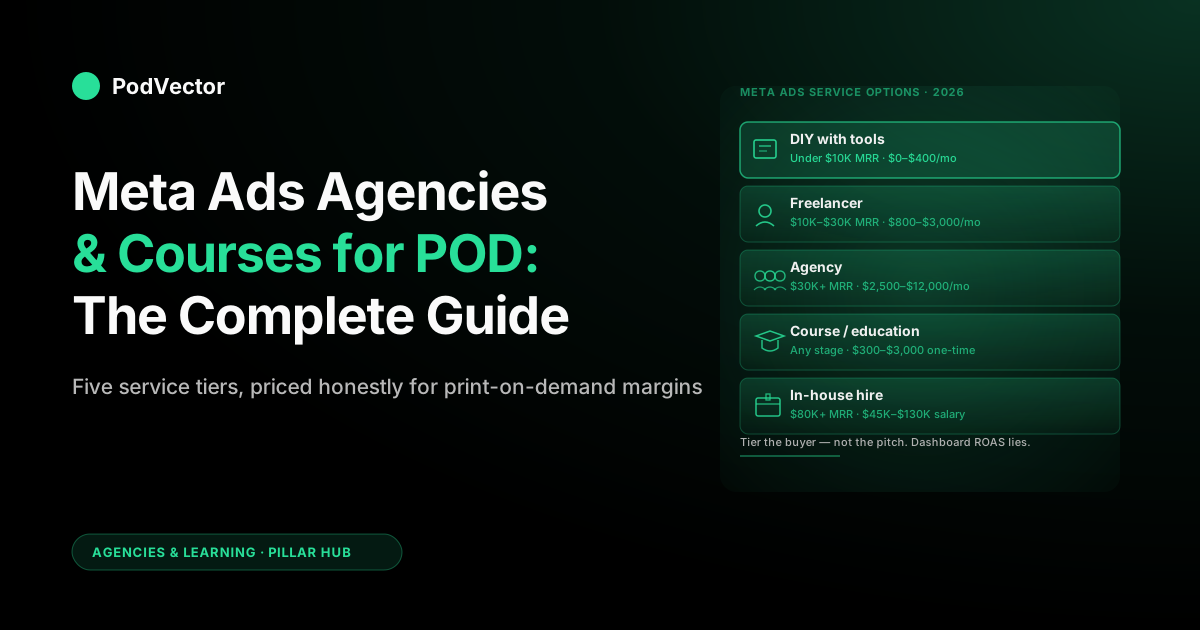
Quick Answer: Meta Ads services for print-on-demand split into five paths — DIY with tools, freelancers, agencies, courses, and in-house hires — and the right one is almost entirely a function of your MRR and your true per-order contribution margin, not your reported ROAS. Under $10K MRR, nearly every POD seller should stay DIY and buy a $300–$1,500 course plus real margin tracking.
From $10K to $30K MRR, a specialist Meta Ads freelancer at $1,000–$3,000/month usually beats an agency on both cost and attention. Above $30K MRR with stable unit economics, a POD-aware agency at $3,000–$8,000/month can scale profitably — but fewer than one in ten ecommerce Meta agencies understands how Printify or Printful supplier costs shred the "dashboard ROAS" they'll quote you in the case studies. This guide walks each option, Meta-specific pricing ranges, the creative-volume treadmill, the iOS attribution trap, red flags on the sales call, and the questions that tell you whether the person on the other end of the Calendly is a POD operator or an optimizer.
Why POD changes the Meta Ads buyer math
Every generic "how to hire a Facebook ads agency" article on the first page of Google is written for a business that print-on-demand is not. The template is built around a DTC brand with fixed COGS, warehouse inventory, 60–80% gross margins, and a single product SKU that gets iterated seasonally.
POD looks nothing like that. Your cost of goods is itemized per order, varies by supplier, garment, print method, size, color, and ship-to country, and never lives inside Meta Ads Manager.
Your contribution margin is 20–35% on a good month. Your SKU count is in the hundreds and your creative treadmill runs faster than any DTC brand's because you're testing designs, not just angles.
That structural mismatch is why most of the agencies ranked in generic "best Meta ads agency" listicles — most of the top 15 Meta agencies rankings — are not the right fit for a POD store, even when their case studies are real. They measure themselves against dashboard ROAS numbers. For a DTC brand with $8 COGS on a $30 product, a 4.0x reported ROAS translates to roughly $22 of contribution per $7.50 of ad spend — genuinely profitable. For a POD seller running the same campaign on a Printify hoodie with $18 supplier cost plus $5.50 shipping and a $2 platform fee, that same 4.0x reported ROAS delivers about $4.50 of contribution per $7.50 of ad spend — a 1.35x true ROAS, which means you paid Meta to lose money slowly while the agency billed retainer and kept the screenshot for the case study.
Meta Ads compounds the problem compared to Google. Meta's attribution under iOS 14.5+ is aggressive on the view-through side — a 7-day click, 1-day view model that frequently credits purchases Meta didn't cause.
Advantage+ Shopping Campaigns amplify this by optimizing for whatever conversions Meta's pixel sees, whether those conversions were going to happen anyway or not. If your dashboard shows 5x ROAS but your bank account shows $1,200 of contribution on $8,000 of ad spend, you're not alone — you're the baseline POD experience on Meta right now.
And no amount of creative refreshes or audience exclusions will fix that. It's a measurement and economics problem, not a targeting problem.
That arithmetic changes what "good service" looks like when you hire for Meta Ads as a POD seller. It changes the pricing you can afford.
It changes which case studies mean anything. It changes the questions you should be asking on the sales call.
Most of all, it changes who is actually qualified to run your account. The rest of this guide is built around those differences, and we'll come back to the margin math repeatedly because it's the hinge everything else swings on.
The 5 Meta Ads service options
The Meta Ads service market for POD sellers in 2026 contains five distinct buyer paths, each with a different cost structure, risk profile, and operator profile:
- DIY with tools — you run the account yourself and buy software to replace the expertise and visibility you don't have. $0–$400/month depending on stack.
- Freelancers — an independent Meta Ads specialist manages the account on retainer. $800–$3,000/month typical.
- Agencies — a team-based firm with strategists, media buyers, creatives, and analysts. $2,500–$12,000+/month depending on tier and spend.
- Courses and education — you buy knowledge and frameworks instead of labor. $300–$3,000 one-time, cohort-based, or annual membership.
- In-house hire — a part-time or full-time employee owns paid social acquisition. $45K–$130K salary plus overhead plus tools.
Most POD sellers cycle through at least three of these as they grow. The ones who scale past $50K MRR usually settle on a hybrid — a course or two to give the operator real platform fluency, a freelancer or agency to execute, and tools that surface the true-margin numbers so the operator can hold whoever is running the account accountable to bank-account reality instead of Meta's dashboard.
We'll walk each option with an honest read on when it fits and when it's wasted spend. The parallel breakdown for Google is in our Google Ads services for POD buyer's guide, and most sellers end up needing both.
Option 1: DIY with tools
The correct default for almost every POD seller under $10K MRR, and the option the service industry is structurally incentivized to talk you out of — because nobody in paid-media services makes money telling you to run it yourself. The math is not close.
A POD store doing $5,000 in monthly revenue at 28% margin generates $1,400 of contribution before ad spend. A $3,500/month Meta agency retainer consumes 250% of that contribution before a single ad has been bought. You cannot hire your way out of the early stage; you can only educate and tool your way out of it.
What DIY actually costs in 2026
The real DIY stack for a POD Meta Ads operator looks roughly like this:
- Meta Ads Manager — free; you pay for impressions and clicks
- Meta pixel + Conversions API (CAPI) — free if you use the native Shopify integration or a free CAPI gateway; $20–$80/month if you use a tracking app like Elevar, Littledata, or Stape
- A creative-production system — Canva ($12/month) or Adobe Express, plus optional AI generators; figure $20–$80/month total including stock, UGC sourcing, or simple video tools
- A creative-testing workflow document — free, but critical; you need a written protocol for how many creatives enter testing each week, what the kill thresholds are, and what graduates to scaling
- A POD margin tracker — the one nobody in the services world mentions. Shopify's native analytics doesn't reconcile Printify or Printful supplier cost against ad-attributed orders. Meta's ROAS column is even further from your bank account. Without this layer, every DIY decision is blind
Total out-of-pocket for a well-equipped DIY POD Meta operator in 2026 is $60–$300/month, with most of that going to server-side tracking and true-margin reconciliation. At under $10K MRR, this stack beats any freelancer on cost and typically beats any agency on outcomes — because you care about the account with a ferocity no retained outsider ever will.
When DIY breaks
DIY breaks predictably, in three places:
- You run out of time. A well-run POD Meta account at the $20K MRR stage demands 6–10 hours per week — creative briefing, thumbnail review, asset-group housekeeping, duplicate-audience cleanup, comment moderation, kill-list enforcement. If your attention is on product development, customer service, or another job, campaigns drift and the learning phase keeps resetting.
- You've hit the creative-volume ceiling. Meta's Advantage+ engine chews through creatives. At $3K/day of spend, most POD stores need 8–15 net-new creative variants every week to stave off fatigue. If you can't produce that solo, the next gain lives in production capacity, not account optimization.
- You can't trust your numbers. If Meta reports 4.8x ROAS, Shopify shows $18K revenue, and your bank shows $2,100 of contribution after suppliers and shipping, no tactical lever inside Ads Manager will fix that. The fix is infrastructure — proper CAPI, deduplication, and true-margin reconciliation. Hiring an agency will not solve it; they'll optimize against the same bad numbers.
The third is the one POD sellers consistently get wrong. They hire an agency to fix a measurement problem, and no agency can solve a measurement problem — they can only optimize against whatever numbers they see. Those numbers will still be wrong. Our complete guide to Meta Ads ROAS and attribution for POD covers what actually fixes this.
Option 2: Freelancers
A freelancer is an independent Meta Ads specialist who runs your account on a part-time retainer. Rates run $800–$3,000/month for POD accounts, with the low end buying 4–6 weekly hours and the high end approaching what an agency account manager would deliver. For the $10K–$30K MRR band, a good Meta freelancer is frequently the best fit — cheaper than an agency, more senior in the platform than you, and economically aligned in a way team-based agencies aren't.
Where freelancers win
Three structural advantages:
- No agency overhead. The $2,000/month you pay a freelancer mostly funds their time. The $5,000/month you pay an agency funds their time plus account management, sales, office, software licenses, slide decks, and margin. A strong freelancer at $2,000/month routinely delivers more senior-practitioner hours than a mid-tier agency at $5,000.
- Direct ownership. The name on the invoice is the hands on the account. No junior media buyer whose training you're funding. If they're bad, you know in two weeks. If they're good, the value compounds.
- POD-native specialization exists in the freelancer pool. There's a small but real bench of Meta freelancers who have run Printify, Printful, or Gelato stores themselves. They understand supplier cost lines, why a 4x dashboard ROAS can still be unprofitable, and why sweatshirt creatives move differently than t-shirt creatives. The same specialization is rare at agencies, which pool talent across verticals.
Where freelancers break
- Capacity ceiling. A freelancer can meaningfully run 4–8 accounts, no more. At your growth stage — or theirs — they'll hit a wall. Good ones either graduate to agency ownership, become fractional CMOs, or raise their rates until you're priced out.
- Single point of failure. Illness, vacation, family emergency, new full-time job — any of these interrupts your account for days or weeks. Agencies hide this with bench depth; freelancers can't.
- Creative production is usually not in scope. Most Meta freelancers will brief and review creative but won't produce it. For POD, where creative volume is the bottleneck, that means you or a separate creator are doing the work either way.
How to vet a Meta Ads freelancer for POD
Three screens cut through 90% of the noise on the first call:
- Ask for two recent POD client references. Not apparel DTC, not dropship general ecom — specifically Printify, Printful, Gelato, SPOD, or similar on-demand. If they can't produce two, they're a generalist and you're paying to train them on your margins.
- Ask how they reconcile Meta ROAS against supplier cost. A POD-aware freelancer will immediately talk about exporting Printify or Printful costs by order, matching them to Meta attribution, and producing a true-margin view. A generalist will tell you "we use Triple Whale's blended ROAS" and move on. Blended ROAS isn't wrong, but it also isn't POD-aware.
- Ask what creative volume they expect you to produce weekly. A serious answer is a specific number per ad spend level — "at $3K/day, you need 8–12 new static concepts and 3–5 new video concepts weekly, split across 3 angles." A non-answer is "whatever you can deliver."
Option 3: Agencies
Agencies range from two-person shops to 200-person operations, and the service you receive scales non-linearly with the price. For POD sellers, the useful agency band is narrow: full-service DTC agencies charging $2,500–$8,000/month, ideally ones that have spent real time on at least two Printify or Printful accounts.
Below $2,500/month you're usually getting a junior account manager running a templated playbook. Above $8,000/month you're almost always subsidizing enterprise-brand infrastructure that POD unit economics can't support.
What a real agency retainer includes
A legitimate mid-tier Meta agency engagement for a POD seller in 2026 typically bundles:
- A strategist who sets the account structure and hypothesis for each testing cycle
- A dedicated media buyer executing asset-group splits, kill decisions, and budget allocation
- 2–8 pieces of net-new creative per week (static + video), produced in-house or via a creative partner
- Weekly reporting against an agreed North Star metric (ideally true contribution margin, not reported ROAS)
- Monthly strategy calls and a shared Slack/Loom channel for async communication
- Pixel, CAPI, and event-setup maintenance as iOS and Meta roll out changes
What you are really paying for is the ability to pause your own engagement with the account for a week without everything degrading, plus a creative pipeline you couldn't operate alone. That's genuinely valuable at the right scale — and almost useless below it.
Where agencies win for POD
- Creative throughput. A strong agency with in-house creative can output 20+ variants per week against briefs you couldn't produce alone. For POD with its creative-volume treadmill, this is the single strongest reason to pay agency rates.
- Attribution infrastructure. A good agency will implement or audit your CAPI setup, deploy a tracking layer like Elevar or Stape, and pressure-test your pixel events on install. Most POD sellers have never had someone methodically verify that every PageView, AddToCart, InitiateCheckout, and Purchase event fires reliably with the right parameters.
- Benchmarking across accounts. Agencies see dozens of accounts monthly. Your CPC spiking 40% in a week is either an account problem or a platform problem — they'll know which, and you won't.
Where agencies break for POD
- The "dashboard ROAS is the deliverable" problem. Most agencies are incentivized to hit the ROAS number on their scorecard, which is Meta's reported ROAS, which for POD overstates truth by 40–120%. An agency can hit 5x reported ROAS on your account while you lose money, and their retention metrics will say they're crushing it. This isn't malice — it's what they measure.
- Junior-heavy staffing. The senior strategist sells you, then you're handed to a 14-month-experience media buyer running a templated account structure. Normal agency economics; specifically painful for POD where the edge cases matter.
- POD literacy is rare. Most mid-tier Meta agencies have never logged into Printify. They don't know how production time affects delivery SLAs, they don't know that shipping cost scales with order count not order value, and they don't know which suppliers cost 40% more than the cheapest option. They will price you as if you're a DTC brand with a 70% gross margin, and the engagement will underperform accordingly.
How to tell a POD-qualified agency from a generalist
Three fast signals on the intro call:
- They ask about Printify or Printful before you mention them. If their discovery call never surfaces "who's your supplier" and "what's your average COGS per SKU," they're going to treat you like every other ecom account and your margins will suffer for it.
- They quote a setup fee or audit phase before running ads. Not a red flag — a good sign. Serious Meta work on a POD account starts with pixel, CAPI, and supplier-cost reconciliation before creative or media. An agency that offers to start spending day one is prioritizing their retention metric over your outcome.
- They're honest about what's broken in Meta. A POD-qualified agency will tell you unprompted that Meta's iOS attribution overcounts, that Advantage+ eats creative, and that scaling past $10K/day on a single campaign usually breaks contribution margin. An agency that pitches "5x ROAS guaranteed" without caveats is either new or dishonest.
Option 4: Courses and education
The most underrated and most abused option in the service mix. Underrated because $300–$1,500 of one-time education frequently produces more durable value than $30K of agency retainer over a year.
Abused because the Meta Ads education space has a high density of "guru" products priced at $2,000–$5,000 that repackage Meta Blueprint content with a personal brand layer. Both extremes exist; the trick is telling them apart.
The four tiers of Meta Ads education
- Free — Meta Blueprint. Meta's own platform. Surprisingly complete on mechanics (campaign structure, audiences, pixel setup, reporting). Useless on judgment — it won't tell you when to kill a campaign, how to think about creative rotation, or how to read Advantage+'s output. Start here, but don't stop here.
- Low-cost ($99–$500) — platform-general courses. Coursera's Meta Social Media Marketing certificate (~$240 over 4 months), Udemy bundles, CXL's Meta Ads course (~$299 or included in their $999 All-Access). Good for filling the judgment gap after Meta Blueprint. Generic on ecommerce; near-zero on POD.
- Mid-tier ($500–$2,000) — ecommerce-specific programs. Courses like Ecommerce Alley's Meta Ads Scaling, private Skool communities run by practicing media buyers, cohort-based programs from operators with public track records. The best of these include monthly office hours, a private community, and real account teardowns. The worst are three-hour VSLs with a private Slack. Due-diligence hard.
- High-tier ($2,000–$5,000+) — guru programs and masterminds. Wide variance. Some are genuine, led by people running $50M/year of spend. Many are lightly updated recycles. The delta between tiers is not price; it's whether the teacher is currently spending real money on Meta or currently selling you their course about spending real money on Meta.
What a POD seller should actually buy
For most POD sellers in 2026, the optimal course stack is two layers:
- A free platform layer — Meta Blueprint's core paths on Advantage+ Shopping, Conversions API setup, and campaign structure. Budget 8–12 hours. Zero cost.
- One $500–$1,500 ecommerce-specific program — ideally one that includes a live community and is taught by someone who runs their own ecom accounts in parallel. Budget another 10–20 hours plus ongoing community time.
That stack, completed in a month, closes 80% of the knowledge gap that agency retainers get hired to fill. It does not replace creative production capacity or weekly execution time — those are labor problems, not knowledge problems — but it makes you dangerous enough to either run the account well yourself or supervise a freelancer without getting played.
Courses to avoid
- Anything teaching "secret interests" or "hidden targeting hacks" — detailed targeting has been materially deprecated since iOS 14.5 and Advantage+ made most of it moot
- Programs whose case studies are all from 2021 or earlier — the Meta platform has changed so fundamentally that pre-iOS-14.5 tactics are often actively misleading
- High-ticket ($3,000+) courses without a public refund policy and at least three verifiable student outcomes
- Anything marketed primarily on "replace your agency" language — courses don't replace labor; they replace ignorance
Option 5: In-house hire
The rarest option for POD sellers, and usually only appropriate above $80K MRR with stable margins. Below that, the math doesn't support it; above that, an in-house hire can outperform an agency on attention, alignment, and long-horizon thinking. The typical spec is a 3–5 year Meta media buyer, often poached from an agency, paid $65K–$110K base plus some performance component, with Shopify and ideally POD exposure.
When in-house makes sense
- You're spending $40K–$150K/month on Meta and want that spend owned by someone who thinks about your account every day
- Your creative velocity requires tight collaboration between media buyer and designer — which is friction-heavy across an agency boundary
- You're planning a multi-channel expansion (Meta + Google + TikTok) and want a coordinated paid acquisition function, not three separate agency retainers
- You've already run at least one agency engagement and learned enough about what good looks like to manage the hire
When in-house breaks
- The hire has never run POD before and you can't coach them on supplier math — they'll optimize toward dashboard ROAS and you'll be structurally worse off than with a vetted freelancer
- You have no way to measure their true-margin output month over month — which means no accountability loop
- Your MRR is volatile and the salary line becomes a crisis during a slow quarter
- The hire is a single point of failure on a business function you can't afford to pause
Meta-specific pricing models decoded
Agencies and freelancers price Meta work in four primary structures, each with its own alignment and misalignment for POD:
Flat monthly retainer
The most common. You pay $X, they do Y. Simple, predictable. For POD, the structural risk is that the retainer is not indexed to your ad spend, so a slow month costs you the same as a fast month. The alignment risk is the ROAS-number-as-scorecard problem covered above.
Percent of ad spend
Typical range: 10–20% of monthly Meta spend, minimum retainer floor $1,500–$3,000. Aligns the agency to scale your spend, which is good when scale is the goal and catastrophic when it isn't. For POD, "scale spend" and "grow contribution margin" diverge faster than in most verticals — a campaign that scales spend 2x can cut contribution margin to zero.
Performance / revenue share
Base fee plus a bonus on ROAS targets or revenue above baseline. Sounds aligned; usually isn't. The ROAS targets are almost always Meta-reported, not true-margin, so you're paying bonuses on attribution inflation. Only use this structure if the performance metric is contribution margin above a baseline, computed from your reconciled numbers, not theirs.
Project / sprint / audit
One-time engagements. $1,500–$5,000 for an account audit, $3,000–$8,000 for a pixel/CAPI rebuild plus 30-day implementation, $2,000–$6,000 for a creative sprint. These are frequently the highest-ROI agency spend for a POD seller — a well-executed audit can surface 3–6 months of tactical improvements that you then execute with a freelancer or yourself.
Typical pricing by seller stage
Treat these as 2026 benchmarks for well-vetted providers, not floors or ceilings:
- Under $5K MRR — stay DIY. Budget $60–$200/month for tooling and $300–$800 for a single course. Hiring a service at this stage destroys contribution margin faster than any campaign loss.
- $5K–$10K MRR — still DIY-first. If outsourcing, a $500–$1,000/month part-time freelancer for 2–3 hours of weekly supervision only. Anything heavier is burning your margin.
- $10K–$30K MRR — freelancer sweet spot. $1,200–$2,500/month for a specialist with POD or apparel-ecom reps. Still do creative yourself or pay a separate creator.
- $30K–$80K MRR — agency-viable if margins are stable. $3,000–$6,000/month for a POD-qualified agency, or a senior freelancer at $2,500–$4,000 plus a part-time creator. Either works; pick based on creative velocity needs.
- $80K+ MRR — agency or in-house. $5,000–$12,000/month for a full-service agency, or a $75K–$110K in-house hire plus creative contractors. At this stage the hybrid (in-house buyer + external creative partner) usually wins.
Red flags and fair-quote signals
Red flags on the sales call
- "We guarantee X ROAS" — impossible to honor without measurement control you're not giving them. Usually means the agency will game Meta's reported ROAS to hit the number.
- No mention of Conversions API, server-side tracking, or event deduplication — tells you they're optimizing against whatever the pixel shows them, which post-iOS-14.5 is insufficient for profitable scaling.
- Case studies with only revenue and reported ROAS, no margin or contribution — the metrics that matter for POD aren't on the deck. Ask specifically.
- Proposed 12-month contract with no performance out — a confident provider offers a 60–90 day evaluation period.
- Junior account manager on the first call after a senior strategist sold you — the classic agency handoff. Ask who will be in the account daily and verify their experience before signing.
- "We don't share our approach until you sign" — your account isn't unique enough to warrant the secrecy, and the real answer is usually "we run the same playbook on every account."
- Unfamiliarity with Printify, Printful, Gelato, SPOD, Gooten, CustomCat — they've not worked on POD. You'll pay to educate them.
Green flags
- They ask about your supplier, average COGS, and true-margin number before they pitch
- They quote a paid audit or setup phase before retainer work
- They mention iOS attribution overcounting without prompting
- They describe creative volume in specific numbers at specific spend levels
- They're willing to contract on contribution margin or profit, not just reported ROAS
- They reference kill-list protocols, fatigue thresholds, and testing cadence with specifics
- They have a POD or apparel reference you can actually talk to
8 questions to ask before you sign
- "How do you reconcile Meta's reported ROAS with my true contribution margin?" A POD-qualified answer talks about exporting supplier costs, matching to attributed orders, and producing a blended-margin view. A generalist answer talks about Triple Whale or a spreadsheet with no specifics.
- "What's your weekly creative production expectation at my spend level?" Specific number. If they hedge, assume you'll be producing creative alone.
- "Walk me through a recent POD or apparel account that underperformed — what went wrong and what you'd do differently." If they can't name a loss, they're either dishonest or too early-career to have one. Both are bad.
- "How do you handle creative fatigue signals?" Answer should involve specific frequency, CPM, and CTR thresholds, not "we monitor it."
- "What's your position on Advantage+ Shopping vs. traditional campaigns for POD?" Currency check — anyone running POD Meta ads in 2026 has a specific opinion. Anyone without one is out of date.
- "Who specifically will be in my account daily, and what's their POD experience?" Force the handoff question up front.
- "How do you measure success month over month if reported ROAS is unreliable?" The honest answer is contribution margin, blended MER, or first-purchase LTV — anything rooted outside Meta's own reporting.
- "What's your offboarding process and do I keep the account?" You must own the ad account. If they control it or use their own Business Manager, walk.
The POD-specific evaluation checklist
Before you pay any Meta Ads service provider, confirm all of the following in writing:
- They will work inside your Business Manager and ad account, not theirs
- You retain admin access and full data export rights from day one
- They understand your supplier (Printify / Printful / Gelato / etc.) and its cost structure
- They have a documented CAPI or server-side tracking setup plan for the first 30 days
- They commit to a monthly reconciliation against your true contribution margin, not only reported ROAS
- They define specific creative-volume expectations and who produces the creative
- They name the specific humans who will execute in your account, with LinkedIn or bio references
- Contract term is 60–90 days initial with a clean out, not annual
- Pricing structure is written: flat retainer, % of spend, or performance — no vague "custom" language
- A written kill-campaign protocol exists and is shared with you before launch
Decision framework by MRR and margin
Assuming your 30–90 day true contribution margin is at least 20%, the default path by stage:
- < $5K MRR — DIY + free Meta Blueprint + one $300–$800 course. Don't outsource.
- $5K–$10K MRR — DIY + one $500–$1,500 ecommerce-specific course + margin tracker. Consider a freelancer only for specific project work (pixel/CAPI rebuild).
- $10K–$30K MRR — freelancer ($1,200–$2,500/month) with POD experience. Keep creative production in-house or with a dedicated creator.
- $30K–$80K MRR — POD-qualified agency ($3,000–$6,000/month) OR senior freelancer + creator. Pick based on creative velocity needs.
- $80K+ MRR — in-house media buyer + creative partner, OR senior agency ($5,000–$12,000/month). Hybrid is usually strongest.
If your true contribution margin is below 15%, none of these paths fix you — the bottleneck is either product pricing, supplier selection, or COGS visibility. Work on that first. Our POD profit margins explainer and break-even ROAS guide cover the upstream math that has to be solid before any Meta service investment pays back.
And before you sign anywhere, make sure your unit economics and per-order contribution are visible in real time — not in a month-end spreadsheet. That's what lets you hold any service provider accountable to bank-account truth instead of dashboard ROAS. Our live-data profit-tracking setup is what most of our sellers use to do that reconciliation automatically against Printify or Printful supplier costs.
FAQs
How much does a Meta Ads agency cost for a POD business in 2026?
POD-viable Meta agency retainers typically run $2,500–$8,000/month, with $3,500–$5,500 the most common band for stores in the $30K–$80K MRR range. Below that band, agency economics don't clear against POD margins; above $8,000/month you're usually overpaying unless you're running multi-channel.
Is it worth hiring a Meta Ads agency if I'm under $10K MRR?
Almost never. A $3,500/month retainer at $10K MRR and 28% margin consumes 125% of your pre-ad contribution. Stay DIY, invest in a course, and build margin visibility. Revisit the agency question when MRR clears $25K with stable margins.
Are Meta Ads courses worth buying or is YouTube enough?
YouTube is enough for platform mechanics and is legitimately free. A paid course ($500–$1,500) is worth buying for judgment — when to kill, how to structure a testing cadence, how to read Advantage+ output, how to price POD creatives against supplier cost. Free content is long on tactics and short on judgment; good courses reverse that.
What's the difference between hiring a freelancer and an agency for Meta Ads?
A freelancer is one person, usually more senior than an agency's junior staff, with less overhead and a harder capacity ceiling. An agency is a team with creative and strategic bench depth, higher retainer, and more process. For $10K–$30K MRR POD stores, freelancers usually win. Above $30K MRR with heavy creative needs, agencies usually win.
Do I need a Meta Business Partner-certified agency?
Meta Business Partner status is a decent signal but not a filter. It tells you the agency hit Meta's spend and client thresholds. It does not tell you they understand POD. A certified agency with no apparel experience will underperform an uncertified freelancer with three Printify accounts. Use Meta Business Partner as a tiebreaker, not a qualifier.
Can I use the same agency for both Meta Ads and Google Ads?
You can, and many agencies pitch it, but the talent pools are different. A strong Meta creative-led agency is usually weak on Google Shopping feed optimization and vice versa. For POD stores that run both channels meaningfully, a specialist per channel usually outperforms a generalist across both. Our Google Ads services buyer's guide covers the sister decision.
How long should I give a new Meta Ads agency before judging performance?
60–90 days for early signal; 6 months for a real read. Meta's Advantage+ learning phase plus creative iteration plus audience learning typically needs 4–6 weeks to stabilize.
Pair that with a 30-day prior audit phase and you're at 8–10 weeks minimum before you can distinguish a good agency from a bad one. Contract accordingly.
What's the single most important thing to ask a Meta Ads service provider about POD?
"Show me how you'd reconcile reported ROAS against my Printify or Printful supplier costs at the order level." Every other qualification flows from whether they have a real answer to that question. If they don't, nothing else they say about targeting, creative, or bidding will save the engagement.
See your true contribution margin before you hire anyone
Agencies, freelancers, and courses all optimize against whatever numbers they see. If your numbers are Meta's reported ROAS, you're going to be told a good story on a losing account. Victor pulls your Shopify orders, reconciles them against Printify/Printful supplier costs in real time, and shows you per-order contribution margin — the number that actually tells you whether any Meta service investment is paying back. And get the reconciliation layer in place before you sign the next retainer.
Try Victor free