
Quick Answer: The eight best ways to lift Meta Ads ROAS — ranked by impact for print-on-demand stores — are: fix the value parameter to send contribution margin, switch bidding to Highest Value or ROAS goal, deploy Pixel plus Conversions API together, broaden targeting and let Advantage+ allocate, build a retargeting funnel against warm audiences, test creative with UGC over polished brand video, cut unprofitable campaigns daily on true ROAS, and raise AOV with bundles.
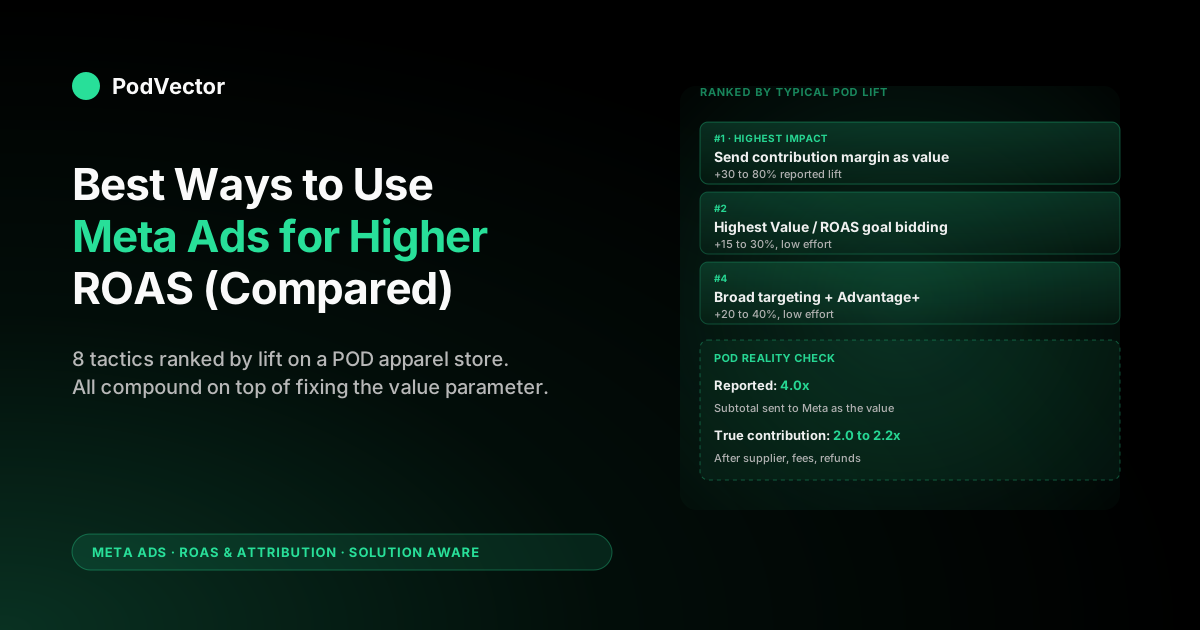
Most public roundups stop at platform tactics. They assume Meta's reported ROAS reflects business profit. For POD sellers, it doesn't. A 4.0x reported ROAS routinely lands at 2.0–2.2x once Printify or Printful supplier cost, payment fees, and refunds come out.
The single highest-leverage move is the one Meta's own documentation never names: stop sending order subtotal as the conversion value, and start sending contribution margin. Every tactic below works harder once that fix is in place.
The 8 best ways, compared
Most ROAS guides list tactics without ranking them. Operators end up working through the list top to bottom regardless of which moves the needle most. The table below ranks each tactic by typical lift on a POD apparel store and notes how much effort it takes to ship.
| Tactic | Typical reported lift | Effort | POD-specific? |
|---|---|---|---|
| 1. Send contribution margin as value | 30–80% | High (warehouse or webhook) | Yes — biggest gap |
| 2. Highest Value / ROAS goal bidding | 15–30% | Low (campaign setting) | Compounds with #1 |
| 3. Pixel + CAPI together | 10–20% | Medium (server config) | Universal |
| 4. Broad targeting + Advantage+ | 20–40% | Low | Universal |
| 5. Retargeting funnel | 3–4x prospecting ROAS | Medium (audience setup) | Universal |
| 6. UGC creative testing | 50–100% on CTR | High (production) | Universal |
| 7. Daily true-ROAS cuts | Cuts losing 20–35% spend | Medium (data layer) | Yes — refund window |
| 8. AOV bundles + thresholds | 10–25% | Low (Shopify config) | Yes — margin lift |
The order is not arbitrary. Lift compounds: fixing the value parameter (#1) makes Highest Value bidding (#2) actually optimise toward profit, makes the daily cuts (#7) sit on accurate signal, and makes Advantage+ (#4) allocate budget to genuinely profitable products instead of chasing high-GMV losers.
If you only have one engineering week, spend it on #1. If you have an afternoon, spend it on #2 plus #4. The rest of the article walks each one in detail.
1. Send contribution margin, not subtotal, as the value parameter
The default Shopify-Meta integration fires a Purchase event for every order with the order subtotal as the conversion value. Meta has no way to know what the supplier charged you to fulfil that order. The "ROAS" Meta reports is therefore GMV-ROAS — gross merchandise value divided by ad spend — not anything close to profit-ROAS.
For a $24.99 t-shirt with a Printify supplier cost of $11.50, that's a 46% gap baked into every reported number. A 4.0x campaign on the dashboard is roughly 2.2x on actual contribution.
The fix is to populate the value parameter with contribution margin: subtotal minus supplier cost minus payment processing fees, calculated at the moment the order is placed.
Two implementation paths.
Webhook path. Build a server that listens to Shopify's orders/create webhook, looks up each line item's Printify or Printful cost via the supplier API, calculates contribution, and fires a Conversions API Purchase event with the corrected value. Doable in a week. Maintenance grows linearly with every supplier you add and every SKU pricing change.
Warehouse path. Pipe Shopify orders, supplier cost data, and ad spend into a unified data warehouse (Snowflake, Redshift, Databricks, or a managed equivalent), calculate contribution there as a derived column, and stream corrected purchase events to Meta CAPI from the warehouse. Heavier upfront. The same warehouse then powers refund feedback, per-SKU profitability dashboards, and the daily-cut rules in tactic #7.
Once Meta receives contribution as the value, every downstream optimisation — Highest Value bidding, ROAS goal, Advantage+ — starts pulling toward actual profit instead of inflated subtotal. This is why this tactic ranks first.
For the deeper walkthrough on the value parameter and what Meta's docs do and don't say, see Meta Ads ROAS definition: Help Center explained for POD sellers.
2. Use Highest Value or ROAS goal, not Lowest Cost
Meta's default bid strategy on most campaign objectives is Lowest Cost — get as many conversions as possible for the budget, regardless of order value. For POD stores selling a mix of $14 mugs and $48 hoodies, that is exactly the wrong objective.
Lowest Cost bidding will happily flood you with cheap mug orders that show "great ROAS" on volume but wreck margin once supplier cost lands. Mug margin per order is dollars; hoodie margin is double-digit dollars.
The two value-aware bid strategies are:
Highest Value. Tells Meta to pursue the highest-value conversions available within your budget, where "value" is whatever you sent in the Purchase event's value parameter. Combined with tactic #1, this becomes "pursue the highest-contribution-margin conversions" — which is what you actually want.
ROAS goal. You set a target ROAS and Meta dynamically bids to maintain that average across the campaign's lifetime. Meta accepts values between 0.001 and 1,000.00 and pulls back delivery when the running average drops below goal. Setting goals too aggressively (8x on a market that delivers 3.5x) starves the campaign — set targets within shouting distance of historical performance.
Both require eligibility for value optimisation, which usually means 50+ purchase events at the ad set level in the past 7 days. Most POD stores under roughly $30K monthly revenue sit below that threshold and Meta will either block the bid strategy or run it on borrowed signal — slow learning, volatile results.
If you're below the threshold, run consolidated campaigns with broader ad sets (one ad set, several creatives) to pool conversion volume rather than fragmenting it across narrow ad sets that never qualify.
3. Deploy Pixel and Conversions API together
Browser-side Pixel events miss conversions whenever Safari ITP, ad blockers, or iOS App Tracking Transparency suppress the page-level fire. CAPI (Conversions API) sends the same events server-to-server, where browser blocking has no effect, with deduplication on the event ID so Meta doesn't double-count when both fire.
Meta's own data, replicated by ad-tech vendors, suggests the dual-channel setup recovers 10–20% of conversions that Pixel alone misses. More signal means Meta's auction algorithm learns faster, which means cheaper acquisition and higher ROAS at the same spend.
The standard Shopify implementation runs Pixel through the native Meta integration and CAPI through the same channel, with deduplication handled by Shopify's event mapping. That gets you most of the way for zero engineering effort.
The gap that integration leaves: it sends order subtotal as the value, not contribution. Fixing tactic #1 means moving CAPI off the native Shopify integration onto a server (webhook or warehouse) you control. The Pixel side can stay on Shopify's native fire and dedupe by event ID against your custom CAPI event.
For the broader Shopify-side wiring, see the complete guide to Meta Ads Shopify integration for POD.
4. Broaden targeting and let Advantage+ Shopping allocate
The 2018 Facebook playbook said to layer interests, behaviours, and lookalike audiences narrowly. The 2025 reality is the opposite. Meta's algorithm has more behavioural signal than any interest you can pick, and constrained ad sets starve it.
Public Meta data and third-party studies have repeatedly shown broad targeting outperforming detailed targeting on ROAS for performance objectives — often by 100%+ on the broadest comparisons. The industry shorthand is that broad targeting now outperforms narrow targeting on most performance objectives — and the gap has widened with each iOS privacy update.
Two implementations to test:
Advantage+ Shopping campaigns. Meta's all-in-one auto-targeted campaign type. You upload creatives, Meta picks audiences, placements, and budgets across every available signal. Public benchmarks show Advantage+ delivering 20–40% higher reported ROAS than manually constructed campaigns at comparable spend. The catch: Meta's optimisation runs against the value parameter you send (loop back to tactic #1).
Manual broad targeting. One ad set, country-level geo, optional age range, no interests, no lookalikes. Treat it as a control against Advantage+ — sometimes it wins, especially on niche audiences Advantage+ over-indexes incorrectly.
Run both for 7–14 days against the same creative pool, then concentrate spend on whichever delivers higher ROAS on the value parameter you actually care about. For a generic-ecommerce treatment of the broad-vs-detailed shift, Madgicx's roundup covers the same pattern with non-POD numbers.
5. Build a retargeting funnel against warm audiences
Cold prospecting is expensive. Retargeting is not. Industry benchmarks consistently show retargeting campaigns delivering median ROAS in the 3.5–4x range against prospecting at 2.0–2.5x — the warm-audience multiplier is roughly 1.7x on most accounts.
The trap most POD sellers fall into: running one giant retargeting audience that lumps cart abandoners with site visitors with social engagers. The funnel is too coarse. Each audience deserves its own ad set, budget, and creative.
A workable funnel structure:
Cart abandoners (last 7 days). Highest intent. Show the exact product they bounced from with a small social-proof tag ("3,000 reviews") or a low-commitment incentive (free shipping over $50, not 20% off — protect margin).
Product page visitors (last 30 days). Medium intent. Show category bestsellers and lookbook-style creative.
Engaged Instagram/Facebook (last 60 days). Lowest intent. Show brand video, testimonials, and bestseller carousels.
Cap retargeting frequency at 4–6 impressions per 7 days. Beyond that, you're paying to annoy people who've already decided.
6. Test UGC creative over polished brand video
Meta's algorithm doesn't care whether your creative is polished. Click-through rate and watch time are the levers. User-generated content (UGC) — phone-shot product shots, unboxings, before-after — consistently beats studio-shot brand video on both.
Independent measurement firms cite UGC delivering 4x higher CTR and around 50% lower CPC than branded equivalents. The reason is simple: UGC looks like organic content, scrolls slower in feed, and reads as a friend's recommendation rather than an ad.
For POD specifically, UGC plays even harder. The objection on POD apparel is "is the print quality good?" — a question polished studio shots answer poorly because they look obviously retouched. A 12-second phone video of someone's friend wearing the shirt outdoors answers it directly.
Operational tactic: put a clause in your packing slip that offers a $5 store credit (or free product) for any customer who DMs a 10-second wearing video. Cost per UGC asset lands around $5–$15 instead of $300–$800 for studio production. Volume goes up, testing tempo goes up, and the algorithm gets more variants to optimise against.
Refresh creative weekly during scaling. Public ad-fatigue data shows performance declining 30–50% after an asset hits 2–3x your audience, and POD audiences are typically smaller than DTC equivalents — fatigue arrives faster.
7. Cut unprofitable campaigns daily on true ROAS
Most operators review Ads Manager weekly. Spend on losing campaigns accumulates. By the time the weekly review surfaces a 1.4x reported ROAS campaign, it's already burned $400–$800.
The two-step shift is to (a) review daily and (b) cut on true contribution ROAS, not reported ROAS. Both are easier said than done.
Daily review is straightforward — set a 15-minute morning slot, scan the previous day's spend, and flag any campaign below your contribution break-even threshold. Cut at 1.5–2x the threshold to absorb day-to-day noise (one slow day shouldn't kill a working campaign), then revisit weekly trends.
Cutting on true contribution ROAS is harder. Reported ROAS in Ads Manager doesn't reflect supplier cost or refunds. A campaign showing 2.8x reported might be 1.5x on contribution — already losing money — and a different campaign showing 2.2x reported might be 2.0x on contribution because its product mix skews toward higher-margin SKUs.
Without the data layer, you're cutting blind. The reliable fix is to centralise Shopify orders, supplier cost data, refund events, and Meta ad spend in a unified data warehouse, then surface a daily contribution-ROAS report at the campaign and ad-set level. The warehouse approach in tactic #1 sets you up for this; the webhook approach gets you partway.
For a CBO vs ABO discussion of how budget allocation changes the cut decision, see Meta Ads CBO vs ABO: inconsistent ROAS 2025.
8. Raise AOV with bundles and tiered shipping thresholds
The cheapest ROAS lift is on the order side, not the ad side. If you can lift average order value 25%, ROAS lifts 25% mechanically — same ad spend, same orders, more revenue per order. For POD apparel, AOV lifts also lift contribution margin disproportionately because supplier cost grows sub-linearly with cart size (the second item in a Printify cart often ships for a smaller incremental fee).
Three tactics POD stores under-deploy:
Bundles. A "matching set" (t-shirt + hoodie) at a 10% discount frequently doubles the line items per order. Margin stays healthy because the discount comes off retail, while supplier cost per added unit doesn't move much.
Free-shipping threshold. Shopify's data consistently shows AOV lifting 15–25% when free shipping kicks in around 1.4x average AOV. If your average order is $32, set the threshold at $45 — enough to push customers to add a second item, not so high they bounce.
Post-purchase upsells. One-click add-on after the buy button (sticker pack, second t-shirt at 30% off) routinely adds 8–12% to AOV at near-zero acquisition cost. Apps like ReConvert or Shopify's native Post-Purchase do the wiring.
None of these affect Meta directly. They make every dollar Meta drives convert into more revenue, which moves the ROAS column up without changing a single bid.
The "best way" depends on which ROAS you actually mean
Most ROAS roundups never define which ROAS they're optimising for. The number you see in Ads Manager is reported ROAS — attributed conversion value divided by spend, where conversion value is whatever your pixel sends. For POD that's almost always order subtotal.
The number your bank account reflects is contribution ROAS — net revenue minus supplier cost minus shipping minus payment fees minus refunds, divided by spend. For typical POD apparel, contribution ROAS reads at 50–60% of reported ROAS.
If your dashboard shows 4.0x and you're targeting "improve to 5.0x," you might already be losing money on contribution while the reported number trends up. Tactics #1 (value parameter) and #7 (daily cuts on true ROAS) are the only two that close the reporting gap. The other six lift reported ROAS without addressing the underlying measurement problem.
For the full breakdown on which benchmark numbers actually apply to POD, see what is a good ROAS for Meta Ads in this cluster, and the complete guide to Meta Ads ROAS and attribution for POD for the cluster pillar. For the wider cluster index of ROAS-and-attribution articles, see the Meta Ads ROAS & attribution hub; for the full topic, the Meta Ads hub for POD sellers.
Worked example: POD apparel store, $750 ad spend
Walk through the math on a real-shape POD apparel campaign. The starting state, before any tactic from this article:
- Ad spend: $750/week
- Orders driven: 100 at average $24.99 subtotal
- Reported ROAS: $2,499 / $750 = 3.33x
- Printify supplier cost: $11.50/order avg
- Shopify payment fee: $1.05/order
- Shipping: pass-through (net zero)
- Net contribution per order: $12.44
- True contribution ROAS: $1,244 / $750 = 1.66x
The store's contribution break-even is 1 / 0.30 = 3.33x reported ROAS at this margin profile (assuming the 1.85x reported-to-true gap factor). The campaign is running exactly at break-even on contribution while the dashboard shows it healthy.
Apply the stack. Tactic #1 (send contribution as value) and Tactic #2 (Highest Value bidding) typically lift reported ROAS 30–50% combined for accounts that previously sent subtotal — Meta's algorithm starts steering toward higher-margin SKUs once the value signal is right. Hypothetically, that pushes the campaign from 3.33x to 4.5x reported.
Tactic #4 (broad + Advantage+) and Tactic #5 (retargeting funnel) typically add another 20–30% on top, for a 5.5x–6.0x reported ceiling.
The combined effect on contribution: 5.5x reported / 1.85 gap factor = roughly 3.0x true ROAS. The store moves from break-even to genuinely profitable, with daily cuts (#7) keeping unprofitable spend out of the mix.
None of these numbers are guaranteed — every account's gap factor and tactic responsiveness are different. The pattern, though, is consistent: tactics 1+2 deliver the foundational lift, and the rest compound on top.
FAQs
What's the single highest-impact way to lift Meta Ads ROAS for POD?
Send contribution margin as the Purchase event's value parameter instead of order subtotal. Meta optimises every downstream lever — bidding, audiences, Advantage+ — against whatever value you send. Tell it the truth and the algorithm starts finding profitable conversions instead of high-GMV losers. Lift on POD apparel accounts ranges from 30–80% on reported ROAS.
Does Highest Value bidding work on small POD accounts?
Only if the ad set qualifies for value optimisation, which usually means 50+ purchase events at the ad set level in the past 7 days. Most POD stores under $30K/month sit below that threshold. The workaround is to consolidate ad sets (broader audiences, fewer ad sets, more creatives per ad set) so conversion volume pools instead of fragmenting.
Should I use Advantage+ Shopping or build manual campaigns?
Run both for 7–14 days against the same creative pool, then concentrate spend on whichever delivers higher ROAS on the value parameter that actually reflects profit. Public benchmarks favour Advantage+ by 20–40% reported ROAS, but it over-indexes on broad audiences which sometimes hurts niche apparel stores. Always test rather than assume.
How often should I refresh creative on Meta Ads?
Weekly during scaling. Public ad-fatigue data shows performance declining 30–50% after an asset hits 2–3x your audience, and POD audiences are typically smaller than generic DTC, so fatigue arrives faster. UGC volume helps — cheap, fast, and on-brand for the medium.
Why does my Meta-reported ROAS look fine while my margin shrinks?
Reported ROAS uses the value your pixel sends, which is order subtotal by default. It ignores Printify or Printful supplier cost, payment fees, and refunds. A 4.0x reported ROAS on POD apparel typically lands at 2.0–2.4x once those costs come out. The dashboard trends green while the bank account trends red.
Is the Conversions API enough on its own, without Pixel?
Technically yes, but most setups run both in parallel for redundancy. Pixel covers the browser-fired path; CAPI covers the server path. Deduplication via event ID stops Meta double-counting. The combination recovers 10–20% of conversions that Pixel-only misses to ITP and ad blockers, and that signal feeds every optimisation algorithm Meta runs.
What's the ROAS lift from raising AOV vs improving creative?
AOV improvements are mechanical — a 25% AOV lift produces a 25% reported ROAS lift at constant spend and orders. Creative improvements are stochastic — sometimes a UGC asset doubles CTR, sometimes it produces nothing. AOV tactics deliver more predictable ROAS gains for less effort, which is why bundles and shipping thresholds rank as one of the eight best ways even though they aren't ad-platform tactics.
Do these tactics work the same for Printful as Printify?
Yes for the platform tactics (#2 through #6). The supplier-cost gap is similar across both — Printful tends to run slightly higher per-unit cost than Printify but with tighter quality variance, so margin profiles look comparable. Tactic #1 (value parameter) requires per-supplier cost lookup either way; the integration code differs but the architecture is identical.
Want Meta to optimise toward profit instead of GMV?
The eight tactics above stack — but only if Meta is optimising against contribution margin, not order subtotal. That fix lives outside Meta's docs. Victor joins your Shopify orders, Printify or Printful supplier cost, payment fees, and Meta ad spend in a unified data warehouse the moment the data lands, then streams contribution-margin Purchase events to CAPI so Meta's algorithm steers toward the campaigns that actually make money. Ask in plain English ("which Meta campaigns were unprofitable last week after supplier cost?") and get the answer from live data.
Try Victor free