
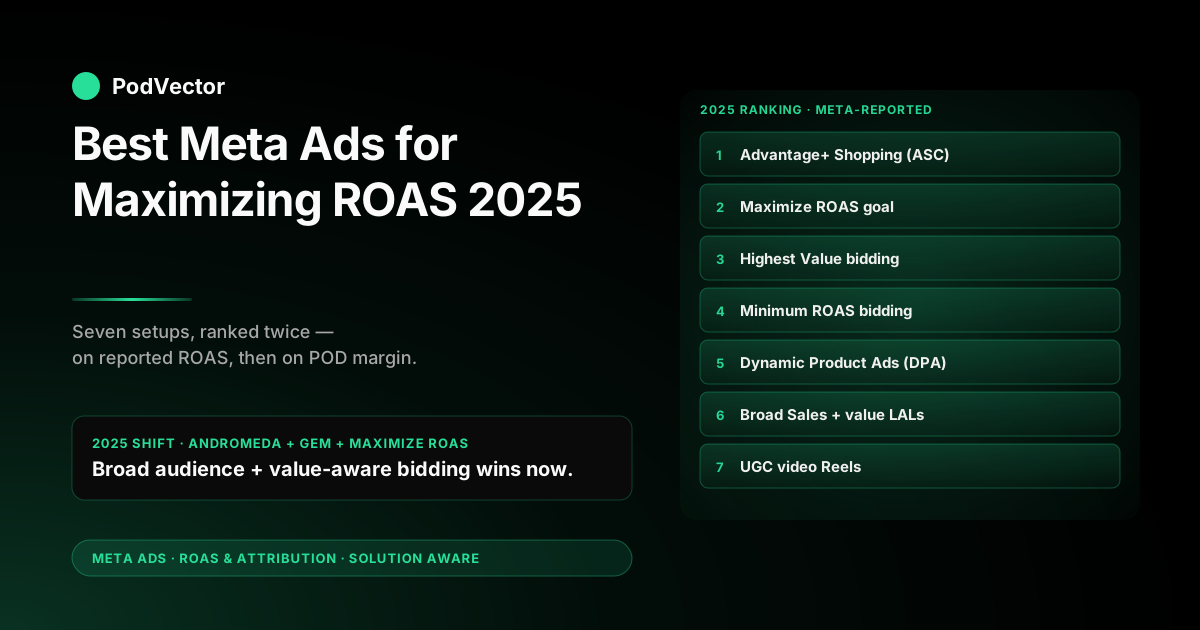
Quick Answer: The seven Meta ad setups producing the highest ROAS in 2025 are Advantage+ Shopping (ASC), the new Maximize ROAS performance goal, Highest Value bidding, Minimum ROAS bidding, Dynamic Product Ads on warm audiences, broad Sales campaigns with value-based lookalikes, and UGC video Reels.
What changed in 2025: Meta's Andromeda bidding system and the GEM creative model now power Advantage+, and the Maximize ROAS goal is no longer beta. Together they shift the winning setup from "manual targeting + Lowest Cost" to "broad audience + value-aware bidding + AI-rotated creative."
The catch for print-on-demand: every ranking on the public SERP is sorted by Meta-reported ROAS, which counts a $24.99 shirt as $24.99 of value. Once you subtract Printify or Printful supplier cost, the order reshuffles. The honest 2025 ranking is below.
The 2025 ranking, compared
Most 2025 roundups list ten things and call it a comparison. The table below ranks the seven that actually move ROAS for a print-on-demand store, with the 2025 update each one received.
| Setup | Job it does | 2025 update | Best for spend tier | Median lift on reported ROAS |
|---|---|---|---|---|
| Advantage+ Shopping (ASC) | AI-driven prospecting + retargeting in one | Andromeda + GEM creative ranking | $5k+/month | ~32% vs manual |
| Maximize ROAS goal | Optimise for value-to-spend ratio, not volume | Out of beta, available to all accounts | $10k+/month | ~15-25% vs Highest Volume |
| Highest Value bidding | Bid for buyers likely to spend most per order | Pairs with new value optimisation signals | $10k+/month | ~20% vs Lowest Cost |
| Minimum ROAS bidding | Show ads only when predicted return clears your floor | Floor settable per ad set, not just campaign | $15k+/month | ~10-18% vs cap-based bids |
| Dynamic Product Ads (DPA) | Auto-generated retargeting from your catalog | Catalog feed now ingests Shopify variants natively | Any (warm traffic required) | ~71% vs cold prospecting |
| Broad Sales + value LALs | Open targeting + value-based lookalikes | Detailed targeting deprecated for new accounts | $3k+/month | ~3.6x median ROAS |
| UGC video Reels | Native short-form creative for cold audiences | GEM rotates UGC variants automatically | Any | ~22% on Advantage+ creative |
Three things to flag before reading further. First, "median lift" is what Meta and the major platforms publish — your account will sit somewhere in a wide distribution. Second, every figure above is on Meta-reported ROAS. Third, the order changes once you account for true ROAS, which we cover below.
What actually changed in Meta Ads in 2025
If you set up your Meta account in 2023, half the muscle memory is wrong now. Three changes matter for ROAS this year.
Andromeda is live. Andromeda is Meta's deep-learning ad-ranking system that replaced the older auction model in late 2024 and rolled out fully through 2025. It scores ads on a much larger feature set, which is why "broad audience" beats "detailed targeting" more reliably than it used to — Andromeda finds the right user without you narrowing the pool.
GEM ships creative. GEM is Meta's Generative Experimental Model for ad ranking, launched late 2025. It dynamically reorders the creative variants inside a single ad set based on early performance signals. The 22% ROAS lift Meta cites on Advantage+ creative is mostly GEM doing what a media buyer used to do manually, faster.
Maximize ROAS left beta. Through 2024 the new Maximize ROAS goal was rationed across accounts. In 2025 it's available to everyone with the value-optimisation requirements met. It's now the default recommendation for value-driven Sales campaigns.
None of these are POD-specific. All three reward accounts that send Meta clean value signals. The accounts losing ground in 2025 are the ones still passing default Purchase events with no value parameter, or sending revenue without subtracting refunds.
1. Advantage+ Shopping Campaigns (ASC)
ASC is the highest-leverage starting point for POD in 2025. You give Meta a budget, a Shopify catalog, and a set of creatives. Andromeda decides who sees what, GEM decides which creative variant ships, and the campaign self-balances between cold prospecting and warm retargeting.
What changed this year: ASC is no longer a separate "experimental" surface. It's the default Sales campaign type for accounts that meet the value-optimisation threshold. Setup time dropped from twenty minutes to about three.
POD setup that wins: Connect your Shopify catalog with full variants. Pass the order subtotal as the value parameter — but only after subtracting your Printify or Printful supplier cost server-side. ASC will optimise toward the value you send. Send revenue, you scale revenue. Send margin, you scale margin.
The trap: most POD stores send revenue. ASC then scales the ad sets driving $24.99 shirts that cost $13 to fulfil. Meta-reported ROAS looks great. Bank account looks worse. Our complete guide to Meta Ads ROAS and attribution for POD walks through the value-event setup that fixes this.
2. Maximize ROAS performance goal
The Maximize ROAS goal tells Meta's algorithm: "Don't just hit volume — get me the highest value-to-spend ratio you can." It's now available on Sales campaigns with value optimisation enabled.
Compared to Highest Volume bidding, Maximize ROAS shifts delivery toward higher-AOV buyers. For a POD store, that often means away from the $19.99 single-tee buyer and toward the $48 two-shirt-plus-mug bundle buyer.
When it wins: stores with at least 50 purchase events per ad set per week, an AOV spread (your top decile is at least 2x the median), and clean value tracking. Below that volume threshold, Maximize ROAS underdelivers because it can't learn fast enough.
When it loses: low-AOV-spread stores. If every order is $24.99 because you sell one product, Maximize ROAS and Highest Volume converge. The lift the SERP cites — 15% to 25% — is real, but only when there's value variance to optimise toward.
3. Highest Value bidding
Highest Value is the older sibling of Maximize ROAS. It tells Meta to find users likely to convert at the highest possible value, without a hard ROAS floor. You typically run it inside a Sales campaign with value optimisation on.
It's still the right pick when you want the lift from value-based bidding but don't have enough volume for Maximize ROAS to settle. The threshold is roughly 20-30 purchase events per ad set per week — half what Maximize ROAS needs.
POD nuance: Highest Value will scale spend on whichever value signal you're sending. If you're sending order subtotal, it scales toward big-cart buyers. If you're sending contribution margin, it scales toward profitable buyers. The setup is identical; the outcome is different.
4. Minimum ROAS bidding
Minimum ROAS sets a floor. If Meta predicts a given impression will return below your threshold, the impression doesn't ship. It's the closest thing Meta has to a profit guardrail at the bid level.
2025 update: the floor can now be set per ad set, not just per campaign. That matters when you run different products at different margin tiers in the same campaign — apparel at 50% supplier-cost share, accessories at 30%.
Where it works for POD: retargeting campaigns where you know the expected ROAS bracket. Setting a 3.0x floor on retargeting will pause delivery during low-intent windows — often a profitability win.
Where it fails: cold prospecting from a new account. With no learning, Meta predicts low ROAS for everything, and the campaign barely delivers. Use Highest Volume or Highest Value for the first 2-3 weeks, then switch to Minimum ROAS once predictions stabilise.
5. Dynamic Product Ads on warm audiences
DPAs are the highest-ROAS campaign type in absolute terms — and have been every year since 2018. They retarget users who viewed or added a specific SKU with that exact SKU, pulled live from your Shopify catalog. The 71% ROAS lift on retargeting that the SERP cites is mostly DPA driving warm traffic back to product pages.
What changed in 2025: the catalog feed now ingests Shopify variants natively, including print-on-demand custom data fields. You can flag a product as "Printify-fulfilled" in the feed and exclude it from delivery if you're out of stock at the supplier — something that required a custom integration in 2024.
POD setup: a 14-day View Content + Add to Cart custom audience, paired with a 30-day catalog exclusion of past purchasers. AOV on POD retargeting tends to be 1.4-1.8x cold-prospecting AOV because warm visitors come back for the bundle. For deeper context on the catalog setup, see our Facebook Dynamic Product Ads Shopify strategy for print-on-demand.
6. Broad Sales with value-based lookalikes
The 2025 targeting rule is simple: broader is better. Meta has deprecated detailed targeting for many new accounts, and Andromeda's wider feature set means narrow targeting starves the algorithm of signal.
The replacement: a broad-audience Sales campaign anchored by a 1% value-based lookalike of your top customers. "Top customers" means top decile by lifetime contribution margin, not by revenue.
The contribution-margin lookalike is the unlock. A revenue-based LAL clones high-spend buyers, including ones who returned half their order. A contribution-margin LAL clones the buyers who actually paid for your business. The shift typically lifts retained ROAS 15-30% over six weeks.
To build it, you need contribution margin per customer in the same place as your customer ID — usually a unified data warehouse pulling from Shopify, Printify or Printful, and your payment processor. The export to Meta's Custom Audiences API is straightforward once the data lives in one place.
7. UGC video Reels
UGC video for Reels is the cheapest creative format in 2025. Meta's GEM model rotates variants automatically, which means a UGC creative that wins on day three gets disproportionate delivery by day five — without you touching budget.
Format that's working: 9-15 second vertical Reels, talking head or hand-on-product shot, opening hook in the first second, captions on. The "we shot it on an iPhone" aesthetic outperforms studio production for POD specifically — the price point doesn't carry the polish.
Where it pairs with the others: ship UGC into your ASC creative pool. ASC + GEM picks the winner. Manual rotation is dead labour in 2025.
One trap to flag. If your UGC variants drive cheap clicks but low-AOV orders, ASC will scale them aggressively on Meta-reported ROAS while shrinking your contribution margin. The sibling article on the eight best ways to use Meta Ads for higher ROAS covers the creative-to-margin chain in more detail.
2025 ROAS benchmarks worth trusting
The benchmark numbers floating around 2025 fall into two camps. The first camp ("aim for 4x") is for general DTC. The second camp ("2x to 3x is healthy") is for thin-margin verticals like POD.
POD-specific benchmarks for 2025, on Meta-reported ROAS:
- New stores (under $5k/month spend): 2.0x to 2.8x reported ROAS is normal. Below 2.0x usually means tracking is broken before it means the campaign is broken.
- Scaling stores ($5k-$25k/month spend): 2.5x to 3.5x reported. Above 3.5x is achievable on retargeting-heavy mixes.
- Established stores ($25k+/month spend): 3.0x to 4.5x reported on a healthy mix of cold and warm.
The numbers nobody publishes are the true-ROAS equivalents. For most POD stores, true ROAS — Meta-reported ROAS minus supplier cost, payment fees, refunds, and shipping subsidies — is 50-65% of reported ROAS. A 3.5x reported account is often a 1.9x true account. That's not a tracking problem; it's a measurement-model problem.
The honest 2025 ranking after COGS
Re-rank the seven setups above by their effect on true ROAS — value-to-spend after Printify or Printful cost, Stripe fees, and refunds — and the order changes.
1. Broad Sales + contribution-margin lookalikes. The unlock here is the lookalike, not the campaign type. A contribution-margin LAL is the single highest-leverage Meta optimisation a POD store can run, and it doesn't show up on standard SERP roundups because most DTC tools can't build one.
2. Maximize ROAS goal — fed contribution-margin values. Same campaign type the SERP recommends, but with the value parameter rewritten to be margin, not revenue. Lift is similar on reported ROAS but 1.5-2x larger on profit ROAS.
3. DPA on warm audiences. Holds its rank either way. Retargeting buyers are inherently higher-margin because conversion costs are lower.
4. ASC with margin-rewritten value events. Drops one rank because cold prospecting inside ASC is more variance-prone on margin than on revenue.
5. Highest Value bidding. Drops two ranks unless paired with margin-aware values. Without that, "highest value" means biggest cart, which is often biggest unit cost.
6. Minimum ROAS bidding. Useful as a guardrail, not as a primary scaler.
7. UGC Reels alone. Cheap to produce but, as a standalone creative play without value-aware bidding underneath, the cheapest path to scaling unprofitable orders.
The pattern: every setup ranks higher when paired with margin-aware value tracking, and lower without it. The campaign type matters less than what you're sending Meta as the conversion value.
Which to pick first by store size
The default trap in 2025 is buying every Meta surface and hoping the AI sorts it out. A realistic ramp by spend tier:
Under $5k/month: One ASC campaign, broad audience, your full catalog, 5-8 UGC creatives in the rotation. Skip Maximize ROAS until you have the volume. Skip DPA until you've built warm traffic. Don't run lookalikes until you have 500+ customers in the source list.
$5k-$25k/month: Add a DPA retargeting campaign and a 1% value-based lookalike to the broad Sales campaign. Switch from Highest Volume to Highest Value bidding. Pause manual detailed-targeting campaigns — Andromeda is doing it better.
$25k-$100k/month: Add Maximize ROAS goal, segregate ad sets by margin tier, set Minimum ROAS floors on retargeting. Build the contribution-margin lookalike if you haven't. By this stage the warehouse work pays for itself.
$100k+/month: Multi-channel attribution becomes worth the spend, but only on top of margin-aware Meta tracking, not as a substitute. The complete Meta Ads playbook for print-on-demand covers the scaling architecture.
For deeper sibling reading, the campaign-type ranking by job and the best AI tools for improving ROAS on Meta Ads in 2025 articles in this ROAS & attribution hub are the natural next reads. For the broader topic, see the Meta Ads guide for POD.
External reading worth the click: Madgicx's writeup on the 71% retargeting ROAS lift covers the underlying numbers in more detail than most.
FAQs
What's the highest-ROAS Meta ad campaign in 2025?
Dynamic Product Ads on warm audiences, on raw reported ROAS. Once you account for supplier cost, broad Sales campaigns paired with contribution-margin lookalikes usually beat them, because warm-audience volume caps out fast on a small store. The honest answer is that "highest ROAS" depends on which ROAS you're measuring.
Should I use Maximize ROAS or Highest Value in 2025?
Maximize ROAS if your ad set runs at least 50 purchase events per week. Highest Value if you're between 20 and 50. Below 20, use Highest Volume — the value-based goals can't learn at that volume, and you'll see worse delivery.
Is Advantage+ Shopping always the best choice in 2025?
Almost always for spend above $5k/month. Below that, the budget gets too thin to feed the algorithm the value signal it needs, and a manual broad-audience Sales campaign with one or two ad sets often outperforms ASC. The crossover happens around the $3k-$5k/month range.
How does GEM affect creative testing in 2025?
GEM auto-rotates variants inside Advantage+ ad sets based on early performance. Manual creative rotation is mostly obsolete inside ASC — you ship five to ten variants into the rotation, and GEM picks the winner faster than a media buyer can. Manual rotation still matters in non-Advantage+ campaigns, where there's no GEM equivalent.
What ROAS should a POD store target on Meta in 2025?
2.5x to 3.5x reported ROAS is healthy for a scaling POD store. The number that matters more is true ROAS — reported ROAS minus supplier cost, refunds, and fees — which usually needs to clear 1.4x to 1.6x for the campaign to actually fund the next print run.
Did detailed targeting really die in 2025?
Mostly. Meta has deprecated many detailed targeting options for new accounts and reduced their effectiveness for existing ones. Andromeda's wider feature set means broad audiences with strong creative signal outperform narrow targeting on most campaigns. The exception is small audience exclusions (past purchasers, employees) — those still work and should still be set.
Why doesn't this article rank Triple Whale or Northbeam?
Those are attribution tools, not Meta ad setups. They sit on top of Meta to measure cross-channel impact. They affect which campaigns you keep running, not which campaigns you launch. The seven setups above are about the campaigns themselves; attribution tooling is a separate decision covered in the cluster's AI-tools roundup.
See your true 2025 ROAS — not the inflated number Meta reports
Every campaign type above looks better on Meta-reported ROAS than on the number that pays for the next print run.
Connect Shopify, Meta, and Printify or Printful. Ask Victor: which 2025 Meta campaigns are unprofitable after COGS, fees, and refunds? Get the answer over your live data, not a dashboard.
Try Victor free