
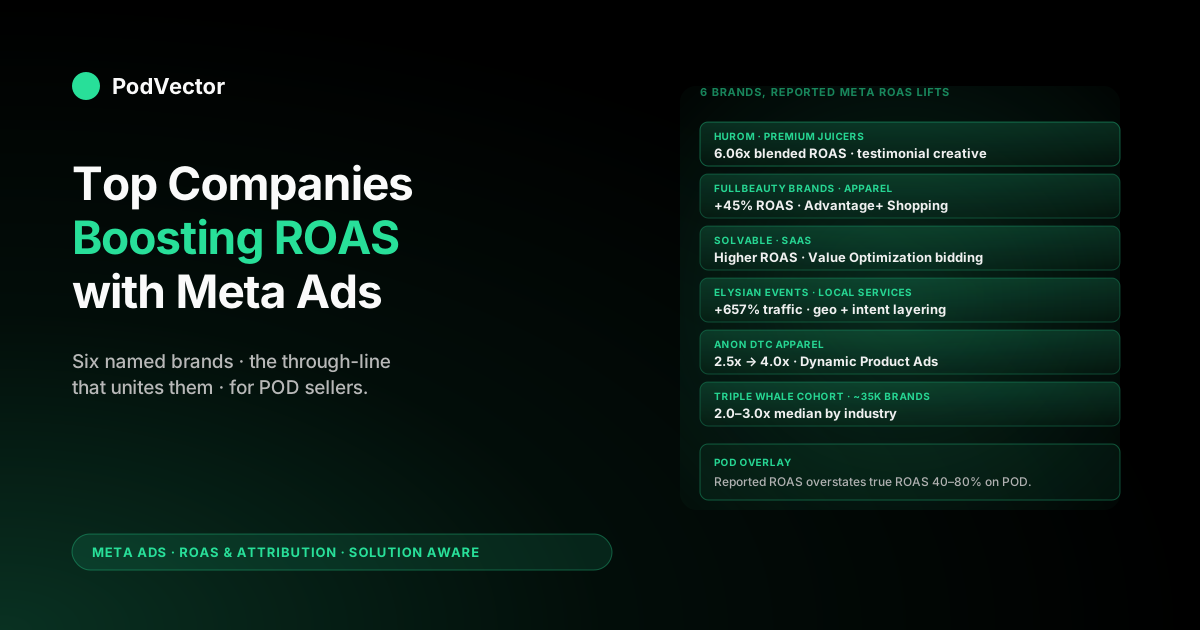
Quick Answer: Six brands repeatedly cited for boosting ROAS on Meta — Hurom, FULLBEAUTY Brands, Solvable (via Adquadrant), Elysian Events Catering, an anonymous DTC apparel brand, and the Triple Whale benchmark cohort — share three habits, not three tactics.
They send a profit-correct value signal to Meta, run layered retargeting against warm cohorts, and refresh creative on a fixed cadence. Reported lifts range from 45% (FULLBEAUTY) to 6.06x blended ROAS (Hurom).
For a print-on-demand store, none of those headline numbers translate directly. Reported ROAS uses order subtotal as the conversion value — for Printify or Printful, that ignores supplier cost and inflates the number 40–80%. Below: what each brand actually did, the POD-specific overlay, and how to copy the move without copying the inflated dashboard.
The 6 brands cited most for Meta ROAS lifts
Almost every "top companies for Meta Ads ROAS" listicle recycles the same handful of public case studies. The same names appear because they have publicly disclosed numbers — most brands either don't share or share only directional claims like "double-digit lift."
The six below are the ones with concrete figures. They span DTC commerce, B2B SaaS, local services, and aggregated cohorts — useful because the through-line works across categories.
| Brand | Category | Reported lift | Signature move |
|---|---|---|---|
| Hurom | Premium juicers | 6.06x blended ROAS (US) | Testimonial + expert video |
| FULLBEAUTY Brands | Plus-size apparel | +45% ROAS, +22% CVR, +36% CTR | Advantage+ Shopping |
| Solvable (Adquadrant) | SaaS | Improved ROAS via Value Opt. | Value Optimization bidding |
| Elysian Events Catering | Local services | +657% website traffic | Geo + intent layering |
| Anonymous DTC apparel | Apparel | 2.5x → 4x ROAS | Dynamic Product Ads + creative refresh |
| Triple Whale cohort | ~35,000 brands | Median ~2.0–3.0x by industry | Aggregate benchmark |
The five named brands and the cohort tell the same story from different angles. The named brands prove that specific tactics work in specific contexts. The cohort proves the benchmark spread is real. Together they bracket the realistic range a POD seller should expect.
Hurom: 6.06x blended ROAS via testimonial creative
Hurom sells premium cold-press juicers — high AOV, considered purchase, strong category authority. They reported a 6.06x blended ROAS in the US market.
The signature move was creative composition: testimonial-led video ads paired with expert-led explainer content. Not polished brand spots, not pure UGC — a mix calibrated to the considered-purchase nature of a $400+ kitchen appliance.
What stands out is creative cadence. Hurom rotated through a portfolio of testimonial angles to avoid fatigue. Their internal benchmark was that any given creative carried 70–80% of an ad set's spend for no longer than 14 days before a fresh variant took over.
The lesson for any operator: at high AOV, social proof beats every other angle. Not every brand has Hurom's product moat, but every brand can collect testimonials.
FULLBEAUTY Brands: 45% ROAS jump via Advantage+
FULLBEAUTY Brands runs plus-size women's apparel across multiple sub-brands. They reported a 45% ROAS lift, 22% CVR lift, and 36% CTR lift after switching prospecting campaigns to Advantage+ Shopping.
Advantage+ Shopping is Meta's all-in-one auto-targeted commerce campaign type. The advertiser supplies a budget, a product catalog, and creative; Meta's algorithm handles audience selection, bid placement, and creative rotation.
FULLBEAUTY's win wasn't that Advantage+ is magic. It was that they had three things ready before flipping the switch — a clean product catalog, a multi-creative library, and enough event volume (50+ purchases per week per ad set) for the algorithm to converge.
Most brands flip the switch without those prerequisites and see flat or negative results. Advantage+ is leverage on existing inputs, not a substitute for them.
Solvable (Adquadrant): Value Optimization for SaaS
Solvable is a Software-as-a-Service product. Their case study, run through agency Adquadrant and published by Meta, focused on Value Optimization bidding — a strategy where the advertiser sends a custom value parameter (lifetime value, contribution, or another internal metric) on each conversion event, and Meta's algorithm optimises against that instead of conversion count.
The result was higher ROAS at equal or lower spend. The mechanism: Meta's bidder learned to identify users who would convert at higher predicted value, not just users who would convert at all.
This is the move that translates most directly to print-on-demand. The default Shopify–Meta integration sends order subtotal as the value parameter. For a Printify or Printful store, that overstates the worth of every order by 40–60%. Replacing subtotal with contribution margin (subtotal minus supplier cost minus payment fees minus expected refunds) gives the algorithm a profit-correct signal.
Solvable's category is different from POD, but the bid-strategy mechanic is identical. For a definition-level walkthrough, see Meta Ads ROAS definition for POD sellers.
Elysian Events Catering: 657% traffic via local intent
Elysian Events Catering is a local services business. They reported a 657% surge in website traffic within one month after launching a Meta Ads program.
The traffic figure is impressive but isn't a ROAS number — services businesses with phone-call conversions and event quotes often can't measure ROAS the way commerce brands do. That's worth flagging, because most "Meta Ads case study" lists conflate top-of-funnel traffic lifts with downstream profit.
Their playbook was geo-locked targeting plus event-intent signals. Catering inquiries spike around weddings, corporate retreats, and milestone birthdays — Meta's interest categories caught users actively planning those events.
The transferable lesson for POD: niche audiences with strong intent signals (a breed-specific dog community, a retired-teacher Facebook group, an LGBTQ+ pride sub-niche) often outperform broad targeting on cost-per-purchase, even though they can't hit the scale Advantage+ reaches.
Anonymous DTC apparel brand: 2.5x to 4x via DPAs
An anonymous DTC apparel brand (referenced in industry case studies but not publicly named) reported a ROAS lift from 2.5x to 4x after two changes: implementing dynamic product ads (DPAs) and instituting a fixed creative refresh cadence.
DPAs use the product catalog feed to show site visitors the specific product they viewed or added to cart. The creative is auto-generated; the targeting is defined by the catalog.
This brand's specific trick was layering DPAs on top of a traditional retargeting funnel — Tier 1 (product viewers) saw the exact product, Tier 2 (cart abandoners) saw the cart contents plus a complementary item, Tier 3 (past purchasers) saw a new collection or bundle.
For POD apparel, DPAs are particularly high-leverage because the SKU count is usually wide (hundreds of designs across a few base products). Hand-built retargeting can't keep up with that catalog breadth. For implementation, see Facebook dynamic product ads for Shopify.
The Triple Whale 35,000-brand cohort
Triple Whale publishes aggregate benchmarks across roughly 35,000 ecommerce brands. Their cohort isn't a single company, but it's the most useful reference because it shows the actual spread.
Median ROAS by industry on their cohort sits in the 2.0–3.0x range. Beauty and personal care leads at ~3.2x. Apparel sits closer to 2.0–2.5x. Home goods land around 2.4x.
What the aggregated number hides: the gap between the top quartile and the median. Top-quartile brands run 4–5x ROAS in apparel — twice the median. The differentiator isn't budget. It's the same handful of habits the named brands above demonstrate.
Triple Whale's external benchmark report is worth reading directly: Facebook ad benchmarks by industry. Treat it as the spread, not as a target.
What all six share
Six brands across four categories. The headline tactics differ — testimonial creative, Advantage+, value bidding, geo targeting, DPAs, aggregate discipline. The underlying habits are the same three things.
Habit 1: They send a profit-correct value signal to Meta
Solvable did it explicitly via Value Optimization. Hurom did it implicitly by selling a high-margin durable. FULLBEAUTY did it by feeding Advantage+ a clean catalog with margin already built into pricing.
What unites them: Meta's algorithm was learning from a value parameter that correlated with their actual profit, not just GMV. The closer the alignment between Meta's signal and your real margin, the more efficient the bidder gets at finding profitable customers.
For POD, this is the single biggest gap. The default integration sends GMV. Without a fix, Meta optimises toward the highest-revenue orders, which on POD are often the lowest-margin ones (large-format prints, all-over-print products with steep supplier costs).
Habit 2: They run layered retargeting against warm cohorts
The anonymous apparel brand did it with three DPA tiers. Hurom did it with sequenced testimonial creative for prospects vs. owners. FULLBEAUTY did it via Advantage+'s built-in funnel logic.
The principle is the same. Cold prospecting feeds the top of the funnel; warm retargeting harvests it. Public benchmarks place retargeting median ROAS at 3.61x versus prospecting's 2.11x — meaning roughly 70% more efficient on the same dollar.
The break-even on retargeting infrastructure is tiny. A 10,000-visitor month is enough seed audience to make the numbers work.
Habit 3: They refresh creative on a fixed cadence
Hurom's 14-day rotation. The anonymous brand's monthly DPA + creative cycle. FULLBEAUTY's catalog-feed-driven refresh.
Creative fatigue is real. Public data shows 30–50% performance decay after a creative reaches 2–3x audience reach. The brands at the top of the benchmarks aren't the ones with one breakout creative — they're the ones with a portfolio so the next creative is already warming up when the current one fades.
Most stores under-produce. Three new creatives per quarter is not a refresh cadence; it's a slow death.
The POD overlay: why these numbers don't translate
Every case study above measured success in reported ROAS — what Meta's dashboard showed. For most ecommerce categories, reported ROAS is reasonably close to true ROAS because supplier cost is a small fraction of revenue.
For print-on-demand, that assumption breaks. A typical Printify hoodie selling for $26.99 carries a $14.20 supplier cost — 53% of revenue gone before Meta's number is reported. Add 2.9% + $0.30 in payment fees, ~5% in refunds and chargebacks, and shipping subsidies, and reported ROAS routinely overstates true ROAS by 40–80%.
That changes which case-study numbers you should anchor on.
| Their reported ROAS | POD true ROAS (approx.) | Profitable for POD? |
|---|---|---|
| 6.06x (Hurom) | 3.0–3.5x | Yes — well above break-even |
| 4.0x (anon apparel) | 2.0–2.4x | Marginal — break-even sits around 2.0–2.2x |
| 3.2x (beauty median) | 1.6–1.9x | No — below POD break-even |
| 2.5x (apparel median) | 1.25–1.5x | No — losing money on every dollar |
The translation isn't a fixed multiplier. It depends on supplier choice (Printify Premium vs. Printful), product mix, and whether you absorb shipping. But the direction is consistent: every POD operator should mentally cut reported case-study ROAS by 40–50% before deciding whether the playbook is good enough.
This is also why the "boosting ROAS" lift matters more than the absolute number. A brand that went from 2.5x to 4.0x reported gained meaningful ground regardless of category. A brand that ran 6.0x in one quarter doesn't tell you whether the playbook is replicable. Focus on the delta.
For a deeper walkthrough of the math, see the cluster's complete guide to Meta Ads ROAS and attribution for POD.
Worked example: applying the moves to a $40K/month POD store
A Printify-backed apparel store. $40K monthly revenue, $8K monthly Meta ad spend, currently reporting 4.0x ROAS in Meta's dashboard.
Pulling the supplier invoices, the contribution math comes out closer to 1.95x. Just above break-even, far below the dashboard.
Move 1: send contribution as the Purchase value (Solvable's habit). Server-side webhook intercepts the Shopify order, subtracts Printify supplier cost, payment fee, and a 5% refund reserve, then fires the Purchase event with the resulting margin. After 10–14 days of recalibration, Meta is bidding against profit instead of GMV. Most POD operators see reported ROAS climb 30–60% within three weeks. True ROAS (the one that pays rent) often climbs 50–90%.
Move 2: build a three-tier retargeting funnel (anonymous apparel brand's habit). Tier 1 — 14-day product viewers, DPA creative pulling exact products. Tier 2 — 30-day cart abandoners, urgency creative with reviews. Tier 3 — 180-day past purchasers, new-collection creative. Median lift on POD apparel is 25–40% blended ROAS, mostly from Tier 3 squeezing repeat purchases out of an audience the store was previously ignoring.
Move 3: institute a 14-day creative rotation (Hurom's habit). A portfolio of 8–12 active creatives at any time, with the oldest swapped out every two weeks. This requires a UGC sourcing pipeline (Insense, Trend, or in-house) and a tagging convention so creative-level performance is analysable in aggregate. Cost: roughly 2–3% of media spend.
Compounded, the three moves take this $40K store from 1.95x true ROAS to a realistic 2.6–3.0x range over a quarter. That's a swing from "barely profitable" to "fund the next product launch."
The compound math is the point. None of these moves is novel, and none of them is the move at the top of the case-study headlines. They're the underlying habits the headlines describe.
For a different angle on the same playbook, see who does Meta Ads best for increasing ROAS and the best ways to use Meta Ads for higher ROAS.
FAQs
Why does Meta's reported ROAS overstate POD profitability?
Because the default Shopify–Meta integration uses order subtotal as the Purchase event's value. For a Printify or Printful store, that ignores supplier cost (often 50%+ of revenue), payment processing fees, and refund reserves. A 4.0x reported ROAS on POD apparel is usually 2.0–2.4x on actual contribution. The fix is replacing the value parameter with computed margin via a server-side webhook or custom data layer.
Are these case studies replicable for a small POD store?
Partially. Hurom's testimonial creative, the anonymous brand's DPA layering, and Solvable's value-bidding mechanic all work at any scale. FULLBEAUTY's Advantage+ result requires 50+ weekly purchases per ad set for the algorithm to converge — most stores under $5K/day spend won't hit that threshold and should run manual broad campaigns until volume catches up.
Which case-study brand is most relevant to print-on-demand specifically?
The anonymous DTC apparel brand. Wide SKU catalog, retargeting-heavy funnel, fixed creative cadence — that's the closest match to a typical POD store's situation. Hurom's high-AOV testimonial play translates poorly because POD tees and hoodies don't carry the considered-purchase weight of a $400 juicer.
What's the realistic ROAS ceiling for a Printify or Printful store?
On reported ROAS: 4–5x is achievable at scale with disciplined creative and value-bidding. On true (post-supplier-cost) ROAS: 2.5–3.5x is the realistic top quartile. Stores operating at 2.0x true ROAS are roughly at industry median. Anything below 1.8x is losing money on the variable side after fees, even if the dashboard looks healthy.
Does Advantage+ Shopping work for niche POD stores?
Usually yes, with audience exclusions. Advantage+ defaults to broad targeting which hurts hyper-niche stores. Use exclusions (off-niche past purchasers, broad demographic exclusions, geo restrictions) rather than narrow inclusions. Test 14 days against a manual broad campaign and compare on contribution ROAS, not reported ROAS. The cluster's CBO vs ABO breakdown covers the campaign-structure decisions in detail.
Is hiring a Meta Ads agency worth it for POD?
Only if the agency demonstrably runs the value-signal fix and the supplier-cost-aware reporting layer. Most agencies optimise to whatever signal the data layer provides, which by default is GMV. Without a profit-correct Purchase event, an excellent agency will still drive the store toward the highest-revenue, lowest-margin SKUs. For agency selection criteria, see the Meta Ads agencies and courses for POD guide.
How do I know if my reported ROAS is overstating true ROAS?
Pull a sample of recent orders from Shopify, subtract supplier cost (Printify or Printful invoice), payment fee (2.9% + $0.30), refund reserve (typically 4–6%), and shipping subsidy if any. The ratio of remaining contribution to revenue is your contribution margin percent. Multiply your reported ROAS by that percent to estimate true ROAS. A 4.0x reported × 50% contribution = 2.0x true. If you'd rather see this answered in plain English from your live data instead of a spreadsheet, see the complete Meta Ads playbook for POD sellers.
See your true ROAS, not your dashboard ROAS
Every case study above measured what Meta's dashboard reported. For Printify and Printful sellers, the dashboard is consistently 40–80% optimistic. Victor joins your Shopify, Meta, supplier, and payments data into a single live data warehouse and answers questions like "which Meta campaigns were unprofitable last week after supplier cost?" in plain English — with the campaign list, the contribution numbers, and the cause.
Try Victor freeRelated reading: all ROAS & Attribution articles · Meta Ads topic hub · the complete guide to Meta Ads ROAS and attribution for POD.