
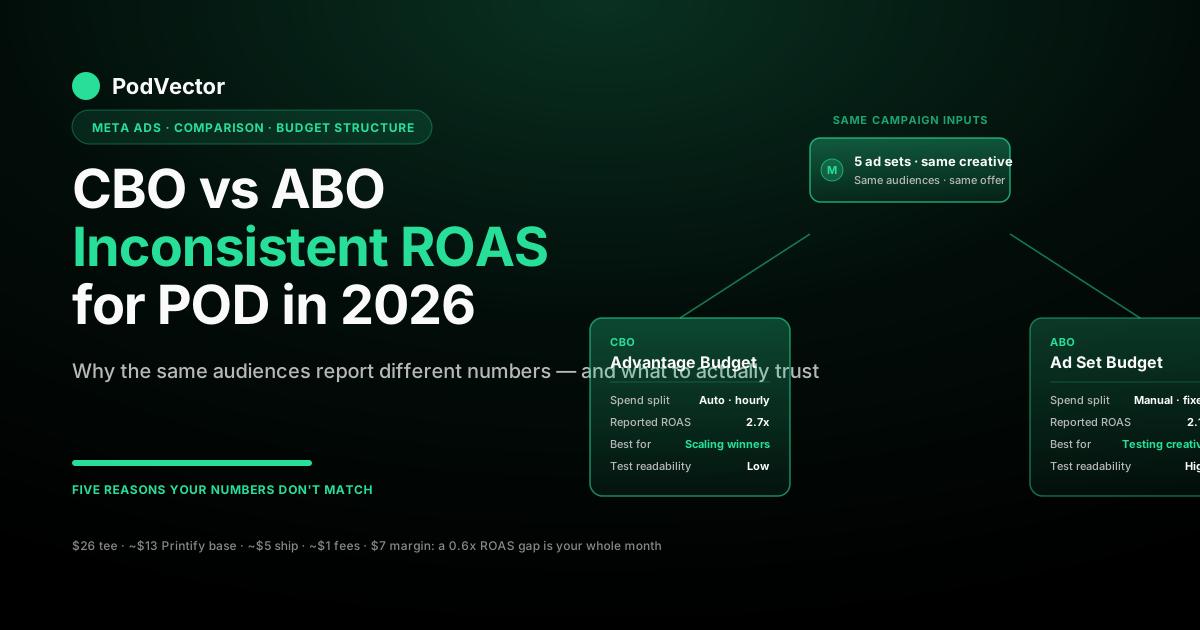
Quick Answer: Neither is "best" on its own — for POD sellers the answer is test in ABO, scale in CBO. ABO (Ad Set Budget Optimization) gives every ad set equal spend so you get a clean read on which creative wins; CBO (Campaign Budget Optimization, now called Advantage Campaign Budget) then lets Meta pour budget into the proven winner.
They report different ROAS on the same audiences because they allocate budget against different objectives, on different time scales. The "inconsistent ROAS" complaint is almost always one of five things: small-sample noise on a low-AOV POD product, Meta's intra-day budget reshuffling, attribution-window drift, learning-phase volatility, or — the one nobody talks about — a Printify or Printful cost change that landed mid-test.
The trick is making both structures reconcile to the same true margin number, which is where most operators fall apart.
Why CBO and ABO ROAS disagree on the same campaign
You duplicate a campaign. Same ad sets, same audiences, same creative, same offer. One runs CBO, one runs ABO. After three days, the ROAS numbers don't match — sometimes by 30% or more.
This is the question almost every POD operator asks within their first six months on Meta. The honest answer is that the two structures aren't actually running the same test. They're allocating budget against different objective functions, on different time scales, with different statistical properties.
CBO lets Meta's delivery system rebalance spend between your ad sets every few hours. ABO locks each ad set's daily budget. So even if you start with identical conditions, day one's spend distribution drifts apart, and from day two onward you're comparing two different experiments.
That's the real reason for the "inconsistent ROAS" complaint. The platforms and the consensus blog posts all say "use ABO to test, CBO to scale" — see AdsUploader's ABO vs CBO playbook — but they rarely explain the budget-mechanics reason the two reports disagree in the first place.
What CBO actually does (and what changed in 2026)
CBO is now officially called Advantage Campaign Budget in Ads Manager. The functionality is the same: you set one daily or lifetime budget at the campaign level, and Meta distributes it across the ad sets inside that campaign in real time.
The distribution algorithm chases the lowest cost per optimization event (purchase, in most POD cases). It can move 70%+ of spend into a single ad set within 48 hours if early signals favor it. It can also pull spend off a winning ad set when the auction conditions shift mid-day.
This is great for scaling proven winners. It's terrible for testing, because you can't read which ad set is "best" when Meta has fed three of your five ad sets almost no budget and given the fourth $400 in a single afternoon.
There's a second bias most CBO write-ups now flag: the delivery system chases the cheapest optimization events, which usually live in your largest, coldest audiences because they generate the most signal fastest. So CBO will quietly starve a smaller, higher-intent segment — a retargeting pool, a lookalike of past buyers, a niche design's interest stack — even when that segment converts at a better contribution margin. For POD, where a tight buyer lookalike often out-earns a broad cold audience on margin (not just on volume), that's exactly the wrong ad set to underfund. Minimum ad set spend is the lever that fixes it.
Two changes worth knowing about for 2026: minimum ad set spend (an option to floor each ad set's daily spend, even under CBO) is now standard rather than beta-gated, and Advantage+ Shopping campaigns have effectively absorbed the "scaling CBO" use case for catalog-driven POD stores.
What ABO actually does
ABO is the manual approach: you set the daily budget at each ad set individually. If you have five ad sets at $20/day, the campaign spends $100/day, and that $100 is split exactly 20/20/20/20/20 regardless of which ad set is performing.
Meta still optimizes within each ad set — it picks which ad to show, which placements, which time of day — but it doesn't move money between ad sets. That's the operator's job.
The reason ABO is the right structure for testing is that equal spend gives every ad set equal statistical weight. With ABO you can compare ad sets on real conversion data after a few days, instead of guessing whether the laggard "would have worked if Meta gave it budget."
The trade-off: ABO will keep spending on losers until you turn them off. There's no automatic budget shift. So ABO requires more daily attention than CBO, which is why most operators eventually graduate to a hybrid.
The five reasons your numbers don't match
1. Small-sample noise on a $20 AOV product
If your tee or hoodie has a $25 AOV and you run two campaigns at $50/day, each campaign needs roughly 8–12 conversions per ad set to escape statistical noise. That's 1–2 weeks of data for a fresh ad set, not the 3 days most operators look at.
POD's lower AOVs make this worse than for, say, a $120 supplement bundle. A 3-day ROAS of 2.1x vs 2.7x on identical creative often means nothing — the confidence interval covers both numbers.
This shows up as "CBO ROAS is way better than ABO" or vice versa on day three, then reverses by day eight when both campaigns have enough conversions to actually compare.
2. Meta's intra-day budget reshuffle
Inside a CBO campaign, Meta can shift $50 from ad set A to ad set B at 2 PM if A's CPM spikes or B's signals improve. Your day-end ROAS at the campaign level reflects that reshuffle.
The same ad sets running ABO would have spent the original $50 each, regardless of intra-day signals. That mechanical difference alone produces 15–25% ROAS gaps on otherwise identical inputs.
3. Attribution window drift
Meta's default 7-day click + 1-day view attribution leaks differently across CBO and ABO when the ad sets have different daily spend curves. A CBO ad set that fires hard on Tuesday afternoon and goes quiet Wednesday will pick up Tuesday-purchase view-through credit that an evenly-paced ABO ad set wouldn't.
Compounded over a 7-day reporting window, this is enough to drive a real-looking ROAS gap that has nothing to do with which structure is "better."
4. Learning-phase volatility
An ad set is in learning until it accumulates 50 optimization events in a 7-day rolling window. Until then, Meta is exploring, not optimizing. CPMs are volatile, frequencies are uneven, and ROAS swings widely.
CBO lets Meta concentrate spend on the ad set that's closest to exiting learning, which can compress total learning time at the campaign level. ABO holds each ad set on the launch budget, which is often too low for any single ad set to leave learning.
Result: 2-week ABO test ROAS often understates the campaign's real potential, because most ad sets never escaped learning.
5. The Printify or Printful cost change nobody flagged
This is the POD-specific one almost no Meta-ads blog covers. Your fulfillment partner adjusted a base cost mid-campaign — a Gildan blank went up $0.40, a hoodie went up $1.80, shipping changed for one carrier zone — and your real margin shifted. But Meta-reported ROAS doesn't know about that. It still shows the same revenue-divided-by-spend number.
Two campaigns with "identical" cost structures may be running on top of different actual POD costs because your test creative is mostly tees while the scale campaign drifted toward hoodies. ROAS looks consistent. Margin doesn't.
For more on this gap between Meta-reported ROAS and real POD margin, see our complete guide to Meta Ads ROAS and attribution for POD.
The POD margin overlay nobody else mentions
Generic Meta-ads advice treats ROAS as the answer. For POD it's only the question.
A typical POD tee sale: $26 retail, ~$13 Printify or Printful base cost, ~$5 shipping baked into price, ~$1 in payment and platform fees. That leaves about $7 of contribution margin to defend against ad spend before you're losing money on the order.
If your blended Meta ROAS is 2.5x, you're paying $10.40 per $26 sale to acquire it. That eats $10.40 of the $7 margin and you're $3.40 underwater per order. ROAS of 2.5x, which sounds fine in a generic ecommerce article, is a slow bleed for a POD store.
This is why CBO vs ABO ROAS gaps matter so much for POD operators specifically. A 20% ROAS difference (2.1x vs 2.5x) is the difference between losing money and breaking even. A 40% difference is your entire month.
The fix is to stop comparing the two campaigns on Meta-reported ROAS and start comparing them on contribution margin, computed from your actual Shopify revenue and your actual Printify/Printful costs for that period. For deeper Printify-cost stack reading, see our complete guide to Printify costs, fees, and discounts.
The hybrid playbook: test in ABO, scale in CBO
Every credible Meta-ads operator in 2026 runs the same two-stage workflow. The only differences are how aggressively each stage is structured.
Stage 1 — ABO testing campaign
One campaign with 4–6 ad sets, equal daily budgets ($15–$50/ad set depending on AOV), one creative concept per ad set. Let it run 7–10 days minimum, ideally until each ad set has 30+ purchases.
Read winners on cost-per-purchase or contribution-margin-per-purchase, not on ROAS alone. Anything within statistical noise of the leader ships to Stage 2.
Stage 2 — CBO scaling campaign
Take the 1–3 winners from Stage 1 and put them in a new campaign with Advantage Campaign Budget enabled. Start the daily budget at 2–3x what those ad sets were spending in ABO. Let Meta distribute.
For catalog POD stores, a parallel Advantage+ Shopping campaign often outperforms manual CBO once you have proven creative. The bar to switch: Stage 2 CBO has run 2+ weeks at stable margin and the catalog has 30+ live SKUs.
Stage 3 — kill, swap, or scale
Kill ad sets in Stage 2 that drop below your contribution-margin floor for 5+ days. Swap creative on stalled winners every 2–3 weeks. Scale daily budget by 20% increments, not 100%, to avoid resetting learning.
Decision matrix: which to use this week
| Your situation | Use this | Why |
|---|---|---|
| New product, untested creative | ABO | Equal spend = readable test |
| 3+ proven winners, want to scale to $300+/day | CBO (Advantage Campaign Budget) | Meta moves money to the strongest ad set hourly |
| Catalog of 30+ live designs, mature pixel | Advantage+ Shopping | Catalog-driven scaling beats manual CBO |
| Mixed: 1 winner + 3 testers | CBO with minimum ad set spend | Floor each tester so Meta can't starve it |
| Sub-$50/day spend, single creative | ABO with one ad set | Below the threshold where CBO matters |
| Q4 spend ramp on proven product | CBO + Advantage+ Shopping in parallel | Manual CBO holds prospecting; A+ handles catalog DPA |
If your store sits closer to the lower-spend end of this matrix, our broader Meta Ads vs alternatives comparison for POD covers when the channel itself is the wrong choice.
Mistakes POD sellers make with CBO/ABO ROAS
Reading 3-day ROAS as if it were 30-day ROAS
Three days of data on a $25 AOV product is almost always inside the noise band. Resist the urge to kill ad sets before day seven. If you're already comparing Meta against other channels at this stage, our Google Ads vs Facebook Ads cost comparison for POD goes deeper on the cross-channel side.
Trusting Meta-reported ROAS without subtracting Printify cost
Meta sees revenue and spend. It doesn't see your $13 base cost or your shipping. A 2.5x ROAS in Ads Manager can be break-even, profitable, or losing money depending on which SKU mix drove it.
Switching from ABO to CBO mid-test
Resets every ad set's learning, throws away your test data, and creates a new attribution window. Don't. Run the test through, then duplicate the winners into a new CBO campaign.
Comparing campaigns on different attribution windows
If your CBO campaign reports on 7-day click and your ABO campaign reports on 1-day click, the ROAS gap is mostly the window — not the budget structure. Set both to the same window before drawing conclusions.
Ignoring frequency caps
CBO campaigns often spike frequency on a single audience because Meta hammers the cheapest-impression target. If your retargeting frequency hits 6+ in a week, ROAS will start degrading regardless of CBO vs ABO mechanics.
Forgetting that Printify ran a price change
Printify and Printful adjust base costs occasionally, and shipping carriers reprice quarterly. A "ROAS dropped" mystery is sometimes a $0.40 base-cost increase on the SKU your top creative happens to drive. For a deeper guide on tracking this, see our complete Meta Ads playbook for POD.
Reconciling Meta-reported ROAS to your real margin
The hardest part of running CBO and ABO side by side isn't the budget structure. It's reconciling the two campaigns' performance to a single trustworthy margin number.
Meta Ads Manager shows revenue and spend. Shopify shows orders and AOV. Printify or Printful shows base cost and shipping. Each tool has its own definition of "the period," its own attribution rules, and its own concept of a refund. Stitching them together by hand in Sheets is where most POD operators give up and just trust Meta's number.
The clean answer is to land all four data sources in a single source of truth — your Shopify orders, your ad spend across Meta and Google, your Printify or Printful line-item costs, and your fulfillment shipping — and compute contribution margin per ad set from there. That single number is what tells you whether CBO or ABO is actually winning.
This is what Victor handles for POD operators. It plugs into Shopify, Meta Ads, Google Ads, Printify and Printful, and a unified data warehouse, and answers margin-per-ad-set questions in plain English. No SQL, no reconciliation spreadsheet, no choosing which platform to trust. For a closer look at the architecture, see our guide to AI agents for ecommerce, POD edition.
FAQs
Is CBO better than ABO for POD?
Neither is "better" in isolation — they solve different problems. ABO gives you a clean test read. CBO gives you efficient scaling. POD operators usually run both: ABO for testing fresh creative, CBO (or Advantage+ Shopping) for scaling proven winners.
Why do my CBO and ABO campaigns show different ROAS on the same audiences?
Five common causes: small-sample noise on a low-AOV product, Meta's intra-day budget reshuffle inside CBO, attribution-window drift, learning-phase volatility, and POD-specific cost changes from Printify or Printful that hit one campaign but not the other. Almost always at least two of those overlap.
How long should I run an ABO test before reading results?
For a $20–30 AOV POD product at $20–50/ad set/day, give it 7–10 days minimum, or until each ad set has 30+ purchases — whichever comes later. Earlier reads are inside statistical noise.
What's the minimum daily budget for CBO to work?
Meta's official guidance is 50 optimization events per ad set per week to escape learning. For a POD store that means roughly $100/day campaign budget split across 2–3 ad sets, assuming a $25 AOV and a 1.5–2.5x ROAS. Below that, CBO will starve some ad sets and the data is unreadable.
Can I switch from ABO to CBO mid-campaign without losing data?
No. Switching the budget structure resets each ad set's learning phase. The right move is to leave the ABO test running, duplicate the winners into a new CBO campaign, and let the original ABO conclude.
Does CBO work with Advantage+ Shopping?
Advantage+ Shopping campaigns have CBO-style budget logic baked in — there's no ABO option. If you're running Advantage+ Shopping for catalog DPA, you're effectively running CBO. For broader Advantage+ context for POD, see our complete Meta Ads playbook for print-on-demand sellers.
Should I trust Meta's ROAS or Shopify's revenue number?
Neither in isolation. Meta over-counts because it claims view-through and click-through credit that overlaps with other channels. Shopify under-counts because it can't see view-through. The right number is contribution margin computed from blended spend across all channels and your real Printify/Printful costs.
How do I tell if it's the budget structure or the creative?
Run the same creative in both ABO and CBO with matched audiences. If the ROAS gap is >30% after both campaigns clear learning, it's structural. Under 30% and the gap is usually creative drift or attribution-window noise.
Is "CBO" still called CBO in 2026?
Officially, no — Meta renamed it to "Advantage Campaign Budget" inside Ads Manager. Operators and most blogs still call it CBO because the name is faster and unambiguous. Both refer to the same feature.
Where do these benchmarks come from?
The CPC, CVR, and ROAS ranges in this guide are 2026 figures from our POD-operator client cohort, cross-referenced against published Meta Ads benchmarks. For a third-party operator perspective on the same workflow, Aden's Lab on CBO vs ABO for scaling covers the testing-to-scaling handoff in similar terms. For broader POD context across our entire Meta Ads comparison cluster and the full Meta Ads topic hub, follow the cluster links.
Stop chasing ROAS that doesn't survive your Printify costs.
CBO says one number. ABO says another. Shopify shows different revenue. Your Printify margin disagrees with all three.
Victor unifies your Shopify orders, Printify and Printful costs, Meta Ads, Google Ads, and pixel attribution into one live data warehouse — and answers margin-per-ad-set questions in plain English. No SQL, no reconciliation spreadsheets, no platform-by-platform ROAS chasing.
Try Victor free