
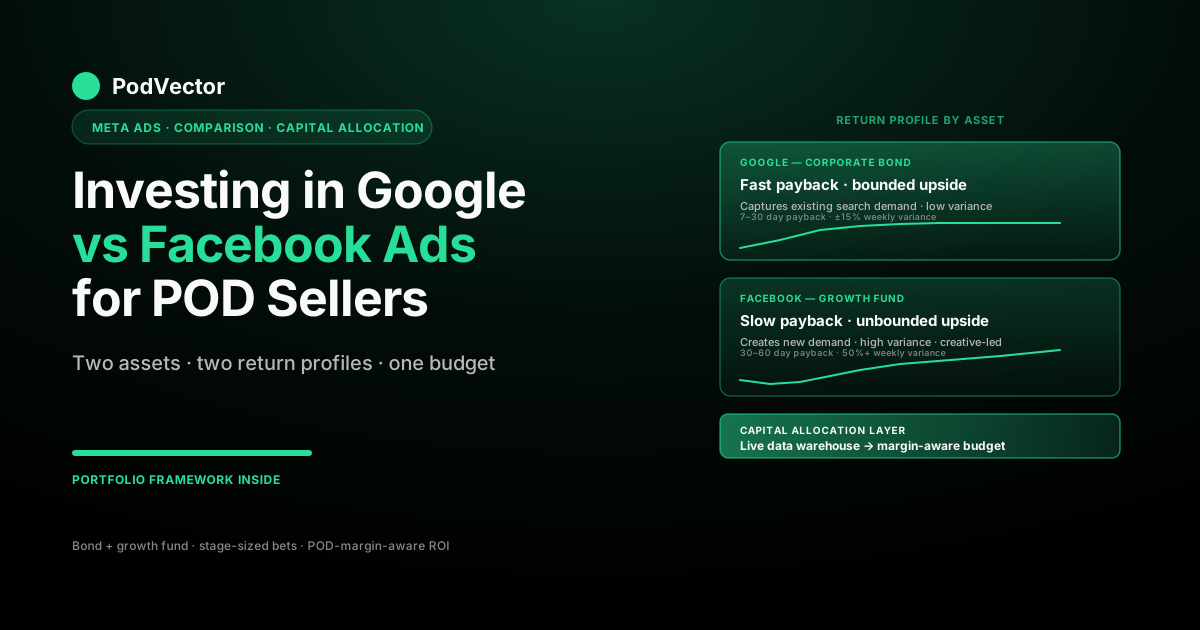
Quick Answer: Treat the platform choice like a capital allocation decision, not a marketing one. Facebook is a higher-variance, longer-payback investment that compounds when creative hits; Google is a lower-variance, faster-payback investment that caps out at how much demand already exists for your category.
For most POD operators, the right "first dollar" goes to Facebook because POD designs are visual and demand has to be created before it can be captured. The right "tenth dollar" goes to Google because branded search and named-SKU shopping are the cheapest revenue protection in the entire ad stack.
This guide reframes the comparison as an investment thesis: what each platform actually returns, how long the payback takes, what the risk profile looks like, and how to size the bet at every stage of a POD store's growth.
Reframing as an investment decision
Most "Google vs Facebook" articles compare features. That framing misses what the decision actually is for a POD operator with a finite ad budget.
A POD operator isn't choosing a tool. They're allocating capital across two assets with different return profiles. Once you frame it that way, the right questions get clearer.
Three questions every investment has to answer
Whether you're buying an index fund or buying ad clicks, the same three questions apply. What's the expected return? How long until I see it? How much could I lose?
For Google Ads, the return is bounded by existing search demand for your category and SKUs. The payback shows up inside the first 14–30 days. The downside is mostly capped at "I spent the budget and didn't convert."
For Facebook Ads, the return is unbounded but contingent on creative hitting. The payback can take 30–90 days as the algorithm learns. The downside is bigger — wasted creative spend on designs that don't resonate, plus the iOS 14.5+ attribution noise that hides what worked.
Why this matters more for POD than for generic ecommerce
Generic ecommerce has 50–75% gross margins. POD has 20–35% gross margins after Printify or Printful supplier costs, shipping, and platform fees.
That margin compression means every wasted ad dollar costs roughly 2–3x more in real opportunity cost than it would for a higher-margin store. The investment lens isn't optional — it's the only frame that survives the math.
The return profile of each platform
Both platforms can produce 2–4x reported ROAS in the right hands. But the shape of the return curve is completely different, and that shape is what should drive the allocation decision.
Google's return profile: bounded, predictable, fast
Google Shopping serves the slice of users who are already searching for products like yours. That demand is finite. There's a cap on how much you can spend before you've bid on every relevant search query and impressions plateau.
Inside that cap, returns are unusually predictable. A standard Shopping campaign on a 30-SKU catalog with decent feed quality will hold a stable ROAS within ±15% week over week once it has 60+ days of conversion data.
The trade-off is that this stability is also the ceiling. You can't 10x your Google Shopping spend without 10x'ing the underlying search demand, which doesn't move on a marketing timeline.
Facebook's return profile: unbounded, volatile, slow to start
Facebook serves users who weren't looking for your product. The addressable audience is effectively unlimited at POD price points — every adult on the platform with a relevant interest is a potential buyer.
That unboundedness is the upside. A creative that hits can scale from $25/day to $500/day in 60 days without ROAS collapsing, because the audience is deep enough to absorb the spend.
The downside is variance. Most creatives don't hit. The expected return on a single creative test is negative — you pay for the test, learn something, and the value is in the next iteration. Treating individual tests as investments fails; treating the testing pipeline as a portfolio works.
The portfolio analogy
Google is a corporate bond — predictable yield, capped upside, low variance. Facebook is a small-cap growth fund — high variance, occasional 10-baggers, regular tests that go to zero.
Real portfolios hold both. The bond floor pays the rent. The growth fund pays for the future. POD ad budgets work the same way. For the head-to-head feature breakdown, our Google Ads vs Facebook Ads features and benefits guide walks through the surface-level comparison this investment view sits on top of.
Payback periods: how fast each dollar comes back
Payback period is the most important metric most POD operators don't track. It tells you how long your cash is locked up before it returns, which is the single biggest driver of how much you can spend.
Google's typical payback
For a Standard Shopping campaign at decent feed quality, the first dollar comes back in 1–7 days for branded search and 7–21 days for non-branded shopping. The campaign is profitable on day 30 if the unit economics support the channel at all.
That fast payback means you can reinvest faster. A Google Shopping account at $50/day producing $100/day in revenue cycles capital roughly 12x per year, which is what funds organic growth without taking on debt.
Facebook's typical payback
For a new Facebook account or new creative, day-1 ROAS is almost meaningless. The pixel is still learning, attribution is still spotty, and the first 50 conversions are noise.
Real Facebook payback shows up at day 30–60 once Conversions API data has stabilized and the algorithm has found the converting audience. Stores that quit Facebook at day 14 because "ROAS is bad" are quitting before the asset has finished being built.
The cash flow implication
A POD store with $3,000 of working capital can run a $50/day Google account profitably starting around month 2. The same $3,000 in Facebook would need to weather a 60-day learning period before it's clear whether the investment paid off.
This is why under-capitalized stores should start with Google. Not because Google is "better," but because Google's faster payback matches the cash cycle of a small store. Our Google Ads vs Facebook Ads cost breakdown for POD covers the per-dollar economics in detail.
Risk profile and variance
Every investment has both expected return and variance. Two assets with the same average return are not equivalent if one swings 50% week-to-week and the other moves 5%.
Google's risk profile
Google Shopping's main risk is structural: if your product category doesn't have searchable demand, no amount of optimization fixes it. A new licensed-design SKU with zero monthly searches will not produce Shopping conversions, period.
Inside categories that do have demand, the variance is low. Week-to-week ROAS swings are usually driven by competitor bid changes or seasonal demand shifts, not by the platform doing something opaque.
The catastrophic-loss scenario for Google is a Merchant Center suspension, which kills the campaign overnight. Mitigation is keeping product data clean and following the GTIN policy.
Facebook's risk profile
Facebook's variance is much higher. The same campaign can do 3x ROAS one week and 1.2x the next with no obvious change, because the algorithm reshuffles audiences continuously.
Layered on top is platform-policy risk. Facebook ad accounts get disabled with no warning for reasons that often aren't violations. POD stores running designs in policy-adjacent niches (political, religious, mental health) carry meaningfully higher account-disable risk than generic apparel stores.
Then there's iOS 14.5+ attribution loss. Facebook's reported ROAS can overstate or understate true revenue contribution by 20–50% on any given week, which adds measurement variance on top of performance variance.
How to size the bet
The classic capital-allocation rule: never bet more on a high-variance asset than you can lose without it killing the business. For Facebook, that means starting at 5–10% of your monthly cash buffer, not 50%.
Google's lower variance lets you allocate more aggressively. A 30–40% allocation of monthly cash to Google Shopping is reasonable once you have 60+ days of stable performance data.
Capital allocation by store stage
The right allocation between Google and Facebook isn't fixed. It changes as the store grows and as you accumulate data that lowers the variance of both bets.
Pre-revenue / first 90 days
Pick one. The variance and learning costs of running both at small budget kill both campaigns. For most POD operators, that one is Facebook, because POD designs are visual and need create-demand work before search demand exists.
The exception is licensed designs in established fandoms (Star Wars, Pokémon, popular sports teams) where named-search demand already exists. There, start with Google Shopping because the searchable demand is already on the table.
$0–5K MRR (Stage 1)
One platform, $25–75/day. The investment thesis at this stage is learning, not scaling. You're paying tuition to discover which designs convert and what your buyer looks like.
If you started with Facebook, stay there until you've found 2–3 winning creatives. If you started with Google, stay there until you've found 5–10 SKUs that profit on Standard Shopping. Adding the second platform before then dilutes both budgets below their learning floors.
$5–20K MRR (Stage 2)
Layer in the second platform. Recommended split: 70% to your primary, 30% to your secondary, with the primary being whichever channel returned positive at Stage 1.
This is also the stage where brand defense earns its slot. Once monthly branded search clears 200, a $5–10/day exact-match Google Search campaign on your store name returns 5–8x because the click is already pre-qualified.
$20–50K MRR (Stage 3)
Allocation shifts toward whichever channel has the best warehouse-attributed margin. Typical splits land at 60/40 Facebook lead for visual-design stores and 60/40 Google lead for licensed/named-SKU stores.
The scaling lever changes too. Facebook moves from cold prospecting to Advantage+ Shopping (ASC). Google adds PMax (Performance Max — Google's all-in-one auto-targeted campaign type) on top of Standard Shopping for incremental scale.
$50K MRR+ (Stage 4)
Allocation is no longer set by stage rule. It's set by warehouse-attributed margin per channel, recalculated weekly. If Google's net margin ran 1.4x Facebook's last week, Google gets the marginal dollar this week.
The right way to time-box add or remove decisions at this stage is the framework in our when to use Google Ads vs Facebook Ads breakdown.
The POD margin overlay
Generic ecommerce ROI math doesn't survive POD. Every investment-return calculation has to net out supplier cost, shipping, and platform fees before it's meaningful.
The contribution margin reality
A typical $26 unisex tee through Printify carries roughly $11–13 in supplier cost, $4.50–5.50 shipping, and about $1.20 in Shopify and payment processing fees. That leaves $5.50–9.30 of contribution margin per unit before any ad dollar touches the math.
That changes the maximum tolerable customer acquisition cost. A generic ecommerce CPA target of $15 is a money-losing strategy at POD margins. The investment math has to use POD-specific contribution per order, not industry averages.
Printify vs Printful matters for the calculation
Printify routes orders to whichever supplier is cheapest per garment, so per-SKU margin varies inside one campaign. Printful uses one in-house production network with consistent base costs.
For Google Shopping investment math, the Printify variance means SKU-level bidding matters. A $26 tee from one Printify provider can carry $11 base cost while the same tee from another provider carries $14 — that's a 30% margin gap inside the same campaign. Our Printify vs Printful cost comparison walks through the per-SKU math that has to underlie any allocation decision.
Why MER beats CPA for POD investment decisions
Single-channel CPA targets miss the multi-channel reality of POD. A buyer who saw three Facebook impressions, clicked a Google Shopping ad, and converted gets credited entirely to Google by Shopify and entirely to Facebook by Meta's pixel.
The investment math that survives is blended marketing efficiency ratio (MER — total revenue divided by total ad spend across all paid channels). For a POD store with $5–9 contribution per unit and 1.4 items per order on Facebook, the MER target that protects margin is 2.0–2.4x.
Measuring the actual return
The reason most POD operators can't tell whether their Google or Facebook investment is paying off isn't that the data doesn't exist. It's that the data lives in three different places that don't reconcile.
The triple-counting problem
Facebook claims credit for conversions its pixel saw. Google claims credit for conversions its tag saw. Shopify claims attribution by its own last-click model. Sum the three and you'll typically see 40–80% more "attributed revenue" than your actual store total.
Investment decisions made on inflated numbers are wrong by construction. The first step in serious measurement is honest reconciliation against your real order ledger.
The warehouse-attributed view
The right architecture is a unified data warehouse — Snowflake, Redshift, BigQuery, or Databricks all work — that pulls raw event logs from Facebook and Google, joins them against Shopify order IDs, and applies a multi-touch attribution model.
That gives you a single source of truth for which channel actually contributed to a sale, with deduplicated touch credit. Investment decisions made against that view stop being arguments and start being calculations.
What Victor does for POD operators specifically
PodVector AI's Victor agent answers questions like "what was Facebook's net return on investment last week after Printify supplier cost?" and "which Google campaign produced the highest-margin orders, not just the highest-revenue orders?" against your live data warehouse.
Today, Victor answers; tomorrow, Victor will act — pausing campaigns and shifting budget when the math says one channel stopped earning its share. The point of the architecture is taking budget decisions off platform-reported ROAS and onto warehouse-attributed margin. Try Victor free to see your true cross-channel return in 60 seconds.
Investment mistakes that erode the return
Five recurring patterns that show up in nearly every POD ad-account audit.
1. Splitting starter capital across both platforms
$50/day split 25/25 starves both algorithms. Each platform has a learning floor — roughly $25–50/day for Facebook ASC and $50–100/day for Google Shopping smart bidding. Underfunded learning produces noise, not data.
2. Quitting Facebook at day 14
Facebook's learning period is 30–60 days, not 14. Pulling the plug at day 14 because reported ROAS is below 2x throws away the option value of the next iteration. The first creative test is rarely the winner.
3. Optimizing on platform ROAS instead of warehouse margin
A campaign at 3.0x reported ROAS can lose money once you net out Printify supplier cost, shipping, and platform fees. Investment decisions made on platform-reported numbers are wrong by construction at POD margins.
4. Skipping brand defense once branded search exists
Once your monthly branded search volume crosses 200, competitors will buy your store name for $0.30–0.50 per click. A $5/day exact-match Search campaign blocks them. Most stores never run it, and the leak compounds month over month.
5. Treating creative testing as a cost instead of an investment
Each Facebook creative test is a small bet with negative expected value individually and positive expected value as a portfolio. Stores that budget creative testing as "marketing expense" cap their winners; stores that budget it as "R&D" find their breakouts.
For the broader cluster context, the Meta Ads comparison cluster hub covers every Meta vs alternative breakdown, and the Meta Ads topic hub spans strategy, attribution, integrations, and ad types end-to-end. The strategic foundation for the whole comparison lives in our Google Ads vs Facebook Ads for POD sellers guide, and the strategic playbook is in our Google Ads vs Facebook Ads strategy breakdown. The Meta-side investment anchor is the complete Meta Ads playbook for print-on-demand sellers.
External reference for the generic ROI framing this analysis adapts: Wicked Reports' Facebook Ads vs Google Ads attribution and ROI comparison.
FAQs
Which platform should I invest in first as a brand-new POD store?
Facebook for original visual designs, Google for licensed designs in fandoms with existing search demand. The reason is that POD's value is in the design itself, and visual platforms are structurally better at making people want a design they weren't searching for. Licensed designs are the exception because the demand already exists in search.
What's a realistic ROI to expect from each platform in year 1?
For a typical POD store at $5–9 contribution margin per unit, a blended 2.0–2.4x MER across both channels is realistic by month 6. Individual-platform reported ROAS will look higher (3–5x is common) because of double-counting, but the only number that matters is what nets out after supplier cost.
How much working capital do I need before adding the second platform?
Roughly 60 days of the new platform's spend, held in reserve. If you're adding Facebook at $50/day, that's $3,000 of working capital that you're committing to the learning period. Adding either platform without that buffer is the most common reason stores quit before payback.
Is iOS 14.5 attribution loss still a real problem?
Yes, even with Conversions API. Facebook's reported ROAS still misses 15–30% of contributed revenue on a typical POD store, and it overstates conversions for impressions Facebook saw last but didn't actually drive. The fix isn't a workaround inside the platform — it's reconciling against your order ledger in a warehouse.
Should I expect the same return profile in different POD niches?
No. Apparel and accessories with broad appeal (general humor, lifestyle, hobbies) work well on Facebook because the addressable audience is wide. Niche or technical products (specialty equipment, professional gear) work better on Google because the buyer pool is smaller and they self-identify by searching.
What's the right way to think about losing months in Facebook?
As tuition, not loss. Each losing creative test reveals what doesn't work, which narrows the search space for what does. The cost is real and the cash matters, but the return shows up in the next batch of creatives, not the one that failed.
How do I decide when to cut a Facebook campaign for good?
Three consecutive months of sub-1.0x net margin (after Printify or Printful supplier cost) despite creative refresh and audience tests. That's the threshold where the platform isn't a fit for your specific product right now. Pause cleanly, route the budget to Google, and revisit Facebook in two quarters.
Does adding Google reduce Facebook's reported ROAS?
Often yes — and it's not a real problem. Google takes credit for last-click conversions that Facebook contributed earlier in the journey. The platform-reported ROAS drops, but blended MER usually rises because Google's lower CPC closes deals Facebook would have missed. Look at blended numbers, not platform-reported ones.
See the warehouse view of your Google vs Facebook investment
Facebook says one ROAS. Google says another. Shopify reports a third. Your bank account shows a fourth. Victor joins both platforms' raw event logs against your Shopify orders and Printify or Printful supplier costs, and gives you a single source of truth for which channel is actually earning its share.
Today, Victor answers questions like "what was my net return on Facebook last week after supplier cost?" and "which Google campaign produced the highest-margin orders?" Tomorrow, Victor will act — pausing underperformers and shifting budget when the math says it's time. And see your true cross-channel return in 60 seconds.
Try Victor free