
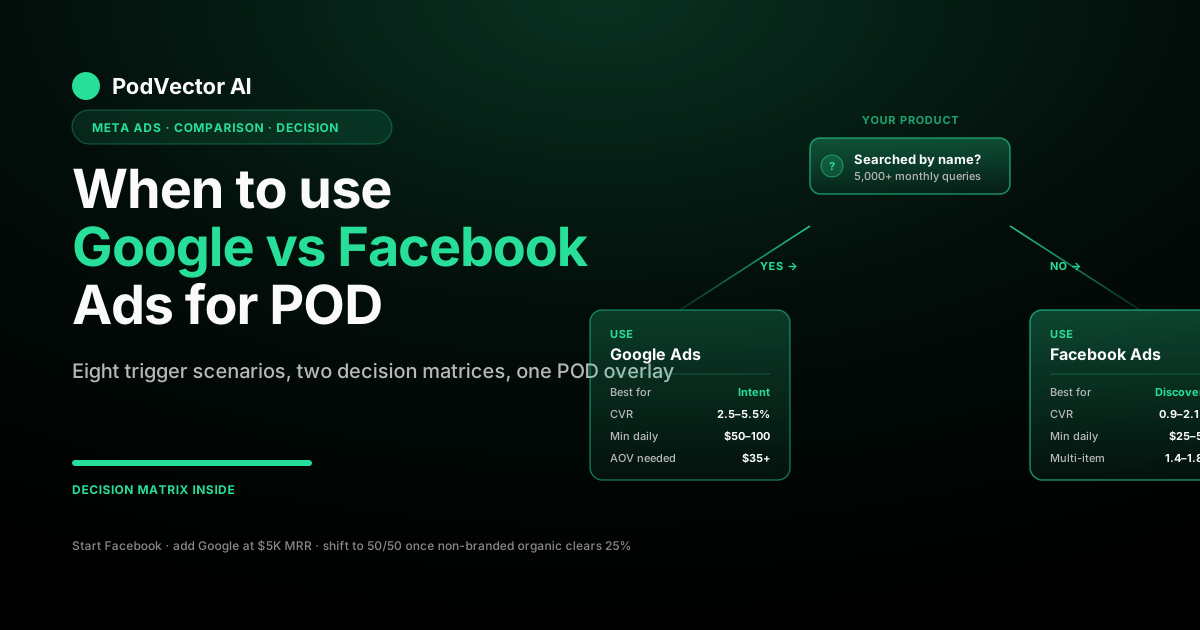
Quick Answer: Use Google Ads when people already type your product into a search box — branded apparel, gift niches with named keywords, products with clear specs. Use Facebook Ads when nobody knows to search for what you sell — original print-on-demand designs, identity-driven merchandise, anything visual that lives or dies on creative.
That intent vs discovery split is the rule that decides 80% of the cases. The other 20% are timing questions: when in your store's lifecycle to add the second platform, when to shift the budget split, and when one of them stops earning its share.
This guide walks through the eight specific scenarios that should trigger each platform, the POD margin overlay that breaks the standard "run both" advice for slim-margin stores, and a decision matrix you can apply this week to your own ad budget.
The intent vs discovery frame (the foundation)
Every "when to use" answer comes back to one mental model: Google Ads captures existing demand; Facebook Ads creates new demand.
Google works because someone typed a query into a search box. The wanting already happened. You're paying to be the storefront they pick.
Facebook works because someone is scrolling their feed and the algorithm decides to show them your product. The wanting hasn't happened yet. You're paying to make it happen.
This is why the same ad budget produces wildly different outcomes on each platform depending on your product. A $26 wedding-photographer-recommendation t-shirt nobody searches for can crush on Facebook and produce zero conversions on Google. A $99 mechanical-keyboard accessory people Google by SKU can crush on Google Shopping and look anemic on Facebook.
The "when to use" question is really: which side of that demand equation does my product sit on this month?
When to use Google Ads — 5 specific scenarios
Google Ads earns the slot when there is measurable existing demand for your category. These are the five clearest triggers.
1. Your niche has 5,000+ monthly searches
Pull your category's main keywords through a free tool (Google Keyword Planner, Ubersuggest's free tier, or even autocomplete) and add up the monthly volume. If the total across product-relevant queries clears 5,000 per month, Google Shopping has enough auction depth to fund itself.
Below 5,000, you'll exhaust the cheap impressions in two weeks and Performance Max (PMax — Google's all-in-one auto-targeted campaign type) will start dumping spend into Display and YouTube placements that don't convert.
2. Your products have named identities
If your customers can describe what they want in three words a stranger would understand — "anatomical heart hoodie," "Texas state outline mug," "border collie agility shirt" — those are searchable. Google Shopping ads attach to that exact phrasing and serve your product to people who already wrote the wanting down.
If your products are abstract, conceptual, or inside-joke-driven ("chaos goblin energy," "girl dinner aesthetic"), Google has nothing to match against. Facebook is the only system that can find buyers for those.
3. You can fund a $50–100/day learning floor
Google Shopping's smart bidding needs roughly 50 conversions in 30 days to converge. At a 3.5% conversion rate and $1.50 CPC, that's about $1,300/month minimum to give the algorithm enough signal.
If you can't commit $50/day for at least four weeks, Google will look bad on under-funded data and you'll quit before the algorithm has learned anything. Facebook's lower starting floor ($25–50/day) makes it the better small-budget starter.
4. You're defending your own brand name
Once your store generates organic search interest — branded queries like "[your store name] hoodie" — competitors will buy your brand name on Google. A small brand-defense campaign ($5–10/day, exact-match on your store name and a few SKU names) keeps competitors off the SERP for queries you already earned.
This is one Google use case that applies regardless of whether you're a "Google store" overall. Even Facebook-first POD operators should run brand defense once monthly branded search volume crosses 200.
5. You sell product categories with high purchase intent
Wedding gifts, memorial items, fan merch for a specific show, hobby-specific gear (axe-throwing belts, wargaming dice trays). Anything where the buyer already knows what they want and is shopping for the best version is a Google Shopping fit.
Conversion rates in these categories run 4–6%, well above the ecommerce average, because the qualification has already happened before the click. Google just charges you to win the comparison.
When to use Facebook Ads — 5 specific scenarios
Facebook Ads earns the slot when your product needs introduction, not just storefront placement. The five clearest triggers.
1. Your designs are original and lack named search demand
This is most original-design POD. If your products are illustrations you drew, typography you wrote, or visual jokes you invented, nobody has typed those into Google. The total addressable search market for your specific design is approximately zero.
Facebook's algorithm doesn't need search demand. It needs visual signal: the image, the price, and pixel data on similar buyers. Original designs that nobody searches for routinely sell at 1.5–3.0x ROAS on Facebook DPAs while producing nothing on Google Shopping for the same spend.
2. You have a creative pipeline producing 8–15 variants per week
Facebook is creative-hungry. Ads fatigue in 7–14 days as the algorithm exhausts the highest-CTR portion of your audience. Without a steady drip of fresh variants — new images, new hooks, new angles — your account will plateau then decline.
If you can produce 2 fresh creative variants per week and that's it, Facebook is going to grind. Google Shopping doesn't have this problem because the creative is the product feed image, which doesn't fatigue the same way.
3. Your AOV is under $35 and you depend on multi-item carts
Facebook's collection ads and DPA cross-sells produce 1.4–1.8 items per order on average for POD stores. That multi-item cart is what saves slim-margin POD math, since the second item carries no incremental shipping cost relative to the first.
Google Shopping shoppers tend to buy the single SKU they searched for. At a $24 AOV with $7 contribution margin per item, single-item Google orders don't survive the customer acquisition cost (CAC) math. Multi-item Facebook orders do.
4. You're under $5K MRR and need a low starting floor
Facebook campaigns can show meaningful learning at $25–50/day in 2–3 weeks. That's a budget a hobby-stage POD store can actually afford while still having room to test creative.
Google Shopping at the same $25/day spends on impressions but doesn't generate enough conversions for the algorithm to learn — you're paying for unconverged learning forever. Start Facebook first; add Google once you can fund both.
5. Your discovery happens on social or email
Look at your existing traffic sources. If 60%+ of your sessions come from Instagram, TikTok, Pinterest, email, or direct, your customers are visual-discovery shoppers. They find what they like by scrolling, not by searching.
That audience is concentrated on Facebook's properties — Facebook, Instagram, Reels, and Marketplace are all the same ad system. Buying ads in front of the audience that already discovers things by scrolling is a structurally efficient match.
When to use both (and the right ratio)
Once you cross roughly $5K MRR with a working pixel and Conversions API setup, the right answer stops being "pick one" and becomes "run both at the right ratio."
The 70/30 starting split
For most POD stores between $5K and $50K monthly revenue, start at 70% of ad budget on Facebook and 30% on Google. Facebook does the demand creation and the bulk of your discovery acquisitions. Google captures the searches that demand creation generates, plus brand defense, plus the high-intent product-name traffic.
The 70/30 split is not arbitrary. It matches the typical revenue split you'll observe in a properly attributed warehouse for POD stores in this revenue band — Facebook drives roughly two-thirds of acquisition and Google catches the searchable tail.
The shift trigger
Watch the share of revenue coming from organic non-branded search in your analytics. When that share crosses 25% of total revenue, your niche has matured into searchable demand and you can shift the ratio toward 50/50.
Past that point, Google Shopping is pulling its weight because there's now real intent traffic to capture. Stay at 70/30 too long and you're leaving cheap searchable conversions on the table.
The de-duplication problem
Both platforms will claim 100% credit for the same conversion when you run both. Sum the dashboard revenue and you'll typically see 40–80% more "ad-attributed revenue" than your Shopify total.
Victor fixes this by matching both platforms' orders back to your real Shopify orders, so the same sale never gets counted twice. For a deeper look, see our complete guide to Meta Ads ROAS and attribution for POD.
The POD overlay: when slim margins change the timing
Most "when to use" advice assumes a 50–75% contribution margin. POD doesn't have that.
The POD margin reality
A $26 unisex t-shirt sold through Printify carries roughly $11–13 in Printify base cost, $4.50–5.50 shipping, and $1.20 in Shopify platform fees. Contribution margin is $5.50–9.30 before any ad spend touches the math.
That changes the maximum tolerable customer acquisition cost. A generic ecommerce store with $13 contribution on a $26 sale can afford $7–8 CAC and still hit a 1.6x first-order MER (marketing efficiency ratio — total revenue divided by total ad spend). A POD store with $7 contribution can afford $3.50 CAC, max.
What this does to the timing
At a $0.85–$2.30 Google Shopping CPC and a 3.5% conversion rate, you're paying $24–66 for a customer. That's lethal at POD margins on single-order math unless your AOV crosses $40.
At a $0.55–$1.45 Facebook CPC and a 1.5% conversion rate, you're paying $37–97 per customer at the same single-order math. The reason Facebook still wins for most POD operators is multi-purchase: Facebook-acquired POD customers buy 1.4–1.8 items per order at higher AOV, while Google customers buy the single SKU they searched for.
The practical timing rule for POD specifically: start Facebook unless your AOV is already above $40, and only add Google once your blended margins can absorb the higher CAC.
The Printify vs Printful supplier-cost wrinkle
Printify routes orders to whichever supplier is cheapest for a given garment, so cost of goods varies by SKU within the same campaign. Printful uses one in-house production network with consistent base costs.
For Printify-based stores, this means per-SKU margin tracking matters — a $26 tee from one Printify provider can carry $11 cost while the same tee from another provider carries $14. That changes which products are even profitable to advertise. For the cost-only deep-dive on this, see our cost comparison of Google Ads vs Facebook Ads for POD.
Decision matrix by business stage
The "when to use" answer depends on where your store is in its lifecycle. Here's a stage-by-stage rule.
| Stage | Monthly revenue | Use this | Why |
|---|---|---|---|
| Hobby | $0–2K | Facebook only, $25–50/day | Lower learning floor, demand-creation matches a brand nobody searches for yet |
| Side hustle | $2–5K | Facebook only, $50–100/day | Still under Google's efficient learning floor; double down on the channel that's working |
| Early business | $5–20K | 70/30 Facebook lead | Add Google brand defense + Shopping for searchable SKUs; Facebook still does discovery |
| Established | $20–50K | 60/40 Facebook lead | Searchable demand has grown; Google Shopping starts pulling more weight |
| Scaled | $50K+ | 50/50 with margin-aware budget shifting | Both platforms have real auction depth; let warehouse-attributed margin numbers move budget weekly |
The rule for stage transitions: don't add Google before you can fund both at their respective learning floors simultaneously. Underfunded Google is worse than no Google.
Decision matrix by campaign goal
Stage tells you what's possible. Goal tells you what's optimal. Here's the second matrix.
| Goal | Best platform | Why |
|---|---|---|
| Capture existing search demand for named products | Google Shopping | The query is the qualification |
| Brand defense (your store name) | Google Search | Cheap, exact-match, blocks competitors |
| Drive trial of a brand new product | Facebook Ads | Visual discovery for unknown products |
| Retarget cart abandoners | Both (Facebook DPA + Google Display) | Multi-touch reminder; cheap clicks |
| Build email list with a lead magnet | Facebook Ads | Native lead form, lower CPL than Google for cold |
| Reach buyers actively comparing options | Google Shopping | Comparison happens in search, not feed |
| Test a new design at minimum spend | Facebook Ads ($25/day, 7 days) | Fastest signal on whether creative works |
| Move inventory before a seasonal cutoff | Both, with Facebook lead | Discovery + intent recapture on a deadline |
If your goal sits in two rows, run the platform that matches the dominant goal first, prove it works, and add the second platform as a complement.
Common timing mistakes
Five mistakes that show up in nearly every POD account audit.
1. Adding Google before you can fund the learning floor
Stores at $3K MRR adding $30/day to Google Shopping because "you need both." The algorithm won't converge at that spend. You're paying for impressions without buying learning. Wait until $5K MRR minimum.
2. Quitting Facebook in week 2
Facebook needs roughly 30–50 conversions of learning data before performance stabilizes. At a 1.5% conversion rate and $1 CPC, that's about $2,000–3,300 spent before you have a real verdict. Stores that quit at $500 spent are quitting on noise.
3. Not running brand defense after building search demand
Once your brand generates 200+ monthly branded searches, competitors will buy that traffic for $0.30–0.50 per click. A $5/day exact-match brand defense campaign is the cheapest revenue protection in the entire ad stack and most stores never run it.
4. Treating PMax and Advantage+ as equivalent
Performance Max expands into Display, YouTube, and Gmail inventory that has nothing to do with Shopping intent. Advantage+ Shopping stays within Meta's feed and Reels placements where the catalog actually performs. Comparing the two as "automated all-in-one campaigns" hides a 2–3x placement-quality gap for ecommerce.
5. Optimizing on platform-reported ROAS instead of margin
A campaign at 3.0x reported ROAS can lose money once you count in your Printify or Printful supplier cost. Victor already has those costs synced, so he can show you the true profit number, not just what the dashboard says.
The honest answer for most POD stores
If you're a typical POD operator selling original designs, here's the timing sequence that works.
Months 1–3: Facebook only, $25–50/day. Test creative, learn what your audience looks like, get the pixel and Conversions API humming.
Months 3–6: Scale Facebook to $100–200/day if the unit economics hold. Add a $5/day Google brand-defense campaign once monthly branded search exceeds 200.
Months 6–12: Add Google Shopping at $50/day for any SKUs with named search demand. Run at 80/20 Facebook lead and watch the share-of-organic-search number.
Year 2+: Once non-branded organic search clears 25% of revenue, shift to 60/40 Facebook lead. By 50K monthly revenue, you should be running 50/50 with margin-aware weekly budget shifts driven by warehouse data, not by either platform's dashboard.
For the broader cluster context on these comparisons, the Meta Ads comparison cluster hub has the full set of Meta vs alternative breakdowns, and the Meta Ads topic hub covers strategy, attribution, integrations, and ad types in depth. The cluster anchor article on this comparison is our Google Ads vs Facebook Ads for POD sellers guide, and the ecommerce-specific framing lives in our Google Ads vs Facebook Ads for ecommerce comparison.
FAQs
Should I start with Google Ads or Facebook Ads?
For most original-design POD stores, start with Facebook. Lower starting floor, better fit for products without named search demand, and faster signal on whether your creative works. Add Google once you cross $5K MRR and can fund both at their respective learning floors.
When does Google Ads beat Facebook Ads?
When your products have measurable named search demand. If your category has 5,000+ monthly searches across product-relevant queries and your AOV is above $35, Google Shopping will outperform Facebook on first-touch ROAS. POD niches that hit this bar include licensed designs in popular fandoms, hobby-specific gear, and gift-occasion merchandise.
When does Facebook Ads beat Google Ads?
When your products are visual, original, and lack search demand. Most POD designs fall here. Facebook's algorithm finds buyers based on behavior patterns rather than query matching, which is the only retrieval system that works for products nobody knows to search for.
Can I run both platforms on a small budget?
Not effectively. Each platform has a learning floor — roughly $25–50/day for Facebook and $50–100/day for Google Shopping. Splitting a $50/day budget between the two starves both algorithms of the conversion signal they need to converge. Pick one, fund it properly, then add the second.
What's the right budget split if I run both?
Start at 70/30 Facebook lead for stores between $5K and $20K monthly revenue. Move toward 60/40 in the $20–50K band as searchable demand grows. Aim for 50/50 with weekly margin-aware shifts above $50K, driven by warehouse-attributed data rather than either platform's dashboard.
How long does each platform take to show results?
Facebook: 2–3 weeks of $25–50/day spend (about 30–50 conversions of learning data) before performance stabilizes. Google Shopping: 4 weeks of $50–100/day spend (about 50 conversions) before smart bidding converges. Below those thresholds, the comparison is noise.
Do POD margins change the answer?
Yes, materially. POD's $5–9 contribution margin per shirt makes Google Shopping's $24–66 per-customer math hard to defend on single-order economics. Facebook's lower starting floor and cross-sell-friendly DPA format produce more multi-item orders, which is what saves the math at POD margins. Run Facebook first, add Google once your AOV crosses $35.
How do I know when to shift the budget split?
Watch the share of revenue from non-branded organic search. Below 15% of total revenue, your niche is still demand-creation territory and Facebook should lead at 70%+. Crossing 25% means searchable demand is real and Google deserves more share. Crossing 35% means you can run 50/50 and let attribution data fine-tune from there.
What about Performance Max vs Advantage+ Shopping?
Both are automated all-in-one campaign types, but they're not equivalent. PMax expands into Display, YouTube, and Gmail inventory that doesn't have Shopping intent. Advantage+ stays within Meta's feed and Reels placements where the catalog performs. For ecommerce specifically, comparing the two as equivalents is a category error.
How should I attribute revenue when running both?
Both platforms claim credit for the same orders, so summed dashboard revenue typically exceeds Shopify revenue by 40–80%. The only honest fix is matching both platforms' orders back to your real Shopify orders, so each sale only counts once. Shopify's own breakdown covers the basics; Victor does this matching for you automatically, so you see your real numbers without needing to build it yourself.
Stop guessing which platform earned the order
Both Google and Facebook will tell you they earned the conversion. Neither will tell you what your real margin per channel was after Printify or Printful supplier costs.
Victor unifies your Shopify orders, supplier costs, Google Ads spend, and Facebook Ads spend in one live data view, then answers "where should my next ad dollar go?" with the actual margin-weighted number.
POD operators using Victor catch losing campaigns 2–3 weeks earlier than dashboard-only operators, which is the difference between a 1.6x MER and a 2.4x MER on the same creative.
Try Victor free