
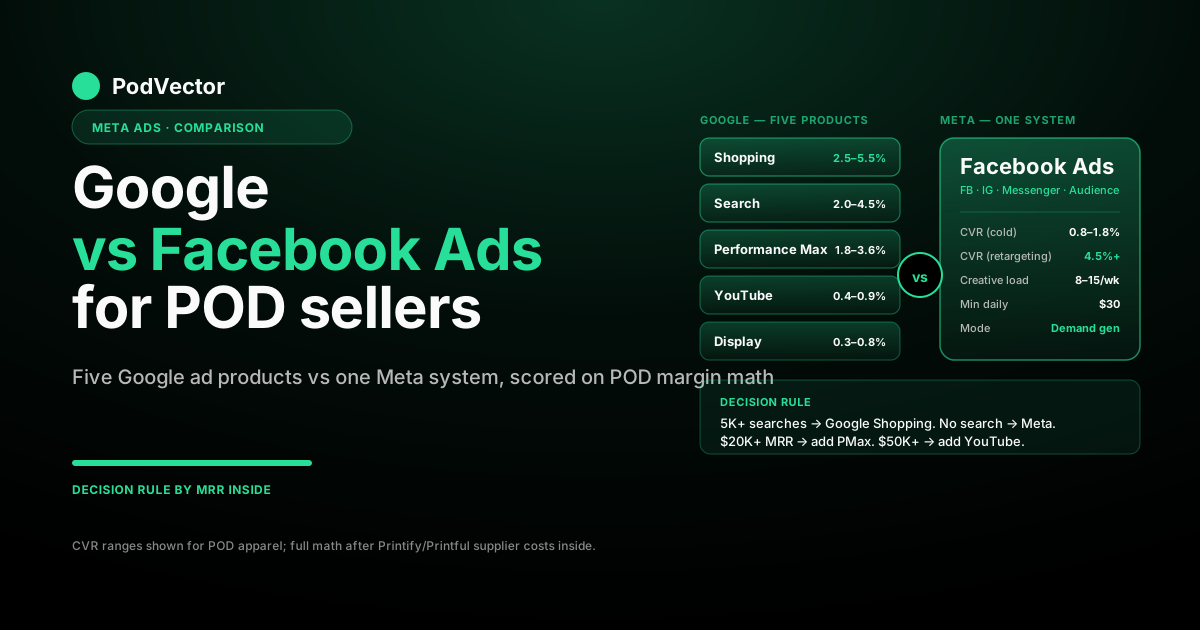
Quick Answer: "Google vs Facebook Ads" is the wrong question for print-on-demand because "Google" isn't one ad product — it's five (Search, Shopping, Performance Max, YouTube, Display), each with a different fit for POD economics.
Compared correctly, Google Shopping wins for POD niches with measurable search volume and clean product feeds. Facebook Ads wins for novelty designs, identity-driven niches with no search volume, and stores with a real creative pipeline. Performance Max and YouTube only earn their slot once you have $20K+ MRR and a clean attribution stack.
This guide compares each Google ad product head-to-head against Facebook Ads through the lens of Printify and Printful supplier-cost math, then gives you a decision rule by niche size and MRR stage you can apply this week.
"Google" is not one ad product
Almost every "Google vs Facebook Ads" comparison treats "Google" as a single thing. It isn't.
Google Ads is a wrapper around five distinct ad products that share a billing system and very little else. Each one fits POD economics differently, and choosing between Facebook and "Google" without specifying which Google ad product you mean is roughly as useful as choosing between Facebook and "the rest of the internet."
The five Google ad products that matter for print on demand are Google Shopping (product feed listings on the SERP), Google Search (text ads against keyword bids), Performance Max (PMax — Google's all-in-one auto-targeted campaign type that places across Search, Shopping, YouTube, Display, Gmail, and Maps from a single campaign), YouTube Ads (in-stream and Shorts video), and Google Display Network (banner placements across the web).
Facebook Ads — the Meta Ads system across Facebook, Instagram, Messenger, and Audience Network — is comparatively unified. One ad-creation flow, one targeting model, one attribution pixel, one set of placements managed inside Meta Ads Manager.
This asymmetry matters because the POD-relevant choice isn't "Google or Facebook." It's "which Google ad product, against Facebook, for which part of my funnel?" The rest of this guide walks each matchup individually.
The five-vs-one comparison table
Here is the full ecosystem-level comparison, scored against POD-specific structural needs. Numbers are 2026 ranges from public benchmark data and our own client cohort across apparel and accessories.
| Matchup | Avg CPC | Conv. rate | POD fit | Min. daily spend |
|---|---|---|---|---|
| Google Shopping vs FB Ads | $0.85–$2.30 / $0.55–$1.45 | 2.5–5.5% / 0.8–1.8% | Shopping wins in searched niches | $50–$100 / $30 |
| Google Search vs FB Ads | $1.20–$3.40 / $0.55–$1.45 | 2.0–4.5% / 0.8–1.8% | Search wins for branded defense | $20 / $30 |
| Performance Max vs FB Ads | $0.45–$1.80 (blended) | 1.8–3.6% (blended) | PMax for $20K+ MRR only | $50–$100 |
| YouTube Ads vs FB Ads | $0.05–$0.18 CPV / $0.55–$1.45 CPC | 0.4–0.9% direct | FB wins; YouTube top-of-funnel only | $50 / $30 |
| Display vs FB Ads | $0.30–$1.20 / $0.55–$1.45 | 0.3–0.8% / 0.8–1.8% | FB wins outright | $30 / $30 |
The headline takeaway: "Google vs Facebook" hides three different verdicts inside one question. The rest of this guide unpacks each row.
Google Shopping vs Facebook Ads
This is the matchup that actually matters for most POD stores. Google Shopping puts your product image, price, and store name directly on the search-results page when somebody searches a relevant query. Facebook Ads puts your creative in front of an interest- or lookalike-targeted audience scrolling Instagram or the Facebook feed.
For POD niches with measurable search volume, Google Shopping is structurally hard to beat. Conversion rates run 2–3x higher than Facebook prospecting because the searcher self-selected. The ad creative is generated from your feed — no weekly creative production tax. The attribution is cleaner than Meta's because it's a tag-based last-click model with less iOS signal loss.
Facebook Ads wins in the opposite scenario: a viral inside-joke design, a niche-identity hoodie, a trending news-cycle quote shirt, anything with low or no search volume. Facebook can manufacture demand among interest-cluster lookalikes for products people don't yet know they want. Google can't.
The break-even rule of thumb: if your top three keyword clusters have more than 5,000 combined monthly searches, Google Shopping should be your primary acquisition channel. Below 1,000, stay Facebook-primary. Between those two, run both at minimum efficient spend and let CPA pick the budget split inside thirty days.
One operational catch on Google Shopping for POD: feed cleanliness. Default Printify and Printful Shopify exports often miss identifier_exists: no, mis-tag Google product taxonomy, or include trademark-flagged designs that Google disapproves. Budget 10–15 hours of feed work per quarter or expect rejections. The sibling deep-dive on this exact tradeoff lives in the Google Ads vs Facebook Ads comparison for POD.
Google Search vs Facebook Ads
Google Search Ads — the text ads above and below organic results — is a different product from Shopping. It bids on keywords rather than products, and POD stores misuse it most often by treating it like Shopping with worse formatting.
The honest verdict: for POD prospecting, Google Search Ads loses to both Google Shopping and Facebook Ads. Shopping is more visual and has higher buyer intent at the click. Facebook is cheaper for cold acquisition and reaches audiences with no search volume. Search ads sit in the middle with worse economics on both sides.
Where Google Search earns its slot for POD is brand defense. Once your store has any meaningful brand recognition, competitor stores and POD aggregators bid on your brand terms. A small ($150–$400/month) branded-search campaign is the cheapest defensive moat available — losing your own brand keyword to a competitor is an own-goal POD operators discover too late.
The other use case is long-tail intent capture. If your designs reference a specific phrase nobody searches as a product but everybody searches as a question — "is the german shepherd shedding season actually two weeks" — long-tail Search ads can capture that traffic at very low CPC and route it to a content page with a soft product offer. This works as a content-marketing supplement, not a primary acquisition channel.
For most POD stores under $20K MRR, the right Google Search budget is exactly two campaigns: a defensive branded campaign at $150–$400/month and a small ($300–$600/month) campaign on your top three high-intent transactional keywords. Anything beyond that is better spent on Shopping or Facebook prospecting.
Performance Max vs Facebook Ads
Performance Max is Google's auto-everything campaign type. One campaign, one budget, and Google's algorithm decides where to place your ads across Search, Shopping, YouTube, Display, Gmail, and Maps using an audience-signal seed plus your asset library.
For POD stores, PMax is the matchup with the most divided opinion. The 2025 brand-exclusion and audience-signal updates made it legitimately workable for stores with clean attribution. The catch is that PMax over-rotates into branded search if you don't fence it properly — meaning a chunk of reported PMax conversions are actually branded-search clicks Google would have captured anyway.
Compared to Facebook Ads, PMax has three structural advantages and three real drawbacks for POD. The advantages: lower minimum creative effort (PMax pulls from your feed), broader reach across Google's full surface area, and Google's intent signal seeding the algorithm.
The drawbacks: placement opacity (you can't see which placement drove which conversion at the line-item level), brand cannibalization risk, and a learning period that burns $1,500–$4,000 before the algorithm settles into a stable CPA. Facebook's Advantage+ Shopping campaigns have similar opacity but lower learning-period spend.
Practical rule: don't run PMax under $20K MRR. The learning-phase burn is too large a percentage of your test budget, and standard Google Shopping gives you cleaner diagnostic visibility at that stage. Above $20K MRR with clean attribution, PMax can earn 20–35% of your Google budget. Below that, stick with standard Shopping campaigns.
YouTube Ads vs Facebook Ads
YouTube Ads — in-stream pre-roll, mid-roll, and YouTube Shorts placements — is the matchup where Facebook Ads wins outright for POD direct response. YouTube's strength is brand-building and view-through demand creation, not last-click apparel sales.
Direct-response conversion rates on YouTube for POD apparel hover at 0.4–0.9% — meaningfully below Facebook prospecting's 0.8–1.8% and far below Google Shopping's 2.5–5.5%. The CPV (cost per view) is cheap at $0.05–$0.18, but views don't pay supplier invoices. Conversions do.
Where YouTube earns its slot for POD is at $50K+ MRR, when you've maxed out Facebook prospecting reach and need a top-of-funnel awareness layer that feeds Facebook retargeting and Google Shopping branded queries. At that scale, a $1,500–$3,000/month YouTube Shorts campaign with a UGC-style creator video can lift Facebook retargeting conversion rate by 15–25% by warming the audience.
Below $50K MRR, the same dollars produce more revenue on Facebook prospecting or Google Shopping. The exception is creator-driven POD stores whose founder can produce 30-second native YouTube content at marginal cost — in that case YouTube Shorts can be added at $30–$50/day as a creative-discovery layer at any MRR stage.
For Facebook's full ad-format range and which formats actually compete with YouTube for POD, the complete guide to Meta ad types for POD sellers covers what each Facebook format does in production.
Google Display vs Facebook Ads
Google Display Network places banner ads across two million-plus partner sites, AdSense publishers, and Gmail. For POD direct response, this is the matchup with the clearest verdict: Facebook Ads wins outright. Display's banner format is too low-engagement for apparel, the placements are too uncontrolled, and conversion rates run 0.3–0.8% — below every other channel in this comparison.
Where Display has any POD use case, it's narrow and tactical. Dynamic remarketing — re-showing the exact products a visitor viewed — can supplement Facebook retargeting at a small budget ($10–$25/day). Brand-keyword display defense on competitor sites can defend share of voice cheaply.
For prospecting, Display loses to Facebook on every dimension that matters for POD: targeting depth, creative format, conversion rate, and minimum efficient spend. Skip it for cold acquisition. Use it sparingly for retargeting overlap with Facebook.
POD unit economics across the matchups
Run the math on a representative POD product to see why these matchups produce different verdicts. Take a $26 t-shirt with $9 supplier base, $4.50 shipping, $1.10 payment processing, and a $0.40 platform fee. Contribution before ads is $11.
| Channel | Avg CPA | Net contribution per sale | Profitable at $0 LTV? |
|---|---|---|---|
| Google Shopping (3.4% CR, $1.65 CPC) | $48.53 | −$37.53 | No |
| Facebook prospecting (1.2% CR, $0.85 CPC) | $70.83 | −$59.83 | No |
| Facebook retargeting (4.5% CR, $0.55 CPC) | $12.22 | −$1.22 | Roughly break-even |
| Google Search branded (8% CR, $0.40 CPC) | $5.00 | +$6.00 | Yes |
| PMax post-learning (2.4% CR, $1.10 CPC) | $45.83 | −$34.83 | No |
Three things this table makes obvious. First, on first-order economics, almost every cold acquisition channel is unprofitable for a $26-AOV POD product after itemized supplier costs. POD is structurally a repeat-purchase or LTV game, not a first-click-profitable one.
Second, Facebook retargeting and Google Search branded defense are the only two channels that produce positive contribution on a single order. Every scaled POD store ends up over-investing in those layers because they're the only ones that can carry the rest of the funnel mathematically.
Third, the platform-headline CPC argument ("Facebook is cheaper") completely inverts when you fold in conversion rate. Facebook prospecting's $70 CPA is the worst number in this table, despite Facebook having the lowest reported CPC. The cluster's Google Ads vs Facebook Ads cost comparison for POD walks the cost arithmetic in more granular detail.
The blended decision: budget allocation should follow contribution math, not platform-reported ROAS. Most POD sellers don't know their per-channel contribution because they're reading platform dashboards instead of reconciling against bank-deposit revenue with itemized Printify or Printful supplier costs. The cluster's complete guide to Meta Ads ROAS and attribution for POD walks the reconciliation method.
The decision rule by niche and MRR
Here is the rule we apply with our POD client cohort. Use it as a starting point, then let your own contribution-margin data adjust the ratios within thirty days.
- Pre-revenue / under $2K MRR. Start Facebook Ads at $30/day across two prospecting ad sets. Add Google Search branded defense once you have any organic traffic. Don't open Google Shopping until you have proven SKUs.
- $2K–$10K MRR, niche has 5K+ monthly searches. Add Google Shopping at $50–$100/day on your top 5 SKUs. This is usually the highest-leverage channel addition a POD store under $10K MRR can make.
- $2K–$10K MRR, niche has under 1K monthly searches. Stay Facebook-primary. Add Facebook retargeting and Advantage+ Shopping. Don't fight Google for searches that don't exist.
- $10K–$20K MRR. Run Google Shopping plus Facebook prospecting plus Facebook retargeting plus Google Search branded defense. Don't touch PMax, YouTube, or Display yet — you don't have the attribution clarity to diagnose them.
- $20K–$50K MRR. Add Performance Max (replacing or running alongside standard Shopping, depending on niche) and a small YouTube Shorts test. Tighten attribution before scaling either.
- $50K+ MRR. All five Google products plus full Facebook plus TikTok. The constraint shifts from "which channel" to "how do I reconcile attribution across them all without believing the dashboards."
For a structured walk through every channel POD operators consider — including TikTok, Pinterest, Microsoft Ads, and email — the cluster's pillar guide on Meta Ads vs alternatives for POD compares all eight realistic options against POD unit economics.
When to run Google and Facebook together
By $10K MRR, the question stops being "Google or Facebook" and starts being "how do I run both without double-counting conversions." The integrated playbook has four moving pieces.
Facebook handles prospecting and creative discovery. Top-of-funnel cold audiences, broad lookalikes, interest targeting, Advantage+ Shopping for proven SKUs. Budget allocation: 50–65% of paid spend at $5K–$15K MRR, dropping toward 35–45% as Google scales.
Google Shopping captures the demand Facebook creates. When a Facebook prospecting creative goes well, branded searches and category-adjacent searches spike on Google within days. Google Shopping should be running on those queries before the Facebook campaign starts. Budget allocation: 25–40%.
Facebook retargeting plus Google RLSA catch the overlap. Visitors who saw a Facebook creative and didn't convert often search Google in the next 24–72 hours. Google RLSA bids more aggressively on those repeat searchers; Facebook retargeting catches the scroll-back. Budget allocation: 10–15%.
Google Search branded defense. $150–$400/month on your own brand keywords, defending against POD aggregators and competitors. Budget allocation: 2–5%.
The hard part isn't the campaign structure — it's reconciling which channel actually drove which sale. Both platforms claim credit for the same conversions, and Meta's attribution drift runs 15–40% on POD apparel. The cluster's complete guide to Meta Ads + Shopify integration for POD walks the integration plumbing, and the complete Meta Ads playbook for POD sellers covers the campaign structures we deploy across MRR stages.
Five mistakes POD sellers make in this comparison
Across hundreds of POD sellers, five mistakes show up over and over when picking between Google's ad ecosystem and Facebook Ads.
- Treating "Google" as one product. Google Shopping, Search, PMax, YouTube, and Display each fit POD differently. The right comparison is product-by-product against Facebook, not platform-vs-platform.
- Comparing reported ROAS as if both numbers mean the same thing. A 3.0x reported on Meta and a 3.0x reported on Google are not the same number. Meta's drift is larger. Reconcile both against bank-deposit revenue weekly before comparing.
- Underestimating Meta's creative-volume burden. Stores benchmarking Meta against Google on dollars-in-dollars-out frequently exclude the labor cost of producing 8–15 creatives a week. When that cost gets folded into per-design profitability, Google often wins outright in searched niches.
- Running Performance Max at $5K MRR. PMax's learning-phase burn is too large a fraction of a small budget. Wait until $20K+ MRR with clean attribution before opening it.
- Picking one platform and refusing to add the second. Past $5K MRR, the platforms cover different parts of the funnel. Refusing to add the complement leaves money on the table that competitors who run both will capture. The AgencyAnalytics walkthrough covers the multi-platform case in agency context — useful complement to this POD-specific take.
For deeper Meta-specific economics, the Meta Ads topic hub indexes every supporting article in this cluster, and the Meta Ads comparison cluster has the platform-by-platform deep dives.
FAQs
Is Google or Facebook better for print on demand?
Neither, framed that way. Google Shopping wins for POD niches with measurable search volume. Facebook Ads wins for novelty and identity-driven niches with no search volume. Google Search Ads, Performance Max, YouTube, and Display each have narrower POD use cases that depend on MRR stage. The right comparison is sub-product by sub-product, not platform vs platform.
Should a new POD seller start with Google or Facebook?
Start with Facebook if you have less than $2K MRR and no proven design winners. The minimum efficient daily spend is lower (~$30 vs Google Shopping's $50–$100), and Facebook's creative-discovery feedback loop helps you find winning designs faster than Google can capture searches you don't yet have. Add Google Shopping once you have proven SKUs and a niche with measurable search volume.
What's the realistic ROAS to expect on each platform?
For POD apparel and accessories in 2026, prospecting Meta campaigns typically report 1.6x–2.4x ROAS, retargeting reports 4.5x–8x, Google Shopping in proven niches reports 2.8x–4.2x, and Performance Max post-learning reports 2.4x–3.6x. Reported numbers overstate true ROAS by 15–40% on Meta and 5–20% on Google. Your real contribution-margin ROAS is whatever those numbers minus drift, divided by your true CAC including itemized Printify or Printful supplier costs.
Can I run all five Google products at once?
Not at any reasonable POD scale. Below $20K MRR, run Shopping plus a small Search branded-defense campaign. Above $20K MRR, add Performance Max if attribution is clean. Above $50K MRR, add YouTube Shorts as a top-of-funnel layer. Display remains a small dynamic-remarketing supplement at any scale, never primary. Trying to run all five simultaneously without that progression burns budget across products that don't yet earn their slot.
How does Performance Max compare to Facebook's Advantage+ Shopping?
Both are auto-everything campaign types. PMax has broader placement reach (Search, Shopping, YouTube, Display, Gmail, Maps) but worse placement transparency. Advantage+ Shopping is narrower (Facebook and Instagram placements) but easier to diagnose. For POD stores, Advantage+ tends to scale faster on Meta, while PMax tends to plateau higher on Google — each fits the side it's on. Run them in parallel above $20K MRR; below that, stick with standard Shopping and Facebook prospecting for diagnostic clarity.
Does YouTube Ads work for POD?
Not for direct response under $50K MRR. YouTube's conversion rate on POD apparel runs 0.4–0.9% direct, well below Facebook prospecting and Google Shopping. Where YouTube earns its slot is as a top-of-funnel layer at $50K+ MRR that warms audiences for Facebook retargeting and Google Shopping branded queries. The exception is creator-driven POD stores whose founder can produce 30-second native YouTube Shorts at marginal cost — in that case YouTube can be added as a creative-discovery layer at any MRR stage.
What about iOS attribution changes?
iOS-driven signal loss hurt Meta more than Google because Meta's attribution model relied more heavily on third-party-cookie-equivalent event signals. Properly configured Conversions API recovers a meaningful portion, but Meta's reported ROAS still drifts more than Google's. For thin-margin POD, that drift is a practical reason to lean Google when search volume permits.
Stop arguing platform vs platform. Track real contribution by channel.
Every POD seller arguing Google vs Facebook is arguing platform-reported numbers. The number that actually matters — true contribution margin per channel after itemized Printify or Printful supplier costs — almost nobody tracks live. Victor connects directly to your Shopify, Printify, Printful, Meta, and Google ad accounts, runs the reconciliation in a live data warehouse, and answers "which platform earned me a dollar today?" instead of "which platform claimed it earned me a dollar." and see your real channel-level profit before your next ad-budget reallocation.
Try Victor free