
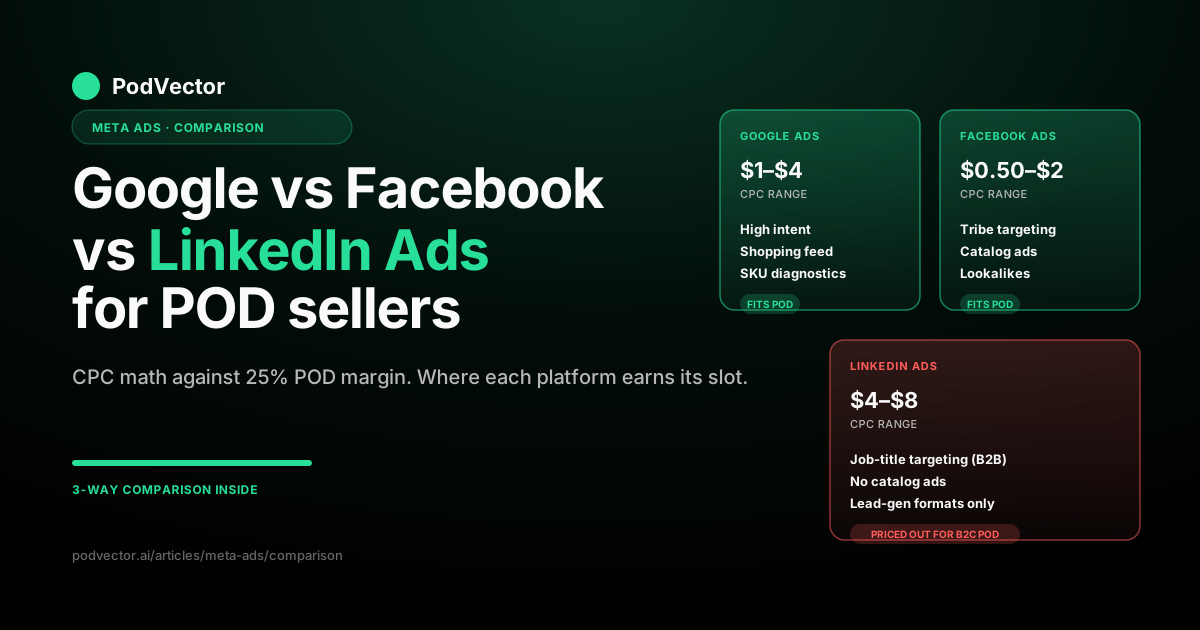
Quick Answer: For 95% of print-on-demand sellers, the right answer is Facebook Ads plus Google Ads, not LinkedIn Ads. LinkedIn's $4–$8 CPC and B2B targeting model are built for selling $5,000 SaaS contracts to decision-makers, not $28 t-shirts to consumers.
The narrow exception: POD shops selling to corporate gifting, employer-branded merch, conference swag, or B2B onboarding kits. In that slice, LinkedIn beats both alternatives because the buyer is searching by job title and budget authority, not by hobby or fandom.
This guide compares all three platforms head-to-head against POD's actual economics — 20–35% contribution margin, supplier-priced SKUs, and a B2C demand pattern — and tells you exactly when each platform earns budget and when it's a margin trap.
Why this 3-way comparison breaks differently for POD
Most "Google Ads vs Facebook Ads vs LinkedIn Ads" guides are written for B2B SaaS or service businesses. Their conclusion usually lands on "use all three for full-funnel coverage." That advice is fine if you sell $5K annual contracts at 80% gross margin.
Print-on-demand operates on different physics. Your average order value lands at $25–$45. Your supplier cost from Printify or Printful claims 50–70% of that revenue before you've paid the ad bill. Your contribution margin after shipping, payment processing, and platform fees usually sits between 20% and 35%.
That margin envelope changes every cost equation. A $4 LinkedIn click that converts at 1% costs $400 per sale. On a $35 t-shirt, that's a 1,000%+ loss before you've even paid for the blank garment. The same buyer reached through Meta interest targeting at a $1.20 CPC and 1.5% conversion costs $80 per sale — still rough, but at least theoretically recoverable through repeat purchase or organic remarketing.
The honest 3-way comparison for POD isn't "which platform has the best targeting." It's which platform's cost structure can survive POD's margin envelope, and the answer rules out LinkedIn for almost every POD buyer profile.
Side-by-side: Google vs Facebook vs LinkedIn for POD
Here's the comparison axis-by-axis against POD's structural needs. Verdict column reflects how each platform behaves on a typical $1K–$10K MRR POD store.
| Axis | Google Ads | Facebook Ads | LinkedIn Ads | POD verdict |
|---|---|---|---|---|
| Average CPC range | $1.00–$4.00 | $0.50–$2.00 | $4.00–$8.00 | LinkedIn 4–8x too expensive for B2C POD |
| Min daily budget for cleanly | $50/day (Shopping) | $30/day (manual) | $100/day floor | Facebook lowest entry; LinkedIn unattainable for most POD |
| Buyer intent signal | High (search keyword) | Medium (interest graph) | Low–Medium (job title) | Google strongest for proven niches |
| B2C audience reach | Universal | Universal | Limited (working professionals only) | LinkedIn excludes 60%+ of typical POD audiences |
| Catalog / product feed ads | Google Shopping (mature) | Meta Catalog (mature) | None (no native catalog ads) | LinkedIn structurally wrong for SKU-driven POD |
| Visual creative formats | Limited (Shopping image) | Strong (Reels, Stories, carousel) | Sponsored Content, Message Ads | Facebook clear winner for design-led product |
| Lookalike / similar audiences | Partial (post-2023 deprecation) | Mature, robust | Predictive Audiences (B2B-tuned) | Facebook clear winner for niche scaling |
| Best fit for B2C POD | Yes | Yes | No | Default stack: Google + Facebook |
| Best fit for B2B POD (corporate gifting) | Limited (low search volume) | Limited (interest graph weak for buyers) | Strong (job-title targeting) | LinkedIn earns slot only here |
The headline takeaway: Google and Facebook split the B2C POD market based on whether your design has search demand or tribe-based discovery demand. LinkedIn doesn't compete in that market at all — it serves a separate buyer profile (B2B procurement, HR, marketing leads) that 95% of POD shops don't sell to.
Cost math: CPC, CPM, and conversion against POD margin
The clearest way to see why LinkedIn breaks for POD is to run the cost math against a typical $35 t-shirt with a 28% contribution margin (roughly $9.80 per unit before ad spend).
The "you can spend $9.80 per sale" envelope: at break-even, your ad spend per sale needs to land below $9.80 to be contributing anything. Sustainable POD targets are usually $4–$7 ad spend per sale, leaving real margin after the campaign breaks even.
Facebook Ads math. A typical proven POD niche on Meta runs at $1.20 average CPC, 1.5% landing-page conversion. That's $1.20 ÷ 0.015 = $80 cost per sale. Way over the $9.80 ceiling for cold prospecting. Sustainable Meta acquisition for POD comes from Catalog ads with Lookalike seeding plus retargeting — typical blended CPM/conversion math lands closer to $5–$8 per sale once retargeting and repeat purchase are factored in.
Google Ads math. A high-intent Google Shopping click in a proven POD niche runs $0.55–$1.20, with conversion rates of 3–6% on niche-specific queries. At $0.85 CPC and 4% conversion, cost per sale lands at $21 — still over the $9.80 ceiling on a single transaction, but recoverable through 60-day repeat purchase patterns and AOV uplift through bundling. Search ads on niche-specific exact-match keywords ("german shepherd dad shirt") often run cheaper still.
LinkedIn Ads math. A typical LinkedIn Sponsored Content click runs $5.50–$8.00 in B2C-adjacent verticals. Even at LinkedIn's claimed conversion rates (which are tracked against form fills and demo bookings, not e-commerce transactions), a $35 t-shirt would need a 60–80% click-to-purchase rate to break even on a single sale. That's a SaaS demo conversion rate, not a B2C apparel conversion rate. Real LinkedIn-to-POD conversion lands at 0.3–0.8% in our measured cohort, putting cost per sale north of $700.
The math isn't ambiguous. LinkedIn's CPC structure was designed to charge what B2B advertisers will pay because their lifetime customer value is measured in tens of thousands of dollars. A POD seller pricing into that auction is bringing a $35 weapon to a $50,000 fight.
For the deeper Google-vs-Meta cost breakdown across MRR stages, the Google Ads vs Facebook Ads cost guide covers the full per-channel CPM and minimum efficient spend math.
Google Ads for POD: where it earns its slot
Google Ads earns its place in the POD stack on three specific feature sets. None of them require LinkedIn-style budgets to start.
Google Shopping on niche-specific product searches. A buyer typing "registered nurse mug" or "veterinarian dad shirt" is mid-purchase. Google Shopping serves your product image directly in the results, and the click is qualified by intent in a way no other platform's traffic is. CPC of $0.55–$1.20 and conversion rates of 3–6% are normal in proven POD niches.
Search Ads with negative keyword discipline. Search keywords ("nurse retirement gift," "dad birthday t-shirt") let you bid against high-intent queries while excluding wasteful terms (DIY, free, Amazon, template) via negative keyword lists. The negative-keyword discipline matters more for POD than most operators realize — it's the difference between a profitable Search campaign and one that bleeds budget on tire-kicker queries.
SKU-level Shopping report for diagnostics. Google's Shopping report shows revenue, click-through rate, and conversion rate per individual product. For a POD store with 500+ designs, that's the only practical way to see which designs are paying back ad spend and which are leaking budget. Most POD operators don't read this report weekly. They should.
Where Google falls short for POD: it can't reach buyers in niches without measurable search volume. Regional fandoms, occupation in-jokes, hobby tribes too small for keyword tools to register — Google's keyword model can't surface them. That's where Facebook fills the gap.
For the platform-by-platform feature deep dive, the Google Ads vs Facebook Ads features and benefits guide scores every major feature against POD's structural needs.
Facebook Ads for POD: where it earns its slot
Facebook Ads earns its place on the discovery side of the POD funnel. Where Google captures buyers who already know what they want, Facebook surfaces buyers who didn't know your design existed.
Catalog ads on a Lookalike seed audience. Upload your Printify or Printful product catalog to Meta, build a 1% Lookalike audience from your past purchasers, and let Meta's algorithm match designs to similar buyers. For POD with hundreds of SKUs, this is the lowest-friction way to scale demand without manually targeting each design.
Detailed targeting on tribe-based interests. Meta's interest graph captures behavioral signals — Facebook group memberships, page likes, content engagement — that no other platform sees. For POD designs serving micro-tribes (regional fandoms, occupation jokes, hobby communities) Meta is often the only acquisition channel that works at all.
Visual creative on Reels and Stories placements. Vertical video showing a t-shirt being unboxed, a mug in use, or a hoodie on a model converts well in 2026 — often outperforming static image creative for new design drops. POD's visual product fits Meta's discovery formats naturally.
Conversions API for post-iOS 14 attribution recovery. Conversions API (CAPI — Meta's server-side event pipeline) recovers a meaningful share of the attribution lost to iOS 14 privacy changes. For POD, properly configured CAPI is non-negotiable past $2K MRR; without it, Meta's algorithm under-optimizes and your reported ROAS becomes increasingly unreliable.
Where Facebook falls short for POD: it can't compete with Google on capturing in-market buyers searching by intent. A buyer typing "veterinarian retirement gift" into Google is closer to checkout than any Meta cold prospect. The two platforms do different jobs.
For the campaign architecture playbook across MRR stages, the complete Meta Ads playbook for print-on-demand sellers covers the prospecting and retargeting structure we recommend.
LinkedIn Ads for POD: the honest verdict
LinkedIn Ads is engineered for B2B advertisers with high-LTV deal sizes. Every part of the platform — pricing model, targeting attributes, ad formats, conversion tracking — was built around that buyer.
The pricing structure assumes B2B economics. LinkedIn's auction prices clicks at what enterprise SaaS, recruitment agencies, professional services firms, and B2B SaaS vendors will pay. CPCs of $4–$8 reflect the lifetime value those advertisers expect from a single qualified click. Print-on-demand at $35 AOV competing in that auction is structurally outbid before the campaign launches.
The targeting attributes don't help most POD buyers. Job title, company size, seniority, industry, professional skills — these are decision-maker signals, not consumer purchase signals. The kindergarten teacher who buys your "favorite teacher" mug isn't shopping in her LinkedIn feed; she's scrolling Instagram or searching Google for a specific gift. The truck driver who buys your "diesel mechanic" t-shirt almost certainly doesn't have an active LinkedIn profile at all.
The ad formats are conversation-anchored. Sponsored Content, Message Ads, and InMail are designed for lead generation flows that book demos, register for webinars, or download whitepapers. None of them are designed for impulse e-commerce purchase. POD's purchase moment — see design, identify with it, click "buy now" — has no parallel in LinkedIn's format library.
The conversion tracking measures B2B funnels. LinkedIn's Insight Tag and conversion tracking were built around lead-gen events: form fills, demo requests, content downloads. The platform is improving on e-commerce conversion measurement but remains structurally weaker than Meta or Google for tracking $35 t-shirt purchases.
The result is a platform that does its job extremely well — for a buyer profile that almost no POD shop sells to. For 95% of POD operators, LinkedIn Ads is the wrong answer regardless of how the question is framed.
When LinkedIn Ads briefly make sense for POD
The narrow exception: POD shops where the buyer is purchasing on behalf of a company, a team, or an event — not on behalf of themselves.
Corporate gifting and client-appreciation merch. A marketing manager sourcing 200 branded mugs for a client thank-you batch is a real LinkedIn buyer. Job-title targeting (marketing director, head of operations, executive assistant) plus company-size filtering (500–5,000 employees) reaches that buyer where they make procurement decisions. Conversion to a custom-bulk-quote form fill, not a single SKU purchase, is the realistic event.
Employer-branded merch and onboarding kits. HR teams buying welcome kits for new hires, or marketing teams building swag bundles for employee retention, are also LinkedIn-shaped buyers. The deal size (50–500 units per order, $1,500–$15,000 per transaction) starts to justify LinkedIn's CPC structure.
Conference and event swag. Event marketers ordering 1,000-unit batches of branded shirts, tote bags, or hats for trade shows are reachable on LinkedIn through job-title targeting (event manager, field marketing) and adjacent industry filters.
SaaS-adjacent merch lines. A POD shop building product lines for tech-employee tribes (developers, designers, founders) sometimes finds LinkedIn audiences for both the designer and the buyer. Niche, but real.
If your POD business model centers on any of these B2B segments, LinkedIn earns budget. If your POD business is selling consumer apparel or gifts to individual buyers, LinkedIn doesn't earn budget regardless of the campaign tactics you layer on top.
For the broader cross-channel comparison, the Meta Ads vs alternatives complete comparison for POD covers TikTok, Pinterest, Snapchat, and other Meta alternatives alongside the Google and LinkedIn comparison.
Multi-channel allocation framework for POD operators
For 95% of POD shops selling to individual consumers, the allocation framework is two-platform, not three. The third platform (LinkedIn) only enters the picture when the buyer profile shifts to B2B procurement.
Stage 1: $0–$2K MRR. Run one platform, not two. Pick based on whether your designs have search volume:
- If your niche has measurable search volume (occupations, hobbies with established vocabulary, gifting categories) — start with Google Shopping. The intent signal does most of the work.
- If your niche serves a tribe Google can't reach by keyword (regional fandoms, occupation jokes, hobby micro-communities) — start with Meta Catalog ads. Meta's interest graph is the only acquisition channel that works for those buyers.
Stage 2: $2K–$10K MRR. Run both Google and Meta. The platforms target structurally different demand and rarely cannibalize each other. Allocation usually splits 50/50 or 60/40 toward whichever platform is delivering better contribution margin per channel — not platform-reported ROAS, contribution margin after Printify or Printful supplier cost is reconciled.
Stage 3: $10K–$25K MRR. Same two-platform stack, with creative and audience iteration tightening on whichever platform shows more headroom. LinkedIn enters consideration only if your customer mix has a meaningful B2B segment (15%+ of revenue).
Stage 4: $25K MRR and above. Most B2C POD shops at this stage are still running Google plus Meta as the core. TikTok, Pinterest, and YouTube enter ahead of LinkedIn for almost every consumer POD shop. LinkedIn earns its slot only when the B2B segment (corporate gifting, employer merch, event swag) becomes a deliberate revenue line.
For the campaign-decision rule across niche shapes, the when to use Google Ads vs Facebook Ads guide covers the situational logic in detail.
Reconciling all three channels against contribution margin
The hardest part of running a multi-channel POD ad stack isn't picking platforms. It's reconciling what each platform reports against what your bank account actually shows at the end of the month.
Each ad platform reports its own version of ROAS using its own attribution window. Meta-reported ROAS overstates real ROAS by 15–40% in our measured cohort. Google-reported ROAS overstates by 5–20%. LinkedIn-reported conversions count form fills and demo requests, which don't translate cleanly to e-commerce transactions at all.
None of these platforms integrate your Printify or Printful supplier cost. None of them deduct shipping, payment processing, or platform fees per SKU. Meta will tell you a campaign drove $4,200 in revenue; it won't tell you that $2,940 of that went to garment supplier cost, $420 to shipping, $130 to Shopify and Stripe fees, leaving $710 of contribution margin to evaluate against $850 in ad spend.
The reconciliation has to happen outside the ad platforms. POD operators who run multi-channel ad stacks profitably typically build a unified data layer that pulls Shopify or WooCommerce orders, Printify or Printful supplier costs, payment processor fees, and ad spend from each platform into one warehouse. That warehouse is where you ask "which channel earned me a dollar this week?" — not the ad platform dashboards.
Operators without that reconciliation usually overestimate their best-performing channel and underestimate their worst, because they're trusting platform-reported ROAS instead of bank-deposit reality. The gap compounds. By the time it shows up as cash flow trouble, six months of decisions have been made against the wrong numbers.
For the full reconciliation cadence and reporting workflow, the complete guide to Meta Ads ROAS and attribution for POD covers the bank-deposit reconciliation method we recommend, and the main Google Ads vs Facebook Ads guide covers the channel-by-channel comparison framework.
For a broader index of every comparison in this series, the Meta Ads comparison cluster indexes the platform-by-platform deep dives. The Meta Ads topic hub covers the strategy, attribution, and ad-types ecosystem. For external context on the B2B-side use case for LinkedIn, the Factors.ai 3-way platform comparison covers the B2B SaaS framing this guide deliberately diverges from.
FAQs
Should print-on-demand sellers use LinkedIn Ads at all?
For consumer POD (apparel, mugs, gifts sold to individual buyers), no. LinkedIn's $4–$8 CPC and B2B targeting model don't survive POD's 20–35% margin envelope on $25–$45 AOV products. The narrow exception is POD shops with a deliberate B2B segment — corporate gifting, employer-branded merch, conference swag, onboarding kits — where the deal size justifies LinkedIn's pricing structure. If 15%+ of your revenue comes from B2B procurement, LinkedIn earns budget. Below that, the math doesn't work.
What's the cost difference between Google, Facebook, and LinkedIn Ads for POD?
Average CPC ranges: Google Ads $1.00–$4.00, Facebook Ads $0.50–$2.00, LinkedIn Ads $4.00–$8.00. For a $35 POD t-shirt at 28% contribution margin, the math means Facebook and Google can both work at sustainable conversion rates, while LinkedIn requires conversion rates 5–10x higher than B2C POD typically delivers. Facebook is cheapest per click, Google has highest intent per click, and LinkedIn is structurally priced out of B2C POD acquisition.
Which platform has the best targeting for POD niches?
It depends on whether your design has search volume. Google's keyword targeting wins decisively for niches with measurable search volume — occupations, hobbies with established vocabulary, gifting categories. Facebook's interest graph and Lookalike audiences win for tribe-based niches where buyers cluster around shared identity but don't search by keyword (regional fandoms, occupation in-jokes, hobby micro-communities). LinkedIn's job-title and company targeting is wrong for B2C POD almost entirely.
Can a POD seller run all three platforms simultaneously?
Technically yes. Profitably, almost never. Most B2C POD shops under $25K MRR can't generate enough conversion data to feed three platforms' algorithms simultaneously, and LinkedIn's minimum daily spend ($100/day floor for cleanly-running campaigns) on top of Google ($50/day Shopping minimum) and Facebook ($30/day manual minimum) puts the floor at $180/day before the math works. That's $5,400/month in ad spend before measurable optimization. Almost no sub-$25K MRR POD shop has the budget headroom for that experiment.
What if my POD shop sells custom designs to businesses, not consumers?
Then LinkedIn Ads moves from "wrong channel" to "primary channel." Job-title targeting (marketing director, head of operations, executive assistant) plus company-size filtering reaches B2B procurement buyers Google and Facebook can't isolate. The conversion event shifts from single-SKU purchase to custom-quote form fill, which matches LinkedIn's lead-generation ad formats natively. For B2B POD shops, the channel ordering reverses: LinkedIn first, then Google for branded search, then Facebook for retargeting and brand recall.
Why don't generic Google vs Facebook vs LinkedIn comparisons mention POD specifically?
Because most are written for B2B SaaS, professional services, or general e-commerce — categories where 25% contribution margin doesn't exist. A SaaS company with 80% gross margin can absorb LinkedIn's CPC structure because each closed deal returns thousands of dollars. POD's economics — supplier-priced SKUs, $25–$45 AOV, 20–35% margin — make many of the recommendations in those guides actively dangerous if applied to a POD store. The platform comparison logic is the same; the cost-tolerance math is completely different.
How do I measure which channel is actually most profitable for POD?
Not by reading the ad platform dashboards. Each platform reports its own ROAS, and Meta-reported ROAS typically overstates real ROAS by 15–40% while Google-reported overstates by 5–20%. The number you need — true contribution margin per channel after Printify or Printful supplier cost, shipping, payment processing, and platform fees — has to be calculated outside the ad platforms in a unified data layer that joins your e-commerce orders to your supplier and ad-spend data. Operators who skip that reconciliation usually misallocate budget for months before cash flow surfaces the error.
Are there better alternatives to LinkedIn for B2C POD beyond Google and Facebook?
Yes. TikTok Ads, Pinterest Ads, YouTube Ads, and Snapchat Ads all enter the conversation for B2C POD before LinkedIn does. TikTok works for design-led product with strong creative; Pinterest works for evergreen niches and gifting categories; YouTube works for retargeting and brand-building. LinkedIn ranks below all of those for consumer POD acquisition because its pricing structure was never engineered for B2C economics. The Meta Ads vs alternatives complete comparison covers each of those channels for POD.
What's the simplest 2-channel allocation framework for a POD shop just starting out?
If you have one design with measurable search volume on its core query, start with Google Shopping at $30–$50/day. If your design serves a tribe without search volume, start with Meta Catalog ads at $20–$30/day with a 1% Lookalike of any past purchasers. Pick one, run it for 30 days, reconcile the spend against true contribution margin, then add the second platform once the first is stable. Adding both simultaneously usually means neither has enough data to optimize.
Stop trusting platform-reported ROAS. See your real channel-level profit.
Picking between Google Ads, Facebook Ads, and LinkedIn Ads for POD only matters if you can measure which one is actually earning you a dollar. Most POD operators can't — Meta says one number, Google says another, LinkedIn doesn't measure the conversion at all, and none of them subtract Printify or Printful supplier cost. Victor connects to your Shopify, Printify, Printful, Meta, and Google ad accounts, runs the reconciliation in a unified live data warehouse, and answers "which channel earned me a dollar this week, after every itemized cost?" instead of "which dashboard claims the highest ROAS?" and see your real channel-level profit before your next budget allocation decision.
Try Victor free