
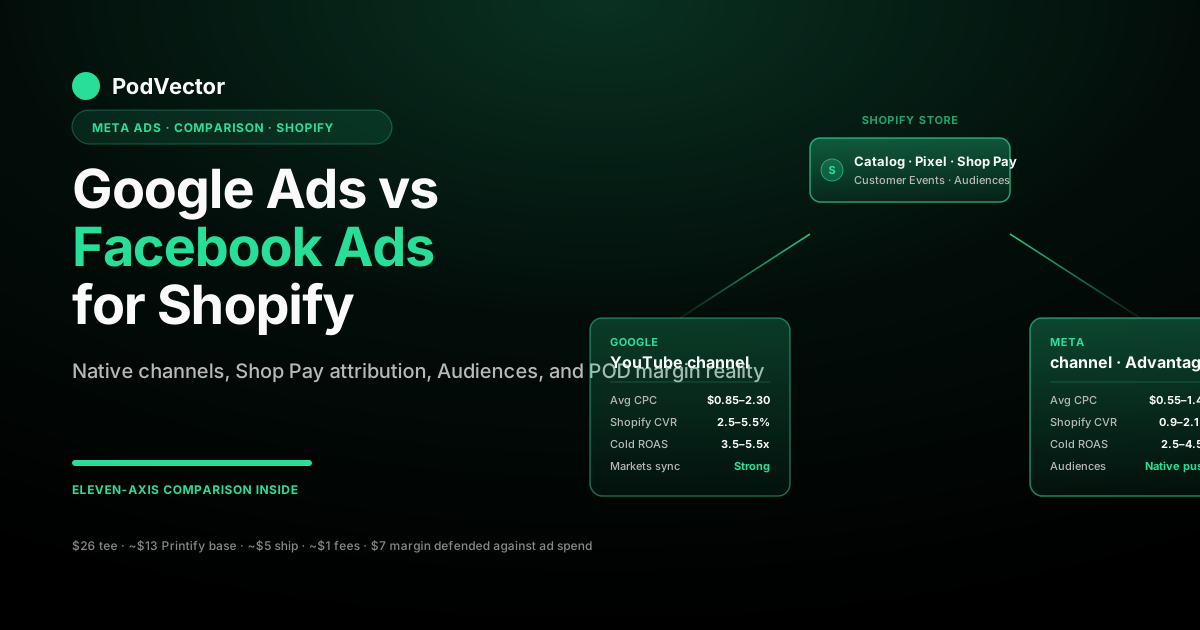
Quick Answer: For a Shopify POD store in 2026, run Facebook (Meta) Ads to create demand for visual, identity-driven designs and Google Ads to capture the search intent that demand generates. If you can only fund one this week, start with Meta for original POD art and Google for keyword-searchable niches (breed names, occupations, fandoms). Both are now first-party Shopify sales channels, so the real question isn't which is easier to install — it's which integration depth and demand type your store can actually exploit.
Google Ads wins for Shopify stores selling categories people search for by name, with searchable product attributes and competitive comparison shopping. Facebook Ads wins for visual or identity-driven products that depend on discovery, which is most original print-on-demand designs.
This guide compares the two on the Shopify-specific axes that matter — channel install, pixel and CAPI handoff, Shop Pay attribution, Shopify Audiences, Markets — then layers POD's $5–9 contribution margin reality on top so you can pick correctly.
Why "for Shopify" changes the question
A generic Google Ads vs Facebook Ads comparison treats the two platforms as interchangeable budgets. For a Shopify store, they're not — they're two different first-party integrations into your store data, your checkout, and your customer list.
Shopify ships a native Google & YouTube sales channel and a native Meta sales channel. Both auto-sync your product catalog, both write conversion events from Shopify's pixel, and both can pull from Shopify Audiences for targeting. That's a much tighter integration than what most ad platforms get with a custom-built site.
This means the "for Shopify" question is less about which platform is cheaper and more about which integration depth your store can exploit. A Shopify POD store with Printify or Printful has a different integration surface than a custom-coded Next.js site, and the ad-platform decision should reflect that.
The rest of this guide compares the two through that Shopify-specific lens, then overlays POD's tighter margin math at the end. If you want the broader Google vs Facebook framing without the Shopify-specific layer, see our main Google Ads vs Facebook Ads for POD comparison.
The Shopify-specific comparison at a glance
Here is the side-by-side using axes that matter for a Shopify operator, not generic ad-platform marketing copy. Numbers are 2026 ranges from public Shopify benchmark data and our own POD-operator client cohort.
| Axis | Google Ads (via Google & YouTube channel) | Facebook Ads (via Meta channel) | Shopify verdict |
|---|---|---|---|
| Native sales channel | Google & YouTube (free install) | Meta (free install) | Tie — both are first-party |
| Catalog sync | Auto-sync to Merchant Center | Auto-sync to Meta Catalog | Tie — both bidirectional |
| Pixel install | One-click via channel | One-click via channel | Tie |
| Server-side conversions | Enhanced Conversions auto | CAPI auto via Shopify | Tie — both work without custom code |
| Shop Pay attribution | Strong (cookieless-resilient) | Strong (cookieless-resilient) | Tie |
| Shopify Audiences sharing | Limited | Native push to Meta | Meta wins |
| Average CPC (2026) | $1.50–$5.25 | $0.70–$1.75 | Meta far cheaper at the click |
| Shopify CVR | 3.0–5.5% | 1.0–2.1% | Google wins on intent |
| Cold-traffic ROAS | 3.0–4.5x | 2.5–4.0x | Close — Google edges cold search |
| Discovery / catalog browse | Weak (Demand Gen only) | Strong (Advantage+ Shopping) | Meta wins |
| POD margin tolerance | Tighter — high CPCs hurt $7 margins | Looser — cheaper clicks soak up testing | Meta safer for $5–9 margin POD |
Read the table as a starting hypothesis, not a verdict. The right answer depends on your category, your average order value, and which integration depth you actually use. The next sections go axis by axis.
Native channels: Google & YouTube vs Meta
The biggest "for Shopify" lift in the last two years is that both Google Ads and Facebook Ads now ship as first-party Shopify sales channels. You install them from the Shopify app store and they handle catalog sync, pixel, and conversion events without custom code.
The Google & YouTube channel does three things at once. It pushes your Shopify product catalog into Google Merchant Center on a near-real-time refresh, installs the Google tag site-wide, and writes purchase events from Shopify's checkout into your Google Ads account.
The Meta channel does the equivalent for Facebook and Instagram. It pushes the catalog into Meta Catalog, installs the Meta pixel, and routes server-side events through Conversions API (CAPI). It also exposes Shopify Audiences sharing — more on that below.
Both integrations are free to install. The cost is the ad spend on top, plus your time. The comparison is no longer about which platform is technically easier to set up on Shopify — it's about which one drives the kind of demand your store actually needs.
What POD-specific friction looks like
For POD stores using Printify or Printful, the catalog sync has one edge case worth flagging. If you publish products to Shopify but your Printify designs aren't all live (work-in-progress drafts, retired SKUs, seasonal pulls), both Merchant Center and Meta Catalog will still try to ingest them.
This shows up as catalog disapprovals — "product unavailable" errors in Merchant Center, "out of stock" suppressions in Meta Catalog. Both platforms handle it the same way: keep your Shopify product status accurate (Active vs Draft vs Archived) and the channel cleans itself up on the next sync.
Pixel, CAPI, and Shopify Customer Events
iOS 14.5+ gutted client-side tracking in 2021. Shopify's response was to push pixel events through a server-side path called Customer Events, and both Google and Meta now plug into it without custom code.
For Google Ads, the channel installs the Google tag plus Enhanced Conversions for Web. Hashed customer email and address from the Shopify checkout flow get matched server-side, recovering the attribution iOS browser settings would otherwise drop. Match rates we see on POD stores: 85–95% on logged-in checkouts, 60–75% on guest.
For Meta, the equivalent is the Conversions API integration, also auto-installed by the channel. Hashed customer data flows from Shopify's checkout server directly to Meta's servers, bypassing the browser entirely. Match rates: 80–92% logged-in, 55–70% guest.
Both setups put Shopify operators in a much better tracking position than they'd be on a custom site that hadn't done the CAPI work themselves. For attribution depth specifically, our Meta ROAS and attribution guide for POD walks through how to interpret these match rates against your reported ROAS.
Shop Pay, checkout, and attribution gaps
Shop Pay is Shopify's accelerated checkout, and it changes the attribution math in a way that's easy to miss. When a buyer clicks an ad, then later returns and checks out via Shop Pay on a different device, the ad-platform pixel may miss the conversion entirely — but Shopify knows it happened.
Both Google and Meta now consume Shop Pay conversion signals via the Customer Events integration, so the gap is smaller than it was in 2023. But it's not zero, and it's larger on Meta because Meta's window-based attribution discounts conversions that take more than 7 days to close.
For POD stores with longer consideration windows — gift apparel, niche fandom merchandise, design-led purchases — this matters. The Shop Pay returner who saw your Facebook ad three weeks ago and finally bought today is real revenue, and Meta's reporting will undercount it more than Google's will.
The fix isn't to abandon Meta. The fix is to triangulate Shopify's reported orders against Meta's reported conversions and treat the gap as a constant haircut on Meta's ROAS reporting. We see 12–25% under-reporting on POD stores running Meta in 2026, depending on how much Shop Pay traffic they get.
Shopify Audiences and first-party targeting
Shopify Audiences is the single biggest "for Shopify" advantage Meta has over Google in 2026. It's a Shopify Plus feature (now also available to Advanced plans on certain regions) that pushes high-intent buyer cohorts directly into Meta as a ready-made lookalike seed.
The mechanism: Shopify aggregates buyer intent signals across the entire Shopify merchant network — without exposing individual customer data — and produces audience segments tuned to your category. You can push these straight into Meta Ads Manager as a custom audience and let Meta's algorithm prospect against them.
POD stores see real lift from this. The audiences are pre-filtered to people who have actually bought on Shopify stores in similar categories — not Meta's broad interest targeting, which keeps drifting toward broader and less qualified pools.
Google has nothing equivalent. You can build customer match lists from your Shopify customer file and push them into Google Ads, but that's the same mechanic any ad platform supports. Shopify Audiences as a network-derived prospecting seed is Meta-only.
Shopify Markets and international ad spend
Shopify Markets lets you run multiple country storefronts off one Shopify store, with localized currency, language, and shipping. Both Google and Meta integrate with it, but the depth differs.
The Google & YouTube channel can push country-specific feeds into Merchant Center per Shopify Market, which means you can run country-targeted Shopping campaigns against a properly localized landing page. This is genuinely useful for POD stores selling US-themed designs into US, AU, UK, and CA markets — the same SKU, three different currencies and shipping promises.
The Meta channel handles international more loosely. You can target by country in Ads Manager and Shopify will route the buyer to the right Markets storefront, but Meta Catalog itself doesn't fragment cleanly per Market. For most POD stores this is fine — Meta's strength is creative-driven global discovery, not strict geo-segmentation.
Verdict: if international expansion via Shopify Markets is a priority in the next 12 months, Google Ads has the cleaner integration. If it isn't, this axis doesn't matter.
AI and automation: what 2026 changed
The biggest shift in the last year is that both platforms now run on near-fully-automated campaign types, and the hands-on "skill" gap between Google and Facebook has largely collapsed into one question: which black box do you feed better?
On Google, that's Performance Max plus Smart Bidding (Target ROAS / Target CPA). You no longer hand-pick placements or keywords — you give Google your Merchant Center feed, a target ROAS, and a set of creative assets, and the algorithm distributes spend across Search, Shopping, YouTube, Display, and Gmail. Responsive Search Ads auto-assemble from up to 15 headlines and a dozen descriptions.
On Meta, the equivalent is Advantage+ Shopping plus AI-generated creative variations and Campaign Budget Optimization. You hand Meta your catalog, a budget, and a few base creatives, and it tests audiences, placements, and creative permutations automatically.
For POD operators this automation cuts both ways. The upside: you no longer need an agency to run a competent campaign on either platform. The downside is sharper than the generic SERP advice admits — both algorithms optimize toward "purchase" volume, and neither knows your Printify or Printful base cost. A Target ROAS of 3.0 that looks healthy in Google's dashboard can still lose money once the $13–14 blank-plus-print cost comes out, because the machine counted a $26 sale, not your $7 of contribution margin. The operator fix: set automation targets against true contribution margin, not revenue. Solve for the tROAS that actually clears your unit economics, feed that number to PMax and Advantage+, and re-check it weekly as base costs and shipping shift.
The POD overlay: where the comparison breaks
Every "Google vs Facebook for Shopify" article on the open web talks about Shopify like it's a generic ecommerce store with reasonable margins. POD operators on Shopify are not running that store.
A typical Shopify POD setup using Printify or Printful looks like this: $26 retail t-shirt, $13 base cost (blank + print), $5 shipping passed through, $1 in payment fees, leaving roughly $7 in gross margin per unit before any ad spend. That's the dollar bill the ad has to fit inside.
Now apply current 2026 CPC numbers. Google at a $2.50 CPC and a 3.7% CVR means about $68 cost per acquisition. Facebook at a $1.20 CPC and a 1.85% CVR means about $65 cost per acquisition. Both numbers are roughly nine to ten times your $7 gross margin per unit — and CPCs on both platforms have climbed, not fallen, since 2023.
This is why generic Shopify advice — "spend $50/day to start, scale what works" — destroys POD stores. The math only closes when your average order value clears two units, repeat purchase rate is real, and your contribution margin per cohort beats your blended customer acquisition cost. None of which the SERP top 3 even mention.
For deeper margin math on POD stores running Shopify, see our Google Ads vs Facebook Ads cost comparison for POD sellers and our ecommerce-focused comparison, both of which run the unit economics in detail.
The high-SKU POD reality
One more layer the SERP top 3 miss. A typical Shopify store has 50–500 SKUs. A serious POD store on Shopify has 1,000–10,000 SKUs because each design times each garment color times each size is a separate variant.
Google Shopping handles this fine — it ranks individual SKU listings and lets buyers filter. Meta's Advantage+ Shopping handles it less well, because the algorithm prefers clear "winners" and high-SKU catalogs dilute the signal. POD stores running Meta should aggressively segment catalogs into top-30-design subsets to give the algorithm something to chew on.
Running both on Shopify: the realistic stack
Most Shopify POD operators end up running both, not one. The split that actually works in 2026:
Google Ads on Shopify (40–60% of budget): Standard Shopping campaigns or Performance Max for buyers who already know your designs (branded searches, retargeting), plus broad-match Search for high-intent niche keywords like "personalized dachshund mom shirt."
Facebook Ads on Shopify (40–60% of budget): Advantage+ Shopping campaigns for cold prospecting against Shopify Audiences seeds, plus dynamic catalog retargeting against Meta Pixel + Customer Events viewers.
The two work as a loop. Meta creates the demand by surfacing your designs to people who didn't know they wanted them, and Google captures the post-discovery search behavior — branded queries, "where to buy [your design]," design-name searches that build over weeks.
For the deeper version of this dual-channel framing, see our Google Ads vs Facebook Ads strategy guide for POD sellers.
The unified-data layer the dual stack needs
Running both platforms creates one structural problem: each platform reports its own ROAS in its own UI, and the two numbers don't add up to your Shopify revenue. You'll see Google reporting 4.2x ROAS, Meta reporting 2.8x ROAS, and Shopify showing total ad-attributed revenue that's 30% lower than the sum of the two.
This isn't a bug — it's double-counting on overlapping conversions and CAPI/Customer Events tracking gaps. But it makes "where should my next dollar go?" impossible to answer from inside either ad platform.
The fix is to pull both ad platforms plus Shopify orders plus Printify/Printful actual costs into a single live data layer and compute blended ROAS against true contribution margin. Victor, PodVector AI's AI employee for POD sellers, sits on top of that data and answers margin questions in plain English without you writing SQL: "what's my Meta blended ROAS net of Printify base costs over the last 28 days?" returns a number that respects both the unified attribution and the unit economics.
Which one to pick for your store this week
If you only have budget for one platform right now, here's the decision tree.
Pick Google Ads on Shopify if: Your designs target named search terms (breed names, occupation jokes, fandoms with strong keyword volume), your average order value is $40+, and you want the cleaner Shopify Markets integration for international expansion.
Pick Facebook Ads on Shopify if: Your designs depend on visual discovery (original art, identity-based humor, niche aesthetics), your average order value is under $30, and you want the Shopify Audiences advantage for cold prospecting.
Pick both if: You're past your first $5K/month in revenue, have at least one design category that's already winning organically, and have monthly ad budget of $1.5K+ to credibly fund both. Below that, splitting starves both platforms of learning data.
Mistakes Shopify POD sellers make in this comparison
Treating channel install as the integration
Installing the Google & YouTube channel doesn't mean your tracking is correct. Verify that purchase events fire with the right transaction IDs, that Enhanced Conversions are matching at 80%+ on logged-in users, and that your Merchant Center feed has zero disapprovals. Same for Meta channel and CAPI.
Forgetting the Printify base cost in CPA math
Both Google and Meta optimize toward "purchases" — units sold, not gross profit. A campaign happily crushing your CPA target at $20 looks great until you remember the unit cost you back $14, leaving $6 to defend against everything else. Always re-cut campaign performance with the print base subtracted.
Comparing platform-reported ROAS instead of blended
Google's reported 4x ROAS and Meta's reported 3x ROAS are not directly comparable because they use different attribution windows and double-count overlapping conversions. The only number that matters is blended ROAS = Shopify revenue / total ad spend, computed in a single source of truth.
Letting Advantage+ Shopping eat the catalog
POD stores with 1,000+ SKUs that hand Meta the entire catalog in one Advantage+ campaign almost always underperform. Curate the top-30 designs into a separate catalog set and let Advantage+ work that subset — the signal density makes the algorithm dramatically smarter.
Skipping Shopify Audiences entirely
If you're on Shopify Plus or Advanced and not pushing Shopify Audiences seeds into Meta, you're leaving the single biggest "for Shopify" advantage on the table. Set up two seeded audiences, run Advantage+ against them, compare to your interest-targeted baseline.
FAQs
Is Google Ads or Facebook Ads cheaper to run on Shopify?
At the click level, Facebook is much cheaper — 2026 average CPC of $0.70–$1.75 vs Google's $1.50–$5.25. At the conversion level the gap closes because Google's higher intent translates into higher CVRs (3.0–5.5% vs 1.0–2.1% on Shopify). Effective CPA usually lands within 20–30% of each other on a well-tuned account — which is why the choice for POD comes down to demand type, not click price.
Do I need to install both the Google & YouTube channel and the Meta channel?
Only the ones you're actively running ads on. Both channels add some load to your store theme and your data flow, so don't install one "just in case." That said, the friction to install when you do start is genuinely low — both are one-click apps from the Shopify app store.
How does Shop Pay affect my ad attribution on Shopify?
Shop Pay buyers who return on a different device may show up as direct revenue in Shopify but go uncounted in your ad-platform reporting. Both Google and Meta now consume Shop Pay events through Shopify's Customer Events, but Meta still under-reports more than Google because of its 7-day click window. Plan for a 12–25% under-report on Meta-attributed revenue.
Can I run Performance Max if I'm on Shopify?
Yes. The Google & YouTube channel handles the feed and pixel work that PMax needs to function. Most Shopify POD stores see PMax outperform standard Shopping for the first 60 days as the algorithm learns, then plateau. Consider running standard Shopping alongside PMax once you have a winning design set.
Is Shopify Audiences worth the upgrade to Plus?
For POD stores spending under $5K/month on Meta, no — the lift doesn't pay back the Plus upgrade. For stores spending $20K+/month on Meta, often yes — the cold-prospecting cost reduction tends to recover the price difference inside 90 days. Run the math against your specific spend.
How does the Meta Ads Shopify integration compare to Google's?
Both are mature, free, and one-click. Meta's edge is Shopify Audiences sharing and Advantage+ Shopping's catalog handling. Google's edge is Shopify Markets multi-country support and cleaner attribution under iOS browser restrictions. For a deep dive on the Meta side, see our complete guide to Meta Ads Shopify integration for POD.
Should I trust Shopify's reported ad-attributed revenue or the ad platform's?
Neither in isolation. Shopify under-counts because it can't see view-through conversions. Each ad platform over-counts because it claims overlapping conversions. The right number is blended — total Shopify revenue divided by total ad spend across all platforms, computed in a unified warehouse.
Does the Shopify-vs-custom-site choice change the Google vs Facebook answer?
Mostly no. The platform-strength differences (search intent vs discovery, CVR vs CPC, audience targeting capabilities) are the same on Shopify and on a custom build. Shopify just makes both integrations dramatically easier to set up correctly. For broader category context, see our comparison cluster on Meta Ads vs alternatives and the full Meta Ads topic hub.
Where do the SERP-average benchmarks come from?
The CPC, CVR, and ROAS ranges in this guide are 2026 figures cross-checked against published Shopify ecommerce benchmarks and our own POD-operator client cohort. For a third-party perspective with named brand examples, Shopify's own Google Ads vs Facebook Ads guide is the most-cited general-ecommerce reference.
Stop guessing which channel deserves your next dollar.
Google says it earned the sale. Meta says it earned the sale. Shopify shows different revenue. Your Printify margin disagrees with all three.
Victor unifies your Shopify orders, Printify costs, Google Ads, Meta Ads, and pixel attribution into one live data layer — and answers margin questions in plain English. No SQL, no spreadsheets, no platform-by-platform ROAS chasing.
Try Victor free