
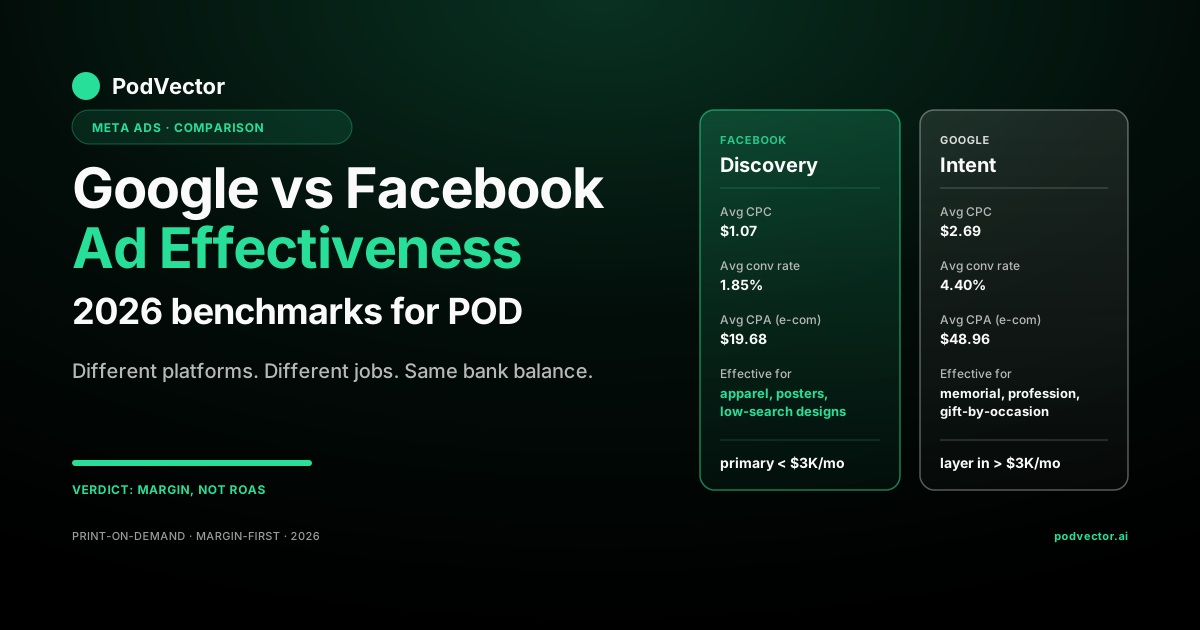
Quick Answer: Effectiveness is the wrong word for what POD operators actually measure. The honest 2026 numbers — Facebook averages $1.07 CPC and 1.85% conversion; Google averages $2.69 CPC and 4.40% conversion — say nothing about whether either platform is effective for your catalog.
Effectiveness for print-on-demand depends on three things almost no comparison article covers: search-query volume for your specific design phrases, contribution margin per order after Printify or Printful costs, and how much of each platform's reported ROAS is real once you de-duplicate the same buyer counted twice.
Run by those three filters, neither platform is universally more effective. Most POD apparel accounts under $5K/month spend should default to Facebook. Most accounts with sharp gift, profession, or breed-specific demand should default to Google. Almost everyone above $4K/month should run both — but only if they have a layer above both ad managers measuring the truth.
What "effectiveness" actually means for POD
Most ad-channel comparison guides treat "effectiveness" as a CPC-and-conversion-rate question. For most B2B SaaS, that's roughly fine. For print-on-demand, it's a misframe.
POD has three structural quirks that break the standard effectiveness math. Margins are thin — often $3–$8 per order at $24.99 average order value. Most designs have zero search demand on day one. And Printify/Printful base costs change the order-level economics in ways platform reports never see.
So when a comparison article says "Google has 4.40% conversion vs Facebook's 1.85%" and stops there, it's measuring something true that doesn't apply. POD effectiveness is whether the platform produces enough orders with positive contribution margin, fast enough, for the catalog you actually have.
That reframe reorders everything. CPC stops mattering on its own. Conversion rate stops mattering on its own. Even ROAS — the metric most operators chase — turns out to be a sales pitch from the ad manager, not a number you can spend.
2026 effectiveness benchmarks side by side
The current 2026 platform benchmarks, drawn from advertising intelligence aggregators and observed POD account ranges:
| Metric | Facebook Ads | Google Ads |
|---|---|---|
| Average CPC (cross-industry) | $1.07 | $2.69 |
| Average CPM | $14.90 | $38.40 |
| Average conversion rate | 1.85% | 4.40% |
| Average CPA (e-commerce) | $19.68 | $48.96 |
| POD apparel CPC range | $0.90–$1.40 | $2.10–$3.20 (Search), $0.40–$0.90 (Shopping) |
| POD cold conversion rate | 0.8–1.8% | 2.5–5.5% (Search), 1.5–3% (Shopping) |
| Time to leave learning phase | 7–14 days | 14–28 days |
| Min monthly spend for stable signal | ~$1K | ~$3K |
Stare at the row labelled "average CPA" and Facebook looks roughly 2.5x more effective than Google. Stare at "conversion rate" and Google looks more than 2x more effective. Same data, opposite conclusions.
The reason both reads are misleading: the cross-industry averages mash together categories where one platform dominates with categories where the other does. POD apparel, mugs, posters, and wall art each behave differently. The averages flatten that signal into noise.
For a deeper cost-side breakdown of how those benchmarks translate into actual POD account spend, our cost comparison for POD sellers walks through the per-order math.
The intent-vs-discovery split that decides everything
The reason headline benchmarks contradict themselves is that the two platforms solve different problems. Google captures demand that already exists. Facebook creates demand that didn't.
That sentence sounds like marketing-speak. It's not — it's the hinge that determines effectiveness for any specific POD catalog.
If you sell a "registered nurse heart-rate" t-shirt, thousands of people search "nurse gift shirt" every month. Google can put your design in front of them at the moment of buying intent. Conversion rate is high; CPA is reasonable; effectiveness is real.
If you sell an aesthetic abstract poster with a phrase you invented, zero people are searching for it. Google has nothing to show. Facebook can put it in the scroll feed of someone who likes minimalist interiors and watch them stop. Conversion rate is lower; reach is enormous; effectiveness comes from volume.
This is why the question "which is more effective" has no general answer for POD. It has a specific answer per design. Operators with a mixed catalog usually need both — but the budget split should follow the catalog's intent profile, not a 50/50 default.
Quick test for any single design: search the design's exact phrase plus a buyer modifier ("[your phrase] shirt," "[your phrase] gift") in Google Keyword Planner. If monthly volume is under 100, Facebook is your primary channel. If it's over 1,000, Google is. In between, run both and let the data decide.
The attribution trap that fakes effectiveness
Here's the thing every comparison article skips: the effectiveness numbers each platform reports overlap. They double-count.
The typical 2026 POD purchase path looks like this: see a Reels ad → don't click → search the brand on Google three days later → click a branded search ad → buy. Facebook's pixel logs a view-through conversion. Google's tag logs a last-click conversion. Same sale, two attributions.
If you add up the revenue both platforms claim and compare it to your Shopify orders, the platform numbers usually total 130–160% of actual revenue. Each platform thinks it's more effective than it is, by 30–60% in combined inflation.
That breaks the entire effectiveness comparison. A platform reporting 3.5x ROAS that's really delivering 2.4x once you de-duplicate looks great in the dashboard and bleeds margin in the bank.
The fix is not to pick one platform and lose the other's contribution. The fix is to measure from a layer above both — your Shopify orders table, your warehouse, or an analyst that joins the two. We cover the mechanics in detail in our performance comparison guide and our full Meta Ads attribution guide.
Effectiveness by POD niche
Effectiveness flips category by category. The same budget, the same operator, can produce wildly different results across niches.
Apparel (T-shirts, hoodies, sweatshirts)
Facebook is usually more effective as the primary channel. Most generic graphic-design tees have zero search volume; the buyer doesn't know they want it until the feed shows them. Google works once you have branded queries or profession/identity-targeted designs.
Mugs and drinkware
Mixed effectiveness. Personalized and gift-occasion mugs ("father's day mug funny," "engineer mug coffee") have real Google demand and convert at intent-driven rates. Generic designs default to Facebook discovery.
Posters and wall art
Facebook wins top-of-funnel — visual scroll-stopper category, high CTR. Google Shopping wins bottom-of-funnel for buyers decorating a specific room or matching a known aesthetic, often at 3–5x the cold conversion rate.
Phone cases and accessories
Google leads. Buyers search "[phone model] case [aesthetic descriptor]" with extreme purchase intent. Facebook plays a useful retargeting role but rarely wins as primary channel.
Memorial, profession, breed-specific designs
Google dominates effectiveness. Search intent is razor-sharp ("retired nurse gift," "border collie mom shirt"). Facebook works as second-touch only.
Notice the pattern: the more specific and searchable the design phrase, the more Google's intent-capture model wins. The less searchable, the more Facebook's discovery model matters. This is why the same operator can call Google "highly effective" for one product line and "useless" for another — both statements are correct, on different SKUs.
Effectiveness by budget tier
Budget changes effectiveness as much as niche. The same ad creative behaves differently at $30/day and $300/day.
Under $1K/month total: Run Facebook only. Google's Performance Max won't escape the learning phase below ~$3K monthly, and split-budget tests at this scale produce noise. Effectiveness measurement is impossible without enough conversion volume.
$1K–$3K/month: Facebook primary, Google branded-search only. The branded-search exception matters: someone who saw your Reels ad will search your brand name within a week, and you want the click. Cost is minimal; effectiveness on branded search runs 8–15x ROAS in 2026.
$3K–$10K/month: Run both. Roughly 70/30 Facebook/Google to start, adjusted weekly based on contribution margin per order. This is where most POD accounts sit, and where unified measurement starts paying back its setup cost.
$10K+/month: Often closer to 50/50, with Google's share rising as Shopping feeds mature and branded demand grows. At this tier, the ineffectiveness of running blind is the biggest cost — manual reconciliation can't keep up.
For the strategic playbook by tier, see our cross-platform strategy guide for POD.
The real effectiveness metric for POD
Drop the platform-reported metrics. The honest effectiveness metric for a POD seller is contribution margin per order — the dollars left after every variable cost.
Run the math for a $24.99 Printify tee:
- Revenue: $24.99
- Product cost (base + print + shipping): -$10.50
- Shopify transaction fee (~3%): -$0.75
- Ad cost per order at 2.5x ROAS: -$10.00
- Contribution margin: $3.74 per order
Now flip the same order to a 3.5x ROAS:
- Ad cost per order at 3.5x ROAS: -$7.14
- Contribution margin: $6.60 per order — 76% more profit per sale
That's why the platform with the higher honest ROAS wins on effectiveness, even if its CPC is higher. A $0.90 Facebook click at 2.5x ROAS produces less margin than a $2.50 Google click at 3.5x ROAS — at the same average order value.
The trap word is "honest." Both platforms inflate reported ROAS through over-attribution. The only number that matters is contribution margin in your Shopify orders table, after every channel has been paid. That's the layer where effectiveness comparison stops being a debate and becomes arithmetic.
How to measure honest effectiveness
Here's the practical sequence to get a clean answer to "which platform is more effective for my POD shop" in 2026:
- Tag every campaign with a UTM source. Don't trust auto-tagging. Manual UTMs survive cookie loss and platform changes.
- Pull Shopify orders, Meta spend, and Google spend into one table weekly. Spreadsheet is fine to start. Match orders to UTMs where possible; treat the rest as blended.
- Calculate blended ROAS. Total Shopify revenue ÷ (Meta spend + Google spend). This is your real number, not the per-platform reports.
- Calculate contribution margin per order. Subtract Printify or Printful COGS, transaction fees, and ad cost from revenue. Aggregate by source.
- Run for 60 days minimum before judging effectiveness. Facebook needs creative iterations; Google needs query history. Either platform's first 30 days is signal-poor.
- Make budget decisions on marginal CAC, not headline ROAS. The right question is "what's the expected new-order count from another $500 on this platform" — not "which dashboard has the bigger number."
If you don't have time to maintain that pipeline manually, you have two options. Build it — a live data warehouse (the customer's Snowflake, Redshift, Databricks, or equivalent) plus an ETL pipeline plus a BI dashboard, usually 4–8 weeks of work for a solo operator. Or use an AI employee that already pulls Shopify, Printify, Printful, Meta, and Google into one warehouse and answers margin questions in plain English.
That's what Victor by PodVector AI does. Victor answers "what's my actual blended CAC this week?" or "which Meta campaign is bleeding margin once Printify costs are netted out?" in a chat. Victor can pause those losing campaigns automatically rather than just flag them.
Before deciding, the broader context lives in our Meta Ads vs alternatives hub, our "which is better" verdict, and the complete Meta Ads playbook for POD. The full Meta vs alternatives cluster and the Meta Ads topic hub cover everything else. For an outside-in agency view of the same comparison, the Swydo agency playbook is a solid non-POD reference.
FAQs
Which platform is more effective for POD sellers in 2026?
Neither in the abstract. For POD apparel without sharp search demand, Facebook is more effective as the primary channel because it generates discovery for designs with zero query volume. For POD niches with intent-driven keywords (memorial, profession, breed, gift-by-occasion), Google is more effective. Most operators above $3K/month should run both with a 70/30 Facebook/Google starting split.
Why does Facebook have higher conversion rates on my account but lower margin?
Two likely causes. First, Facebook's pixel claims view-through conversions Google never sees, so each platform's reported conversion rate overstates its true contribution. Second, Facebook's lower-intent traffic often produces orders with lower average order value or higher refund rates — eating margin even when conversion rate looks healthy. Measure margin in Shopify, not conversion rate in the ad manager.
Is Google Ads more effective than Facebook Ads for e-commerce in general?
For e-commerce categories with strong search intent — branded products, gifts, replacement parts — yes, Google's higher intent typically produces higher honest ROAS even at higher CPC. For visual-discovery categories like apparel and home decor, Facebook is often more effective. POD straddles both and benefits from running them together.
How long does Facebook need to leave the learning phase compared to Google?
Facebook's Advantage+ Shopping (Meta's auto-targeted commerce campaign) typically stabilizes in 7–14 days once it sees 50+ weekly conversions. Google's Performance Max (Google's all-in-one auto-distributed campaign) usually needs 14–28 days and at least $3K/month spend. Both shorter on accounts with mature pixels and conversion history.
Why is my Google CPC so much higher than the platform averages?
Two common reasons for POD specifically. First, generic POD apparel keywords ("custom t-shirt," "graphic tee") are dominated by Amazon, Etsy, and large brands bidding aggressively on broad match. Second, low quality scores on landing pages with thin content drive the auction price up. Branded queries and tightly-themed Shopping campaigns produce CPCs 40–60% below the cross-industry $2.69 average.
Should a $500/month POD ad budget go to Facebook or Google?
Facebook only. Below $1K/month, you can't generate enough conversion volume to escape Google's learning phase, and split-budget testing produces unreliable data. Use the entire $500 on Facebook with one creative testing campaign and one retargeting campaign. Layer Google in only after monthly spend reliably crosses $3K.
Can I trust the ROAS my ad manager reports for effectiveness comparisons?
Not for cross-platform comparison. Each ad manager attributes generously to itself and ignores the other platform's contribution. The platform numbers can total 130–160% of actual Shopify revenue when both are running. Use platform-reported ROAS for in-platform optimization decisions only — and always reconcile against your Shopify orders table for cross-channel decisions.
Does Performance Max actually work for POD catalogs?
Conditionally. PMax needs a clean Shopping feed (variants, accurate titles, GTINs where possible) and at least $3K/month to learn. POD accounts with thin product metadata or generic titles get worse PMax effectiveness than they would from manual Shopping campaigns. Fix the feed first, then turn PMax on.
Effectiveness is a number you can spend, not a number in a dashboard
Facebook's ad manager says one ROAS. Google's says another. Your Shopify orders say something else once you net out Printify costs. Victor by PodVector AI pulls Shopify, Printify, Printful, Meta, and Google into one live warehouse and answers "which channel actually delivered margin this week?" in plain English — so you stop comparing two sales pitches and start measuring effectiveness from the bank balance up.
Try Victor free