
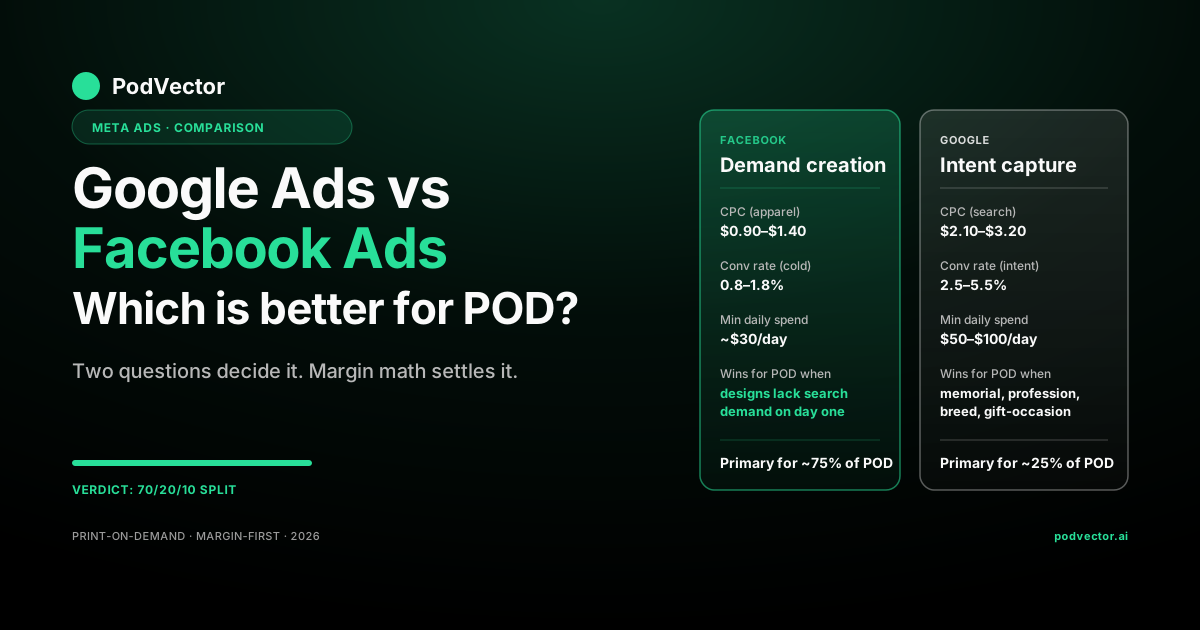
Quick Answer: "Better" depends on whether your designs have search demand. For the average print-on-demand seller — design-led, sub-$50K monthly revenue, no branded queries — Facebook Ads is the better primary channel in 2026.
For the minority of POD sellers in high-intent niches (memorial gifts, profession-specific apparel, breed-specific pet designs, gift-by-occasion phrases), Google Ads wins because the buyer types the design into the search bar before scrolling a feed.
The honest answer isn't "pick one." It's: weight your spend 70/30 toward whichever platform's structural strength matches your niche shape, and judge both on contribution margin per order — not headline ROAS.
"Which is better" is the wrong question — but here's how to answer it
Most POD operators arrive at this question after a frustrating month on one platform. Facebook Ads burned $800 testing creatives. Google Ads burned $600 testing keywords with no Shopping feed. Neither felt "better." Both felt expensive.
The framing trap is treating Google and Facebook as substitutes. They're not. Google captures buyers who already know what they want. Facebook creates buyers for things they didn't know existed.
For a print-on-demand business, those are very different jobs. Most of your designs — the niche T-shirt with the funny line, the personalized hoodie, the new mug pattern — have zero search volume on day one. Nobody is Googling "vintage retired-truck-driver T-shirt with cardinal." But somebody scrolling Reels with that exact backstory will stop on your ad.
That's the whole game. The platform is "better" when it matches what your product needs to do at this point in its life cycle. The rest of this article is how to figure out which side of that line you're actually on.
The three variables that actually decide the winner
Forget headline CPC and conversion-rate averages for a minute. The platform winner for any given POD account is decided by three account-level variables:
- Search demand for your designs. If people type your design phrase or your niche into Google, intent capture wins. If they don't, you're paying for an empty inventory.
- Creative production capacity. Facebook needs 8–15 fresh creative variants per week to keep CPMs sane in 2026. If you can't produce that, Google's lower creative cadence is friendlier.
- Contribution margin per order. POD margins are tight ($8–$15 typical on a $24.99 tee through Printify or Printful). The platform with the better effective CAC for your margin wins, regardless of which has the cheaper click.
Run those three through your own account and the answer often changes from what you'd guess based on Twitter consensus. We unpack each below, with the math.
Where Facebook Ads wins for POD
For the average POD account, Facebook is the better primary channel for five structural reasons. None of these are platform fanboyism — they're consequences of how POD products and POD margins actually behave.
1. It creates demand for designs that have none
This is the headline. A new design has no search volume. Google can't show it because nobody is asking for it.
Facebook can. Lookalike audiences off your previous buyers, interest stacks ("vintage trucks" + "country music" + "Vietnam veterans"), and creator-style UGC video put the design in front of people who didn't know they wanted it until they saw it. That's demand creation, and it's the only way most POD designs can reach a profitable audience size.
2. The minimum spend per ad set is lower
Facebook ad sets exit the learning phase around 50 conversions. At a $20 effective CPA on POD, that's roughly $1,000 over 4–7 days at $30/day. Google Shopping campaigns and PMax need closer to $50–$75/day to feed the algorithm enough signal to optimize.
For a seller testing a new niche on $50/day total, Facebook's lower per-campaign minimum is the difference between getting a real signal and never escaping "still learning."
3. Creative is the lever, and POD already produces creative
Most POD operators are already designing — that's the business. Turning a design into a 6-second video ad with Canva, CapCut, or AI tools is a 30-minute task. Each variant tested gives Facebook fresh signal.
Google Search and Shopping ask for keyword and feed work, which is a different skill. Most POD sellers have more creative reps than keyword-research reps.
4. CPM scales reasonably below $50/day
Facebook's CPM for US 18–65 lookalikes typically runs $11–$22 for POD apparel. Even at $30/day, you're getting 1,500–2,700 impressions per day per ad set. Enough to read whether a creative is working.
Google Shopping at the same daily budget often spends only on a few high-value queries, leaving you with under 1,000 impressions and no read at all.
5. Retargeting visual assets do double-duty
The same product photo that ran cold on Facebook can power Dynamic Product Ads to retargeted traffic. The asset library compounds. Read the Facebook Dynamic Product Ads Shopify playbook for how POD sellers are running dynamic ads off the Shopify catalog without a paid feed tool.
Where Google Ads wins for POD
The minority case isn't small. Roughly 20–25% of POD sellers are in niches where Google wins decisively. If your account fits any of these patterns, weight your spend toward Google instead.
1. Memorial, sympathy, and gift-by-occasion designs
Searches like "memorial gift for father funeral," "sympathy ornament for loss of mother," and "personalized gift for retirement" are high-intent and well-funded. Buyers will compare 4–6 results before clicking. Your job is to be in the consideration set, not to plant the idea.
Facebook can't surface these intents at the moment of need. Google can, and the conversion rate often hits 4–7% on those queries — enough to absorb the higher CPC.
2. Profession-specific and identity-specific apparel with branded modifiers
Phrases like "registered nurse coffee mug," "diesel mechanic shirt funny," "third-grade teacher gift" all carry steady volume. Buyers are searching the exact phrase you'd put on the design. Google Shopping with the right title and image converts at 3–5%.
For these niches, the Google Shopping vs Facebook Ads breakdown shows the unit economics flip.
3. Pet-breed-specific and hobby-specific designs
"Australian shepherd dad shirt," "border collie mom hoodie," "dirt-bike mom T-shirt" are all queries with monthly volume. Google's intent layer is doing the audience selection for you — the searcher self-identifies.
4. Branded product searches if you've built any awareness
Once your store gets occasional branded searches ("[your store name] hoodie"), Google brand-defense costs almost nothing and protects revenue Facebook can't see.
The CPC trap: why the cheaper click usually loses
"Facebook CPC is $1.20, Google CPC is $2.80, so Facebook is cheaper" is the most expensive sentence in this whole comparison. It's true and useless at the same time.
The number that decides which platform pays back is effective cost per acquisition: CPC divided by conversion rate. Run it both ways for typical POD apparel:
| Variable | Facebook (POD apparel) | Google (intent queries) |
|---|---|---|
| Average CPC | $0.90–$1.40 | $2.10–$3.20 |
| Conversion rate (cold) | 0.8%–1.8% | 2.5%–5.5% |
| Effective CPA (mid-range) | $78 | $70 |
| Days to learning-phase exit | 4–7 at $50/day | 7–14 at $75/day |
| Min daily spend for signal | ~$30 | $50–$100 |
The mid-range effective CPA is within $10 of each other. The platform that "wins" on cost depends on whether your niche has the search demand to land you on intent queries — back to variable #1 above.
For deeper cost math, the Google Ads vs Facebook Ads cost breakdown for POD walks through the spreadsheet by spend level.
The contribution-margin math most POD sellers skip
Effective CPA only matters if you know your contribution margin per order. POD operators routinely overestimate margin and so think they can absorb a CPA they can't.
Run the actual math on a typical $24.99 unisex tee through Printify or Printful:
- Sell price: $24.99
- Print provider cost (Printify Premium, base tee + standard print): ~$9.50
- Shipping (US, charged $4.99, true cost ~$5.49): -$0.50 absorbed
- Shopify transaction + payment: ~$1.10
- App fees (catalog, upsell, etc., averaged per order): ~$0.30
Contribution per order: roughly $13.59. That's your true ceiling for blended CAC if you want to be profitable on the first order — and most POD sellers don't get a strong second order soon enough to relax that ceiling.
At a $13.59 contribution margin, an effective CPA of $70–$78 means you need a 5–6x repeat-order rate to break even on first-order acquisition. If you're not seeing that, you need either (a) cheaper CAC, (b) higher AOV via bundles, or (c) a different platform mix.
This is why "Facebook is cheaper" is dangerous shorthand. Cheaper-per-click isn't cheaper-per-margin-dollar. The Meta Ads ROAS and attribution guide covers how to read true ROAS after COGS for POD sellers.
Victor — PodVector AI's AI employee — is built for exactly this. It joins your ad-platform spend, your Shopify orders, and your Printify or Printful itemized costs in a unified data warehouse, then answers questions like "what was my true ROAS on Facebook last week, after COGS and fulfillment?" in plain English. You don't need to build a spreadsheet to know whether the cheaper click was actually cheaper.
A two-question decision rule
Skip the gut check. Use these two questions:
Question 1: Do my designs have search demand? Open Google Keyword Planner or Ahrefs and check 5–10 of your top SKUs as search phrases. If 3+ of them have 200+ monthly searches, Google is in play. If 0–1 do, Facebook is your primary.
Question 2: Can I produce 8–12 creative variants per week? If yes, Facebook has the runway it needs to optimize. If no, weight Google heavier — its creative cadence demand is closer to 2–4 refreshes per week.
Two yeses on Facebook + low search demand = Facebook primary. Two yeses on Google + high search demand = Google primary. Mixed signals = run both, with the split below.
The cluster guide on when to use Google Ads vs Facebook Ads walks through more decision branches if your account has unusual constraints.
The 70/20/10 split most POD accounts should run
Even if Facebook is your primary, running zero Google is a mistake. And vice versa. The split most healthy POD accounts settle into in 2026 looks like this:
- 70% primary platform. Whichever platform won the two-question decision rule above. This is where most of your acquisition happens.
- 20% secondary platform. The other one, scaled enough to fight for the conversions your primary platform misses (intent queries on Google for a Facebook-primary account, lookalike volume on Facebook for a Google-primary account).
- 10% retargeting and brand defense. Dynamic Product Ads on Facebook for site visitors, brand-search defense on Google for store-name queries, and email/SMS warmups.
The 10% bucket is the highest-ROAS spend on most POD accounts. Don't skip it because the absolute dollars are small.
For deeper structuring, see the Google Ads vs Facebook Ads strategy guide for POD, which walks through campaign-level structure on both sides.
Mistakes that wreck every "which is better" comparison
The same five mistakes keep showing up in POD account audits. Each one makes whatever comparison you ran look wrong, even if the underlying answer was right.
1. Comparing platforms at different funnel stages
Running Facebook on cold prospecting and Google on retargeted searches and concluding "Google has better ROAS" — the comparison is contaminated. Both platforms need to be measured on the same intent layer.
2. Ignoring view-through and post-iOS attribution loss
Facebook's reported ROAS understates true contribution by 20–35% for most POD accounts post-iOS 14. Google's mostly doesn't (deterministic search). If you compare reported numbers without correcting, you'll always pick Google — wrongly.
3. Underspending Google to "test" it for a week
Google Shopping at $30/day for 7 days is not a test. It's noise. Either commit to $75/day for 14 days or don't claim you've tested Google.
4. Judging Facebook on a single creative
Facebook is a creative-volume platform. Running one image ad for two weeks and concluding Facebook doesn't work for your niche is like judging a restaurant by one dish. Test 8–12 variants before drawing conclusions.
5. Reading ROAS without subtracting COGS
"4x ROAS on Facebook" means $4 of revenue per $1 of ad spend. On a POD product with 35% contribution margin after COGS, that's a 1.4x return on margin — barely break-even. Always read post-COGS.
FAQs
Is Google Ads or Facebook Ads better for a brand-new POD store?
For a brand-new POD store with no search demand for your designs, Facebook is almost always the better starting point. Google Shopping needs both a fed Merchant Center catalog and search demand for your niche — neither of which a new store typically has on day one.
What's the minimum budget to test both platforms fairly?
$50/day on Facebook for 7 days ($350) and $75/day on Google Shopping for 14 days ($1,050) — about $1,400 total — is the fair test. Less than that on Google leaves PMax under-fed and inconclusive.
Should POD sellers use Performance Max or Standard Shopping?
For accounts under $5K/month in Google Ads spend, Standard Shopping with manual bidding gives you more control and clearer signal than PMax. Once you cross $5K/month and have 30+ conversions/month, PMax often outperforms.
Does the iOS 14 update still affect Facebook Ads in 2026?
Yes. The Conversions API and aggregated event measurement have closed some of the gap, but reported Facebook ROAS still typically understates true contribution by 15–30% on POD accounts. Build that buffer into your CAC ceiling.
How do I measure true ROAS after Printify or Printful COGS?
Either build a spreadsheet that pulls platform spend, Shopify orders, and your print-provider invoice line items into one place — or use a tool that does it for you. Victor pulls live data from Shopify, Printify or Printful, and your ad platforms into a single warehouse, then answers true-ROAS questions in plain English.
Can I run Facebook Ads without a pixel installed?
Technically yes, but you'll lose 80%+ of the optimization Facebook would otherwise do. Always install both the Meta Pixel and the Conversions API on Shopify before running paid traffic.
Is Google Ads cheaper if I'm in a high-search-demand niche?
Often, yes — for the conversions Google Search captures. But the demand-creation work Facebook does for new designs has no Google equivalent. The honest answer for high-demand niches is "Google captures cheaper, Facebook still scales harder."
Where can I see the cluster overview comparing Meta Ads to alternatives?
The Meta Ads vs alternatives guide is the cluster hub and links to every supporting comparison. The Meta Ads topic hub covers ad types, attribution, and strategy beyond comparison alone.
Stop guessing which platform paid back. Ask Victor.
Facebook says one thing. Google says another. Your Shopify dashboard says a third. Without a unified view that includes Printify or Printful COGS, you'll never know which platform actually paid back.
Victor — PodVector AI's AI employee — pulls your ad spend, Shopify orders, and itemized POD provider costs into a live data warehouse, then answers questions like "what was my true ROAS on Facebook last week after COGS?" in plain English. And stop arguing with disagreeing dashboards.
Try Victor freeExternal references: Shopify's 2025 Google Ads vs Facebook Ads guide, WordStream's comparison, and CometogetherMedia's 2026 winner analysis.