
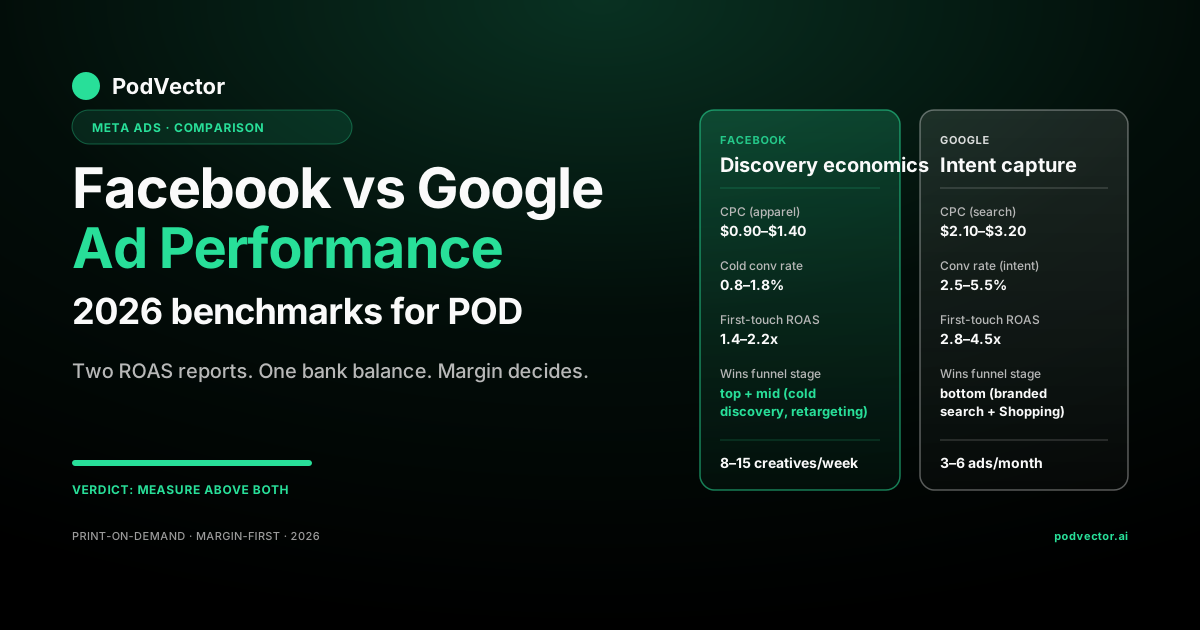
Quick Answer: Neither wins outright — the best performer depends on whether your designs have search demand. For most POD apparel sellers, Facebook is the better primary channel because it creates discovery for designs with zero search volume; for sharp-intent niches (memorial, profession, breed, gift-by-occasion), Google performs better.
Typical 2026 POD numbers: Facebook runs $0.55–$1.20 CPC, 0.8–1.8% cold conversion, and 1.4–2.2x first-touch ROAS. Google runs $2.30–$3.00 CPC on search, 2.5–5.5% conversion, and 2.8–4.5x ROAS — but only where real query volume exists.
The honest verdict: judge both on contribution margin per order (revenue minus product COGS minus fees minus ad cost), not the ROAS each platform self-reports. The platforms attribute the same buyer twice; your warehouse doesn't.
What "performance" actually means on each platform
Both ad managers show you a "performance" tab. They mean different things by it. That mismatch is the root cause of most POD operators getting the wrong answer when they compare the two.
Facebook's performance is built around discovery economics. The algorithm finds people who weren't looking for you, makes them stop scrolling, and converts a fraction. Cheap CPM, broad reach, low intent. Performance lives or dies by creative refresh rate and audience freshness.
Google's performance is built around intent capture. The algorithm waits for someone to type a query, then competes in an auction for a placement. Higher CPC, narrower reach, much higher intent. Performance lives or dies by query coverage and landing-page conversion rate.
Comparing the two platforms by raw CPC is like comparing the price of a cold call to the price of an inbound demo request. The unit is the same; the context is incomparable. For POD specifically — where margins are thin and most designs have zero search volume on day one — the framing matters more than for almost any other business model.
2026 performance benchmarks side by side
Here are the numbers most POD accounts running on Printify, Printful, or a similar fulfillment partner are seeing in 2026. These are observed ranges, not hopes.
| Metric | Facebook Ads (POD apparel) | Google Ads (POD apparel) |
|---|---|---|
| CPM | $10–$14 (feed), $8–$12 (Reels/Stories) | N/A (search), $4–$8 (Shopping/Display) |
| CPC | $0.55–$1.20 | $2.30–$3.00 (search), $0.40–$0.90 (Shopping) |
| CTR | 1.0–1.8% (feed) | 3–6% (search), 0.6–1.2% (Shopping) |
| Cold conversion rate | 0.8–1.8% | 2.5–5.5% (search), 1.5–3% (Shopping) |
| First-touch ROAS | 1.4–2.2x | 2.8–4.5x (where intent exists) |
| Min daily spend to escape learning | ~$30/day | $50–$100/day |
| Creative refresh cadence | 8–15 variants/week | 3–6 ad variants/month |
Read the table once and Google looks like the obvious winner. Read it twice and the catch shows up: "where intent exists." For 70–80% of POD designs, query volume is functionally zero. A 4x ROAS on zero impressions is zero revenue.
That's why the benchmark comparison alone is misleading. The real performance question isn't "which platform's numbers look better in a vacuum." It's "which platform's strengths match what my catalog actually needs."
Why platform-reported ROAS lies for POD
If you've ever run both Facebook and Google at the same time and added up the ROAS each platform reported, you've probably noticed the math doesn't reconcile to your Shopify revenue. There's a reason. Both platforms claim the same buyer.
The typical 2026 POD purchase path looks like: see a Reels ad → don't click → search the brand on Google three days later → click a branded search ad → buy. Facebook's pixel records it as a view-through conversion. Google's tag records it as a last-click conversion. Same buyer, two attributions, two ROAS numbers, one actual sale.
Stack a few weeks of overlap and your channel-level ROAS reports inflate by 30–60% combined. That's not a measurement bug — it's the design. Each platform optimizes for showing you it deserves your next dollar. Neither has visibility into the other.
For POD this matters more than most categories because margins are tight enough that the misattribution gap eats real money. A 3.5x reported ROAS that's actually a 2.4x once you de-duplicate is the difference between a profitable account and a slow bleed at $24.99 average order value.
The fix isn't to pick one platform. It's to measure performance from a layer above both — your warehouse, your Shopify orders table, or an AI employee that joins the two. A live data warehouse (Snowflake, BigQuery-style, Redshift, Databricks, or equivalent) gives you the order-level truth neither ad manager can see.
This is the gap PodVector AI's AI employee, Victor, was built to close for POD specifically. Victor runs your Meta and Google campaigns off a unified data layer that pulls Shopify orders, Printify or Printful COGS, and both platforms' spend into one place. When a campaign's true blended CAC blows past target once COGS are netted out, Victor flags it and — with your approval — shifts budget or pauses the bleeder, rather than waiting for you to reconcile two dashboards. We cover the deeper attribution mechanics in our cost-side breakdown of these two channels and our full Meta Ads attribution guide.
Algorithm performance: Advantage+ vs Performance Max
The 2026 conversation about Facebook vs Google performance is really a conversation about Advantage+ Shopping (Meta's auto-targeted commerce campaign) vs Performance Max (Google's all-in-one auto-distributed campaign). Both platforms have pushed advertisers toward black-box automation. Both have trade-offs.
Advantage+ Shopping needs roughly 50 conversions per week to stabilize. Below that threshold it spends inefficiently and bounces between audiences. Above it, it tends to outperform manually-segmented campaigns by 15–25% on POD apparel accounts running clear creative variation.
Performance Max distributes the same campaign across Search, Shopping, YouTube, Discovery, Display, and Gmail. The performance upside is reach. The downside is opacity — Google won't tell you which placement drove which sale, only the blended outcome. For POD operators trying to understand whether Shopping or YouTube is doing the work, that's a real cost.
The honest performance read in 2026: Advantage+ is the right default once you can feed it 50+ weekly conversions. Performance Max is the right default once you have a clean product feed and at least $4K/month to spend. Below those thresholds, manual campaigns still beat automation on both platforms.
For a deeper breakdown of how to actually run these on POD-specific catalogs, see our cross-platform strategy guide.
Performance by funnel stage
Performance numbers shift dramatically depending on which part of the funnel you measure. A platform that "loses" at one stage often wins at another. POD operators who only measure cold-conversion ROAS miss the picture.
Top of funnel (cold reach)
Facebook wins decisively. CPM is lower, audience targeting on broad interest signals still works, and Reels delivers cheap thumb-stop attention. Google's display network can compete but rarely produces purchase intent at this stage.
Middle of funnel (warm consideration)
Roughly even. Facebook's retargeting from page views and add-to-carts remains strong despite iOS signal loss. Google retargeting through display + branded search captures the comparison-shop moment where the buyer is checking your reviews and pricing.
Bottom of funnel (purchase intent)
Google wins clearly when query volume exists. Branded search and Shopping ads convert at 4–8% on POD accounts with established trust. Facebook's bottom-funnel performance comes from dynamic product retargeting, which is more variable.
The implication: looking at a single ROAS number at the campaign level hides where the platforms actually earn their keep. A POD account spending $5K/month on each platform usually has Facebook overperforming on top-funnel and Google overperforming on bottom-funnel — and the right read is to run both, not to pick a winner.
Performance over time: speed vs lifetime value
The two platforms perform on different clocks. Comparing them on the same day is half the reason POD operators reach the wrong verdict.
Google search ads convert fast because the buyer already has intent. When real query volume exists, you'll see sales inside 24–72 hours of turning a campaign on. There's no demand to manufacture — the buyer typed what they wanted.
Facebook is slower out of the gate. A new campaign needs 7–14 days to clear Meta's learning phase, then another week or two of data before its ROAS means anything. Judge Facebook in week one and you're reading noise, not performance.
Short-term: Facebook usually shows results first
For a brand-new POD design with zero search footprint, Facebook is the only platform that can move units in the first month. It creates the demand Google waits for. Most accounts see their earliest cold sales from Reels and feed before a single Google search converts.
Long-term: Google compounds through intent and repeat buyers
Over months, Google's edge grows. Branded search appears once Facebook discovery has seeded awareness, and intent buyers tend to come back — pushing customer lifetime value (LTV) higher than impulse-driven first-touch buyers.
For POD this is the quiet multiplier. A $24.99 first order looks thin in isolation, but a niche buyer (memorial, profession, hobby) who reorders or buys the matching mug turns a break-even acquisition into a profitable one. That LTV shows up in Google's numbers more than Facebook's — which is exactly why a single-snapshot ROAS comparison misleads.
Performance by POD product category
Different POD categories have wildly different performance profiles on each platform. The same ad budget moved between two niches can flip the winner.
Apparel (T-shirts, hoodies, sweatshirts): Facebook usually wins as primary channel because most designs have zero search demand. Google works once you have branded queries.
Mugs and drinkware: Mixed. Personalized and gift-occasion mugs have Google demand ("father's day mug funny," "engineer mug coffee"). Generic designs default to Facebook discovery.
Posters and wall art: Facebook usually wins on top of funnel (visual scroll-stopper category) but Google Shopping converts at 3–5x when buyers are decorating a specific room.
Phone cases and accessories: Google leads. Buyers search "[phone model] case [aesthetic descriptor]" with high purchase intent. Facebook plays a supporting retargeting role.
Memorial, profession-specific, breed-specific designs: Google dominates. Search intent is sharp ("retired nurse gift," "border collie mom shirt"). Facebook works only as second-touch.
Notice the pattern: the more searchable the design phrase, the more Google's intent-capture model wins on platform performance. The less searchable, the more Facebook's discovery model matters.
The one metric that decides the winner
Drop ROAS for a moment. The metric that actually decides Facebook vs Google performance for a POD seller is contribution margin per order — the dollars left over per sale after every variable cost.
The math, for a $24.99 tee through Printify:
- Revenue: $24.99
- Product cost (base + print + shipping): -$10.50
- Shopify transaction fee (~3%): -$0.75
- Ad cost per order at 2.5x ROAS: -$10.00
- Contribution margin: $3.74 per order
Now move that same order to a 3.5x ROAS:
- Ad cost per order at 3.5x ROAS: -$7.14
- Contribution margin: $6.60 per order — 76% more profit per sale
That's why the platform with the higher honest ROAS wins, even if its CPC is 2x. A $0.90 Facebook click that converts to a 2.5x ROAS produces less margin than a $2.50 Google click that converts to a 3.5x ROAS — at the same average order value.
The catch is "honest." Both platforms inflate their reported ROAS through over-attribution. The only number that matters is contribution margin in your Shopify orders table, after all platforms have been paid. That's the layer where performance comparison stops being a debate and becomes arithmetic.
Fixing performance comparison the right way
Here's the practical sequence most POD accounts should run if they want a clean answer to "which is performing better" in 2026:
- Stop trusting platform-reported ROAS as your primary metric. Use it for in-platform optimization decisions only.
- Calculate blended ROAS weekly. Total Shopify revenue ÷ (total Meta spend + total Google spend). This is your real number.
- Track contribution margin per order, not revenue per order. Pull product COGS from Printify or Printful, transaction fees from Shopify, and ad spend from both platforms into one table.
- Run both platforms for at least 60 days before judging. Facebook's algorithm needs creative iterations; Google's needs query history. Neither shows true performance in week 1.
- Decide budget allocation by marginal CAC, not headline ROAS. The right next-dollar question is "if I add $500 to Facebook this week, what's the expected new-order count vs adding $500 to Google?"
If you don't have a unified analytics layer to do this manually, you have two options. Build it (BigQuery, Snowflake, Redshift, Databricks plus an ETL pipeline plus a BI tool — usually 4–8 weeks for a solo operator). Or use an AI employee that already pulls Shopify, Printify, Printful, Meta, and Google into one warehouse and answers margin questions in plain English.
That's exactly what Victor by PodVector AI does. Victor watches blended CAC and per-campaign margin once Printify or Printful costs are netted out — then, with your approval, reallocates spend toward the channel earning real margin and pauses the one that's bleeding. You run both platforms; Victor does the reconciling and the reallocating.
If you want the full comparison context before deciding, our Meta Ads vs alternatives hub walks through every channel POD sellers test, our "which is better" verdict covers the strategic decision framework, and our Meta Ads topic hub covers everything Meta-specific. For an outside-in agency view of the same comparison, the Swydo agency playbook is a thorough non-POD reference.
FAQs
Which platform has better performance in 2026, Facebook or Google?
Neither, in the abstract. For most POD apparel sellers without strong branded search demand, Facebook performs better as the primary channel because it generates discovery for designs that have zero query volume. For POD niches with sharp search intent (memorial, profession, breed, gift-by-occasion), Google performs better.
Why is my Facebook ROAS higher than my Google ROAS?
Usually because Facebook's pixel claims view-through conversions Google never sees. The buyer scrolled your Reels ad, then a few days later searched your brand and converted on Google. Both platforms count the sale. The fix is to measure blended ROAS from your Shopify orders table, not from each platform separately.
Is Facebook Ads still worth it after iOS privacy changes for POD?
Yes. The signal panic of 2021–2022 has largely passed. With the Conversions API (Meta's server-side tracking) live and AI-driven optimization maturing, the 2026 performance gap to pre-iOS-14.5 levels is roughly 8–15% on cold campaigns — not the 30%+ it once was.
The catch is implementation. POD accounts that never wired up the Conversions API still bleed signal; those that did still see 1.8–2.4x cold ROAS in 2026. If you're running Facebook without server-side tracking, fix that before judging its performance.
How long before I can compare Facebook and Google performance fairly?
60 days minimum. Facebook's algorithm needs 50+ conversions per week to leave the learning phase on Advantage+ Shopping. Google's needs query history and a clean conversion signal to stabilize on Performance Max. Comparisons run before that threshold are noise, not signal.
Should a $1K/month POD ad budget go to Facebook or Google?
At $1K/month total, run Facebook only. You won't escape Google's Performance Max learning phase below ~$3K, and split-budget testing produces unreliable data. Once you cross $3K/month and have a Shopify product feed connected, layer Google Shopping in at a 70/30 Facebook/Google split.
What's the cheapest way to compare both platforms' real performance?
Pull Shopify orders, Meta spend, and Google spend into a single spreadsheet weekly. Calculate blended ROAS as total Shopify revenue divided by combined ad spend. Calculate contribution margin per order by netting out Printify or Printful COGS. That's the truth — both ad managers' "performance" tabs are sales pitches.
Does Performance Max work for POD?
Conditionally. PMax needs a clean Shopping feed (variants, accurate titles, GTINs where possible) and at least $3K/month to learn. POD accounts with thin metadata or generic product titles get worse PMax performance than they would from manual Shopping campaigns. Fix the feed first, then turn PMax on.
Stop trusting two ad managers that both claim the same sale
Facebook says one ROAS. Google says another. Your bank says something else. Victor by PodVector AI runs both channels off one live warehouse of Shopify, Printify, Printful, Meta, and Google data — reallocating spend to the channel that earns real margin and pausing the one that bleeds, each move on your approval. Stop reconciling two sales pitches; let an operator act on the truth.
Try Victor free