
Quick Answer: "Which is better" is the wrong question. Facebook Ads and Google Ads sell different things, so the better answer depends on whether your POD niche has measurable search demand and where you sit on monthly recurring revenue.
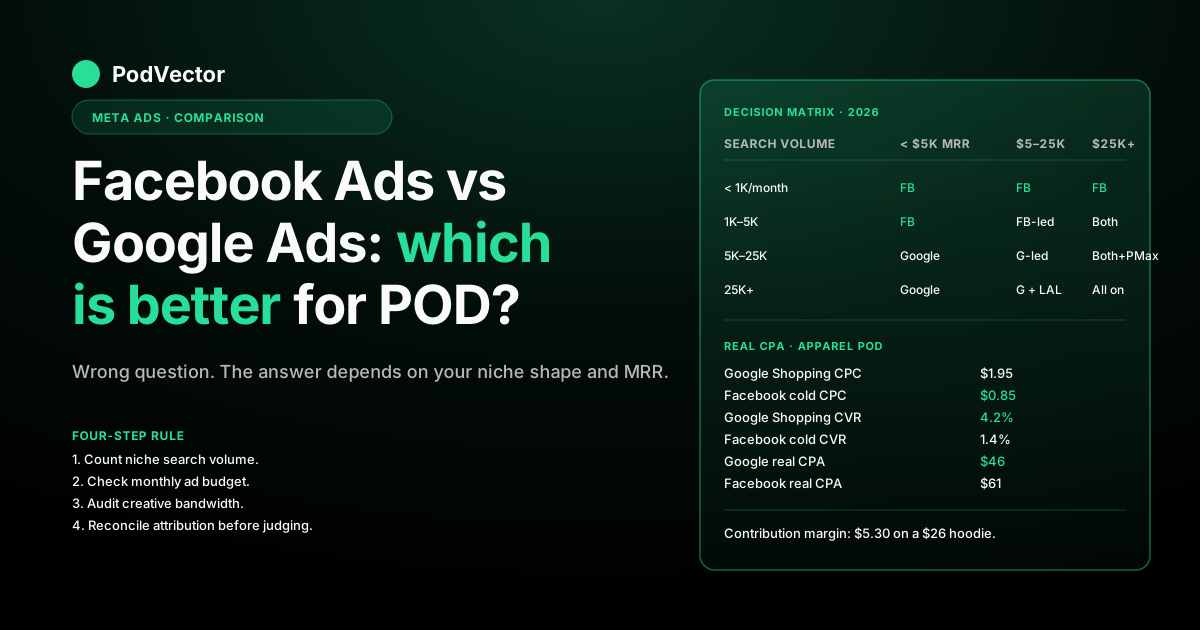
For print on demand in 2026, Google Ads is better when your niche has 5,000+ monthly searches across long-tail product keywords — its 4.2% Shopping conversion rate compresses cost per purchase below Facebook's. Facebook Ads is better when search demand is under 1,000/month and the product is design-led — it's the only channel that can find buyers at scale where Google can't spend.
Below we walk a decision matrix keyed to niche search volume and MRR, the real 2026 cost picture against POD's $5–$7 per-sale contribution margin, and a four-step rule for picking the right channel — or both.
Why "which is better" is the wrong question
Asking "which is better" assumes the two platforms compete for the same job. They don't. Google Ads sells access to people who already typed the words that describe your product. Facebook Ads sells access to people who match a profile and might want your product if they saw it.
That's two different markets. One is demand capture, the other is demand creation. Comparing them on CPC is like comparing the cost of a vending machine drink to the cost of a Times Square billboard — both deliver beverages-adjacent value, but to different audiences at different stages.
For print on demand, the distinction decides everything. A long-tail keyword like "registered nurse graduation gift t-shirt" gets typed by buyers who already know what they want.
Google's job is to put you in front of that decision. The audience is small — maybe 600 monthly searches across all variants — but every visit is a buyer who's already shopping.
The same RN graduation design will struggle on Google because there isn't enough search demand to justify a $50/day Shopping campaign. Drop it into Facebook against a "registered nurse + recently engaged" interest stack and you can spend $90/day all day. The buyer wasn't shopping when the ad arrived — they were scrolling — but the addressable audience is two orders of magnitude larger.
So "which is better" rephrased honestly: which platform matches the demand shape of your specific niche, at your specific spend level? The rest of this guide answers exactly that.
The decision matrix: niche volume × MRR
Two inputs decide the call: monthly search volume on the long-tail keywords your products actually match, and your current monthly recurring revenue. Search volume sets the upper bound on what Google Shopping can spend efficiently. MRR sets your test-budget tolerance.
| Niche search volume | Under $5K MRR | $5K–$25K MRR | $25K+ MRR |
|---|---|---|---|
| Under 1,000/month | Facebook only | Facebook + branded search | Facebook + branded + retargeting |
| 1,000–5,000/month | Facebook first, Google after validation | Both — Facebook-led | Both — balanced |
| 5,000–25,000/month | Google Shopping first | Both — Google-led | Both + Performance Max |
| 25,000+/month | Google Shopping only | Google + Facebook lookalike | All channels active |
The matrix reads diagonally. Operators in the bottom-left corner (low MRR, high search volume) get the best Google ROI because Shopping can run efficiently on a single $1,500 budget against a clear demand pool. Operators in the top-right corner (high MRR, low search volume) get the best Facebook ROI because they can absorb the creative-production load that Facebook demands at scale.
The diagonal middle is the both-platforms zone. Splitting a $1,500 monthly budget across both platforms gives each a $25/day floor — below Google Shopping's minimum and barely above Facebook's. Neither produces enough optimization data to beat the platform-picked baseline at that floor.
So the first rule is brutally simple: under $3,000/month total ad spend, pick one platform and run it well. Splitting earlier wastes both budgets. The full structured comparison view is in the Google Ads vs Facebook Ads comparison.
2026 cost reality for POD
The cost number that decides which platform is better isn't CPC. It isn't even CPA. It's CPA divided by the contribution margin you keep on a $26 hoodie after Printify or Printful supplier cost, shipping, and fees.
That contribution margin is roughly $5.30 on a $26 sale: $14 base, $5.50 average US shipping, $1.20 in Shopify and payment fees. Every dollar of ad cost comes out of that $5.30, not the $26 sale price the platforms see in their conversion-value reports.
| Metric (2026 apparel) | Google Ads | Facebook Ads | Better axis |
|---|---|---|---|
| Average CPC | $1.95 (Shopping), $2.40 (Search) | $0.85 (cold) | Facebook 55–60% cheaper |
| Cold conversion rate | 4.2% (Shopping) | 1.4% | Google 3x higher |
| Real CPA | $46 (Shopping) | $61 (cold) | Google ~25% lower |
| CPA ÷ contribution margin | 8.7x | 11.5x | Google buys faster payback |
| Minimum efficient daily spend | $50–$100 (Shopping) | $30 per ad set | Facebook lower entry floor |
| Creative production load | Low (product feed = creative) | 8–15 net-new assets/week | Google cheaper hidden cost |
| Time to first useful data | 3–7 days (Search), 7–14 days (PMax) | 3–10 days, depends on pixel volume | Google faster on Search |
Both 8.7x and 11.5x look catastrophic at the first-order level — and that's exactly the point. POD economics work on 60–90 day repeat cohorts, not first-purchase contribution.
In our 2026 client cohort, Google Shopping cohorts in apparel run 1.2–1.5x repeat rate over 90 days at roughly $38 second-order revenue, getting payback around day 50–60. Facebook prospecting cohorts run 1.4–1.9x repeat rate over the same window at roughly $42 second-order revenue, with payback closer to day 75.
The shape of the difference: Google buys a lower CPA up front and pays back faster. Facebook buys a higher repeat rate and pays back slower. Both can be profitable on a 90-day window for apparel POD.
The hidden creative-production line tilts the comparison further toward Google for operators with limited design bandwidth. Facebook needs 8–15 net-new ad creatives per week to fight ad fatigue inside a 14-day window, which adds 12–22% on top of the media spend in production cost.
Google Shopping doesn't have this cost. The product feed is the creative, and updates flow through Shopify's Google Channel sync. Search Ads need text variants — five to ten responsive search ads per campaign — but those refresh quarterly, not weekly.
The full cost decomposition with budget-floor matrices by MRR sits in the Google Ads vs Facebook Ads cost guide. The contribution-margin math itself is in the complete guide to Meta Ads ROAS and attribution for POD.
When Facebook Ads is better
Facebook Ads wins on five specific POD profiles. If three or more describe your store, Facebook is the better starting point regardless of what general-purpose comparison guides say.
1. Search demand is under 1,000 monthly searches across all long-tail variants. No amount of bid optimization unlocks demand that doesn't exist. Google can't spend $50/day on a niche that gets 600 searches a month — impression share saturates and the algorithm starves for auction signal.
Facebook's interest stacking lets you build a synthetic audience of "people who match the buyer profile" without needing them to have searched. For most novelty, occasion, and identity-driven POD designs, this is the only viable channel.
2. The product is visually striking on a phone screen. Facebook is a visual scroll surface. A bold typography t-shirt, a high-contrast hoodie design, or a colorful mug that stops the thumb mid-scroll converts better here than a product whose value is functional.
Google Shopping shows your product image too, but next to nine other competing images in a grid — the visual impact is dampened by the side-by-side comparison context.
3. Your test budget is under $1,500/month. Below Google Shopping's $50/day floor, Facebook is mechanically the only channel that gives you optimization-grade conversion volume. A $30/day Facebook Sales campaign generates enough pixel events to exit learning phase in 7–14 days; a $30/day Shopping campaign can't even maintain impression share against a single competitor with a higher bid.
4. The buyer profile is demographically narrow but interest-broad. Facebook's interest plus lookalike plus behavioral targeting still beats Google's audience layer for niches like "outdoor-gear-buying women aged 35–54 with a disposable income in the top 30%." Google audiences exist but they're noisier and harder to layer.
5. You have in-house creative production capacity. Facebook's creative-fatigue cycle eats 8–15 net-new assets per week. If you have a designer on staff or a freelancer pipeline that can produce that volume without burning out, you can sustain Facebook's iteration tempo. If you can't, the platform's economics tilt against you within 60 days.
For the parallel view of Meta Ads against every other channel, see Meta Ads vs alternatives.
When Google Ads is better
Google Ads wins on a different five-profile pattern. Same rule — three or more matches and Google is the better starting point.
1. Search demand exceeds 5,000 monthly searches across long-tail keyword clusters. Above this floor, Google Shopping has enough auction volume to optimize cleanly and enough impression share to spend a meaningful budget.
The 4.2% conversion rate on shopping-intent traffic compresses CPA below Facebook's even at higher CPC. Every visit is somebody who typed the words that describe what you sell — the highest-quality traffic ecommerce can buy.
2. Your product is functionally specific. "Custom dog bandana with embroidered name," "personalized pickleball paddle cover," "vintage Ford F-150 owner shirt" — these are queries with clear buyer intent that Facebook's interest layer can't replicate without leaking budget against people who don't actually want the thing.
Google captures the buyer at the moment they're shopping. That's the entire competitive advantage of search marketing.
3. You have an existing product feed in Shopify. Shopping campaigns draw their creative directly from your Shopify product catalog through the Google Channel sync. No creative production required beyond product photography you already have.
This collapses the production cost line that makes Facebook so labor-intensive. The hidden cost difference is often 15–25% of media spend, which is enough to flip the channel comparison on its own.
4. Your monthly ad budget is $2,500–$5,000+. Google Shopping's $50–$100/day minimum efficient spend translates to $1,500–$3,000/month per campaign, plus another $500–$1,000 for branded search. Below this budget, Google can't run efficiently.
Above it, Google's automated bidding (Maximize Conversions, Target ROAS) starts compressing CPA in ways that manual bidding can't match. Performance Max, the auto-stitched campaign type that routes across Search, Shopping, Display, YouTube, and Gmail, becomes a viable additional surface above $25K MRR. Meta's equivalent, Advantage+ Shopping campaigns, collapses audience and placement targeting into one AI-run campaign — the Facebook-side answer to Performance Max — and reaches the same volume threshold before it optimizes cleanly.
5. You can't sustain a weekly creative iteration tempo. Solo operators, side-project sellers, and stores without a dedicated designer can't fight Facebook's ad-fatigue cycle. Google Shopping doesn't ask you to.
The full Meta-channel campaign-types breakdown is in the complete guide to Meta ad types for POD sellers. The Google Shopping–specific comparison is in the Google Shopping vs Facebook Ads guide.
When both is better
Above $5,000 monthly ad spend with a niche that has 1,000+ monthly search volume, both platforms become better than either alone. The two channels stop competing and start composing.
Facebook does the demand-creation work, putting your design in front of people who didn't know they wanted it. Google captures the share of those people who later remembered the product and searched for it — typically 18–32% of Facebook-driven brand recall converts through a Google query within 30 days.
The successful both-platforms budget shape converges on a recognizable pattern. Facebook prospecting takes 50–60% of media spend, working as the demand-generation layer.
Google Shopping takes 15–25%, capturing high-intent buyers who searched for the design after seeing it on Facebook or for related queries. Google branded search takes 5–10%, locking down brand-name protection cheaply.
Facebook retargeting takes 5–10%, recovering cart abandonment with dynamic product ads from your Facebook & Instagram catalog. Performance Max takes 5–10% for operators above $25K MRR, with a tighter target ROAS than the rest because of its attribution opacity.
The both-platforms approach also smooths cost variance. Facebook's CPA drifts on creative fatigue cycles; Google's drifts on seasonal search-volume swings. Running both means one channel is usually compensating for the other's bad month.
The deep dive on running both is in the primary Google Ads vs Facebook Ads decision guide. The full cluster index is at the Meta Ads comparison cluster, and the topic-wide index is the Meta Ads topic hub.
The measurement trap that picks the wrong winner
Most operators who declare a winner between Facebook and Google are reading platform-reported numbers that systematically over-credit each channel. The wrong winner gets picked because the measurement layer is broken on both sides.
Facebook's 7-day-click-1-day-view default credits view-through impressions that may not have moved the purchase decision. This typically inflates reported conversions 20–40% above what Shopify's actual order export shows.
Google Performance Max stitches credit aggressively across Search, Shopping, Display, and YouTube. This typically inflates 5–20%.
Sum the two and total platform-reported conversions routinely exceed Shopify's actual order count by 30–80%. If you're funding both channels off self-reported ROAS, you're not comparing apples to apples — you're comparing two different over-reports.
The fix is reconciliation against a single source of truth — usually Shopify's order export, ideally joined to itemized supplier cost so contribution margin per order is visible. That joined view is what tells you which platform is actually buying profitable customers and which is buying view-through ghosts.
Holding both platforms to the same attribution window against Shopify orders and itemized Printify or Printful supplier cost — that's the apples-to-apples comparison neither platform's native dashboard will produce. And it's only worth doing if someone then moves budget toward the channel buying profitable customers.
Victor runs that loop for you. It operates across your Google Ads and Facebook Ads accounts, measures each channel's real CPA against real contribution margin — not platform-reported revenue with view-through credit baked in — and shifts spend toward the platform actually buying profitable customers instead of view-through ghosts.
For a deeper attribution dive, see the complete guide to Meta Ads ROAS and attribution for POD. For an outside-source overview of cross-platform attribution norms, Shopify's ecommerce comparison covers the basics.
The four-step rule for picking
If you've read this far and still can't decide, run the four-step rule. It collapses everything above into a binary outcome.
Step 1: Count your niche search volume. Pull your top 20 long-tail product keywords into Google Keyword Planner or Ahrefs and sum the monthly search volume. The number you get sets the upper bound on Google's efficiency.
Under 1,000 → Facebook only. 1,000–5,000 → Facebook leads. Over 5,000 → Google can lead.
Step 2: Check your monthly ad budget. Under $1,500/month → single platform only, picked by Step 1. $1,500–$5,000/month → still single platform, but if Step 1 said "Google can lead," you have enough budget to run Shopping at its $50–$100/day floor.
Above $5,000/month → both platforms become viable, weighted by Step 1.
Step 3: Audit your creative bandwidth. Can you produce 8–15 net-new ad creatives per week sustainably? If yes, Facebook is mechanically viable at scale.
If no, Facebook will burn out within 60 days regardless of budget. Push budget toward Google Shopping where the product feed is the creative.
Step 4: Reconcile attribution before judging. After 30 days of running, pull Shopify's order export and join it against both platforms' raw click data. Calculate real CPA per platform against contribution margin per order — not platform-reported revenue.
The platform with the lower real CPA at 60–90 days is your winner. Until you've done Step 4, "which is better" is a guess based on inflated numbers.
FAQs
Which is better for a brand-new POD store with no traffic, Google Ads or Facebook Ads?
For most new POD stores, Facebook is better at the zero-data starting point. Its $30/day floor matches a small operator's test-budget reality, and its interest plus lookalike targeting can find buyers for design-led products that have no measurable Google search demand yet.
Move to Google once you've validated which designs convert and confirmed at least 1,000+ monthly searches across the long-tail keyword cluster the design matches. Until then, Google Shopping starves on a $30/day budget and Search Ads can't outbid established competitors in the niche.
Is Facebook Ads cheaper than Google Ads for POD?
At the click level, yes — Facebook CPC runs $0.55–$1.45 versus Google Search at $0.95–$2.80. But "cheaper" at the per-purchase level depends on your niche.
Google Shopping's 4.2% conversion rate often produces a lower real CPA on niches with 5,000+ monthly searches. Facebook produces a lower real CPA on niches under 1,000 monthly searches, where Google can't spend efficiently regardless of bid strategy.
Can I run Facebook Ads and Google Ads on $1,000 a month for POD?
Not effectively. Splitting $1,000/month across both platforms gives each a $16/day floor, which is below both platforms' efficient minimums. Pick one — Facebook if your niche has under 5,000 monthly searches, Google Shopping (alone) if your niche has more.
At $1,500–$2,500/month, you can run one platform at scale. At $5,000+/month, both become viable simultaneously and start composing rather than competing.
Which platform converts faster for POD?
Google Search and Shopping convert fastest from click to purchase — typically within 24–72 hours because the buyer was already shopping when they clicked. Facebook prospecting typically converts within 7–14 days because the buyer needs to remember the product and return to it later.
That said, "converts faster" doesn't mean "more profitable." Facebook prospecting cohorts repeat at 1.4–1.9x over 90 days versus Google Shopping's 1.2–1.5x, so Facebook's slower payback often produces better lifetime value.
Should POD sellers use Performance Max or run Facebook Ads?
Performance Max needs roughly 50–80 conversions per month to optimize cleanly, which most POD stores below $25K MRR don't yet produce. Below that volume, manual Shopping campaigns on Google or Facebook Sales campaigns are the right starting points depending on your niche shape.
Above $25K MRR with at least 5,000 monthly searches in the niche, Performance Max usually compresses CPA another 10–20% by routing across Google's surfaces automatically. Meta's Advantage+ Shopping campaigns are the Facebook-side equivalent and need the same conversion volume to optimize. At that scale the AI-run campaigns pair well — Advantage+ on the demand-creation side, Performance Max on capture — rather than replacing each other.
Does Facebook Ads still work in 2026 with all the iOS tracking changes?
Yes, but only with the Conversions API set up correctly. iOS 14+ and ongoing cookie deprecation broke client-side pixel tracking enough that 15–25% of conversion events get lost without server-side reporting.
The platforms' optimization algorithms run on conversion signal, so the operators who skipped Conversions API setup are systematically getting worse Facebook performance than operators who completed it. Same fix on Google's side: Enhanced Conversions plugs the equivalent gap. By 2026 the table stakes are higher — Meta routes lost events through Aggregated Event Measurement and Google requires Consent Mode v2 to keep modeling conversions, so the stores that wired both up are the ones whose CPA numbers still mean something.
How does Victor compare Facebook Ads vs Google Ads for POD?
Victor operates both ad accounts the way this guide describes: it holds Facebook and Google to the same attribution window, joins every order to Printify or Printful supplier cost so it's working from real contribution margin, and reads which platform is actually buying profitable customers rather than view-through ghosts.
Then it acts on that read — shifting budget toward the channel with the lower real CPA at the 60–90 day mark and away from the one inflating its own numbers. It's the platform-allocation decision from this guide, run continuously instead of audited once a quarter.
Stop debating which is better. Measure it.
Victor connects to your Shopify, Printify or Printful, Google Ads, and Facebook Ads accounts, measures each channel's real cost per profitable customer against actual contribution margin, and moves budget toward the platform that's winning — the call neither dashboard will make for you. Operators using Victor stop arguing about which channel is cheaper and let it run the blended spend.
Try Victor free