
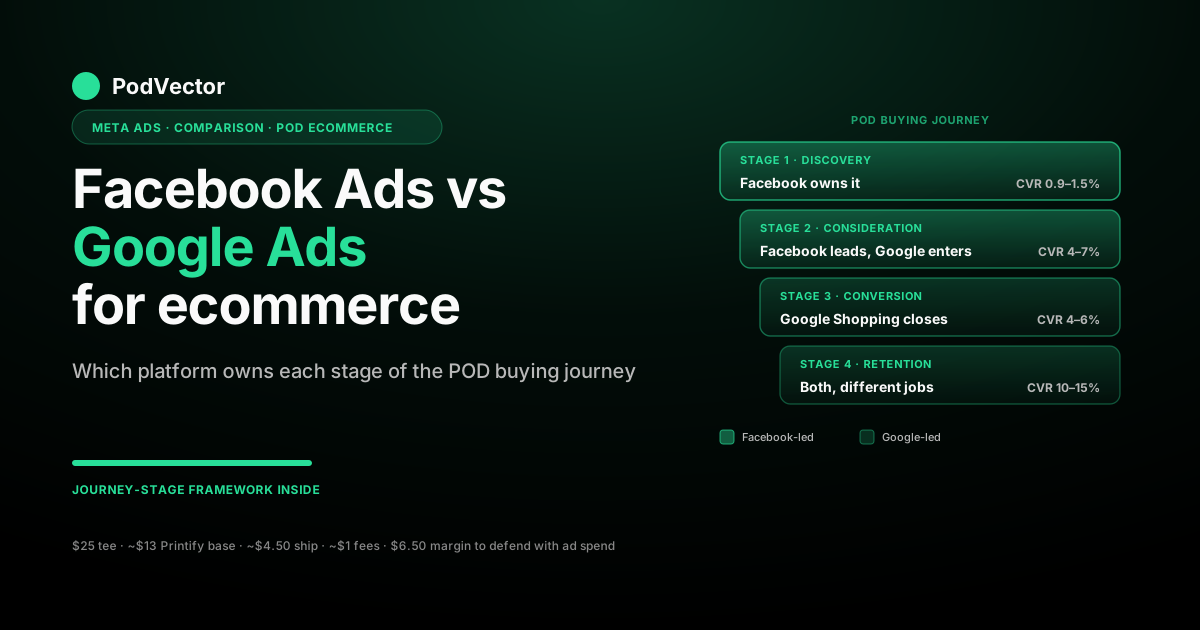
Quick Answer: For ecommerce, Facebook Ads vs Google Ads is really a question about which stage of your customer's buying journey you're paying to win. Facebook owns discovery and consideration; Google owns conversion and branded defense.
For POD ecommerce specifically, Facebook is the better starting platform for most stores under $10K MRR because original designs don't yet have a search-volume base for Google to monetize. Once a winning design starts generating branded searches and named-product queries, Google Shopping becomes the more efficient way to capture that downstream demand.
This guide compares the two platforms across the four buying-journey stages, then layers in print-provider royalty math (Printify vs Printful by channel) and the under-$5K-MRR starter split that actually fits a POD operator's budget reality.
Why "for ecommerce" means thinking in journey stages
Most "Facebook vs Google Ads" comparisons frame the choice as one platform or the other. For ecommerce, that framing leaves money on the table.
Ecommerce buyers move through four stages on their way to checkout: discovery (they don't know your product exists), consideration (they're weighing it against alternatives), conversion (they're ready to buy), and retention (they've bought once and might buy again). Each platform is structurally better at one or two of those stages — not all four.
Facebook excels at the first two stages because feed-based discovery surfaces products people weren't searching for. Google excels at the second two stages because search ads catch high-intent queries and branded defense locks in customers who already know your name.
For POD ecommerce, the journey-stage framing is especially important. Original designs start with zero search volume. Nobody Googles "minimalist dachshund silhouette tee" before they've seen one. Until your design becomes a search query — which only happens after Facebook does the discovery work — Google has nothing to bid on.
The rest of this guide walks through each stage, shows which platform owns it for POD ecommerce, and ends with the budget split that actually fits a POD operator running under $10K MRR.
Stage 1 — Discovery: Facebook's home turf
Discovery is where someone sees your product for the first time. For POD original designs, this is the stage that matters most because no other channel does it.
How Facebook handles discovery
Facebook's algorithm matches your product to users based on behavior, not search queries. It uses past purchases on similar SKUs, lookalike audiences, interest signals, and engagement patterns to predict which users will respond to your design.
That means a brand-new design with zero search volume can still find buyers on day one. The pixel doesn't need keywords. It needs creative that stops the scroll and a price that fits the audience.
How Google handles discovery (poorly, for POD)
Google Shopping and search ads only run when someone types a query. If your design name doesn't yet exist as a search term, Google has nothing to surface.
Performance Max (Google's automated cross-network campaign type) tries to fill this gap by showing your products in Discover, Gmail, and YouTube placements. In practice, PMax discovery for unbranded POD designs is a money pit — the algorithm needs conversion volume to learn from, and you don't have it yet.
What this means for your store
If you're launching a new design, Facebook is the only platform that can predictably find buyers in the first 30 days. Google Shopping doesn't enter the picture until your designs have generated enough branded interest to seed search volume.
For more on how Facebook's discovery engine actually works for POD, see our small-business breakdown of Facebook Ads vs Google Ads, which covers the under-$2K creative budget reality. Shopify's own ecommerce comparison reaches a similar conclusion at the platform level, though without the POD-specific margin overlay.
Stage 2 — Consideration: Facebook leads, Google enters
Consideration is where a shopper has seen your product but hasn't bought yet. They might be comparing it to similar products, waiting for payday, or just stalling.
Facebook in consideration: dynamic retargeting
Facebook's Dynamic Product Ads (DPA — ads that automatically show users the exact products they viewed) and Advantage+ retargeting are very strong here. They re-serve the specific SKU a user viewed, bumped against social proof and price anchors. Conversion rates on Facebook retargeting audiences run 3–6x higher than cold prospecting.
For POD specifically, this is where most of your Facebook ROI shows up. Cold discovery converts at 0.9–1.5% on POD products. Retargeting converts at 4–7%. Most POD stores running Facebook see roughly 60% of their attributed sales come from retargeting layers, not cold reach.
Google in consideration: branded search and remarketing
Once a user has seen your product on Facebook and started Googling your brand or specific product names, Google Search ads catch that downstream intent. Google Display retargeting also re-serves your products across the GDN, though typically at lower ROAS than Facebook's pixel-based retargeting.
The structural insight: Google doesn't drive consideration for POD originals — it captures consideration that Facebook seeded. That's still valuable, but it's a downstream role, not an upstream one.
What this means for your store
If you're running Facebook well, branded Google searches will start showing up in Search Console within 30–60 days of a winning design. That's your signal to add a small Google Search budget targeting your brand name and top product names. Don't add Google Shopping yet — wait for stage 3.
Stage 3 — Conversion: Google Shopping closes
Conversion is where a buyer is ready to purchase. They know what they want, they're price-comparing, and they're typing specific queries into Google.
Google Shopping in conversion: pure efficiency
This is where Google Shopping shines for POD ecommerce. A search like "navy retriever silhouette mug" comes from someone who's already convinced — they just need to find the cheapest, fastest, or most-reviewed seller. Google Shopping serves your product card with price and image, the user clicks the cheapest reasonable option, and converts at 4–6%.
For POD stores with named designs that have started generating branded queries (typically after 90 days of Facebook traffic), Google Shopping ROAS often runs 4–6x first-touch — substantially higher than Facebook cold prospecting at the same spend level.
Facebook in conversion: weaker but still working
Facebook DPAs do convert at this stage, but inefficiently relative to Google Shopping. The user is in feed-scrolling mode, not search mode, so even a perfect retargeting impression converts at 4–7% rather than the 6%+ a Google Shopping click delivers.
Facebook's job at this stage is to keep the brand visible while the user mulls — not to be the closing channel. If your retargeting impressions are firing but the user converts on a branded Google search, Google will get last-click credit. That's a feature, not a bug — Google's higher-intent traffic deserves higher per-click value.
What this means for your store
Once a design crosses ~$2K/month in revenue from Facebook, add Google Shopping for that specific product with a tight CPC cap. Most POD stores see Google Shopping pick up 15–25% of that design's downstream conversions at lower blended CAC than running Facebook spend higher.
Our deeper Google Ads vs Facebook Ads for ecommerce comparison walks through the eight axes (CPC, ROAS, feed handling, attribution) in more detail. The Meta Ads comparison cluster hub indexes every comparison guide in this series.
Stage 4 — Retention: both platforms, different jobs
Retention is where past customers come back for a second order. POD has below-average retention rates because most products are gift purchases or one-off identity buys, but the retention you do capture is highly profitable.
Facebook in retention: lookalike-anchored
Facebook's strongest retention play is using your customer email list as a lookalike seed for cold prospecting — your existing buyers' Facebook profiles inform who Meta targets next. This isn't strictly "retention" in the repeat-purchase sense, but it's the highest-ROI use of your customer list on Meta.
For actual repeat-purchase retargeting (showing past buyers your new designs), Facebook's custom audiences from email work, but expect modest scale because POD email lists are typically small.
Google in retention: branded search defense
Google's retention play is straightforward: bid on your own brand name to keep competitors from bidding on it. If a past customer Googles "PodSellerName mug" looking for their second purchase, you want your ad above any organic results — not because you'd lose that customer, but because brand-search CPCs are pennies and conversion rates are 10–15%+.
Google Shopping also surfaces your full catalog to past visitors via remarketing list for search ads (RLSA — search ads targeted to users who've previously visited your site), which catches high-intent re-engagement queries.
What this means for your store
Run a small "always on" Google brand-defense campaign as soon as your store has a name worth defending. Use Facebook custom audiences to refresh lookalikes monthly. Don't try to build a sophisticated retention layer until your store crosses $20K MRR — the volume isn't there.
Cost-per-acquisition math at POD margins
The journey-stage framing only works if the per-stage CAC fits your margin. POD margins are tighter than the ecommerce average, so the math has to come down to dollars per order.
Typical 2026 ecommerce ad benchmarks
Public 2026 benchmarks put Google's median search CPC around $2.29 with a ~4.3% click-through rate, against Facebook's ~$0.49 CPC and ~1.8% CTR. Those blended medians hide how differently the two platforms behave at POD's tight margins.
Across our POD-operator client cohort and triangulated against that public ecommerce benchmark data, the POD-specific ranges that actually matter:
- Facebook cold CPC (POD apparel/mugs): $0.55–$1.30
- Facebook cold conversion rate: 0.9–1.5%
- Facebook cold CAC: $40–$140 depending on creative quality and audience
- Facebook retargeting CAC: $12–$28
- Google Shopping CPC (named POD products): $0.85–$2.30
- Google Shopping conversion rate: 3.5–6.0%
- Google Shopping CAC: $18–$48
- Branded Google Search CPC: $0.10–$0.45
- Branded Google Search CAC: $0.80–$3.50
What this looks like at $25 AOV
A $25 POD product with a $13 Printify base, $4.50 shipping, and $1 in payment fees leaves $6.50 of pre-ad contribution margin. To run profitably at the unit level, your blended CAC has to land under that $6.50.
That math is brutal. It means cold Facebook prospecting at $40+ CAC only works if a meaningful share of those buyers convert again or buy multiple items. Retargeting at $12–28 CAC is profitable on a per-order basis. Google Shopping at $18–48 CAC is a coin flip — profitable on the low end, marginal on the high.
The way most POD stores actually make the unit economics work is by raising AOV with bundles or upsells (a tee + a matching mug bumps order value to $42, lifting contribution margin to ~$15) and by running cold acquisition slightly unprofitably while retargeting and repeat orders carry the blended margin.
Why de-duplicated attribution drives the budget split
Both platforms over-credit themselves in their own dashboards. Facebook claims credit for view-through conversions that Google's last-click also claims. Add up the two dashboards and you'll see 130% of your actual orders attributed across the channels.
The fix is to route your ad spend, order data, and print-provider costs through a single source of truth — a live data warehouse (Snowflake, Redshift, Databricks, or equivalent) where Facebook's pixel data, Google Ads spend, Shopify orders, and Printify or Printful cost feeds sit in one schema.
That de-duplicated, itemized view is what tells you which channel to feed and which to cut next week — so the staged split below rests on real blended CAC, not two dashboards each claiming the same order. Our Facebook Ads cost guide for POD walks through the cost-tracking specifics.
Print-provider royalty math by channel
One factor that no generic ecommerce comparison covers but every POD operator should understand: your print provider's base cost changes which channel works at which price point.
Printify vs Printful base differential
For a standard 4.2oz unisex tee, Printify base costs typically run $9.50–$11.00 depending on the partner print shop. Printful's equivalent runs $12.50–$15.00. The same shirt at the same retail price has $3–$4 less contribution margin on Printful.
That base differential matters because it changes the ad-CAC budget you can spend per order while staying unit-profitable.
Channel implications
On a $25 retail tee, Printify gives you ~$7 of margin to defend with ad spend. Printful gives you ~$3.50–$4. That difference is the gap between Google Shopping working at a $20 CAC and being a money loser.
For Printful sellers, the channel implication is clear: you need higher-AOV products (mugs and posters add less margin pressure than apparel), more bundles to lift order value, or a heavier reliance on retargeting and repeat orders versus cold prospecting.
For Printify sellers, the wider margin lets you run cold Facebook prospecting at a higher CAC tolerance, which means faster discovery iteration on new designs.
If you're weighing print providers, our print-on-demand provider comparison hub breaks down where each one wins on cost, quality, and integration depth.
Branded vs identity designs: which platform fits
The other POD-specific variable that determines channel fit is what kind of design you're selling.
Branded or named designs
Designs with a name, a recognizable property (licensed work, established artist, viral meme reference), or a product type that buyers know to search for ("retro Phoenix Suns hoodie") all generate search volume. Google Shopping monetizes that search volume efficiently because users already type the right keywords.
If 30%+ of your sales come from designs with searchable names, allocate a meaningful share of spend to Google Shopping after the discovery phase.
Identity-expressive designs
Designs that express a feeling, a personality, or an in-group joke ("normalize hating mondays") don't generate search volume because buyers don't know to look for them. Facebook's behavior-keyed retrieval is the only system that can find buyers for these designs at scale.
If most of your designs are identity-expressive, run 80%+ of your spend on Facebook for the foreseeable future. Google's role is brand defense, not acquisition.
Hybrid stores
Most successful POD stores end up running both — their best-performing designs eventually become "branded" through repetition, generating their own search volume, while new designs in the pipeline still need Facebook discovery. The split between platforms shifts over time as the catalog matures.
The under-$5K-MRR starter split
For POD operators under $5K MRR, the right starting allocation is heavily Facebook-weighted. Concretely:
- $0–$2K MRR: 100% Facebook. Run cold prospecting on your top 3 designs at $20–35/day per ad set. No Google spend. Your designs don't have search volume yet.
- $2K–$5K MRR: 90% Facebook, 10% Google brand defense. Add a $5–10/day Google Search campaign on your store name and top 5 product names once branded queries start showing in Search Console.
- $5K–$10K MRR: 75% Facebook, 25% Google. Add Google Shopping for your top 10 SKUs with named-search demand. Tight CPC caps ($0.80 max), product-level bidding.
- $10K+ MRR: 60–65% Facebook, 35–40% Google. Full Shopping catalog, Performance Max for catalog products, branded search defense, retargeting on both platforms.
This curve roughly tracks how a POD catalog matures: early, your designs are unknowns and only Facebook can find buyers. Late, your top designs have generated enough brand-name and product-name search volume that Google Shopping becomes the most efficient way to capture downstream demand. Trying to run the late-stage split early is the most common reason new POD stores burn cash on Google Shopping campaigns that don't get impressions.
For the wider context across all POD ad-channel decisions, the Meta Ads topic hub indexes every guide on running, costing, and attributing Facebook Ads for print-on-demand.
For a step-by-step ramp plan with weekly creative volume targets, see our small-business comparison guide, which lays out the 4-week ramp specifically for sellers under $2K MRR.
Mistakes POD sellers make running both
Mistake 1: starting with Google Shopping
The classic new-seller error. They read that Google Shopping has higher conversion rates and start there with $30/day. Six weeks later, the campaign has spent $1,260 and produced four orders, because there's no search volume for the designs to match against. Start with Facebook. Earn the search volume. Then add Google.
Mistake 2: running both at full spend without de-duplicated attribution
Both dashboards take credit for the same orders. If you optimize Facebook ROAS up by killing low-performing ad sets, you might be killing the demand layer that's feeding Google's branded conversions. Pull both into a single warehouse before you make any kill decisions.
Mistake 3: ignoring print-provider impact on CAC tolerance
A Printful seller with $4 of margin per order can't run at the same CAC as a Printify seller with $7 of margin. Both might see "Google Shopping ROAS 3.5x" in their dashboards. Only one is actually profitable. Pull the cost data into your warehouse with the ad data so the dashboards aren't lying to you.
Mistake 4: treating Facebook and Google as interchangeable demand sources
They're structurally different — Facebook creates demand, Google captures it. If you cut Facebook spend during a slow week and notice Google Shopping volume drops 20% three weeks later, that's the lag effect of upper-funnel demand drying up. Plan budget shifts at the journey-stage level, not the platform level.
Mistake 5: skipping branded search
Branded Google Search ads cost almost nothing and convert at 10%+. Most POD stores leave them off because "people who search my brand will find me organically anyway." That's true until a competitor bids on your brand name. The defensive cost of running branded search is usually under $30/month and protects materially more revenue than that.
FAQs
Is Facebook or Google Ads better for ecommerce overall?
Neither in isolation. The best-performing ecommerce stores run both, with Facebook owning discovery and consideration and Google owning conversion and branded defense. For POD specifically, start Facebook-heavy and shift toward a 60/40 Facebook/Google split as your catalog matures.
What's the minimum daily spend to test each platform for POD?
Facebook: $25–$35/day per ad set, with at least two ad sets running. Google Shopping: $40–$60/day to give the algorithm enough volume to learn. Branded Google Search: $5–$10/day. Below those floors, the platforms can't optimize and the data is too noisy to read.
Why do my Facebook and Google Ads dashboards together show more than 100% of my orders?
Both platforms count an order if their ad touched the user, even if the other platform actually closed the sale. Facebook claims view-through credit (someone saw the ad but didn't click). Google claims last-click credit (the click before checkout). Same order, two claims. Pull both data feeds into your warehouse and de-duplicate against your Shopify order timestamp.
Should I run Google Shopping if my store has fewer than 10 products?
Probably not yet. Google Shopping needs feed depth to optimize and conversion volume to learn. Stores with under 10 SKUs and fewer than 25 conversions/month typically waste spend on Shopping campaigns that fail to compound. Spend that budget on Facebook discovery instead, then add Shopping once you've crossed $5K MRR.
Does the Facebook iOS 14 / privacy update still affect POD ecommerce?
Yes, but less than it used to. Conversions API (CAPI — server-side event sending that bypasses browser tracking limits) and Aggregated Event Measurement have closed roughly 60–70% of the visibility gap, but you'll still see Facebook's reported CAC running 15–25% below your warehouse's true CAC. Plan budget against warehouse numbers, not Ads Manager numbers.
What ROAS target should I aim for at POD margins?
Blended ROAS of 2.8–3.5x is realistic and profitable for most POD apparel stores at $25–35 AOV. Cold Facebook ROAS will run 1.6–2.4x; retargeting will run 4.5–7.0x; Google Shopping on named products will run 4.0–6.0x; branded search will run 8x+. Optimize against the blended number, not any single channel's reported ROAS.
How long before I should add Google Ads if I'm running Facebook successfully?
Watch Search Console weekly. Add a small branded Google Search campaign once you see your store name or product names appearing as queries with non-trivial volume — usually 30–60 days into a winning Facebook campaign. Add Google Shopping for those same products another 30–60 days after that, once their named-search demand is repeatable.
Is there a POD niche where Google Ads should come first?
Personalized gifting (custom name necklaces, "Best Dad" mugs with the recipient's first name, anniversary date prints) is one of the few POD niches where Google Ads belongs first. Buyers actively search for those specific gifts. For everything else — original artwork, identity-expressive apparel, niche fandom designs — Facebook leads.
Let Victor run both ad channels — with your approval
Facebook says one number. Google says another. Both are inflated.
Victor is the AI employee that connects to your Shopify store, Meta Ads, Google Ads, and your print provider's cost feed. He reconciles the real blended CAC across both channels — net of Printify or Printful base cost — then proposes the move: shift spend off cold Facebook into branded Google search, pause the ad set that's underwater, add Shopping for the design that just earned its search volume.
You approve each change before it ships. No dashboards to build, no SQL to write — just the next action, ready to run.
Try Victor free